'July 2005' Archive

Improve your rankings, traffic, and profits today. The SEO Book training program offers you:

  • Over 100 training modules, covering topics like: keyword research, link building, site architecture, website monetization, pay per click ads, tracking results, and more.
  • An exclusive interactive community forum
  • Members only videos and tools
  • Additional bonuses - like data spreadsheets, and money saving tips
  • Every order comes risk free, and with the best selling SEO Book as a free bonus

Watch this video to learn more.

Join The #1 Online SEO Community

Hear what our members say about the #1 SEO Community. Here are some of our recent thread topics:

Improve your rankings today!

Jul
30

WebmasterWorld has a [subscription required] thread titled What books have impacted your life the most?.

Many people recommended Rich Dad Poor Dad, however it was also mentioned that it's author might have a somewhat sketchy story. I find that critique to be amazingly in depth and link worthy.

If you can get people to buy what you are selling it does not matter that it could be based on pure garbage, illusionary success marketed hard enough becomes self reinforcing.

As people get more successful their departure from reality grows larger. The truth is that some people enjoy being lied to, and so people embelish more and more:

In his book The Image: A Guide to Pseudo-Events in America, historian Daniel J. Boorstin said, “[P.T.] Barnum’s great discovery was not how easy it is to deceive the public, but rather how much the public enjoyed being deceived.”

While some people love being lied to, others love debunking. If the market for a person, place, company, or idea grows large enough there is a huge market in discounting it. At the same time, as people write more they leave a longer trail of facts that can be cross compared.

As their popularity (and link popularity) grow so will the link popularity of their biggest debunkers (so long as their research and debunking is done well).

I am heavily weighting the idea of creating physical books and whether or not to sell them on other sites. John T. Reed, the above mentioned debunker, has wrote a book called How to Write, Publish, and Sell Your Own How-To Book.

His site looks like rubbish, and his sales copy says:

The Internet changes everything. Previously, selling your own book without the help of distributors and book stores was difficult. But with the Internet, you just put up a Web site and the orders flow in continuously. Typically, you will sell your first copy within hours of your Web site being known to the search engines.

If the content is full of B/S then it is sure to be a link popularity hit creating a review page debunking the debunker :)

From personal experience I certainly did not sell my first copy within hours, and that sounds like a load of crap (unless hours means hundreds or thousands of hours, you already have a strong brand, or know how to do pay per click marketing well), but the book might have some useful content in it.

I have actually wrote a couple ebooks, and have deleted the other one because I did not want it to interfere with the branding of this site. I did sell a few of the other ebook, but not too many. Understanding a bit about current search algorithms I can tell you that most websites will not sell their first ebook in the first hour. I didn't sell many until I built trust and brand value.

Some other sites selling search related ebooks claim hundreds of sales a week, (recently updating sales volumes from 10,000 to 30,000) but few sites are as heavily trafficed as ThreadWatch and SearchEngineWatch. In the last two days I got mentions on both of those and Danny Sullivan even mentioned my ebook in a podcast and my volume is still nowhere remotely close to that 200 per week rate.

I probably should write and distribute a few more articles, and do some more pay per click marketing. I have also been seeing a number of dictionary type sites used to drive traffic. Maybe I will also learn a few good sales tips from John T. Reed.

I have been hoping to create a few SEO tools and am doing many interviews to help gather SEO war stories from some of the best minds in search. That will help broaden the collective voice of my ebook. Later today I will post an interview of Jim Boykin from WeBuildPages, and I still want to interview a couple dozen more people. Eventually the interviews will get formatted into a bonus download with the ebook.

With the recent mentions my sales have went way up, but that certainly does not make my book any better than it was last week. I still can make it much better. My end goal is to continue to learn more about search and writing to where my book could hopefully end up on some of the books that have impacted your life most type threads. A lofty goal no doubt, but I still am having a lot of fun and learning a bunch :)

Subscribe to our blog via email or RSS to get more great posts like this one.

Jul
28

Much of this post was stolen from NickW ;)

SEO Book Review:
NickW reviews SEO Book. That is about the most thoughtful review I have seen of any book or software or anything like that in a long time. Thanks for the killer review and suggestions Nick!

Danny Sullivan:
Now has a show on Webmaster Radio and posts daily archives on Search Engine Watch.

Fairly interesting to see that in the last year and a half Search Engine Watch changed from a site that was primarily driven by articles and email newsletters to a site that also has a forum, a blog, and a daily podcast.

It is easy to get stuck with a format because it is easy to do what worked in the past, but the fact that Danny's publishing mechanisms evolve so much should be a reminder to those in strong market positions afraid of changing formats. GrayWolf suggested that I make ebook updates available via RSS and others have asked why I have not made a printed version yet.

Ask Jeeves PPC:
Ask Jeeves to sell their top 3 ad positions internally, if they will make more cash from them than selling Google AdWords ads (factoring in both CPC and clickthrough rate). They will also syndicate these ads onto other sites including Dogpile, Search.com, and Search123.

Surely some of the quicker selling ads will be travel related ones, since IAC has a ton of potential selling ad space across it's various properties including Expedia, Hotels.com, and the like.

Widgets:
Yahoo! owns the market.

With search being so profitable you can bet that niche companies which create products that make it easy to access data or may drive traffic are going to be bought up quickly and have their products given away.

Subscribe to our blog via email or RSS to get more great posts like this one.

Jul
27

While not insecure about money issues, there is no doubt Seth Godin is one of many ego driven bloggers:

I don't blog to make money. I don't run ads on my site. I don't even blog to win awards. I blog because it pleases me to see my ideas spread. I like it when I see people talking about one of my ideas--without even mentioning where the idea came from. That means it's the idea that spread, not my brand. Which is the whole point.

For me, anyway. Not for you or for her or for him.

And that's the tricky part about marketing to ego. Everybody feeds their ego in a different way.

While I sell an ebook on this site I am sorta the same way on that front, entirely ego driven. I like helping people and I like links.

A friend of mine asked me how much money was my goal for the year and I said I will measure my success in HTML links. He told me I could get that with blogspam and FFA pages, but I believe those are only part of a well rounded link building campaign ;)

Think I am a bit behind for the month (stuck at #34 for Aaron in Goolge), so here is to a good August...Aaron Aaron Aaron Aaron Aaron Aaron Aaron Aaron

On a related note, congrats to Gurtie, who already owns 6 of the top 7 Google Gurtie results. She recently stopped targeting TheGurtster because, as she states, "it was too easy".

In a recent Fast Company article Sergey Brin stated that he thought Google still has the ability to attract the right kind of people because they have the ability to feed their ego:

"Here's the way I think of it," he says. "Is this the place I would want to work if I were graduating from a PhD program now?" Brin and Larry Page were pursuing doctorates at Stanford when they founded Google, which they now run together with Eric Schmidt, a veteran executive who had worked at Sun and Novell.

"Yes," he answers. Why? The key reason is that Google lets brilliant computer scientists work on "great technical problems" that provide the intellectual stimulation and challenge they crave. "Artificial intelligence, complex systems, user interface -- all the things I studied as a graduate student, we hit the limits of," he says.

What fills your ego? Do your offers fill the egos of those you want to do business with?

Subscribe to our blog via email or RSS to get more great posts like this one.

Jason Duke is a true lover of all things search, and that came through in his recent interview.

I think the interview flowed pretty well from question to question and is sorta hard to take out of context, but a good sample might be something like:

Whether it be an Amazon feed or the entire Gutenberg project you can get volumous amounts at no charge and it is all duplicate content.

But if you have rights to the content or the content is free contractually for you to do with as you want then there are software tools ... the so called "Button Pushing".... that helps turn that dupe content into a unique position.

Read Jason Duke's thoughts on the future of search, how algorithms work, and how you can get the most out of SEO.

Subscribe to our blog via email or RSS to get more great posts like this one.

Which has greater value to an SEO:

  • seeing an accurate indication of PageRank (connectivity data) -or-

  • predicting what the social importance of a site or idea should be and will eventually go to (perhaps even before the site or idea is launched)

Sometimes our own successes hold us back (as we fear change and need to be financially viable until we land the really good ideas). I have a killer idea, but am unsure when I will have enough time and motivation to do it.

I want to rebrand a site soon, I am currently building at least 3 or 4 SEO tools (one of them is taking way longer than I intended), I will be going on at least 4 trips in the next 2 months, and I may have Jury duty in October. Meanwhile I have to blog away, update my ebook, read at least 3 books, interview about 15 people, do SEO for a few websites, start exercising again, and get a hair cut. :)

Subscribe to our blog via email or RSS to get more great posts like this one.

Andrew writes a 4 page article about the new AdWords system. Smart of him to reinforce his market position by writing an article about it. I also found it interesting that he wrote about his speculations as to why some things at Google change and how Google is viewing the ad system more like organic search results.

You can count on the backend technology driving both AdWords and Google's search results to get more complex. Eventually the systems may require some sort of degree or certification, although for now nothing can really beat what you get out of hands on experience.

Subscribe to our blog via email or RSS to get more great posts like this one.

Jul
26

A while back I got a cease and desist letter from Traffic Power, citing an obscure federal law about hacking information systems which seemed less than relevant to my websites.

The only way I could have complied with it is if I shut my site down and gave them contact information of everyone I have ever contacted. Since it was impossible to comply without destroying my business model and potentially getting my friends and customers spammed or cold called I asked a friend about the situation.

A well known friend (I am not sure if he wants to be identified, but he knows who he is and to him I say thanks) asked them some questions, like why there were no specifics in the letter, etc. and Traffic Power backed down from their cease and desist position.

I have been told that other people recently got similar letters and I am not too pleased with the bully activity. When are these people going to learn? The whole reason I took well to the web is that it allowed me to avoid that sort of crap.

Some other sites have already caved to pressures from Traffic Power, but it is not something I intend on doing anytime soon. A copy of the cease and desist letter which now hangs on my wall is posted in the extended portion of this entry.

Subscribe to our blog via email or RSS to get more great posts like this one.

Hopefully Mike still likes me, but I disagree with this snippet from his second part of the Could PageRank Possibly be any more OverratedTM? series:

If I'm paying for links, I want a lot more tangible evidence from the site owner. I want stats that tell me how visible the links are across all major search engines, how much traffic they send, and how much traffic they attract overall. I want to see the site owner is a savvy online marketer and is an authority in his community or is developing a presence as such. I need to know he understands and uses analytics to provide tactical data. This is sound, useful marketing intelligence. It's a lot more important to me than a meaningless 4 or 5 in a little sprinkling of green fairy dust above the pages.

Sure if you are paying a ton of money you want to have some evidence backing up the link price, but due to my business model (which lacks recurring revenue) I am willing to take gambles buying many cheap links knowing the owner may not realize the value of them (something like US Web does, but usually with a bit more tact).

Most webmasters know nothing about tracking and most successful web based businesses can not compete with the largest ones on all aspects, and thus must look for market inefficiencies to help market their sites until they tap viral marketing and their business models mutate to become more competitive with the industry leaders.

I would prefer to buy links from people who may not necissarily understand the market value of their links. I don't want the average link selling webmaster to be marketing savvy. Think how bad it would suck if you had to pay full market value for every link you bought. It would end up becoming a zero sum market like AdWords.

I bought links which quickly increased in price by over 300% for anyone who followed. A few times I did it based primarily on PageRank because I knew to have PR8 internal pages the site had to have solid connectivity data, but most of those type of link buys were over a year ago and when I did it the linking page were typically virgin and this site was a bit (maybe a lot) more obscure than it is today.

Of course due to many people reading these blog posts and looking through linkage data that sort of stuff does not last very long if I get those types of links for this site (which is perhaps a good example of why it is sometimes better to dominate low key categories than to try to compete in overtly competitive high profile ones).

I helped a friend market one of their websites, which only retails one type of product for one manufacturer, and on under $1,000 a month ad spend their site sells well over twice as much as this one does (and their site does not have much original / unique / compelling content).

I have been a bit lazy with link building recently, but for a while I was in the top 10 of Google for SEO (currently #7) & search engine marketing (currently #15) with 2 different sites on well under $1,000 of monthly link spend, due in large part to buying or renting low power links for under fair market value.

The most powerful links are no doubt worth a pretty penny to many business models, but sometimes it is just cheaper to give those people a good reason / excuse to link at you instead of trying to buy ads, and if you can't do that then the links may not be worth buying if you have to pay full market value for them.

Outside of SearchEngineWatch, DMOZ, & Yahoo! this site has few on topic high power links from official type resources. I have bought or rented:

  • many cheap on topic links from low power sites

  • a few off topic links from sites with great webwide connectivity

and this site ranks well for a wide variety of search related terms without significant ad spend.

***Disclaimer: I am not saying my time is an unlimited free resource, but am saying that spending a bit of time finding underpriced links may be a better link buying route than expecting webmasters to come up with numbers and justifications for expensive link prices.***

While I am still feeling obstinate, Jakob Nielson disses Amazon's usability, also calling contextual ads on merchant sites crap:

Amazon spends about two inches of each product page advertising other websites. Although this generates revenue, the average e-commerce site should be ashamed if it can't make far more money selling to a hot lead who's already investigating one of its own products. Amazon's position as the default place to buy books is so strong that it can afford to send shoppers off to other sites, knowing they'll return later and buy the book anyway. You can't make the same assumption. Sell to your prospects, rather than throw them away.

Many people have stated contextual ads provided a low effort passive income stream without doing much damage to the main income streams. The only way you can be sure whether or not ads are right for your sites is to test.

Jakob should probably step away from his ideals and visit a bit of reality before calling good business logic a shameful activity.

Subscribe to our blog via email or RSS to get more great posts like this one.

Jul
25

Not entirely search related here, but some good marketing, etc. (and of course the games are fun)

Grand Theft Auto

An uproar over hidden, sexually explicit scenes in the video game "Grand Theft Auto: San Andreas" spread to the halls of Congress on Monday.

How much marketing $$,$$$,$$$.$$ is THAT exposure worth? Games are already going for over $70 on eBay.

Psychonauts
You run around as a kid learning various psychic tricks, and you jump into the minds of various people to collect their thought figments, clear their mental cobwebs, and fix their problems.

If you pick up some of the trends it may make it easier to see what drives other people to do things, which would make link requests, writing linkable articles, and creating linkable tools much easier. Psychonauts is amazing.

What other fun video games help teach good marketing?

Subscribe to our blog via email or RSS to get more great posts like this one.

Jul
22

I am a big fan of Search Engine Blog, and wanted to ask Peter a few questions about search, blogging, pants, and the web (ish).

He said sure and here is the Peter D interview. I think I have changed some of my ideas of how I should do stuff from about every interview I have done, and this one is no exception.

Thanks again Peter.

Subscribe to our blog via email or RSS to get more great posts like this one.

Jul
21

I guess I just sorta find these funny :)

LYCOS CLAIMS NUMBER TWO SPOT IN ONLINE COMMUNITIES WITH
TRIPOD AND ANGELFIRE MEMBER SITES...

What good business do you know that consistantly tries to market that they are second or third best in every market they participate in? Why not pick a legitimate brand strategy and go with that?

I will try not to post about any more Lycos press releases on my blog, even if they keep annoying me with multiple releases every week.

Subscribe to our blog via email or RSS to get more great posts like this one.

Subscribe to our blog via email or RSS to get more great posts like this one.

Jul
19

Google:
Eric Schmidt lecture at University of Washington
Google may be in the S&P 500 within 12 months

China:
Google to open a new R&D development location - the timing of this news perhaps trying to lower the IPO value of Baidu
Baidu remove links to thousands of MP3s - perhaps trying to look more legal and investor friendly to have greater IPO value

Yahoo!:
reported earnings:

Yahoo (YHOO) said it earned $755 million, or 51 cents a share. This compares to earnings of $113 million, or 8 cents a share in the year-ago period. Excluding $563 million in profit related to a sale, Yahoo earned 13 cents a share, in line with expectations. Yahoo also generated sales of $1.253 billion, up 51% from a year ago. Excluding the cost Yahoo pays to Web distribution partners, revenue grew to $875 million, below expectations of $881 million. Shares of Yahoo rose 3% to $37.73 in regular trading, but fell sharply in late trading.

Yahoo! opened a research & development lab at Berkeley

MSN Search:
a while ago they posted about some of their new advanced search operators on their blog.

IAC / Ask:
today IAC completed the Ask acquisition
Expedia spinoff to occur week of August 8th.

Snap:
Bill Gross, founder of pay per click marketing, now loudly toots the click fraud horn:

Gross is among those who believe click fraud is a big problem. He aims to change things with a "cost per action" system that only charges ad commission when a purchase is actually completed.

"I believe the commercial side of search will evolve toward cost-per-action in the next five to 10 years," Gross said.

If people realize the cost per action would it make them question the relevancy or purpose of the engine?

Subscribe to our blog via email or RSS to get more great posts like this one.

Jul
18

Dan Thies has been branded as THE keyword guru, and has a great background in business and marketing. I asked him for an interview and he said sure.

Doing SEO and selling SEO are two separate things, as explained by well by Dan:

SEO consultants, in particular the small firms, the one-person shops.... I've rarely seen a group of people with more talent going to waste, because they don't get marketing, they don't understand sales, they can't write proposals, they spend so much time chasing bad leads. If I had a dollar for every consultant who has asked for advice on how to get someone to spend $500 on SEO...

If $500 is an issue, you either have no credibility (because you haven't created it) or they just don't have any money. Most of the time, the budget is there, but the credibility isn't.

He then goes on to recommend resources and offers tips to help close sales and improve SEO business efficiency. Dan talks about keywords, proposals, and running an SEO business.

That is my fourth interview in the last month or so and all of them have been great. I feel somewhat silly for not doing more of them earlier. More to come...

Subscribe to our blog via email or RSS to get more great posts like this one.

Smaller search networks can not compete with the big boys in building advertisers, users, and monetizing traffic. Hence they have to rely on gimicks and low quality publishing partners to get any exposure.

Joe Holcomb, a former executive at BlowSearch, was recently canned:

The “official” reason for my termination from BlowSearch was “Company Financial Crisis / Downsizing”.

He did a bunch to try to pump up the issue of click fraud and promote BlowSearch as a nearly fraud free network, but most of that was just marketing spin. They were using white label MyGeek services:

How was this a gimmick? Well, I used two of the services in the MyGeek back end and promoted it as a partial solution to click fraud. The manual IP blocking became “Competitor IP Blocking” and the publisher selection page became the “Traffic Source Selection” system. This all served to help the advertiser to achieve better ROI and really answered two of the biggest problems the search engine industry has been harping on (me included) for a long time now. Giving the advertiser the ability to choose and protect their ad investment.

Of course Joe just got a bad deal, and thus is going to have reason to paint a negative picture, but traffic tends to consolidate (just look at the share price of Google vs Miva) and the only way to break into a hyper competitive market is to create something uniquely innovative:

There was a post over at sew recently, some guy whining that he was getting beat silly in the serps by some old established sites. He was whining that they were doing x and so was he, they were doing y and so was he, they were doing z and so was he.

He didn't have the right attitude to succeed on the web. When you go up against those big established sites you really have to be committed and go the extra mile. If you want to world champion you have to fight the best in their own back yard, its no use being as good or even a little better, you have to knock them spark out to get the decision. - NFFC

No matter how you spin it, BlowSearch was not some amazingly new blow your hair back website. Heck they were spinning up something that was nothing more than a white label feed.

You can fake people for a bit, but eventually your source shows.

Joe also talked about his Click Defender idea, which the company never apparently believed in as much as he did. A while ago I called him out on the ClickDefender.com domain content being a joke, and apparently the owners of BlowSearch thought the same.

Interesting to see another blogger blog that they lost their job. I certainly noticed some of the marketing spin he created to help boost BlowSearch, and althoug I doubt they have much mindshare it will be interesting to see how quickly BlowSearch loses it.

From my short experience crossing with Joe online he at least seems like a good marketer, and someone should want to hire him for that. Best of luck Joe.

Subscribe to our blog via email or RSS to get more great posts like this one.

A person going by the forum name of Critters offers tips to increase AdSense clickthrough rate. They show before and after layouts for what they have done.

The biggest change they did was show related images near their AdSense ads, stating that the ads helped grab the attention of more website visitors. In spite of moving the ads below the fold they increased the advertisement CTR by 300%.

To keep the images fresh some people randomize related images on their site. Here is a random image randomizer article and PHP code to randomize images & another image randomizer code.

While crazy images may get you more clicks, as stated by Newquestions:

That whole "Paris Hilton" - "look at my clothed dog" type concept. From my experience, people are prepared to click advertisements that are supported by whacky images. The more crazy, the better IMHO.

What about men in drag? Perhaps distasteful, but some women love this
sort of stuff, and perhaps they will click your advertisements to see more.

Critters states that the ads have to be related for it to work longterm:

Putting images next to ads that are NOT relevant to your sites content will only produce short term gains. Smart pricing will kick in and reduce the value of the ads.

Only place images next to ads that you know are matching what the visitor is on your site for (ads for cameras on a camera review site) and that the images match the ads (photos of cameras next to camera ads)

I believe some people have also been using search APIs or scraping some of the engines to grab relevant images, although that might have a few copyright issues associated with it.

As a bonus from that thread, if you hate that damn frog this is the site for you.

found from Abakus

Subscribe to our blog via email or RSS to get more great posts like this one.

Jul
17

Yahoo! Search Marketing Workbook:
They never had the manners to redirect the old link, but Yahoo! have finished rebranding the old Overture Workbook. Yahoo! Search Marketing Workbook [101 page PDF]

Google PageRank Update:
Not that it matters much, but Google has recently updated toolbar PageRank

Google AdSense TOS:
have been updated

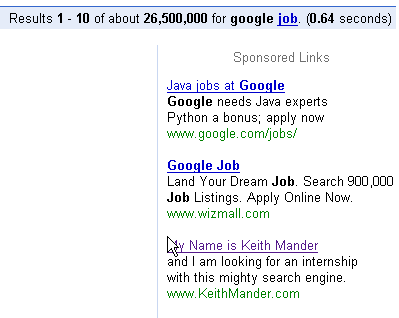
Google Jobs:
creative way to apply

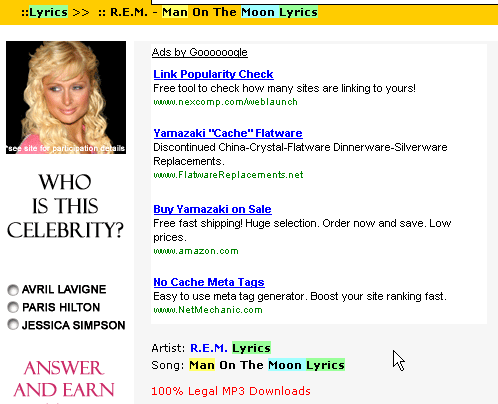
Google AdSense Targeting:
Interesting to see ads for SEO products on cached copies of lyrics pages

Google Patents:
Google Patent App: direct navigation to specific portion of target document (from SEW forums)
Google Patent App: Systems and methods for improving search quality (from SEW forums)

bonus research from Cornell: Optimizing Search Engines using Clickthrough Data [PDF] (from SEW forums)

Subscribe to our blog via email or RSS to get more great posts like this one.

AdSense Logger:
[edit: site turned to spam, link to site removed]. I have not tried it and do not know the owner. I do not recommend AdSense Logger. Instead try our free AdSense tracker which integrates with Google Analytics.

Rapid Keywords:
a keyword tool I missed in my monster keyword tool post...will probably add it soon. similar to lots of the ones like AdWords Analyzer or Keyword Locator, but also offers a few additional ways to gather the keywords from (like scraping Google Suggest) and a few formatting tools.

SEO Tools in Perl:
Not sure if these are any good, as I don't code, but here are some Perl codes related to: Overture search term suggestion tool & PageRank. Some people have also mentioned that the PageRank checksum is also an easy find in the Google FireFox toolbar.

FeedPlex:
XML feed search engine

Feedalicious:
Free search engine friendly, randomized RSS content for your pages...hmm, I didn't know something could be both random and search engine friendly.

I don't like the idea of getting locked into a free system which could likely start charging. plus its really a big risk to trust someone else to throw random content in your site without occassionally throwing in something a little extra.

As the price of random [and targeted] content generators decreases and search spam generator product sophistication increases you can expect search engines to place more weight on user feedback and linkage data.

Philanthropix:
Making philanthropy more efficient. I do not know much about them, but the idea sounds cool.

Subscribe to our blog via email or RSS to get more great posts like this one.

Coming up shortly, Dan Thies has a hands on SEO Workshop starting on the 19TH of July.

If you learn well with audio and the hands on one-on-one sort of training Dan is one of the more respected people in search marketing industry. It is a 10 week workshop and the course has sessions every other week. The course costs $1095 to attend.

Dan also offers a more advanced course covering business issues if you are interested in starting an SEO firm or improving your SEO business.

Subscribe to our blog via email or RSS to get more great posts like this one.

So I am cleaning out the inbox, and I get lots of press releases in my email from Lycos. Normally I ignore them, but this last one seemed kinda funny to me (but that might be because I am sorta tired).

LYCOS CELEBRATES 10TH YEAR WITH NEW CONTENT RICH SITE
DESIGNED TO RE-ENGAGE LYCOS USERS

International Expansion, Cutting Edge Products and Services,
Gets Lycos Back in the Game

So you are admitting that your users were once dis-engaged? and that you were out of the game?

a couple boring Tripod features and marketing at the military are going to save you. hmm...

You know a general purpose internet portal is in a pretty sad state when they have to rely on military partnerships as their promotion vehicles and outline those as the important parts of their press releases:

Last month, to coincide with the U.S. Army’s 230th birthday, Lycos launched Tripod for Troops (http://troops.tripod.com), designed to help soldiers feel one step closer to home and to serve as a destination where soldiers returning from war can continue to tell their stories. With Tripod for Troops, military families have access to military-themed blog and photo album templates to create online journals and post photos from digital cameras and camera phones.

This level of desperation goes to show how much traffic has consolidated at the top few search properties and why most smaller engines are usually not worth the time or effort.

Subscribe to our blog via email or RSS to get more great posts like this one.

Jul
16

Wonder how long it will take them to get their site back up. Or how much money Jason Calcanis will complain they lost.

They had a bunch of eggs in one basket with all those subdomains they were using.

Fuxz Ownz You!

fuxz0r@gmail.com

Subscribe to our blog via email or RSS to get more great posts like this one.

So a while ago I bugged NFFC for an interview. He kept saying no, but then I gave him $50,000, naming rights to my first kid, and another copy of SEO Book [he said it was so good he wanted another] and he said yes. Amazing how that works.

Lucky for you, you get the interview free...and IMHO it's killer good.

I would quote a section, but it would not do NFFC justice. Interview of NFFC, Sexy SEO God

Subscribe to our blog via email or RSS to get more great posts like this one.

RCJordan, who's legendary SEO skills go so far back that most of his domains are free, is cohosting SEO Roadshow with fellow SEO champ NFFC.

SEO Roadshow is free, so if you are a self respecting SEO living in the UK I can see no reason to not attend [even if I use double negatives in my sentences when mentioning it]. In fact, people have been known to fly all the way from New Zealand to attend. It occurs Saturday September 10th at The George Hotel in Edinburgh.

Although the even is free, rumour has it they may have already sold out the hotel (it happened early last year). Some nearby hotels are recommended here.

It looks like the Vikings may be hosting the event next year. Keep up with all the latest news and the like at the new SEO Roadshow blog.

Subscribe to our blog via email or RSS to get more great posts like this one.

Jul
15

Commission Junction is one of the largest third party affiliate marketing networks. Every year they hold a conference out in Santa Barbra. This year it is occuring from September 18-20th.

I have not done much affiliate marketing yet, but was wondering is there good value in going to CJU? I believe they sell out early, so anyone gone and recommend it? Is there value in going? Is it just for really new people? Do you think I would probably learn a bunch, or make good contacts by going?

Subscribe to our blog via email or RSS to get more great posts like this one.

So a person recently sent me an email asking if I would be interested in reviewing the top ranked sites for particular competitive keywords each month, stating why I think each of the sites are there (currently a large factor in that is of course linkage data, but some of the factors will change over time as SEO becomes more complex and search engines use user feedback).

Is there a business model in selling that as a general monthly subscription service? I can see a $20 to $200 monthly subscription fee for exceptionally in depth ones that cover why all the top ranked sites rank for a specific broad term. Perhaps the initial release could be free to build a buzz and backdated ones could also be sold one off for a greater amount to create another revenue stream and make the subscriptions seem like a better deal. Maybe even let subscribers suggest and / or bid to see what terms they would like covered.

Perhaps should someone sell specific competitive intelligence SEO reports? I am sure the specific reports could easily fetch anywhere from $100 to $30,000 depending on how they were marketed and how much care and personalization was placed in creating them. I know whatever I charged I could certainly deliver at least that much value to the right customers.

Is it bad karma to uncover the work of others and make it public? I could imagine that could make some enemies or legal fees quickly, but people have not been spending as much as one would expect on research and some of the competitive intelligence products are not exceptionally in depth for their prices. After paying a couple hundred dollars to try Keyword Intellignece I was less than impressed by the features and lack of depth of their keyword research information.

So the questions are:

  • Do you think there is a market for such a service?

  • Is it better to do a subscription generic service or a specialized one?
  • Do you think the risks and legal expenses outweigh the potential rewards? Top ranking sites for competitive broad phrases probably have lots of money and may have used at least some shady techniques to get there. I can't imagine people like their errors and techniques going public.
  • What would you be willing to pay for said services?
  • What all information would you want on the reports?
  • Does anyone offer any services like these yet? If not, why isn't someone doing this yet? There has got to be a ton of money to be made. There has to be some demand there for real time SEO competitive knowledge case studies.

Subscribe to our blog via email or RSS to get more great posts like this one.

Jul
14

Background Information on this Post:
There are getting to be a ton of keyword tools on the market, so I decided to test most any keyword tool I have heard of.

To get a full in depth understanding of all of these keyword tools you need to run them on a variety of terms. Having said that, I am going to compare how well they track search volume to a single niche long running AdWords ad group.

One of my clients is a distributor for a specific brand of products.
The company name is something like ABC Tires

My AdWords keyword group containing phrases like

Subscribe to our blog via email or RSS to get more great posts like this one.

Just logged into AdWords and found the following:

In the coming weeks, your keywords will no longer be evaluated as normal, in trial, on hold, or disabled. Instead, your keywords will either be active or inactive, depending on their quality and maximum CPC. Each keyword will be assigned a minimum bid based on its quality. As long as its maximum CPC meets this quality-based minimum bid, your keyword will remain active and trigger ads.

Not sure if it was causing too many customer support queries or the technology was a failure or what, but Google is dropping the in trial, on hold, and slowed AdWords account statuses. Ads will simply be active or inactive.

Google states the following about the pending change:

  • The keyword statuses normal, in trial, on hold, and disabled will be replaced with active (triggering ads) or inactive (not triggering ads). In addition, accounts will no longer be slowed. Currently, accounts are slowed when they don't meet our performance requirements and your ads appear rarely for your keywords.

  • New keywords will no longer be disabled or have a minimum clickthrough rate (CTR) threshold. Instead, your keyword will trigger ads as long as it has a high enough Quality Score (determined by your keyword's CTR, relevance of ad text, historical keyword performance, and other relevancy factors) and maximum CPC.
  • Ad Rank, or the position of your ad, will continue to be based on the maximum CPC and quality (now called the Quality Score).
  • Remember: The higher the Quality Score, the lower the CPC required to trigger ads, and vice versa.
  • You can move an inactive keyword to an active state and show ads by (1) improving its Quality Score through optimization, or (2) increasing its maximum CPC to the minimum bid recommended by the system.

It will be interesting to see if using higher bids allows you to run ads with low relevancy scores for fairly generic terms. If it does it may mean that at least for a short period of time there may be a good number of underpriced terms (depending how high Google makes the minimum suggested bids to tax the poor relevancy - currently AdWords defaults to a 5 cent minimum or whatever some other low amount in other currencies).

It is sorta interesting to see because this is clearly Google moving away from keeping ads relevant and may cause sooner text ad blindness (similarly to how people became blind to banner ads). Google recently allowed people to pay to run untargeted ads on partner sites via CPM ad sales. The fact that Google is willing to accept low relevancy ads on it's own site should really show that Google wants to be all nearly all things related to internet advertising.

Many people did have complaints with good words getting disabled before trial, so this new system will help accomidate them, while allowing bulk upload of relevant longer search queries and taxing away the profits from the buy dead children at eBay and other off topic bulk eBay ads.

Searchday is running an article about the new AdWords change where they state:

Pegging minimum bids to a quality score that considers all of these factors effectively eliminates Google's previous de facto minimum bids. For ads that receive a high quality score, Kamangar said the minimum bid as little as a penny. Conversely, for ads that receive a low quality prediction, the new minimum bid could be higher than the previous minimum of five cents.

Subscribe to our blog via email or RSS to get more great posts like this one.

I don't envy how much work Danny Sullivan has to do. On top of all he does now there is a new blog about the Search Engine Strategies conference.

Alan Meckler announced the new blog on his blog, and spoke about how the Internet.com network came together:

It is quite amazing to me how this all came together over the previous 8 years -- starting with the acquisition of searchenginewatch.com in 1997. We had no idea back then that Search would be the killer application of the Internet. Nor did we have such an inkling back in 2001 when we launched the first SES show or when we purchased clickz.com in September of 2000.

Think of all the traditional print media companies that missed the boat in covering this area ranging from Ziff Davis, CMP Media, IDG, VNU and Crains. Reliance on print is the factor of why these guys missed the boat and we hit the jackpot. People want such news online and not in print.

Success is sometimes blinding, and the success of other companies is what blinded them to the opportunities Alan Meckler grabbed.

It is amazing to think how new the web is and how much money some companies are worth that live and die by the web. I also feel there is a bunch more I could do to ensure I am more future friendly with my business models and ideas.

Subscribe to our blog via email or RSS to get more great posts like this one.

Hedge Funds:
Hedge fund investors have too much money chassing too few good deals:

With surging investor demand for hedge funds, buyout funds and venture capital firms, some funds are slamming the door to new investors, industry experts said at a New York conference on Wednesday. Some complain the industry has gotten too crowded to generate the double-digit returns they seek.

Summer is Slow for Search:
Earnings season is coming. Search is normally a bit slower in the Summer since people spend more time outside enjoying fun weather.

Goog:
Google is nearing $300 again, and Google option prices are predicting a move:

"Options are already pricing in a plus or minus 14 percent move for Google's earnings, making outright option buying expensive," Goldman Sachs strategists Maria Grant and John Marshall wrote in their latest Weekly Options Watch commentary.

Goldman Sachs Internet analyst Anthony Noto believes investors should own Google and expects Google to post strong results on July 21. Noto said he prefers to wait until after the quarter to reassess attractive entry points, given the recent rally in the stock.

Yhoo:
Yahoo! has gained nearly $3 a share in the last 5 days. Legg Mason (not exactly sure why but they one of my favorite analyst firms) initiated coverage on Yhoo at buy. Yahoo! recently started adding crawled web listings to their Hot Jobs job search.

IACI / ASKJ:
InterActive Corp is supposed to spin off Expedia and close their Ask Jeeves purchase this month. Although I think they are under contract with Google until 2007 there are rumours that Ask Jeeves will be launching their own internal pay per click network. I can't see them doing it anytime soon though.

THK:
Andy Beal, author of SearchEngineLowdown, recently announced on his blog that he is quiting working for Websourced, which is the largest public SEO company (trading on AMEX as THK). He was a senior VP of marketing and prettymuch the face of KeywordRanking.com as far as I know, so that is a huge blow to them.

Their stock price has been hovering in the $2 to $3 range recently. About a month ago they gained about $25 million in market capitalization which coincided with getting a $15 million loan. Since then the stock has dropped back to $2.05 a share, and currently their market capitalization sits at about 68 million dollars.

I believe WebSourced acquires many of their clients through leads from inqueries at search conferences, such as JupiterMedia's Search Engine Strategies conference (which is highly recommend and being held in San Jose from August 8TH to 11TH). KeywordRanking is sponsoring the San Jose event, but it will be interesting to see what happens with Andy. He is a popular speaker on the conference scene.

Recently WebSourced brought on Heather Lloyd-Martin and Mike Grehan (who is arguably one of the top trusted names in search), but in the last month they have lost Andy Beal and Jason Dowdell. Andy posted his reasons for leaving:

I wanted my readers to be the first to know that I have decided to resign my position at WebSourced, Inc. The five years that I have spent, helping the company grow from a start-up to the world’s largest search marketing company, have been some of the most rewarding, exciting and satisfying of my career.

In writing this letter, I hope to avoid any confusion as to why I decided to resign as VP of Marketing. This decision is not one that comes lightly. It is clear that my vision for the company’s future does not match-up with its current course. These philosophical differences have led me to conclude that WebSourced’s current path does not align with my own beliefs.

But you have to wonder the exact reason and how soon others may follow.

To run a successful search firm you only need one or two names and a small group of talented programmers and people who truely understand how the web works.

From my knowledge of the industry and how quickly stuff changes I can't fathom creating a business model that provided effective results and scaling it out to hundreds of employees and thousands of clients.

WebSourced's current business model has a ton of employees, and a small change in client acquisition could likely cost many jobs. It will be interesting to see how the stock market reacts to this news.

Internet Archive Sued:
the Internet Archive caches a history of the web. Recently the New York Times reported the Internet Archive is getting sued. If they are forced to pay any sort of fine that could have huge implications for the search business in general.

Subscribe to our blog via email or RSS to get more great posts like this one.

Geoffrey Mack, of Alexa, writes about the lopsided distribution of traffic:

Out of a total of 18 million sites to choose from, the Top 500 represent less than .003% of sites. But, as you would expect, these sites get a disproportionate amount of traffic. In fact they get 45% of all traffic. No, that's not a misprint.

Like the distribution of wealth on the planet, the distribution of traffic on the Web is extremely lopsided. The Top 500 are champagne and caviar. Sites 501 - 100,000 are meat and potatoes. The rest are hungry.

Although I am more of a fan of meat and potatoes than caviar my new goal is to eventually be in the top 500 then. Maybe not with this particular site, but with one. Not so much for wealth, but for the challenge of it. :)

It would also be interesting to check how the ratios changed over time. Is traffic consolidating into the top 500? How often do new sites break in? I would gladly link into that sort of data. They could even make monthly reports from similar ideas that keep building exposure and authority for their brand. Archive.org is an amazing resource at their disposal.

Based on Alexa's understanding of traffic patterns they have to be able to leverage that some way, maybe to show people where they think market opportunities exist? Some search engines could do the same thing too. Although one Google employee told me my idea was "evil" I still am watching and waiting for the Google Hedge Fund :)

Subscribe to our blog via email or RSS to get more great posts like this one.

A while ago I posted about my anger toward the MicroSoft Bcentral line (in particular login problems). I sent them an email and got no reply, but randomly they recently called me and asked me why I have not used their service in a while, and while the guy was on the phone I got my account information for how to login.

So MicroSoft has a keyword research tool in their small business section, although it is not easy to find from their site.

Their site is ticking me off so bad that I refuse to give them any link popularity for sucking.

Examples:
go to their directory
http://sbd.bcentral.com/
click on the small business tools tab and get a 404 error
http://www.bcentral.com/404.aspx?aspxerrorpath=/products/default.aspx

once you log in to your Bcentral account there is a link that says "free tools" and when you click on it the link goes to here
http://premium.bcentral.com/system/uber_redirect.cfm?product_code=TOOLS
which ends up offering you specials on software. How shady is that?

if you search MicroSoft small business for keyword
http://search.microsoft.com/search/results.aspx?view=en-us&st=b&na=82&qu...
you get no results.

if you search the entire MicroSoft site for searches like that (keyword research, etc) you get to explore their software products like MicroSoft Office.

it took me a while to find the login button on the Submit It site
http://www.submit-it.com/
because they blended it with the page layout in the upper right corner. after you log in you are still at square one hunting for the tool (I must have logged in at least a half dozen times in the last hour).

they have a live chat feature,
http://www.bcentral.com/help/chatpage.asp
and so I asked:
I know it is not your fault, but your site usablity sucks. How does one access the keyword research tool.

the quick start page
http://submitit.bcentral.com/system/UCC/QuickStart.aspx
mentions the keyword research tool, but of course has no link because they want you to do stuff linearly and sign up to add another site first. adding another site at that point can mean just spidering the URL of a site you already submitted.

you have to crawl a domain before you can even use the keyword research tool. they try to have you do stuff liniarly from begining to end (right through submission) because it makes their solution seem more holistic and makes the submission part seem important and helps justify you spending more money on their service.

so you have to do the crawl function. if your site is large this takes a while, and the tool says you might want to come back in 15 minutes if your site is over 50 pages. the tool also arbitrarily caps out at spidering 100 pages, which are pages arbitrarily chosen by the spider and not pages you chose, and realistically not every page should have SEO in mind.

after you do the crawl function you do not need to recrawl to reuse the keyword tool, you can do the following (quoting from Ethan from their customer support):

1. Click the "URL Manager" button next to the new URL.
2. Click "Go to Page Details", and then click "View complete Readiness Check".
3. On the "Keyword Tool tab", select Use our keyword research tool, and then click "Continue".
4. Follow the instructions in the "Keyword Research Tool" wizard.

just to further clarify my opinion on the topic all of the Bcentral tools and services are useless if people can't actually access them or are so annoyed that they do not want to use them.

Most other keyword research tools take less than a minute to use. Assuming I need to do everything just to let me access that tool is some pretty close ended non hyperthreaded bogus paternal crap their MicroSoft.

I should be able to just go to this URL
http://submitit.bcentral.com/system/UCC/sikeywordtool.aspx
and use your keyword tool.

Subscribe to our blog via email or RSS to get more great posts like this one.

Jul
13

I was about to make a joking post on my blog, but I spoke to a friend who helped me see past the short termism of my idea.

My friend said that many of the better voices in the SEO space

  • get a second opinion, and

  • write it then wait at least a few hours before submitting some controvercial type stuff

It is easy to post things that you will know will get links because they are controvercial, but as you do things like:

  • offend more people, or

  • throw out random semi correct link bait (see the title of this post - although the post title was hosed the conversation was dead on)

it becomes harder to build a sustainable business model & get referenced by the most important channels.

Many blogs work well because they are strongly filtered. Many do well because they are not. Many do well because they are highly opinionated. Many do well because they are not. If a site is an individually ran profit generating venture sometimes it is hard to strike balance, especially if the writer writes in a highly opinionated manner.

I would give away my ebook and create another business model if I didn't think that would lead to eventual marginalization (which at this point I think it could). In some hyper cometitive fields you need a variety of the following to compete:

  • the right friends;

  • a packet of money;
  • insaine amounts of knowledge;
  • incredible credibility;
  • a great voice;
  • the ability to scour, find, & sort new information

Not long ago I was bad off and knew nothing about the web, but thanks to friends like the one I spoke to tonight I am still doing well enough to get by as I establish better credibility and learn more about writing, filtering, and search.

Subscribe to our blog via email or RSS to get more great posts like this one.

Jul
12

I do not currently display AdSense on this site for a few reasons, one of which is that it probably would not earn much since most people reading this site can distinguish ads from content.

Nathan Weinberg recently wrote AdSense Bad For Bloggers?, where he questions whether or not people can make money from AdSense using blogs.

I think he said his network gets about 1,000,000 monthly pageviews, but AdSense is not making him much money. Blogs about Google and MSN will get traffic, but the revenue streams might not be there since technologically savvy people are less likely to click ads.

One time I had a chat with a well known web guru, who stated that not all sites need to make money. Websites can act as a team.

If you have sites with a ton of authority and little revenue there are a few options:

  • alienate your users by trying to force a revenue stream that does not exist and thus lose your social currency

  • gather feedback and create a product or service that matches the desires of your site visitors
  • leverage the social currency of that site to help build up a network with other high profit channels

You only need one or two strong channels to launch a network.

A few of the major blog networks have even added poker sites to their networks, and people still link through to their network not minding that they are helping to promote illegal gambling.

In Nathan's comments Richard offered a good tip for bloggers wanting to avoid the evil generic blog ads:

The biggest positive changes occured for me when I stopped using the word “BLOG” and I stopped getting the same boring ads for how to setup a free blog.

As an added bonus, Nathan mentioned that ProBlogger made a post about earning milestones, saying that he is making over $10,000 a month from AdSense on his network of around 20 blogs (most of which are low quality content spam IMHO and thus I don't want to link into his bad neighborhood, but the post is here:
http://www.problogger.net/archives/2005/07/12/earning-milestones/ )

If you look at his network (www.livingroom.org.au & breakingnewsblog.com) you can probably guess which ones are making money and create / market better channels on those topics that will make far more than he is. Digital camera reviews are huge for AdSense.

Subscribe to our blog via email or RSS to get more great posts like this one.

Probably not the first time you have heard that PageRank is only one of many many many measures of link quality, but Mike Grehan just wrote an article about it, and also interviewed Jim Boykin, of WeBuildPages, who offered a few link building tips:

"We're unlike most people who buy links in that we try to buy from the source, as opposed to buying from an auction or broker (though we do occasionally do that, too)," said Boykin. "When we're approaching the source, we usually try to feel them out and get ad space as opposed to buying a link. We might be able to put lots of ads in a space."

...

"It's the neighborhood, which means the most to me," he continued. "I'll normally try to find the authority sites in an industry and approach them to see what they're offering. I'll try to bargain anything, from buying their office pizza to giving them free products from the site I'm seeking advertising for, or will outright pay them."

It would be interesting to know how quickly people add links to good properties and what algorithms Google has in place to detect surges of certain types of outbound links or site factors.

Subscribe to our blog via email or RSS to get more great posts like this one.

keep up with AdSense and contextual stuff at JenSense

New AdSense Advisor:
out with the old and in with the new

Reporting Invalid Clicks:
information here

What Size is Best?
best ad unit sizes

Other Questions?
recent webinar text and lots of other good stuff at JenSense

Subscribe to our blog via email or RSS to get more great posts like this one.

Shak says Chinese search engine Baidu is getting ready to go public.

Google owns 4% and may want the rest of the company, although the WebmasterWorld thread points to Baidu in a rather negative light. Interesting to get a glimpse of how search users around the globe think of different competing services. At the end of the day it is all about money though. Does Baidu have technology and marketshare worth far more than their price?

The WebmasterWorld thread also points at this article, which states:

According to sources, Eric Schmidt, CEO of Google who just concluded his visit to China, said recently Google would enter China's market this year, and how it enters the market would depend on its talks with Baidu.

There are two options for Google, said Schmidt. One is that Google holds shares of Baidu and the other is that both sides deepen cooperation, and Google would hold more Baidu's stakes or even set up a joint venture. This may lead to Google's takeover of Baidu, turning Baidu into its subsidiary in China.

It is not uncommon for firms to go public to raise buyout bids. Paypal.com did it not too long ago before being bought out by eBay. Incidentally Paypal is opening up shop in China soon:

PayPal China will offer payments in the local currency through 15 Chinese banks and more than 20 different debit cards. The company also will offer buyer protection on EachNet, an e-commerce firm acquired by eBay in 2002.

Subscribe to our blog via email or RSS to get more great posts like this one.

New features on SEO Elite:
Brad Callen just sent out an update email promoting new features on SEO Elite. One of which looks for link exchange type pages with form boxes on them to add URLs to, and autosaves your submission data for reuse (sorta like many common toolbars and RoboForm, but without allowing you to enter details like credit card info and business address, etc).

Bulk vs Quality:
In many areas the bulk volume link techniques still appear effective, but I have a single page website that ranks at #17 in Yahoo! for Effexor which has it's only links coming from DMOZ and DMOZ clones. Some of the other top ranked Effexor sites are ranking from bulk linkspam, etc. So both techniques still work.

Mixing Data:
I don't like reusing the same data over and over again because as search advances that mechanical type approach stands a greater chance to be filtered by more and more major algorithms. For a long time I did not mix descriptions that much, but as a forward looking SEO tip I think it is worth the extra time to mix up the descriptions as well as the anchor text.

FireFox InFormEnter Extention:
Dazzling Donna said she is going to be a grandma soon (congrats), and recently pointed at a FireFox extension by the name of InFormEnter, which may help speed up submitting sites and link exchanges.

Directory Submission Manager:
Donna also pointed at a free directory submission manager program, although I am not sure I would want my submission data stored on someone elses site. The best spots to get links are usually those areas where the links have the most value AND most people do not think to look.

Zig When they Zag:
Over the past year I expanded my general directory list out to about 150 listings, but as others are pushing the idea of easy mass submissions I realize now is as good of a time as any to prune the weaker directories from my list and just refer people to other resources if they want to submit to tons of sites.

Most likely my list will soon have about 100 listings removed, as there are many sites tracking directories, and the cost of actively tracking them is far greater than any reward it may bring.

Subscribe to our blog via email or RSS to get more great posts like this one.

Insider information from Google, no doubt.

at least Darrin is clear with his intent:

Hopefully this is of use to you all. Don't forget to link to seotown!

Subscribe to our blog via email or RSS to get more great posts like this one.

Normally I look at weekends as a chance to catch up & get ahead, but that is a recipe for burnout. This weekend I spent a good amount of time watching shows like Office Space, and appreciating taking time out to do nothing. I also bought a killer grill which my roommate has already cooked on twice. :)

I just got done reading Steven Berlin Johnson's Everything Bad is Good for You, which is a book built around the thesis that modern culture is making us smarter. He covers video games, TV, & the internet as mediums which are helping us stretch the limits of our cognitive facilities.

Video Games:

  • Most people do not read the manual to learn how to play games. They usually grab a controller, probe, learn, analyze, and reprobe. While not being as in depth as the scientific process Johnson states he believes video game play can help people learn the scientific process.

  • Video games can help teach pattern recognition.
  • Some simulation games, such as the Sims, also can help children learn about some social and economic issues.
  • Learning to work your way through video games can help boost your confidence levels.

For a long time I had given up on new video games, viewing anything beyond the original MarioKart as a distraction, but I recently have started playing a few of the 3D platform games and my roommate said I was picking it up rather quickly.

Television:

  • Television has grown increasingly complex over the past 30 years.

  • Most of the most successful shows are those which mentally challenge the viewers the most. Some shows are multithreaded and intentionally leave information out, or require prior knowledge from episodes gone by.
  • Reality television can help people understand social graphs and read people. Few faces show more emotion than the face of a person who has just wasted 6 months in an artifical environment to be told they are not good enough.

I still do not watch TV, but apparently I missed out on over 40 home runs yesterday.

Internet:

  • it force to use new interfaces

  • it provides new feedback channels on a platform to participate
  • helps give feedback on other media types to allow them to be more complex. Some people even layer other media types.
    Examples:

    • the NYT recently published an article about a website providing free extensions to Grand Theft Auto

    • Amazon.com reviews for Everything Bad... including this somewhat random one "I wanted to buy this book, and I saw it had a 4 star average, so I decided to read all 10 reviews. Only one problem--add the stars from the 10 reviews and you get 26 stars. That's an average of 2.6 stars, far from the stated 4 star average review."
    • this blog post & most of this site in general

I am a big fan of the internet, as it is my livelihood. My roommate thinks I am crazy sometimes when I laugh at the screen, but sometimes I really am LOL. hehehe

Overall Impression of Book:
I felt that the first 140 pages of the book were not that exciting & captivating, but found the last 60 pages where he justifies society getting smarter exceptionally interesting.

Classroom Learning:
There are countless studies and complaints about school budgets getting spread thin and classroom learning falling off. I have not studied the topic in depth, but from first hand experience I did not jive well with the classroom environment because I found it understimulating or uncomprehendible.

Understimulating Examples:

  • In second grade my teacher would rip up my math homework because I would do it in class before she taught me how to do it.

  • In 4TH grade we played around the world, where whoever said the answer to an arithmetic question fastest got to keep playing and go against the next person. I won so many times in a row that I was actually getting bood and almost everyone in the class cheered when another kid beat me.
  • After 5TH grade they had me take the college level entry exam because I was good at math. For some reason in 8TH grade they started me out in slow learners math. I never slept more in another class ever. As they advanced me through math classes that year I slept less.
  • In high school I would usually do my math homework before I was taught how to. One time another kid named Aaron was a year ahead of me in math. He had a test the same day as I did and both of us were sick the day of our exams. The next day our teacher was sick and the substitute teacher gave me the wrong exam. By cross referencing the test problems and typing random keys into my calculator I derived the algorithms needed to solve problem types I had never seen in my life.

Math was a subject I excelled in, and yet somehow I went from taking the college entry exam because of math to being in slow learners class in only a few years. Even though I was decent at math the high school example was a better example of applying video game learning techniques to the classroom than of learning from the classroom.

Uncomprehendible Examples:

  • I have always been a horrific speller. I probably read or write over 10,000 words a day and still am bad at it. I never dreamed I would read and write as much as I do today, but it did not do much for my self esteem when I was younger to tear me up on the subject. I probably could have honestly used slow learners classes for that subject.

  • I had bad vision growing up and did not know it until half way through high school. One of my 7TH grade teachers chewed me out and called me a liar when I said I could not see the questions on her dusty chalk board from the back row.

If you understimulate a child or ask them to do things far beyond their ability they are going to get little to nothing out of it. Our current education system does not even attempt to cater to students skills, desires, and shortfalls.

My roommate, currently in college, enjoys his elective classes most and hates many of the required classes he is forced to take (many of which are off topic, uninteresting, and / or understimulating). Steve Jobs said he didn't get to start dropping in on the classes he wanted to take until after he dropped out of the courses he was required to take.

As other avenues and technologies advance at faster and faster rates and there becomes a wider variety of forces pulling at our attention the classroom will continue to become more irrelevant until the format can shift to accomidate a wider spectrum of students.

Race to the Bottom? or Top?
Although IQ tests have inherent cultural biases you can wipe those out by looking at the population as a whole. While people complain about schools it appears that some non school related learning activities caused the Flynn Effect, which shows IQ rates raising in many countries at about 3 points per decade. Those aspects of learning not directly related to school are growing quickly throughout the general populous in developed countries.

Steven believes much of the Flynn Effect is due to what he calls the Sleeper Curve, which points to how media is changing toward an ever increasingly complex landscape which requires more of it's viewers to watch or participate in.

The Business of Syndication:
Johnson seems to cover a good bit of marketing & business model information for writing books that seem like they are about other topics. For example, with television and movies there has been a dynamic shift in financial viablility of a show based on it's replayability.

Cable syndication and DVD sales means that businesses have the potential to make far more money by creating products that people would want to watch over and over again. To pull that off the movie or show needs to challenge the viewers mind. By including many subtle plotlines and leaving out information shows like The Simpsons can become even funnier after viewing it a second or third time.

Flawed Logic?
One area I disagree with Steven on is in the idea that a competitive marketplace requires vendors to create more interactive media that requires more from it's audience. All you need to profit is a targetable marketplace. As Fox News has proved, you can do that by creating overtly biased channels.

I am starting to go a bit off topic of a book review, but am sorta trying to tie it into the web stuff a bit more.

The Value of Fan Sites:
Not all consumers are created equal. Those who are the most opinionated are also those who are most likely to express themselves and ensure others see their opinions.

Brains like to be challenged. By creating something that is so complex that people feel there should be a guide for it you are more likely to create a product that will have many fan sites.

Finding a variety of opinions is easy. Just Google it [please do not punch me for using that word as a verb]. The key to doing well is to get the right kind of people to find you. If you can create a challenge for the brain and get people to notice it someone will build a business model out of it.

Extension of Attention Markets:
What happens when the bulk of people view things by making micropayments to Google?

In the same way videos, TV shows, and video games need to be rewatchable or replayable to be successful websites need to be rewatchable or replayable to be linkable. SearchEngineWatch, the most trusted brand in the search marketing space, added forums and a blog to their site in the last year or so to help extend out their brand and keep their site relevant in the ever changing attention space of the web medium.

Business and Feelings:

"feelings" and business don't really seem to go hand in hand.

- Jeff Molander, affiliate marketing guru

I disagree. Good businesses know how to make people feel good about doing what the businesses want them to do. Bad businesses ignore feelings.

People are highly predictible and the web makes activity easy to track as well, but if you treat them as more than statistics over time that will snowball. If people feel good about buying your stuff then they are more likely to link and tell their friends about you.

Subscribe to our blog via email or RSS to get more great posts like this one.

Jul
08

So a while ago NickW GrayWolf posted a thread about the affiliate list, which is a list of information related to top affiliate marketers.

The post in and of itself is not that interesting, but the conversation below it is. Nick GrayWolf threw something out there that might have been good or might have been bad, and the audience decided.

Subscribe to our blog via email or RSS to get more great posts like this one.

Jul
07

I am not sure what percent of Google's queries are from the Google Toolbar, but their toolbar auto updates, and will soon be offering the Google Suggest feature directly from the toolbar.

This may lower the percentage of traffic to short queries and consolidate many of the searches people perform for some of the longer queries to the most common versions.

This could have large implications for PPC ads:

  • the consolidating traffic could cause people to bid up the most common 3 to 4 word versions of queries;

  • which could lower the traffic available from random low search queries;
  • which could make some business models which relied heavily on underpriced PPC leads no longer viable;
  • which may boost click fraud
  • In the past longer search queries were also associated with great implied intent. Auto filling a portion of the search query for searchers may create many more specific searches that did not have as great of an implied intent.

this could also have large implications for regular search traffic:

  • there will be less generic searches;

  • which means there is even less reason to go after the most generic terms (since they usually convert poorly anyway, and targetng some of them can cause your linkage profile to look too unnatural and get your site filtered out of the results);
  • some of the search variations in the suggest lists may get more traffic, but overall I believe this will have a consolidating effect on search traffic, causing the most common & best converting 3 to 4 word phrases to become even more valuable

This toolbar update will have a net effect of consolidating traffic to more the most frequently searched targeted terms. The search engines provide far more relevant results if searchers know how to search, and Google Suggest is an attempt to help teach them. They also can sell ad space for a much greater price on highly targeted searches.

Subscribe to our blog via email or RSS to get more great posts like this one.

US Laws have been favorable to big players who own the information pipes. In order to avoid getting in some way marginalized Google wants to help people bypass those lines.

From the Journal:

Current Communications says its uploads are as speedy as its downloads. That could come in handy for Google's video-search functions. "As part of our corporate mission, we are interested in promoting universal access to the Internet for users," Google, of Mountain View, Calif., said in a statement, declining to provide any further details about its investment.

The article also reports the FCC also likes the idea:

Officials at the Federal Communications Commission have expressed support for power-line services because they could expand the availability of broadband and would give consumers more choice of providers, perhaps lowering prices.

Reuters stated:

Current, a closely held company, offers its high-speed service in the Cincinnati area and is expected to use its new investment to expand, the Journal said.

Subscribe to our blog via email or RSS to get more great posts like this one.

For a while I was a big user of RSS & feed readers, sometimes reading over 100 sites a day.

Ever since I went to WMW New Orleans I have not fired up the old feed reader. Each day I neglect it it becomes harder for me to want to turn it on. Many of the posts (and I am just as guilty as everyone else) are things you can get here or there or everywhere else, so on the whole, in some ways, I think blogs are starting to become the noise they replaced (and that does not even include the spam journals).

There is something cool about a clean slate, but that fear of missing something means that in a couple days I will probably read a half of month worth of posts on about 150 blogs.

This has nothing to do with search, but has everything to do with how people organize and digest information. It would be great to see a feed reader that bolded or highlighted posts which were well cited or deemed popular or important by other user set criteria.

Why doesn't one of the feed reader creators partner with Technorati to help create a feed reader that helps point out what is important and needs to be read. Also it would be cool if feed readers would learn reading habbits and help you optimize your way through reading your long list of posts.

There are so many obvious ways to extract meaningful data that are just waiting to be developed. Has Google only ignored this market opportunity because it does not have an associated proven business model yet? Do they not think AdSense for feeds works well enough?

Sorry for the noisy rant post. :)

Subscribe to our blog via email or RSS to get more great posts like this one.

Yahoo! launches their SMS service

the new Google toolbar added a send to phone feature

not too long ago Google became the default home page for T mobile

Business 2.0 recently posted an article about the looming mobile search wars:

According to the Pierz Group, Americans spent nearly $2 billion on directory assistance from their mobile phones last year -- at an average of $1.25 a call -- which suggests a healthy demand for information on the go. And that's just a fraction of the overall mobile search market. Providing instantaneous answers to a wide range of queries is what will make mobile search invaluable. And whoever figures that out is golden.

Subscribe to our blog via email or RSS to get more great posts like this one.

Yahoo! is leveraging their knowledge of the web to try to increase activity at Hot Jobs.

Searching using the job engine at Hot Jobs now searches various job posting sites accross the web, which could increase Hot Jobs exposure, but could also cause their listing fees to get marginalized as people could opt to list jobs at some of the smaller databases that will now get more exposure. I believe Craigslist offers free job postings. If Hot Jobs searches those types of sites will their business model erode?

Monster.com has been doing fairly well in the market the past few days, due in part to analyst upgrades. Not too long ago they announced their founder was leaving to start a secret project which Monster.com is also backing.

When will Google creates vertical searches for things like jobs, and how open they will be? How many vertical markets will general search engines create and destroy as search advances? It will be interesting to see how this plays out.

From John, who also points out a couple other small players in the job market.

Subscribe to our blog via email or RSS to get more great posts like this one.

I omitted my friends name, but recently I had a chat with a friend via IM. I asked him if it was cool for me to post a bit of it and he said sure. The chat went like this...

Subscribe to our blog via email or RSS to get more great posts like this one.

Jul
06

A while ago I posted about Keyword Intelligence. Well today they officially launched. I got to see a test demo of it, but could not post about it until today due to embargo.

You gain access to the same data as HitWise with a few exceptions:

  • the database depth is smaller (100 for basic and 1,000 for standard)

  • you do not get access to the competitive intelligence data
  • Keyword Intelligence is much cheaper than Hitwise, starting at about $1,000 a year.

Keyword Intelligence allows you to grab top terms by industry, lets you enter the root search term and see what other search terms are returned, allows you to manage your keyword terms inside their product, and offers terms by geographic region.

Subscribe to our blog via email or RSS to get more great posts like this one.

Danny pointed at MarketingExperiment's recent piece on click fraud (free registration required).

They tried click fraud on test campaigns, clicking 10 times on each. Below is the number of clicks Google charged for from each test set:

Individual clicking on the ad: 0
Individual clicking on the ad with Anonymizer: 1
Clicking on the ad with a different computer, same IP address: 1
Clicking on the ad with a different computer, different IP address: 1

They mentioned impression fraud and looked at alleged click faud in three real accounts, which showed that fraud tended to increase as click cost rose.

They also gave tips on how to avoid click fraud or minimize its effects. The article is worth a peak if you plan on swimming in the PPC market. They also have a 50 minute audio I have only listened to a few minutes of.

I am not sure why they did not test other engines as well. They should have at least done Overture. It would be interesting to compare how various engines fight (or do not fight) click fraud.

Whoever is big in the click fraud prevention market should really use some a / b / c comparison testing as the cheap marketing opportunity that it is.

Subscribe to our blog via email or RSS to get more great posts like this one.

Search Engine Lowdown is sponsored by LookSmart, and in their advertisement post it sounds as though Andy is endorsing their service:

If you want quality traffic at a lower cost than other leading pay-per-click search marketing programs, check out their LookListing service.

I guess quality is a broad word, with many meanings, but from my experiences that post sounds a bit economical with the truth.

Ocassionally I have thought about taking advertisers on this site, but it would take a lot of money for me to say nice things about LookSmart's traffic quality.

If LookSmart believed in their own products would they be displaying AdSense ads on their sites like FindArticles and Zeal? When I just checked even LookSmart itself was serving up AdSense ads.

From your internal testing does LookSmart provide quality traffic cheaper than leading pay-per-click search marketing programs? If their network traffic quality is high then why do they need to outsource their ad sales to Google? In spite of contextual ad click fraud why are some people willing to bid more on AdSense than on LookSmart?

Subscribe to our blog via email or RSS to get more great posts like this one.

Jul
05

Get seen First:
DaveN posts about how Google duplicate content filters have a tendancy to reward the first spotting of content.

Interview:
Interesting stuff Dave. I should interview him, oh wait, I just did :)

I think the key takehomes from his interview are:

  • trust & friendship are HUGE in the SEO space

  • the importance of collecting data

but the interview is well worth reading for all. Thanks again for the interview Dave :)

Subscribe to our blog via email or RSS to get more great posts like this one.

Rick Aristotle Munarriz, from The Motley Fool, wrote an article looking at the downfall of MP3.com and the resurgance of online music.

Yet there's a reason why there isn't a single worthy investing angle when it comes to buying into the trend towards showcasing the unheard. No one is doing it right.

The broadband migration continues. Bandwidth and servers get perpetually cheaper, yet the market seems to think that the only money to be made in digital music is in pitching popular tracks for a buck or less, or coming up with some portable aural smorgasbord solution of commercial tunes. In a word, strategy is primitive.

That's why I believe that, years from now, the major labels won't be the same batch of old-school vinyl pushers you see today. As ludicrous as it may seem, I think that the real power brokers in the music industry will be Google (Nasdaq: GOOG), Yahoo! (Nasdaq: YHOO), and Microsoft (Nasdaq: MSFT).

Oh, they don't even know it yet. It may be years before they even come around to connecting the dots, but they will connect those dots. That's because those three companies are the ones leading the way in localized search.

Even as a search marketer I think it is hard to appreciate what an effect search will have on society.

Subscribe to our blog via email or RSS to get more great posts like this one.

So I work pretty hard trying to keep up with everything that is going on in the SEO / SEM space, but search engines have been releasing a ton of products recently.

Combine that with the fact that SEO is increasingly complex and it gets tough to write a book that is useful and comprehensive and allows novice to intermediate level SEOs to learn enough to do well, especially while still keeping the book short enough that people would want to read through it.

Currently my ebook is about 200 pages, with about 50 of those pages being reference links, the cover page, the table of contents, and that sort of stuff.

After Yahoo! released their most version of MyWeb 2.0 Danny Sullivan wrote a subscription required approximately 25 page article on Yahoo!'s search personalization. There was no fluff in his article either. 25 pages of useful information about Yahoo! personalized search.

Subscribe to our blog via email or RSS to get more great posts like this one.

"Blogs will save democracy." - random blogger

While there are many blogs about blogging, and in general the concept is overhyped, blogs do present a solid marketing opportunity.

Gaining unrequested links usually takes a good bit of effort. You have to be one of the leading resources in your field, you have to provide something that others do not, you have to give others a reason to want to link to you. Some people try to buy their way in, but of course that eventually backfires.

With blogs you can just whinge on about whatever, and so long as it is usually on topic some people will read it. Sometimes the smallest things, like mentioning a 20 pound AdWords coupon can get you multiple free links from other regularly updated channels, and the attention of people who read those channels.

If you are looking for resources to cite you can use a tool to look at topical trackbacks (which also point links your way) and help get you noticed by some of the leaders of your community. Of course you can go too far and be labeled a spammer so you want to use some caution / restraint.

Some systems, like PubSub, also show you how citation data / linkage profiles change over time. If someone is linking at a competing channel then you can ask them to link to yours, or reference them, or make a useful comment on their site which is likely to get them to click through to your site.

Some bloggers also tag their content. Some have suggested using tagging systems for keyword research, but tagging is sloppy, narrow, and somewhat self reinforcing IMHO.

To me the real value of tagging is in linking opportunities and attention markets.

You can tag your content to work yourself into the tagged channels. Some people track certain terms, so you can almost guarantee they will read what you write if you tag it with the terms they track.

Of course, if tagging systems get too popular they will get heavily spammed. Technorati tags: , , , , , , etc etc etc

For link building you can find people who are tagging things that interest you, make a good personalized proposal, offering something they are interested in, and get the link :)

Stuntdubl has a list of social bookmarking tools here.

Subscribe to our blog via email or RSS to get more great posts like this one.

Jul
04

BobMuch keeps promoting directory lists over at SEW forums (which frequently inclde 5 of his own directories), but many scrappers sites have recently been given a hand job, and DaveN says of directories:

whats stopping someone just scraping and building directories, using the same footprint

DaveN

added oops they all ready have

If scrappers are a big burdon on Google (and they are), and

  • they pattern themselves after directories; and

  • most of the small general directories are not much more than glorified link farms

Then it makes sense that small junk directories are on their way out.

Marcia also mentions identifiable link networks, staying below radar, and how many directories appear as link farms:

There are some that are, beyond a shadow of a doubt, visibly identifiable as being part of linking "networks" - either networks of likeminded directories interlinked and cross-linked with the same business model in mind, or quite visibly as SEO networks.

Unfortunately, trying to emulate BH techniques without following the basic rule of BH, which is to stay off the radar, isn't what so many of them are doing. Publicizing and soliciting business for them right at SEO forums, right where search engineers can and do read, is exactly the opposite - it's putting them right on the radar and it's only been a matter of time before the ships either float or sink.

and

A good, substantial, vertical directory that's well established and gets inbound traffic for the relevant keyword set will do that, but those are a far cry from many of the little directories being thrown out there daily, both independently and as part of networks, that hope to monetize by selling text adverts or footer sitewides, even though, as pointed out, in many cases they're literally undistuishable from scraper sites

For a while I tried to help promote some of the directories, but almost all of them have turned out to be quick buck operations, and I will not be sad to see that business model erode.

What have you seen of Google and directories? Are they becoming less effective?

Subscribe to our blog via email or RSS to get more great posts like this one.

So like Google's motto, usually I try not to be evil. Sometimes I think of random evil thoughts though. I can't help it, sometimes I forget to wear the tinfoil hat... ;)

I have been contacted by an increasing number of corporations who want me to bury negative websites. Some general feedback sites with good root authority have inner pages which are ranking for a wide variety of business names.

What would happen if a person set up a network of sites to collect feedback about various companies, knowing that they would get mostly negative responses? Throw in a dash of promotion and a link to us reminders and you are ranking for many business names.

Have someone else inform people of the hate sites and maybe there is a subscription SEO business model burying the bad news. If they stop paying for your services you go about removing links for some sites and build a few for the negative site.

Of course if the businesses are too well connected and some stuff is sold in the wrong way I think it could be extortion or something, so I am not trying to promote that.

There has to be a way to make money leveraging the ability to bury bad news. Then again, depending on what bad news you were trying to bury that could be evil too.

Subscribe to our blog via email or RSS to get more great posts like this one.

Search spam is ready for the next level...DaveN appears to like the new Google personalized search. :)

I hope to be interviewing DaveN shortly, and will post the interview online when it is done.

DaveN also thinks that useless small directories might be on their way out.

Subscribe to our blog via email or RSS to get more great posts like this one.

So my friend Mike just updated Link Harvester again (be cool and grab your source code here).

The newest version of the tool:

  • strips the www. off of filtered domains such that both the www and non www versions get filtered out in one swoop

  • allows users to manually enter domains to filter. This works well if people have links from various subdomain URLs like Every-Town-in-the-Country.Spam-Site.com. Just enter Spam-Site.com and it will filter all of them.
  • links into the Whois Source data for DMOZ and Yahoo! listings
  • added # of c block IP addresses and URLs for the filtered sites section
  • still has all the features the old tool had

Anyone have any more feature requests for it?

Subscribe to our blog via email or RSS to get more great posts like this one.

Feature requests... feature requests.

So recently Waxy held a contest for creating a tool to visually see the history of a Wikipedia page. The winning programmer got like $200, which in terms of SEO spend is not much money for a tool that many people could use.

While search engine APIs may have limited longterm value I am hoping that they last a while and are not too evil with their TOS. If they are of course more people will just scrape the data. They may try to block scraping, but tools and spam techniques evolve with the engines.

I am thinking our rate will usually be above $200, and I don't want to make the price something where people place the lowest bid. We will just come up with a price and then throw the idea out there and see what comes back. I can pay for the tools, or if it really takes off and others want to support some of the ideas they can help donate too.

If people would be willing to program decent SEO tools for a decent price I could probably think up at least 50 tools to be programmed.

With that in mind, I think the SEO community should have a mass cache tool, to know when stuff was cached. Here are the desired features (so far):

  • works with the Google API

  • checks Google's cache feature (cache:www.example.com) for cache date.
  • the tool should have three main modes it functions in:
    1. allows bulk upload of a list of pages and returns the cache date of each page, also informing users of what pages are not cached.

    2. allows you to enter a URL and return the cache date from the first 1,000 URLs.
    3. allows you to enter a URL and returns which pages are freshly cached. also allows you to set a fresh date to return URLs spidered since then when you do a bulk upload of URLs.
  • If it is possible return if the page is in the supplemental results.
  • The data should be easily exportable to CSV for further manipulation.

Is this a good tool idea? Bad idea? Have any feedback on how to make the idea better? Ideas on how to market it? Suggested award amount? Did I use too many vowels in the post? please give feedback :)

Subscribe to our blog via email or RSS to get more great posts like this one.

Jul
03

So I have noticed trackback spam is much heavier on the weekends. This weekend some kind souls have been promoting bestiality and hentai in my trackback section for me. I always wonder why there is the need to promote those types of topics, when it is just as easy to be relevant (but then again there probably are not too many hentai bestiality bloggers, and I can't see why a person would want to market anything else).

I just got an email from a guy named Jim promoting a free tool called Trackback Search. I have not yet asked how the database was created and the like, but am emailing him right now.

Most people using a tool such as Trackback Search would probably use it to create low quality automated spam, but there are probably good ways to use it, Technorati, BlogPulse, PubSub, Feedster, Blogdex, Daypop, and many of the other tools to help find useful blog type content to cite in meaningful ways.

Interesting to see free automated tools building topical relevance into their systems. Having looked at a number of searches it appears as though the topical relevancy is not perfect, but it does return many relevant sites, and most of them are from rather new posts.

The nice thing about a tool like Trackback Search is that it automates part of the research process, but still allow you to manually write posts, and manually integrate the data such that the people you are referencing do not see you as a dirty trackback spammer (like the hentai and bestiality people are).

Tools are tools, and I always adovcate looking at your long term goals and the potential outcome of using any tool prior to using it.

Even if search engines did not count the trackback linkage data trackbacks could still be a great way to help integrate yourself into a topical community, but you don't want to do it in a manner to where experts on your topic are hating you unless you are creating a crash and burn site.

As time passes more and more tools and sites will continue to blur the line between spam and useful remixing.

Subscribe to our blog via email or RSS to get more great posts like this one.

Not sure how long they will last, but here is a free 20 pound Google AdWords coupon.

found on SG

Subscribe to our blog via email or RSS to get more great posts like this one.

Jul
02

So a new thread over at SEW (which always has the best ethics / white / black / gray / green / orange hat SEO threads), is questioning whether or not white hat SEO techniques are still relevant.

Most successful sites do not need to practice SEO, but is it worth doing low risk SEO stuff? If you are not going to be agressive about it why even do SEO at all? How do you define the line between what is risky and what is not? What is SEO and what is not? In the thread Jill Whalen made it sound like marking up page structure is not SEO. What is? Research papers dating back at least to 1998 show code structure is used to help determine relevancy (Marcia added the link to the SEW thread).

The thread also mentions that some of the White Hat SEO practices sometimes get nuked by more aggressive marketers. Interesting that at SEW some people also recently asked to hire SEOs who did not have arbitrary ethical hangups. Even Doug is realizing the end is near.

I do think the whole white vs black thing is a bit silly. I like Tim Mayer's knife to a gun fight analogy much more.

Subscribe to our blog via email or RSS to get more great posts like this one.

So a while ago I was really bad at making uber literal content. Being literal and easy to understand is a good thing as it makes it easy for people understand what you are doing, but if you are too literal you miss the fact that conversion is driven from emotion more than logic and your copy may convert like crap.

I just rewrote a bunch of page titles and meta tags for a client (I did not write the original ones, but the original titles looked like something I would have wrote a couple years ago). In the past I would do things like create a page about SEO Book FAQs. I would then title the page SEO Book FAQs. Much more commonly people would search for things like Best SEO Book or SEO Book Reviews.

When people are new to SEO with limited marketing experience it is easy to be too literal, focusing on arbitrary stuff like keyword density or keyword repition, and miss out on the end goal of the page. Because there is so much search volume, and maybe only a few billion pages in most of the major search indexes pages will come up frequently so long as you are writing about a popular subject and build a few links into your site.

A big problem with the web is that stuff spreads quickly and success is self reinforcing. A website can be uber sloppy and generally messed up and still make a living.

When you are new to the web it takes a bit of time and effort to figure stuff out, but after you gain a bit of experience it is not that hard to make boat loads of cash, since on the whole the marketplace is not that competitive and most websites are garbage.

As you read more marketing books, sales letters, and web pages learning how to write better sales copy just kinda comes naturally.

Search engines are still a bit stupid. You don't want to write for them and forget your visitors. It is easy to write a bit more naturally and conversion oriented, and then just build a few more links to boost your relevancy.

Some search algorithms may eventually look at conversion metrics to help determine relevancy (ie: Google Wallet, Google buying Urchin, Overure & Google offering free conversion tracking). Things that convert are also more likely to be things that are recommended or cited frequently. Even if more people try your stuff and hate it that means that there will still be more people talking about you, linking to you, and giving you feedback on how to improve your products or services.

I guess the point of this post is don't be too literal, as I think it is a problem I had for an extended period of time. I still probably do it to a bit, but nowhere near as bad as I once did.

Subscribe to our blog via email or RSS to get more great posts like this one.

Looking through keyword research databases it is funny to see how much more volume there is for wedding vows than there are for people renewing their weddings.

People sell weddings as being the perfect day, even though most of them end in divorce.

Normally I wouldn't look at that sort of data, but an old client wants me to rewrite their meta tags. A total waste of time, but if it makes them happy, oh well...Meta tags? I do.

hehehe

On another funny note, I have a strange desire to put gay wedding vows next to Christian wedding vows in their meta keywords tags...but I resisted.

Subscribe to our blog via email or RSS to get more great posts like this one.

So I had about a half million ad displays since I started the Google site targeted ads. Still no sales from it, but good market data.

The wider your keyword set is the better your chance of being able to lower your per click costs. Doing site targeting makes sense if you have rich business models or are trying to target niche low volume sites, but otherwise it can be far more expensive than large contextual keyword based ad sets.

Some of my term based contextual ads have an effective CPM of around 16 to 20 cents, but the site targeted ads have a $2 minimum price.

You can't know for sure if your site targeted ads are a completely accurate measure of traffic volume because:

  • they are only going to show on some pages with lower earnings potential

  • different sites and site formats are better at monitizing content
  • your overall daily budget might be too low
  • your CPM bid might be too low
  • some sites use multiple ad units

Despite the above I believe many of the anomalies offset each other a good bit. It is interesting to see that the traffic volumes drop off logarithmically from site to site.

Digital Point gets amazing traffic. In a single day I had over 26,000 ad displays on Digital Point. Some of the smaller SEO forums only displayed a few hundred or few thousand ad displays.

Andrew Goodman sees CPM as eventually phasing out the CPC model:

Other than trying not to antagonize webmasters who have been making a living off AdSense, I can't think of very many reasons for Google keeping the old version of content targeting around. I think that very soon it will become evident that the old content program is merely being grandfathered for a set amount of time so as not to confuse or upset publishers and advertisers. Phasing out the old program will perhaps lead to a slackening of revenues, as with any painful economic transition. In this case, the transition can be boiled down to moving advertisers dollars from bad publishers to good ones. In the long run, that should strengthen the fundamentals of online advertising and attract more advertisers to the party.

although I don't see that happening anytime soon. What makes Google's business model so powerful is the extreme targeting and allowing small advertisers to participate. I can't see them wanting to outright punt on that anytime soon. The only way they will do that is if click fraud gets tons of exposure, or if the cost of policing the small sites outweighs the returns.

Even if the small sites are a break even proposition, keeping them in the AdSense system means:

  • free exposure for the AdSense program

  • Google gets to boast about their program being so much larger than any competing contextual ad network
  • If Google's ads are on the page then some other network's contextual ads are not.

The smaller niche channels tend to have a slightly greater CTR than the larger more well known sites. People moved to search because it was so easily trackable and targeted, but the $2 minimum on branding ads will keep some people away from participating in the brand ads.

While people may not realize the value of the small niche sites I believe their traffic quality is higher than the more well known sites since they are harder to get to (read as: what leads get there may be more prequalified). I had decent clickthrough rates on many of the smaller SEO forums & blogs (some averaging about 2 to 3 cents per click), whereas the clickthrough rates on the larger & more established sites were typically much lower.

I (at least temporarily) ended my site targeted AdSense ad campaign a few days back because I think there are far more effective ways I could spend money to promote this site, but for some business models the site target ads probably make great sense.

Subscribe to our blog via email or RSS to get more great posts like this one.

Good News:
Ian Turner was found, and DaveN has the whole story. This really shows the power of a strong viral story. Technorati shows Ian Turner as the top search for the past hour.

Rant about Hotel:
Part of Ian's experience involves a lack of quality sleep leading up to his departure. At some points in time, the hotel where the WMW conference was held had air conditioning that was so cold that you wanted to borrow a coat off someone. At other times the same hotel had me sweating just standing around (even when sober).

I also paid for a wireless connection and a wired internet connection while I stayed there. Frequently neither worked. When I called the desk to ask about it I was assured that I would not be charged for the time the services were down, and when I checked out they still charged me. I still need to write the people at that hotel a nastygram or reverse the credit card charge.

I am not usually one to complain about a hotel, but that hotel sucked. When you are putting together conferences of that size a bit more thought needs to go into where it is held.

Other Recent Important Stories:
Sandra Day O'connor, one of the US supreme court justices just announced her retirement. This has huge implications for how laws can be wrote and what laws will remain legal.

Today is also the day of Live8, where there are a network of concerts and meetings around the world aimed pushing the largest countries to end poverty in some of the poorest countries.

Sure Technorati is just a small snapshot of what is going on in the world, but the fact that NickW, Danny Sullivan, Brett Tabke, and company helped push a story to be more visible than ending world poverty is amazing.

What would happen if the SEO community used that same level of influence to try to change the image of SEO for the better?

Subscribe to our blog via email or RSS to get more great posts like this one.

Jul
01

So I have content match turned on with Overture, and with my recent post about click fraud, it appears they are trying to make me a liar. One of the terms in my account is Improve Search Engine Rankings. My Overture content match usually costs me about $20 a month total, across a large number of words. In the last week I spent over $75 on that single term, at 44 cents a click, while my ad was in 3RD position. Whats up with that?

I understand they enable certain terms on certain partner sites, but I just can't believe that traffic was legitimate.

I have not seen much sketchiness with their regular search product, just their content match on that specific term. Since it never really made any sales Overture content match has now been disabled :)

Subscribe to our blog via email or RSS to get more great posts like this one.

Whether you like Omega Watches or hate horses hopefully this post will have something for you. :)

Interviews:
Dr. Garcia
Greg Jarboe

Keyword Locator:
A while ago I did a review of keyword locator, and did not plug in my account details for logging into AdWords. The people from Keyword Locator probably should have mentioned this somewhere.

Sports:
I played tennis with the roommate yesterday. He gave me this gem of a compliment:

For as fat as you are, you sure are mobile.

For Sale...or Maybe Not:
Recently someone offered me $7,000 for this domain because they wanted to help drive traffic to another SEO related domain.

They think they have the best SEO domain possible, but in an industry generally lacking in credibility the domain name is far less important than what links and other people say about it.

It's Crazy:
That MicroSoft would even consider buying Claria / Gator and their bad karma.

The Point of Diminishing Returns:
WSJ has an article about how Google is running into roadblocks with many of their vertical searches (ex: video search, news search, library search)

Every Search Engine & Their Dogs:
are releasing new products.

  • recently A9, Yahoo!, & Google released or updated maps or map APIs.

  • Yahoo! recently launched a subscription search. Google is rumoured to be readying the same.
  • AOL is launching a new video search, Google recently made a video search player, and some copyright works were found within Google video.
  • Google and Yahoo! both recently upgraded their personalized search services, and Yahoo! made theirs social as well.

Subscribe to our blog via email or RSS to get more great posts like this one.