This year is a rather easy year to be depressed. ;)
COVID-19, fearmongering media, polarized hyper-charged social media, mass unemployment, lockdowns that killed exercise routines and social connections, loss of hope / purpose / meaning, a guy who stuck a gun in the belly area of a pregnant woman overdosing on fentanyl shortly after he passed counterfeit currency, that broader background being utterly ignored so outrage could fuel widespread rioting with a man in dreadlocks kicking a man sitting in the street unconscious & other bonus random drive by shootings where actual heroes are murdered at random, cities being burned down, communist anarchy, social "justice" movements founded on the idiotic idea of improving society by ripping apart the family unit, etc.
This post is not a suicide letter, but an ode to reality of accepting today for what it is. :D
Last year was the first year where I managed an office with a bunch of employees in it. When the office opened my email inbox had under 2,000 emails built up in it over a 16 year period of working on the web. Far from inbox zero, I am now above 20,000. I think in a Bill Gates interview about a half year ago I smiled after hearing his sort of EGT was how his email inbox was doing. I timed that office opening almost perfectly for COVID-19 so I could have all the stress and cost associated with training a team, setting up a ton of computers, creating workflow, ... and then none of the benefits as the office would get shut down shortly after things began to operate smoothly. :D
By the end of last year a was a bit (err...lot) on the fat side from working too much, too much stress, and exercising too little. My weight and the length of my fuse are reciprocals.
In the past I used to harness negative energy into a form of rage to fuel drive, but now that I am over 40 I find it much harder to live that way. I've already had a number of near death experiences (including one when my wife was pregnant with our only child) and think at some point living that rage-drive way is just shitty. Just say no to endless rage.
So when it was obvious this year was largely going to be dog crap, I started to look internally instead of externally & figured it made more sense to improve health & mood than to fight the gravity of the global depression we are currently living through.
Exogenous Shocks
When things change out of nowhere they can end up dramatically changing the social and economic order.
Many such changes are utterly arbitrary and orthogonal to the concepts of fairness, justice, human decency, etc.
Some parties are politically connected & shielded from actual market forces.
As a self-employed person living overseas I am certainly not one of those protected parties. That said, my family and the people who work for me look to me and hope I can help shield them from some of the crap reality served up this year.
As a rule, when exogenous shocks happen those who are not politically connected get screwed hardest.
Smaller firms tend to under-perform larger firms: "As the earnings season draws to a close, companies within the Russell 2000 stock index — the small-cap benchmark — have reported an aggregate loss of $1.1bn, compared to profits of almost $18bn a year earlier, according to data provider FactSet. Meantime, the much bigger companies within the benchmark S&P 500 index have posted a 34 per cent aggregate drop in earnings, to $233bn."
Emerging markets tend to get hit harder than developed markets. Which only adds to the powder keg of instability as the food price inflation tied to falling incomes makes many people rather desperate.
etc.
As people get desperate violence increases & many governments get overthrown.
Central banks printing cash to prop up the financial markets only increases the divide further.
That increased income & wealth inequality makes "the system" only feel that much more fraudulent, which in turn acts as a powder keg to fuel more arbitrary misdirected violence.
Tesla now has a $340 billion market capitalization. They remain unprofitable outside of harvesting tax credits.
Beyond fueling increased violence, the sky high numbers for FOMO stocks also lead some people to feel like they are failures for only slightly succeeding or just getting by.
Others pile in to trashy cryptocurrencies in an attempt to catch up where they only further compound their losses.
Waiting Things Out
It is worth noting many of the jobs that are gone are gone for good.
"The pandemic has created a massive economic contraction that will be followed by a financial crisis in many parts of the globe, as nonperforming corporate loans accumulate alongside bankruptcies. Sovereign defaults in the developing world are also poised to spike. This crisis will follow a path similar to the one the last crisis took, except worse, commensurate with the scale and scope of the collapse in global economic activity. And the crisis will hit lower-income households and countries harder than their wealthier counterparts. ... In all of the worst financial crises since the mid-nineteenth century, it took an average of eight years for per capita GDP to return to the pre-crisis level. (The median was seven years.) ... The last time all engines failed was in the Great Depression; the collapse this time will be similarly abrupt and steep."
If you can't afford to feed your family of course you have to solve that problem first. But if you are not absolutely financially desperate then this can be a good year to win in ways other than finances & only worry about money after other things are in a better place.
This is a good year to find meaning through various types of self-improvement and doing lots of small & kind things for the people around you. Yesterday was a good day to buy your wife flowers. So is today. Tomorrow is a good day to buy a friend a surprise gift.
One of the best books you can read about developing positive personal habits is Charles Duhigg's The Power of Habit. It is 8 years old now but it is still a great read.
Pushing for broad structural changes in a crisis through ideology which removes ordinary feedback loops often ends up creating only further injustice with the campaign "hero" looking like their polar opposite. Ideology pushed hard enough wraps around to the other side.
When things are absolutely screwed the world over it is better to focus on improving yourself and your family rather than promoting arbitrary extrajudicial justice and burning things down further.
Here are the steps I took to improve a good bit so far this year.
Coronavirus Lockdowns
When I saw a video of a guy walking down the street in Wuhan cough blood and fall over dead I immediately ordered facemasks for everyone in my extended family. I also bought facemasks and gloves into the office for workers. As it turns out gloves were largely a non-winner because using them is more likely to spread virus and bacteria, but the intent was good.
Cygnus recommended taking the supplement quercetin & so did Dr. Zev, so I do that.
Our government does not want us to treat covid early. If I get covid and no hcq access-I would take IMMEDIATELY quercetin 500mg three times a day for 7 days and elemental zinc 50mg one a day for 7 days, and z-pack. Every American home should have quercetin and zinc.— Dr. Zev Zelenko (@zev_dr) August 16, 2020
When lockdowns were announced I hoarded months worth of baby formula so I know my daughter would be ok & bought her a couple birthday presents in case the lockdowns were extended repeatedly. They were, so that worked out ok.
When lockdowns ended I bought a ton of different toys for my daughter so I could share them with her and make up for the limited outside contact for the time being. I also brought my lead graphic & web designer a dual monitor computer to his house to improve his efficiency.
Any day where there is not a lockdown I try to make the most of it knowing another couple months or quarter year can disappear arbitrarily.
Making the most out of the day for me often means doing something positive on the health front & meaning front right away. Things like getting food for my daughter or going for a walk are big wins early in the day as we tend to slow down and get tired as the day drags on.
Health / Fitness
Early in the year when I could use the gym I was walking at a brisk pace for about an hour a day while reading books and listening to podcasts.
After gyms were forced to be closed I started walking outside. Initially this was often to get groceries or various baby supplies, though I continued to walk daily even when there wasn't a real direct need just to keep mood up with all the ridiculous crap going on in the world. I used to think the Philippines was way too hot when I had to drive everywhere, but even if it is hot as hell it isn't bad to be out in the sun and heat so long as you are only walking especially if the walk has a purpose which helps your loved ones in some way.
Walking regularly with nothing else going on can be boring as hell, of course, so to offset the boredom I bring my iPhone and have some Airpod Pro earbuds with their killer noise canceling features. When nobody is near me I sometimes pull down my face mask and jog or sprint for a while to add variety to the day. I also sometimes make people's ears bleed by singing along in an effort to share the joy of whatever I am listening to. :D
There are many awesome acoustic songs on YouTube. Revisiting unheard versions of songs you liked a long time ago can make the lyrics more powerful.
Some of the spoken-word song introductions are quite powerful: "everyone wants you to forget you are gonna die, because if they convince you your not gonna die you waste your time doing what they want you to do. Spend money on what they're selling. ... one day I'm gonna die, but before then I'm gonna live, live, live, the way I want to live and I hope you do too."
Whenever I exercise I usually have caffeine as well. I view it a bit like a band aid or kick start, but I try to only use it either explicitly when walking or when intensely focusing on work.
If my back hurts from sitting at the chair too long that is a cue to get up and take a break even if it is a short one to go play with my daughter.
Sometimes I will walk two or three times throughout the day to break up the monotony.
Most my exercise is walking or jogging, but occasionally I will do a few push ups or sit ups.
In a world of gloom it is hard to look in the mirror and see a steaming pile of garbage which is not well maintained and feel good about yourself.
You know what sacrifices you have made and what the costs were, but it is easy to go down the path of resentment if outcomes are subpar and beyond your control in the short term.
If you don't feel alive you aren't. :D
It's a lifeless life, with no fixed address to give
But you're not mine to die for anymore
so I must live
Diet
I try to eat salad, Indian food, quiche, nuts, beef jerky, and all sorts of other foods where carbohydrates are sort of only incidental and are not core to the dish.
Anything that looks/smells/feels/sounds like sugar, rice, potatoes, bread, derivatives thereof, etc. I consider to be poison / systemic inflammation / weight gain and try to skip it.
I also consider drinking calories to be a disaster as the glycemic index on things like a soda are through the roof.
If you are fat and eat a lot of carbs you are repeatedly spiking your blood sugar, then it crashes, then you are hungry again. This habit & addictive cycle works on some of the same neural pathways that hardcore drugs do.
Sometimes I still do eat a bit of peanut butter or chocolate or frozen chocolate dipped in peanut butter, though I try not to use it meal replacement style very often & try not to be "full jar now empty" Aaron. Three tips on that front are to eat peanut butter using a chop stick so you eat it slower, eat small pieces of chocolate, and freeze the chocolate before eating so it takes a while to chew and you realize just how much you are eating. :D
When I wake I often wait at least 4 or 5 hours before eating my first meal. In some cases I stretch that out to 6 or 8.
Communicating
I know a lot of people are in a bad state this year, so I try to offset that at least slightly by overcommunicating.
I send my mom pictures or videos of my daughter every day as she told me those help her sleep better at night and her watch even shows her blood pressure is lower and she feels much more well rested the next morning. I have bought my daughter a ton of extra clothes to wear just so my mom gets a bit more variety in the pictures and my daughter will have a ton of memories to sort through when she is older.
Our daughter has quite a bit of energy so sometimes she makes communicating with my wife hard. Sometimes we have better luck texting back and forth if something is urgent and then discuss it in more detail over email or when our daughter is taking a nap.
A lot of people around me have recently went through hardships beyond the financial uncertainties many are facing.
Our web designer's mom had a heart attack then got COVID-19 but I think she is ok now.
Our lead writer had a friend younger than I who after going to the hospital with COVID-19.
Our lead programmer's parents recently had their house broken into with some of their sentimental jewelry stolen & he is the glue guy for the whole family.
One of my buddies recently broke up with his long time girlfriend.
I am sure there are a lot more similar stories that I have not been told yet. So as a rule of thumb I sort of consider that if people have historically been good its ok to give them more leeway this year & be extra kind.
Mental Health
One of the cheapest & easiest wins in terms of quality of life is setting your grounding from a perspective of feeling lucky so that you are appreciative & try to be a better version of yourself. Episode 504 of This American Life shares an inspiring story about Emir Kamenica.
"These stories we tell about ourselves, they're almost like our infrastructure, like railroads or highways. We can build them almost any way we want to. But once they're in place, this whole inner landscape grows up around them.
So maybe the point here is that you should be careful about how you tell your story, or at least conscious of it. Because once you've told it, once you've built the highway, it's just very hard to move it. Even if your story is about an angel who came out of nowhere and saved your life, even then, not even the angel herself can change it." - Michael Lewis
I generally am not a fan of taking prescription drugs to solve symptoms of larger underlying problems as in many cases those can cause additional bonus problems. I get that some people need various drugs to get by and survive, though outside of caffeine I typically try not to drink much or do much of anything else that can add more instability or create more bonus issues.
The above said, I think my baseline mood (especially if I am not in great health) tends to be a bit darker than average.
The early web was quite cool and you could do things like email Tim Berners-Lee and get a response, or someone would read your site and see you mentioned Carl Sagan and shoot you an email like this one:
I wrote the first modern book on depression in 1980. It was the first book to present depression as a biochemical disease, rather than a 'mental' illness (whatever that is). And, I was the one who introduced Carl Sagan to television as a local TV personality in L. A., Carl was a good family friend who came to watch a taping of my PBS show, he got really intense when he realized what a medium for communication TV was, and I introduced him to the GM of the station, that's how he got to TV. He was more of a scientist than an actor, I coached him on TV persona. He was a very intense person, and did not have a big ego; he was always open to new information, whether it came from experiences or ideas. He would have loved living now.
To solve both depression and weight gain problems, try an over-the-counter nutrient called 5HTP. The Walmarts here sell the least expensive and best pills. Take about nine a day for about nine days, you will notice you haven't felt the urge to eat all day and you don't have as much depression symptoms; the griffonia seed from which 5HTP is made increases serotonin in the brain.
Now something gets clearer! When tryotophan was banned because of one supposedly contaminated batch, I used every tiny bit of influence I had as a journalist, talked to every politician I could get in touch with. It was like going up against a brick wall. I wrote articles, did everything, could not understand at all why the nutrient was being banned for one bad batch in Japan and why resistance to overturning the ban was so solid. I even tried to obtain the animal version, and was told it 'wasn't the same,' yet according to a chemical analysis, it was. Now I understand....
My book is "Depression, How to Recognize It, Cure It and Grow From It, Prentice Hall hardback, Simon Schuster paperback.
She also mentioned
Depression research is such big business that I feel they don't want to find a real cure. The way the research should have gone is to study the chemical makeup of depression, then match the medication effect to different brain hormones (as well as cortisol-though it's not a biogenic amine, it's a definite precursor), and find accurate ways of testing which hormone or combination thereof is/are out of balance, so the correct medication can be prescribed right off the bat. So, if it's a seratonin imbalance, the doc gives one medication, if it's monomaine oxadase, the patient gets another, and so on. Prosac is like a huge blanket device, rather than an accurate laser beam going to the exact place it is needed.
Depression research really hasn't progressed that much in the last 20 years, imho.
I know a big part of my improved mood was from taking 5-HTP along with Vitamin B & Vitamin C just before bed. When I take those I can fall asleep a bit quicker, sleep about an hour less, wake up feeling more refreshed, and am less hungry the following morning. If I had to guess, I would say the 5-hydroxytryptophan contributed to my recent 40 pound weight loss more than anything else did.
Anyhow, I would not recommend 5-HTP for anyone who is on SSRIs, MAO inhibitors, or many other drug classes (talk to your doctor first, etc.). But I figured a lot of people feel like crap this year so I should mention it has worked well for me.
Before writing this blog post I also recommended it to a few other people.
Our lead content writer was down after her friend died & I recommended it to her. She said she felt a difference the very next day.
Our backend developer took some after I told him about it and said his personal doom loop he was going through was better within 2 days.
I do not think it is a magic cure-all or would work for everyone, but if you are a bit down combining a bit of 5-HTP with exercise, healthy diet, sleep, etc. can help you improve your worldview and outlook a bit to get through the challenging times we are going through.
My only complaint (glass is always at least half empty :D) would be that as I have discarded that sort of rage cycle I find it easier to be distracted and harder to focus on work. If you love what you do focus comes automatic, but if you don't then you do sometimes have to trick yourself a bit into being productive if you literally could be retired for life. But I suppose most people would say that is an absurd "problem" to complain about.
My only solution to the above is watching MJ on MJ. :D
I’m going to tweet this & pin it to my page so I can watch it every single day
When MJ talks about winning & leadership has a price, he’s talking about sacrificing a part of who you are for all that your team can become.
Destruction leads to a very rough road but it also breeds creation
And earthquakes are to a girl's guitar, they're just another good vibration
And tidal waves couldn't save the world from Californication
If you are reading this blog post you are almost certainly involved in some part of web development, content production, internet marketing and/or e-commerce.
Ultimately as the world is reshaped you will benefit as long as you get through the current period as literally *everything* is moving online.
Given that the big platform monopolies are now getting the PR black eyes they deserve for their locked down ecosystems there is a good chance the web will be a much better place in the next half-decade.
The number of people rushing to become their own bosses is at a record level. Many will fail, but many will innovate and create new markets as they have no choice but to succeed. As more things move online, attention merchant platforms keep breaking culture into smaller and smaller chunks to fuel increasingly distorted views of reality that cater toward confirmation bias and rage.
At some point people will tire of the feed-based never-ending stream and want things they can complete. The growth of Neflix and their streaming competitors reflects the desire for something longer and more in-depth.
Some of legacy print media brands with high cost structures are now recycled selling marked-up garbage in parallel markets.
The combination of these trends will drive an increased appreciation for authenticity & the desire for human connection.
This is what I think, SEO is all about emotions, all about human interaction. People, search engineers even, try and force it into a numbers box. Numbers, math and formulas are for people not smart enough to think in concepts.
I think the best brands, the best sites have a large portion of their founders personality in them. Never be afraid to be yourself, after all there are 1/2 billion people on the www, not all of them have to agree with you. Concentrate on the ones that share your views, concentrate on making their experience the very best it can be, the rest forget them.
Or to put it another way, the best sites say - this is what we do, this is how we do it, if you don't like it go somewhere else.
Ultimately though I think it comes down to desire and the will to win.
He later sold his business for a life changing sum, so unlike his favorite football club, I guess he had the will to win. The question remains if he will purchase the football club and "fix" them. :D
I was not going to leak the document publicly until others did and it was cited by other popular sources, but given that SEL blogged about the remote quality rater document, now is a fine time to mention the best weekend reading any SEO could wish for...here is the 43 page confidential Google document in PDF format.
Make sure you download a local archive in case either or both go offline. And if you don't know why the document is so important for SEOs, read my post on spying on Google.
In social networks there tends to be an echo chamber effect. Stories grow broader, wider, and more important as people share them. Tagging and blog citation are inevitably going to help push some stories where they don't belong. Spam will also push other stories.
What is considered worthwhile data will change over time. When search engines rely to heavily on any one data source it gets abused, and so they have to look for other data sources.
Yahoo is far more willing to have overt editorial and commercial agendas, and to let humans intervene in search results so as to create media that supports those agendas…. Google sees the problem as one that can be solved mainly through technology–clever algorithms and sheer computational horsepower will prevail. Humans enter the search picture only when algorithms fail–and then only grudgingly.
A couple years ago I might have agreed with that, but now I think Google is more open to approaches that are scalable and robust if they make our results more relevant. Maybe I’ll talk about that in a future post.
If there’s an algorithmic reason why your site isn’t doing well, you can definitely still come back if you change the underlying cause. If a site has been manually reviewed and has been penalized, those penalties do time out eventually, but the time-out period can be very long. It doesn’t hurt your site to do a reinclusion request if you’re not sure what’s wrong or if you’ve checked carefully and can’t find anything wrong.
Editors don't scale as well as technology though, so eventually search engines will place more reliance upon how we consume and share data.
Ultimately Search is About Communication:
Many of the major search and internet related companies are looking toward communication to help solve their problems. They make bank off the network effect by being the network or being able to leverage network knowledge better than the other companies.
eBay
has user feedback ratings
product reviews reviews.ebay.com
bought Shopping.com
bought PayPal
bought Skype
Yahoo!
partnered with DSL providers
bought Konfabulator
bought Flickr
My Yahoo! lets users save or block sites & subscribe to RSS feeds
offers social search, allowing users to share their tagged sites
bought Del.icio.us
has Yahoo! 360 blog network
has an instant messenger
has Yahoo! groups
offers email
has a bunch of APIs
has a ton of content they can use for improved behavioral targeting
pushes their toolbar hard
Google
may be looking to build a Wifi network
has toolbars on millions of desktops and partners with software and hardware companies for further distribution
bought Blogger & Picasa
alters search results based on search history
allows users to block pages or sites
has Orkut
has an instant messenger with voice
has Google groups
Google Base
offers email
AdWords / AdSense / Urchin allows Google to track even more visitors than the Google Toolbar alone allows
Google wallet payment system to come
has a bunch of APIs allowing others to search
search history allows tagging
MSN
operating system
browser with integrated search coming soon
may have been looking to buy a part of AOL
offers email
has an instant messenger
Start.com RSS aggregation
starting own paid search and contextual ad program based on user demographics
has a bunch of APIs
AOL
AIM
AOL Hot 100 searches
leverage their equity to partner with Google for further distribution
Ask
My Ask
Bloglines
Amazon
collects user feedback
offers a recommending engine
allows people to create& share lists of related products
lists friend network
finds statistically improbably phrases from a huge corpus of text
allows users to tag A9 search results & save stuff with their search history
Even if search engines do not directly use any of the information from the social sharing and tagging networks, the fact that people are sharing and recommending certain sites will carry over into the other communication mechanisms that the search engines do track.
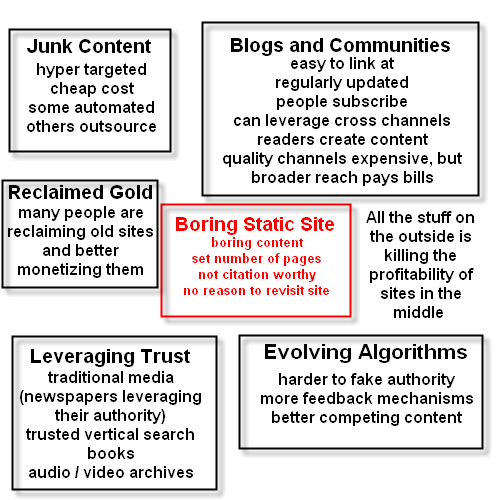
Things Hurting Boring Static Sites Without Personality:
What happens when Google has millions of books in their digital library, and has enough coverage and publisher participation to prominently place the books in the search results. Will obscure static websites even get found amongst the billions of pages of additional content?
What happens when somebody comment spams (or does some other type of spam) for you to try to destroy your site rankings? If people do not know and trust you it is going to be a lot harder to get back into the search indexes. Some will go so far as to create hate sites or blog spam key people.
What happens when automated content reads well enough to pass the Turing test? Will people become more skeptical about what they purchase? Will they be more cautious with what they are willing to link at? Will search engines have to rely more on how ideas are spreading to determine what content they can trust?
Marginalizing Effects on Static Content Production:
As the web userbase expands, more people publish (even my mom is a blogger), and ad networks become more efficient people will be able to make a living off off smaller and smaller niche topics.
As duplicate content filters improve, search engines have more user feedback, and more quality content is created static boring merchant sites will be forced out of the search results. Those who get others talk about them giving away information will better be able to sell products and information.
Good content without other people caring about it simply means to search engines its not good content.
Moving from Trusting Age to Trusting Newsworthiness:
Most static sites like boring general directories or other sites that are not so amazing that people are willing to cite them will lose market share and profitability as search engines learn how to trust new feedback mechanisms more.
Currently you can buy old sites with great authority scores and leverage that authority right to the top of Google's search results. Eventually it will not be that easy.
The trust mechanisms that the search engines use are easy to defeat and matter less if your site has direct type in traffic, subscribers, and people frequently talk about you.
Cite this Post or Subscribe to this Site:
Some people believe that every post needs to get new links or new subscribers. I think that posting explicitly with that intent may create a bit of an artificial channel, but it is a good base guideline for the types of posts that work well.
The key is that if you have enough interesting posts that people like enough to reference then you can mix in a few other posts that are not as great but are maybe more profit oriented. The key is to typically post stuff that adds value to the feed for many subscribers, or post things that interest you.
Many times just by having a post that is original you can end up starting a great conversation. I recently started posting Q and As on my blog. I thought I was maybe adding noise to my channel, but my sales have doubled , a bunch of sites linked to my Q and As, and I have got nothing but positive feedback on it. So don't be afraid to test stuff.
You wouldn't believe how many people posted about Andy Hagans post about making the SEO B list. Why was that post citation worthy? It was original and people love to read about themselves.
At the end of the day it is all about how many legitimate reasons you can create for a person to subscribe to your site or recommend it to a friend.
Man vs Machine:
For most webmasters inevitably the search algorithms will evolve to become advanced to the point where it's easier and cheaper to manipulate human emotion than to directly manipulate the search algorithms. Using a dynamic publishing format which reminds people to come back and read again makes it easier to build the relationships necessary to succeed. To quote a friend:
This is what I think, SEO is all about emotions, all about human interaction.
People, search engineers even, try and force it into a numbers box. Numbers, math and formulas are for people not smart enough to think in concepts.
Disclaimer:
All articles are wrote to express an opinion or prove a point (or to give the writer an excuse to try to make money - although this saying that SEO is becoming more about traditional public relations probably does not help me sell more SEO Books).
In some less competitive industries dynamic sites may not be necessary, but if you want to do well on the web long term most people would do well to have at least one dynamic site where they can converse and show their human nature.
Most searches occur at the main search sites and portals (Google, Yahoo!, MSN, AOL, etc.), but some people also search for temporal information, looking to find what is hot right now, or seeing how ideas spread. Not everyone can afford WebFountain, but we can all track what people are searching for or how stories are spreading using:
Feed Readers :
Subscribe to your favorite channels (or topical RSS feeds from news sites)
write press releases and submit them cheaply to see how much buzz & news search volume their is around a topic, using sites like PR Web or PR Leap
post on a topic
see if it spreads
check referrer data
Sometimes stories emerge out of the comments. The Save Jeeves meme that spread originated around the time the person who created that story commented on my post about Jeeves getting axed.
Don't forget to have friends tag your story on Del.ico.us and submit it to Digg.
Tagging:
Some are busy tagging what information they think is useful.
Google Search History (you can't see what others are tagging, but I bet it eventually will influence the search results - Google is already allowing people to share feeds they read)
more tagging sites come out daily...lots of others exist, like Edgio, StumbleUpon, Shadows, Kaboodle, etc etc etc
also look at the stuff listed in Google Base...there may or may not be much competition there, and Google Base is going to be huge.
Track Individual Stories and Conversations & Trends of a Blog:
I am going to see if I can finish up the article today. Here is the next piece:
How News Spreads:
News has to start from somewhere. It doesn't really matter if it comes from blogs or traditional media. A few things that are important with both publishing formats are
both have incentives to get the scoop or report on stories early
both have audiences who can further spread your message
both are fairly viral
both have lots of legit link popularity
getting viral marketing via blogs or news coverage is something that most people will not be able to replicate
Eventually if the story spreads the feedback network becomes the next round of news. If one or two well known reporters write your story other journalists and bloggers may feel like they are missing out if they do not cover it.
The story about me getting sued was picked up by another blogger, then BusinessWeek, then the WSJ. About a few hundred blog citations followed that. Sometimes news that goes a bit national comes back local, and even then you get a bonus links. A Pittsburgh paper mentioned I was sued. That story was syndicated on a Detroit paper, and even got a mention in the blog of the local paper.
Newspapers love to syndicate content from each other to lower costs. Sometimes they even syndicate things that don't make sense because they need fill to surround their ads. I have even seen an Arizona column featuring local Rhode Island bloggers.
Can Individuals & Small Sites Compete With Big Ones?
Some people think individuals can't compete with large corporations. The numbers prove otherwise.
When I was recently sued many sites linked through to my site referencing the lawsuit. The first day traffic volume of some of the leading referers was
Slashdot ~ 7,500
Wall Street Journal ~ 6,000
Atrios.blogspot.com ~ 6,000
News.com ~ 50
An individually written blogspot blog sent me nearly as much traffic as the Wall Street Journal did, and sent far more than most media sites did. Keep in mind that around 100 or so bloggers linked into the WSJ article, so the average blog post on Atrios.blogspot.com likely gets more online readers than most WSJ online articles do.
Working Alone:
If people like your biases or the way you present the news they will send you stories as well. As you develop trusted and trusting readers even individuals do not end up working alone. Many people will send you tips about the news they uncover. Over time those relationships develop and you know who to trust more and if your channel becomes profitable enough you may even be able to hire one or two of your favorite researchers.
Should I Have Said That:
Being the first person with the news is also an easy way to get links. Sometimes through misinterpreting a story, not fully analyzing it, or just going with gut instinct it also can help uncover things that might have otherwise gone unnoticed.
Some people are afraid to blog because they think I am not sure if I should of said that. In many cases when I write on the web I write it like... should I have said that? Hmm... if I was wrong someone will hopefully tell me or it might get links or comments.
Those who write the rules write them to keep themselves in power. The advantages of being new & small are:
You can move quickly, changing your business model or adding multiple new channels each day.
If you make errors people may be more tolerant of it if they do not think of you as a professional or do not realize your reach.
If you are brand new you may not have much to lose if you break a few rules.
Sometimes hidden stories come out when we make mistakes.
Controversy is typically surrounded in links. Sometimes being wrong is more valuable than being right.
Most anything that may hurt your credibility in the eyes of some may help you in the eyes of others.
Niche & Bias:
Being small means lower overhead and you can focus more on a specific market. The tighter your niche the easier it is to carve out a market position. The same may be true for the way you bias stories.
If you look in the political sphere the most prominent blogs are typically ones that lean far in one direction or another. If you fake the position eventually it will sound shifty and the truth will wash out, but if you are biased or broken that can lead to added profitability or authority on the web.
If you use a weblog or any other type of dynamic site, as content ages you create a large quantity of pages which can rank for a variety of terms in many engines. The site archive systems mean that posts not only get their own pages, but can also be organized by date and category. This creates what is considered to be legitimate keyword driftnet content bank.
People can also subscribe to the feeds to remind themselves when to come back and read your new information. Many people who read feeds also write sites with feeds, and can provide you with additional link popularity and another channel to acquire readers from.
Most people who subscribe to what you have to say will usually be people who agree with many of your points. This means that when they talk about you or mention your site you are:
likely to be presented to additional like minded people with similar biases to your own
in a positive manner
from a voice readers likely trust.
If people disagree with you and still subscribe to your feed then there is a great chance they will frequently want to say how wrong you are, maybe even linking through to your site.
Ultra Targeted Content:
Not all ideas need a whole article to explain. By publishing your thoughts with one topic per post it makes it easier for you to refer back to your own content in the future. It also makes it easier for others to point at / link to / reference it.
Ultra targeted content will also stand a good chance of ranking high for it's keyword theme since it is so well targeted.
Consumer Feedback & Product Catalogs:
For a long time creating pages by keyword phrase permutation was a functional SEO strategy, but Google does not want to display hollow product databases in their regular search results. Creating industrial strength spam works well for some, but as time passes the hollow databases need to get better at remixing sources and integrating user data.
If there is commercial value for a term Google believes Froogle & AdWords work well. It seems to be almost a yearly process that Google dials up the rankings on authority sites right around the Christmas shopping season. This forces merchants to need to buy in to the vertical shopping sites, buy AdWords, or spend Christmas out in the cold.
Allowing user feedback and interaction makes your content more original than most competing sites. It also adds value to the consumer experience & makes it easier to link at your site. Both of which make Google far more likely to want to include your site in the result set. Tim O'Reilly states Data is the Next Intel Inside:
While we've argued that business advantage via controlling software API's is much more difficult in the age of the internet, control of key data sources is not, especially if those data sources are expensive to create or amenable to increasing returns via network effects.
Google is just a giant feedback network, learning to better understand the relationships between queries, links, and content. If you own the smartest and richest consumer feedback network in your vertical you will only continue to gain profit, customers, and leverage, at least up until someone creates a better feedback network that displaces the current one.
Part 3 in a series... let me know what you think :)
Blog Software is a Simple CMS
Some of the conversations stemming from my article series starting with Why Bloggers Hate SEO's & Why SEO's Should Love Bloggers have stated that blogs are just a simple CMS. The one catch is they are social in nature.
I have probably read about a couple hundred books, and have only emailed about 5 book authors to tell them how great their books were. Most of the book authors quickly replied to my emails to say thanks. This tells me that they must understand the value of having fans (Seth Godin surely fits in that group) or they are not as inundated with email as I sometimes am.
Compare the books, which take months to write, to most blogs. On blogs I have left hundreds or thousands of comments. Across my various blogs I have got thousands of feedback posts others have left. One blog is almost nothing but a framework for people to leave their comments, and yet they still do!
Some people have stated that blogs are a fad that will die out. They may be right, but if they die out it will only be if other software emerges which does a better job of social integration, as some of the current tools are lacking on many fronts.
Static Content & the Game of Margins
Some old estabished static sites may long live on, but both directly and indirectly the web is becoming more of a read write medium. Margins will require content to become more social.
In spite of years of branding and content creation even the most well known publishers are caught playing the margins, selling ad space aggressively, and push the blame onto their advertisers.
Creating content is a game of margins. If you use a static website, and update it's content to keep it current, you are writing over your old work, which means:
you are throwing away it's historical record
you are creating less pages (which means less chances to pull in visitors) , as each page is another search lottery ticket
it is likely going to be harder for an audience to find the new content
it is less likely people will reference the new content, since they do not know what URLs are changing when
it is less likely people will reference the old content, since it may eventually change
many people will not want to reread the parts they already read
as your content size grows it means you are forced to worry about keeping it up to date while still trying to keep up with the news and the shifting marketplace
Add all of those things together, and a business model which would wildly succeed could easily become a complete failure.
The static site this article is on generally sucked until my blog became popular. In spite of the effort writing this aritcle, my average blog post will probably be read many times more than this article is.
Who is a Static Site For?
When you first learn about a topic it may be useful to create a large site about the topics you are learning, just as a way of forcing you to learn it all. Even in doing that, so long as you map out the general hierarchy ahead of time, there is no reason to avoid creating the site using a dynamicly driven database. Eventually when I have enough time this site will likely be shifted to a dynamic format.
The only people who can really afford to get away with using purely static sites are:
those who have other dynamic sites which help build their credibility & authority
those who are creating a site out of boredom or for a personal hobby
those who are not trying to profit or spread ideas
those who are known as the authority on their topic (who can do well in spite of the shortfalls in their publishing methods)
amazing writers who write so well that they can do well in spite of their publishing format
those who were first runners or are in niche fields with few competitors
those who are gurus in fields that change slow
those who run tons of sites and want to make them scalable (although it is even easier to do this with dynamic sites)
In almost all the above cases I can point to examples of how using dynamic sites could save time or be more profitable.
Example of a Sucky Static Site:
Not too long ago I created a site called Link Hounds to give away free link building tools on. I find the tools exceptionally useful, but the site failed to take off for a number of reasons.
API Limitations: when I first announced the site people used it beyond the API limits and it did not work. I should ask the engines for increased limits.
Lack of Incentive to Syndicate: in part to make up for the API limitations I gave away the source code and referenced tool mirrors, but some who mirrored the tool did not want to share it with others. Also Yahoo! requires that sites have DOM XML support if you use PHP4 to program the tool. I should have had my friend program in PHP5.
Crap Design: While the site design was not bad for free, it obviously is not something stellar.
Open Source & SEO: Are generally not concepts which are paired together. I think it will take a bit of time for people to get used to it. An open source website recently asked me to write an article, so that may help a bit.
Perception of Value: People think they get what they pay for. In spite of the fact that some of my software is similar to (and in some ways better than) stuff that sells for $150 or more, some people think the software is worthless because it is free. Similar software with strong affiliate marketing is seen by many more people:
Boring / Static: If I started working a bit harder at link building and placed a blog offering a bunch of creative link tips on that site I suspect it would garner many more links.
As it sits, there is little reason for people to remember to go back to the Link Hounds site, so they rarely do.
Sites that are dynamic in nature which make it easy to give feedback will fair far better.
Part 2 of an ongoing series, the future mini articles will shift away from blogs and into other areas, at the end there will hopefully be a point to all these :) if not well then sorry ;)
Blog Blog Blog Blah Blah Blah
I run an SEO related blog which sells a guide to doing SEO, and yet despite the chronic hate toward SEO many authoritative bloggers recently linked through to my site because I was sued by an SEO company for blog posts & comments. As of writing this I am unsure of the specifics of what made my site worth suing, although those lack of specifics pissed off many people.
Most likely Traffic Power thought they could scare me silent, and since I was a blogger with a few good blogging friends that story backfired rather badly for them. It is an easy story to link at, and many people did. Adam Penenberg painted a rather accurate picture of the situation. The story spread far and quick. There was much syndication of the story that my site started ranking for the word sued.
Traffic Power Sucks.com was sued along with me, and yet they got minimal coverage because: they did not want to talk much, and more importantly, they had a static site. Method of publishing plays a hugely important role in whether or not ideas will spread, and how quick they spread.
Smarter Content
Sometimes what makes you / your site comment worthy is what others do there, and how people react to that (just look at Threadwatch to see how important the comments can be). Allowing others to add content to my site allowed them to make the content smarter and more complete. It also was the exact reason why the lawsuit became so comment worthy.
People wanted to save the right to comment on blogs without needing to worry about others cutting off their feedback loops. It is a large part of the reason some think blog comment spam and trackback spam is so nasty: feedback about an idea is sometimes worth far more than the original idea.
Ease of Link Acquisition
By giving people something to talk about and reminding them to regularly visit your site it is much easier to build linkage data. It also is easier to reference old stories that once again become relevant as more news emerges.
The viral behavior of blog posts in a large social network benefits those who can figure out what stories would spread & why people would want to spread them. Arbitrarily answering questions like "How much is my blog worth?" is an easy way to get links.
Someone created a blog called anti-blog to say how lame blogs are. As soon as I found it I made a quick mention of how I thought they were a bunch of lamers. They quickly linked back saying how dumb I am. Easier and quicker than a link exchange, and that link is much more likely to be up in a year than most link trades, which usually turn out to be junk.
Echo Chamber
When you have a regular site and are stuck asking for links one at a time it is an arduous task. Blogs have an echo chamber effect. After stories are above radar they spread without effort, and sometimes how stories spread makes them linkworthy.
That last thread we actually pulled from our forums back in mid-April. No, not because of a cease-and-desist letter or any message. Instead, our forums have a policy about public spam reporting. We don't allow it, unless a site is incredibly well-known or the issue has become discussed in a variety of public forums. Ironically, with the many blog comments now about the cease-and-desist, the thread that previously was pulled now qualifies for restoration.
MC Hammer visits Google - how hard would you normally have to work to get authoritative topically related links from sites with a quality level as high as SEW?
I was not trying to pick on Danny with those examples. I used his site as the example because he is the most authoritative voice on search, has a journalism background, and a long history of spotting the future trends in search before they emerge.
Everyone likes to have a bit of fun. The often informal nature of blogs make it easier to reference somewhat random topics, especially if you get to be the crazy frog. Having a blog lets you tap the flow of linkage data from other related sites, for serious or fun stuff.
Hard to Reproduce
When you do link exchanges most of the sites that exchange with you will gladly exchange with your competitors. When your site garners linkage data from authoritative sites that are not heavily directly interested in making money or search rankings it is hard for competitors to reproduce your linkage data. In fact, if they prod too heavily on that front they stand a good chance of damaging their brand value and credibility.
Quality of Links
When you get links from within the content of an actively read channel typically
the individual archive pages have few links on each page
the links are the type that drive direct traffic. If search engines bias relevancy based on user data and link activity more then these types of links will become more powerful
the Google Sandbox concept really does not matter much if all the high ranking active channels are referencing you anyway
many links in social networks lead to secondary links
I was writing a longer article and decided it would be better in pieces. This first one is about marketing, profit, and why I think most bloggers hate SEO.
Let me know what you think of part 1. Tomorrow I will post part 2.
Algorithm Manipulation & Constant Change:
In the forums recently there has been some whining about Google being an out of control beast with no relevancy, etc. I guess when you look close enough there is always some amount of that.
People are also comparing the new Yahoo! algorithms to the Google Florida update. We tend to think the relevancy is not there when our own site disappears, even if it is temporary. Admittedly the algorithms may be jacked for a while, but if people like your site and sites like yours are not in the search results it hurts the relevancy and brand of the search engine when those results do not show up, even if some of those sites were banned long ago.
Search algorithm manipulation may still be beneficial, but is not necessary to succeed if others are interested in what you offer. Those who take a holistic approach to marketing do not need to worry as much about the ups and downs associated with changing search algorithms or search business models. If people believe in you enough they will push you to success even if you do not know what you are talking about.
There is nothing wrong with creating content with the intent to spread it. That is all SEO is focused on: spreading content, ideas, and websites for profit.
What is Profit?
Profit can be:
money
feeling important
knowing others are reading what you write
getting feedback
knowing you helped others
settling a score with someone you are pissed at
doing something which others stated you could not
or a variety of other things
Bloggers are SEOs?
When a blogger Google Bombs a person they are doing nothing more that a souped up blog version of SEO. In spite of the fact that bloggers do the same things as SEOs (and sometimes even far worse) many bloggers like to tell you just how much scum the average SEO is.
I suspect the ratio is more like 95/5 with regard to who's making reasonable money at blogging.
Personally, i see this as the new seo if you like - and the old guard, who can get their heads round the new medium, are all set to rake in what they want pretty much - it's open season out there...
While many bloggers and designers claim they absolutely hate the topic of SEO - and SEOs - much of the bad SEO advice offered is given by bloggers and web designers who never studied the topic.
At one point in time I had to tell a content rating website to stop hiding content on their own site. They were handed that dubious hide the content tip from a web designer (who ensured them that it was search engine friendly). Even outside of search think how poor it sounds for a content rating website to hide their own content. Where does the credibility go with moves like that?
Why Do Bloggers / Designers Really Hate SEOs?
Many people who are chronically pissed at anything remotely related to SEO are probably in that mode of thought for one of a few reasons:
Envy: I remember when I just started out on the web and was doing economically bad because I had few connections, limited experience, and minimal business savvy. I am not ashamed to admit that for a period when I was barely getting by I felt envious of people with better business models. Many web developers, bloggers, and designers whom are barely getting by like to push the blame of their lack of marketing skills and low wages on budget shifts toward marketing and spammy results clogging up the engines.
Sick of blog spam: Whenever a blogger talks about comment or trackback spam, or any webmaster gets referral spam many of them blame that annoyance on SEO in general, although the software developers are at fault for selling software with holes in it. Some people have even been known to blog spam for a competitor to hurt a competitors website, just because the software vendors make it so easy.
Sick of low quality search results: Search engines have spent a ton of money, time, and attention marketing their faults as belonging to a third party.
Some of the best search spammers also help search engines clean up the search results by explaining some of the common search spam techniques that are hurting search relevancy, but that is not something you see search engines heavily marketing.
Quality of Content: Some people believe that SEOs aim to do anything necessary to avoid creating useful websites or content. While some people just aim to exploit algoritmic holes, some of these same people later go on to do SEO for many legitimate websites. As an SEO, if you have clients, it is ideal to have clients that give you a performance based cut (affiliate programs) or clients that have naturally authoritative sites which can easily rank for their official name and related terms. Some of the better SEOs refuse to work for a company unless they are deeply interested in that companies products and market.
Web Standards: Many sites follow no standards other than putting money in the pocket of the author. That would occur whether or not there was a field called SEO. Sadly most of my sites are not yet standard compliant, and it would probably cost me about $100,000 to even attempt that. I may eventually try it, but you can't learn everything all at once. Learning is a process. Just as many designers are bad at marketing I am bad at designing and web standards related stuff.
Easy to pick on: XYZ marking firm is a bunch of knuckleheads is an easy story to spread. Web mob justice means those stories spread fast. Did you know that Gillette now has a 5 blade razor?
Selective Memory & Anchoring: How often do you hear a person thank an SEO for placing a relevant result at the top of the results? Never. How often do you hear of SEOs being $@&*ers? Much more often.