An Interview with Johns Wu

Internet success stories rarely get any sexier than the story of Johns Wu. 

In 2006, while still an undergraduate research student in neuroscience, Johns started a Wordpress blog he named Bankaholic.com. A one-man-show, Johns used an SEO/SEM-focused approach to build traffic and revenue. Just over 3 years later, he sold Bankaholic to BankRate for a reported $14.9 Million.

He was 22 years old.

Recently, we caught-up with Johns. This proved to be a bit of a challenge, as he is currently enjoying the ability to travel all over the world. He graciously stopped just long enough to answer some questions about his success and what it takes to create a multi-million dollar website these days.

So what leads a guy like you from studying neuroscience into SEO?

My original inspiration was the story of Anand Lal Shimpi and Anandtech.com. When I was in middle school, I saw a news report about how he became a media-tycoon when he was only in high school. Since then, I have always been fascinated by online media. In college, I was originally on track go to medical school, but the deeper I got into science, the more I realized that I hated it! I explored some computer and business classes on the side, and in 2005, I started a stock blog called thebulltrader.com. I had a good time blogging and running the site, and a year later, in 2006, I started Bankaholic. After getting my first AdSense check of $50+, I became interested in getting more traffic, and the rest is history! ;)

Online affiliates tend to do really well in areas that are either directly or closely tied to finance. Do you evaluate the proximity to finance when considering an area or niche where you'd like to build?

Not at all. The Internet is huge and there are tons great niches out there.

Is topical expertise required to compete in a valuable market?

It definitely helps, but it isn't 100% required.

What are specific things you feel might substitute for topical expertise?

Being Internet savvy definitely helps. More specifically, understanding how SEO and SEM works will grow your business and give you a shot even if competitors have more topical expertise.

Do you like to operate in markets where there is passionate competition, or markets where people tend to approach it with less passion?

I always steer clear of competitive niches. Always. There is so much money out there that you shouldn't be wasting your time chasing over-saturated/impossible niches like ringtones and online poker.

Let's talk a bit about how you grew Bankaholic. What was your original vision for the site?

In 2006, it was the peak of the financial bubble. Banks were very aggressive with marketing so they were paying easy sign-up bonuses to new customers. Any average Joe with a social security number could make a couple hundred bucks a month by taking advantage of these deals.

My goal was to aggregate the best deals and create a SlickDeals/Fatwallet kind of site that was exclusively about banking. My vision was to create an online cult of "bankaholics" that would come to my site every day for the latest deals.

Great domain name, BTW. What led you to create a uniquely brand-focused name opposed to using a direct-match or keyword-rich domain within the finance sector?

Picking a domain name was incredibly frustrating because (as you can imagine) all the good names were taken. I remember the day I thought of the word "Bankaholic" very clearly. I was in the neuroscience lab waiting for one of my lab experiments to finish, so I went on the computer and used NameBoy.com to brainstorm some names. I saw the word "Bankaholic" and I thought hey, this sounds alright...so then I quickly registered it on GoDaddy.

Given the size of the sale {$14.9 Million}, it would seem you were quite ambitious and narrowly focused to build that much market leverage so quickly. Were you always focused on reaching that level of success?

Yes, after I graduated college, Bankaholic became my life. I knew that I was sitting on a goldmine and that it was my one shot in life to make it big, so I took it very seriously and spent every free moment obsessing over how to grow and improve my business.

Did you employ any offline strategies to help drive your success?

The only offline strategy I ever attempted was printing Bankaholic t-shirts and giving them out. Since the ROI was so dismal, I never did this again!!

Did you have any specific priorities that you feel contributed in a meaningful way to your success?

Measure and optimize. You can't optimize what you don't measure.

Are you still writing regularly on the site? (One of the current authors in particular seems to share your love affair with culinary treats).

LOL! I continued writing for a few months after the sale, but after the transition, Bankrate has totally taken over.

The social media scene was emerging as Bankaholic grew, but is a much stronger presence today. Has this changed the way you are approaching new ideas or projects?

I'll be honest. I HATE social media. I admit, it can be powerful, but it is so unpredictable and uncontrollable that it is more of an afterthought for my online strategy. I personally would much rather spend my time on SEO since it is predictable, measurable, and (most importantly) 100% profitable.

However, Twitter and Facebook are valuable tools because they allow you to reach a fresh demographic that hasn't yet descended into the 'conversion funnel'... So in that respect, yes it is important to have a level of fluency in SMM depending on your niche and business model.

If new to a niche with limited resources, how does someone tackle bigger, more challenging markets?

Experience is everything. Learn from your mistakes, and don't be afraid to fail your way to the top.

Do you feel a success story like yours is something that anyone can do, or what makes the difference?

Not just anyone can do it, but there are many who can. To be a successful affiliate marketer, you need to be a jack of all trades. You gotta be able juggle and excel at many disciplines: creativity, design, business, project management.

You can only pick one: which is the most valuable asset for a young webmaster starting a competitive website (with all things being magically equal):

  • capital to invest,
  • passion for the subject matter,
  • expertise on the subject matter,
  • SEO savvy,
  • technical/graphic/content development skills

Definitely expertise. If you are a true authority in your niche and you create remarkable content, your website will naturally attract links, advertisers, and business development opportunities.

How has the money affected the way you're approaching new business interests?

I'm very active in domaining because it is a great place to put my money. I think premium domain names are great for my situation. Since I understand the Internet better than anything else, I know what valuations are attractive. Buying domains also leaves me the option to get into more web development in the future.

You've created an amazing "Rags to Riches" story with this entire effort. How does this affect the way you're viewing future challenges?

Unfortunately, I have a lot less motivation these days. I am a lot less 'hungry' for success but it's okay... eventually I will get back into my Internet marketing groove.

So what's next for Johns Wu?

These days, I've just been traveling and relaxing. Once I get the travel bug out of my system, there is no doubt that I will continue chugging away at domain acquisitions and development.

Thanks for taking a moment to talk, Johns - safe travels, and here's to your continued success!

Marty Lamers owns a Freelance SEO Copywriting company you can visit at Articulayers.Com. Since 2001, Articulayers has been fixing the world, one word at a time.

BlueGlass LA

I spoke to Loren from Search Engine Journal today and he mentioned a conference he is helping put together in Los Angeles.

The conference is BlueGlass LA.

It's on July 19/20 in LA. The speaker line up is pretty awesome and takes a business / start up approach on top of the killer search & social media tactics he will be reviewing. Tickets are only $495, and he has put together a 15% discount for SEObook readers/members. It's seobook

SEJ is also running a contest to give away a free pass. Many years ago I got my start in going to SEO conferences at the 2003 Boston SES conference by Danny giving me a free pass for help packing the schwag bags. And on the last day of the conference it snowed and snowed & was a scary snowy drive home. Years later I got to pass the free pass favor onto Patrick (who now has a great view).

If you have any questions about the conference, you can comment below and Loren will catch them.

Google Maps Devours Second Click

In the past when I claimed that the Google Maps insertion in organic search results wasn't more organic search but rather a Google promotion, I was met with skepticism by some, who argued that Google Maps was just another flavor of organic search and visitors would still be able to go to the end ranked website.

If you search for something on Google and click on one of the end URLs you can still visit them, but Google made one step in the opposite direction today. If you click on the map now the Google Maps section lists a bunch of places on the maps, rather than giving you the URLs. You then have to click onto one of the locations to see it on the map and open a pop up area which contains information including the URL. More clicks to do the same thing.

How long until Google replaces the URL listings in the search results with links to locations on the Google Maps or links to Google Places pages? It is the next obvious step in this transition.

Originally Google wanted to send you to the destination as quickly as possible, hoping that in doing so they would encourage you to come back again. This year Google's strategy has changed to one that wants you to stay for a while. There is no better example of that shift than Youtube Leanback:

Jamie Davidson, a YouTube product manager, says that the 15 minutes of daily viewing by a user typically involves six videos, with the conclusion of each presenting "a decision point, and every decision point is an opportunity to leave. We’re looking at how to push users into passive-consumption mode, a lean-back experience."

New Google AdWords Training Course

Back when I got into SEO part of the reason I wasn't too into PPC back then was because I had limited cash, but another big reason I wasn't big on it was because it seemed so simple and boring. Over the past couple years that has changed a lot!

Today Google AdWords is far more complex than SEO was in 2003.

With that complexity there are additional opportunities for some & additional expenses for others. But keeping up with all the changes is easily a full time job.

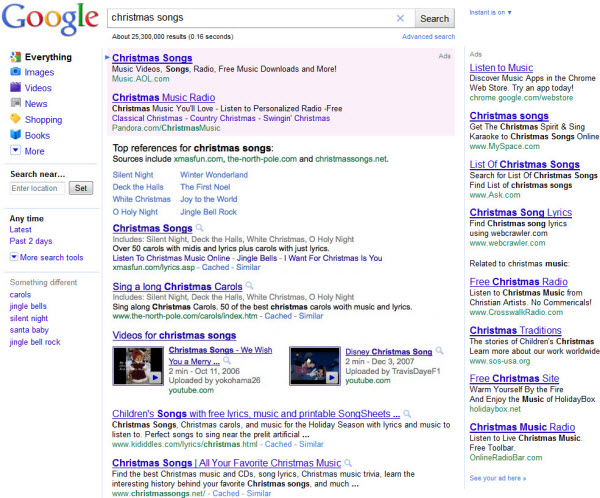
Noticing that trend, and seeing stuff like the below image, I thought it made sense to try to create something great servicing the AdWords / PPC market.

Google keeps controlling more real estate, and if you are not leveraging AdWords then there is a chance your business could eventually get pushed "below the fold" - perhaps not for longtail keywords...but certainly for the highest traffic and most valuable keywords in your industry. Google recently launched their vertical search panels, and to some degree you can think of many of these as what will eventually amount to some form of an ad channel (or a channel which promotes content from premium related partnerships with Google).

I am decent at AdWords, but my level of proficiency is nowhere near my level with SEO, and so we needed the help of someone else if we were going to make sure that we had bar-none the best product/service on the market. And so we decided to partner with Geordie to turn PPC Blog into a great membership website which mirrors this one.

Off the start access costs $179, but Geordie and I wanted to offer SEO Book blog readers a recurring 30% discount off of that, by using this code
EF0

This coupon will work for the first 100 subscribers, and then after the discount will no longer be available.

You can join here
http://ppcblog.com/member-tour-seobook/

Just like with SEO Book, you can cancel anytime and are under no obligation to stay any longer than you find it valuable to do so. If you do any serious amount of PPC it is quite easy to find a few tips that help you save $5 or more a day, especially when you consider how much PPC stuff Geordie has done (he has managed millions/yr in ad spend for the past 4 years & has brain dumped everything he knows) & how high quality the membership will be.

60+ training modules and a friendly PPC focused forum await you :D

Introduction Thread #4

We are now working on our fourth welcome thread (prior ones here). If you are new to the site, please say hi and introduce yourself. :)

Since we are getting close to 300 comments I am closing this thread out in favor of a new one here. :)

eHow Aggregating Bulk Register.com & eNom Data

The third reason we really like [eNom] is because the data, right. Almost 10% of the entire web hits our servers. At least 10 million domains. In a world like the web, where everybody is everywhere, trying to figure out what people are doing, particularly in the longtail this is a really exciting source of data.

If the domain name data leakage from eNom & BulkRegister is "exciting" for him that means sharing it must be "not exiting" for their customers.

One more from the "competing against yourself" series. ;)

A few other recent examples: giving away your analytics data, giving away your most valuable keywords, and doing link research for competitors.

Keyword List Comparison Tool

This video is a review of one of our online SEO tools - the keyword list comparison tool, which makes it easy to compare up to 10 keyword lists against each other. This can be used to help determine the quality of keyword data sources, to pool data into a handy unified list, or to help understand the overlap in keyword strategy from competing sites when using competitive research tools.

LiveStrong OR SpamStrong? You Decide!

Want to Live Strong?

  • You have to look strong. Start with a nice manly high & tight haircut livestrong.com/business_barber/
  • You have to be strong. Drink propane. 3 times daily. livestrong.com/propane/
  • You have to bulk up. Not steroids! Feed the search engines their own search results. livestrong.com/business-don-and-tennas-hair-place_563-326-2277/

I think Google is getting the message on what the search results would look like in a couple years if they let the above continue.

Sure they own the search category, but if they let the rot set in too much then people will shift to other modes of discovery. Google realizes that search may splinter - its why they bought Youtube, why the offer a mobile operating system, etc.

Google may not be 100% responsible for the above trend. But they will be 100% responsible for cleaning it up.

I won't be surprised to see a lot more of this in the near future. Such a shame, as Jason is such a great guy. :(

TV is the New Mobile

When Google enters a field sometimes they do so quietly, but when they decide they want to own something there is nothing quiet about their approach. They are not content to pick one niche and one model (the way that Netflix does):

Google keeps fighting on multiple fronts. Like boxing a glacier, over time they just wear the market down.

Google wants to turn Youtube watchers into mindless drones who are spared the expense of thought:

“If too much of your brain is occupied with the process of choosing, it takes you out of the experience of watching,” explains James Black, a NowMov co-founder. ... “We’re looking at how to push users into passive-consumption mode, a lean-back experience,” Mr. Davidson says.

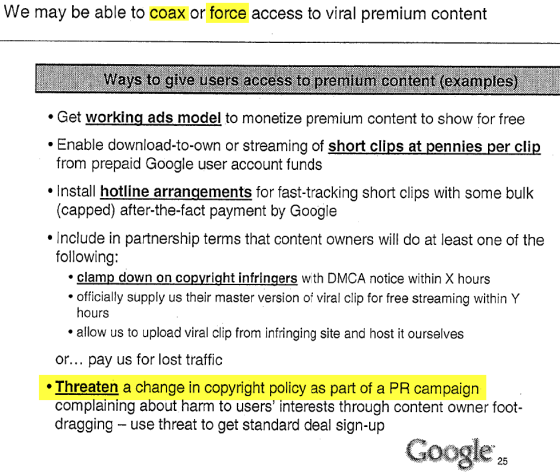
They want Youtube to be like television, because the TV ad market is far larger than the web ad market, and they already own search. They are desperately searching for new markets for avenues to grow.

Google spent $106 million buying On2, and then open sourced their V8 video codec:

It’s the “first one is free” approach that a drug dealer uses, and it’s not a “free” play, it’s a “we are the new railroad” play. For one-tenth the amount they paid for that crappy old codec, they could have paid Firefox’s licensing fees in perpetuity, if being a sugar daddy is what they want. They don’t want it. This is a “in your face, Apple” play, and a monopoly play.

And in addition to owning Youtube, tons of dark fiber, and their video codec, Google announced their Google TV effort. The person who controls the set top box has the market data.

Mark Cuban highlights the gaming that will occur in manipulating the rankings

The success of Google TV will come down to one thing….PageRank. Can you imagine the white hat and black hat SEO battles that will take place as video content providers try to get to the top of the TV Search Listings on Google TV ? Like Google said, there are 4 billion TVs and growing and the US TV Ad market is $70 BILLION. There is a lot at stake if Google TV takes off. How Google does its PageRank for this product will have a bigger impact on the success of the product in the TV market than anything else it does.

but if Google is passively monitoring the network they are far better than a guide. It becomes easy for them to see when their recommendations were not relevant & adjust. And if a network screws them multiple times they can always provide a dampening factor in their rankings.

If successful their TV efforts can tear down the walls between different types of content:

Google will do what it does, and that’s insinuate itself between information and the user. And the fretting will be minimal. As for the impact of Google TV, this has the potential to challenge the TV hegemony. By blurring the lines between TV and the Internet, Google TV has the potential to destroy classifications of content. No more “TV shows,” just “content.” No more “Web videos,” just “content.” And, once the distinctions are completely undermined, then direct distribution via the Internet becomes more viable. Google TV could replace Big TV as the aggregator, then it just becomes a matter of who offers the fattest pipes.

Once Google has the aggregate usage data they can use it any way they like. The concept applies to any market. Economies of scale advantages breed more economies of scale. Apple and Amazon want to have proprietary ebook formats? Fine. Google will assist publishers in creating the default common e-book format.

It is not just regular algorithm updates that can whack your traffic. A couple years out these additional content formats will be a big issue for many web publishers because if Google gets a significant sample size & market leverage in any of these parallel markets then some of these other content formats will start bleeding into the search results. And that (along with market competition) can quickly drive margins into negative territory for many publishing business models.

The Hidden Risk of Trusting Link Building Networks

Yesterday someone emailed me this quote

"People that pay for things never complain. It's the guy you give something to that you can't please." ~Will Rogers

and I think it is true on so many levels. If you want real feedback from someone ask them to put their money where their mouth is. Few will, and so most free feedback is garbage.

But when you pay for something you are giving a much stronger/cleaner signal, which is easy to trust & value.

What a lot of SEO professionals don't realize is that when they rent text links many of them are paying for their own demise. If you go through a central link broker that operates at scale you are telling them:

  • what areas your business is focused on
  • what keywords are important to you
  • what links you are buying
  • how much you think you will make from the marketing

That is fine if you are a huge company with tons of other quality signals which can't be replicated. But if you are a smaller company, what happens when that link broker is also a web publisher? Hmm... xyz is spending $5,000 a month with us to promote that site...well they must be making some good money off it - lets clone it. ;)

The equivalent to trusting most your link buying to a single link broker would be doing a public export of all your bids and conversion data for PPC. You wouldn't stay profitable very long with that strategy, and if you share your link purchase data with some of the shadier (and more well known) link brokers you can expect the same result.

A friend of mine recently mentioned buying some links and then seeing a number of sites pop up which seemed suspiciously associated with people who work behind the scenes at their link broker. Oooops!

Buying links from a central network is not only risky from a Google risk management perspective, but also from a "thanks for the data, fool" perspective.

Pages