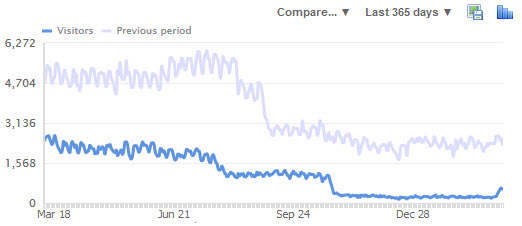
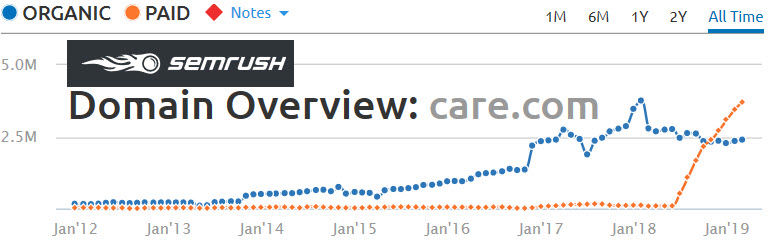
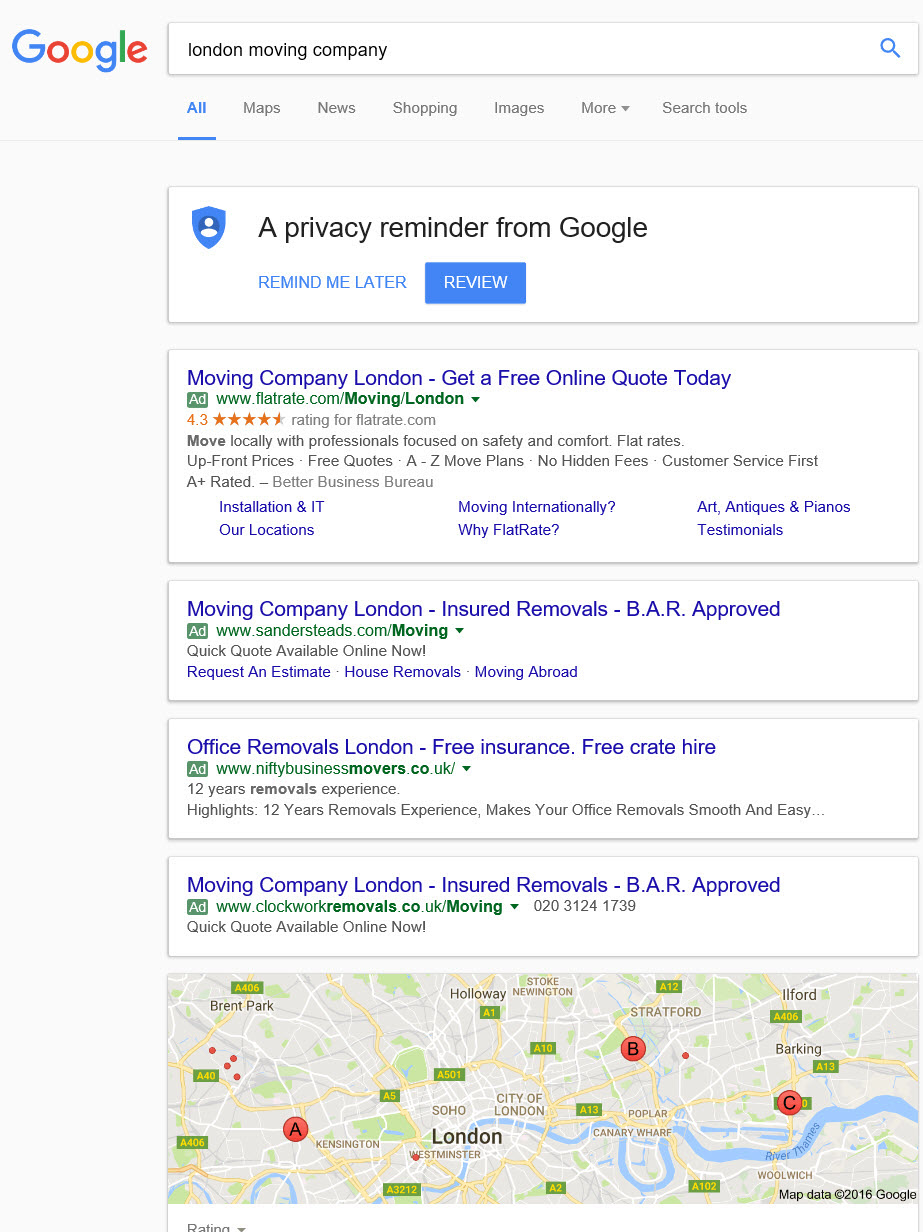
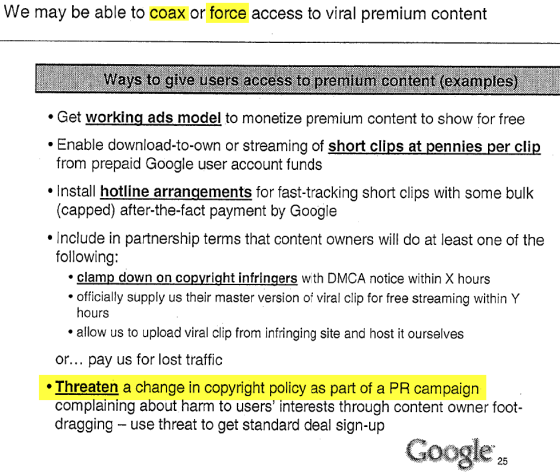
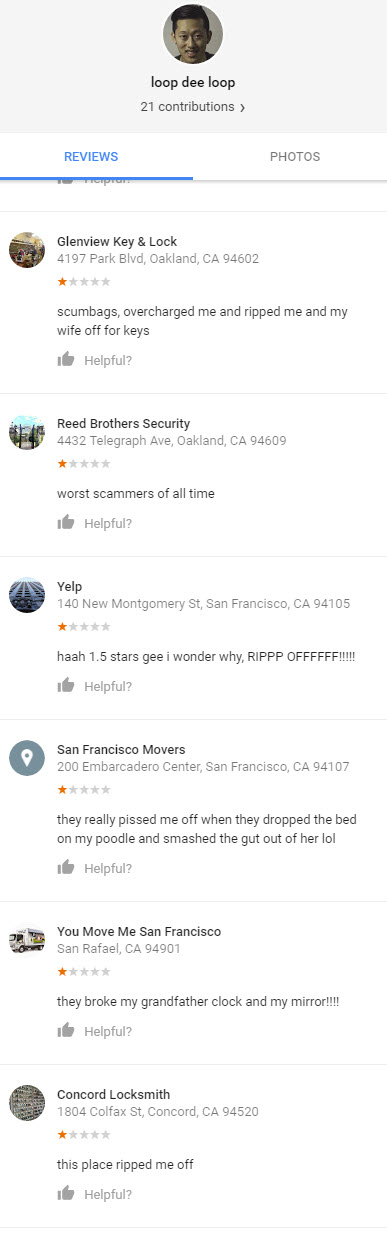
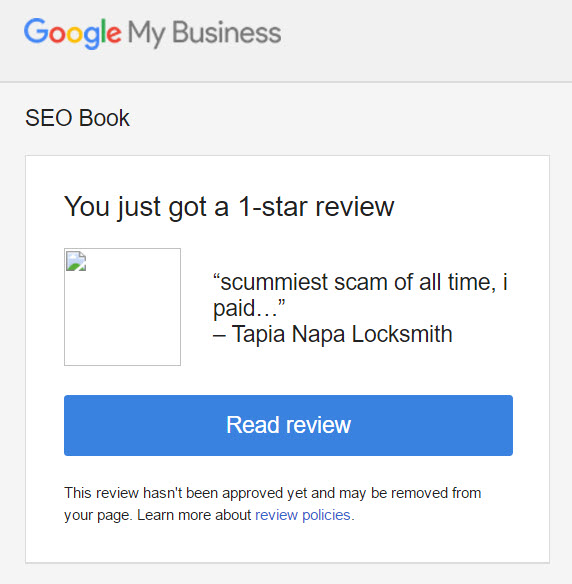
Beyond search Google controls the leading distributed ad network, the leading mobile OS, the leading web browser, the leading email client, the leading web analytics platform, the leading mapping platform, the leading free video hosting site.
They win a lot.
And they take winnings from one market & leverage them into manipulating adjacent markets.
Embrace. Extend. Extinguish.
Imagine taking a universal open standard that has zero problems with it and then stripping it down to it's most basic components and then prepending each element with your own acronym. Then spend years building and recreating what has existed for decades. That is @amphtml— Jon Henshaw (@henshaw) April 4, 2019
AMP is an utterly unnecessary invention designed to further shift power to Google while disenfranchising publishers. From the very start it had many issues with basic things like supporting JavaScript, double counting unique users (no reason to fix broken stats if they drive adoption!), not supporting third party ad networks, not showing publisher domain names, and just generally being a useless layer of sunk cost technical overhead that provides literally no real value.
Over time they have corrected some of these catastrophic deficiencies, but if it provided real value, they wouldn't have needed to force adoption with preferential placement in their search results. They force the bundling because AMP sucks.
Absurdity knows no bounds. Googlers suggest: "AMP isn’t another “channel” or “format” that’s somehow not the web. It’s not a SEO thing. It’s not a replacement for HTML. It’s a web component framework that can power your whole site. ... We, the AMP team, want AMP to become a natural choice for modern web development of content websites, and for you to choose AMP as framework because it genuinely makes you more productive."
The AMP development team now keeps track of whether AMP traffic drops suddenly, which might indicate pages are invalid, and it can react quickly.
All this adds expense, though. There are setup, development and maintenance costs associated with AMP, mostly in the form of time. After implementing AMP, the Guardian realized the project needed dedicated staff, so it created an 11-person team that works on AMP and other aspects of the site, drawing mostly from existing staff.
Feeeeeel the productivity!
Some content types (particularly user generated content) can be unpredictable & circuitous. For many years forums websites would use keywords embedded in the search referral to highlight relevant parts of the page. Keyword (not provided) largely destroyed that & then it became a competitive feature for AMP: "If the Featured Snippet links to an AMP article, Google will sometimes automatically scroll users to that section and highlight the answer in orange."
That would perhaps be a single area where AMP was more efficient than the alternative. But it is only so because Google destroyed the alternative by stripping keyword referrers from search queries.
"I see them as part of the effort to normalise the use of the AMP Carousel, which is an anti-competitive land-grab for the web by an organisation that seems to have an insatiable appetite for consuming the web, probably ultimately to it’s own detriment. ... This enables Google to continue to exist after the destination site (eg the New York Times) has been navigated to. Essentially it flips the parent-child relationship to be the other way around. ... As soon as a publisher blesses a piece of content by packaging it (they have to opt in to this, but see coercion below), they totally lose control of its distribution. ... I’m not that smart, so it’s surely possible to figure out other ways of making a preload possible without cutting off the content creator from the people consuming their content. ... The web is open and decentralised. We spend a lot of time valuing the first of these concepts, but almost none trying to defend the second. Google knows, perhaps better than anyone, how being in control of the user is the most monetisable position, and having the deepest pockets and the most powerful platform to do so, they have very successfully inserted themselves into my relationship with millions of other websites. ... In AMP, the support for paywalls is based on a recommendation that the premium content be included in the source of the page regardless of the user’s authorisation state. ... These policies demonstrate contempt for others’ right to freely operate their businesses.
After enough publishers adopted AMP Google was able to turn their mobile app's homepage into an interactive news feed below the search box. And inside that news feed Google gets to distribute MOAR ads while 0% of the revenue from those ads find its way to the publishers whose content is used to make up the feed.
Appropriate appropriation. :D
Thank you for your content!!!
Well this issue (bug?) is going to cause a sh*t storm...
Google @AMPhtml not allowing people to click through to full site? You can’t see but am clicking the link in top right
European and American tech, media and publishing companies, including some that originally embraced AMP, are complaining that the Google-backed technology, which loads article pages in the blink of an eye on smartphones, is cementing the search giant's dominance on the mobile web.
Each additional layer of technical cruft is another cost center. Things that sound appealing at first blush may not be:
The way you verify your identity to Let's Encrypt is the same as with other certificate authorities: you don't really. You place a file somewhere on your website, and they access that file over plain HTTP to verify that you own the website. The one attack that signed certificates are meant to prevent is a man-in-the-middle attack. But if someone is able to perform a man-in-the-middle attack against your website, then he can intercept the certificate verification, too. In other words, Let's Encrypt certificates don't stop the one thing they're supposed to stop. And, as always with the certificate authorities, a thousand murderous theocracies, advertising companies, and international spy organizations are allowed to impersonate you by design.
Anything that is easy to implement & widely marketed often has costs added to it in the future as the entity moves to monetize the service.
This is a private equity firm buying up multiple hosting control panels & then adjusting prices.
This is Google Maps drastically changing their API terms.
This is Facebook charging you for likes to build an audience, giving your competitors access to those likes as an addressable audience to advertise against, and then charging you once more to boost the reach of your posts.
Shivane believes GrubHub purchased her restaurant’s web domain to prevent her from building her own online presence. She also believes the company may have had a special interest in owning her name because she processes a high volume of orders. ... it appears GrubHub has set up several generic, templated pages that look like real restaurant websites but in fact link only to GrubHub. These pages also display phone numbers that GrubHub controls. The calls are forwarded to the restaurant, but the platform records each one and charges the restaurant a commission fee for every order
Settling for the easiest option drives a lack of differentiation, embeds additional risk & once the dominant player has enough marketshare they'll change the terms on you.
Small gains in short term margins for massive increases in fragility.
"Closed platforms increase the chunk size of competition & increase the cost of market entry, so people who have good ideas, it is a lot more expensive for their productivity to be monetized. They also don't like standardization ... it looks like rent seeking behaviors on top of friction" - Gabe Newell
Those who look at SaaS business models through the eyes of a seasoned investor will better understand how markets are likely to change:
"I’d argue that many of today’s anointed tech “disruptors” are doing little in the way of true disruption. ... When investors used to get excited about a SAAS company, they typically would be describing a hosted multi-tenant subscription-billed piece of software that was replacing a ‘legacy’ on-premise perpetual license solution in the same target market (i.e. ERP, HCM, CRM, etc.). Today, the terms SAAS and Cloud essentially describe the business models of every single public software company.
Most platform companies are initially required to operate at low margins in order to buy growth of their category & own their category. Then when they are valued on that, they quickly need to jump across to adjacent markets to grow into the valuation:
Twilio has no choice but to climb up the application stack. This is a company whose ‘disruption’ is essentially great API documentation and gangbuster SEO spend built on top of a highly commoditized telephony aggregation API. They have won by marketing to DevOps engineers. With all the hype around them, you’d think Twilio invented the telephony API, when in reality what they did was turn it into a product company. Nobody had thought of doing this let alone that this could turn into a $17 billion company because simply put the economics don’t work. And to be clear they still don’t. But Twilio’s genius CEO clearly gets this. If the market is going to value robocalls, emergency sms notifications, on-call pages, and carrier fee passed through related revenue growth in the same way it does ‘subscription’ revenue from Atlassian or ServiceNow, then take advantage of it while it lasts.
Large platforms offering temporary subsidies to ensure they dominate their categories & companies like SoftBank spraying capital across the markets is causing massive shifts in valuations:
I also think if you look closely at what is celebrated today as innovation you often find models built on hidden subsidies. ... I’d argue the very distributed nature of microservices architecture and API-first product companies means addressable market sizes and unit economics assumptions should be even more carefully scrutinized. ... How hard would it be to create an Alibaba today if someone like SoftBank was raining money into such a greenfield space? Excess capital would lead to destruction and likely subpar returns. If capital was the solution, the 1.5 trillion that went into telcos in late '90s wouldn’t have led to a massive bust. Would a Netflix be what it is today if a SoftBank was pouring billions into streaming content startups right as the experiment was starting? Obviously not. Scarcity of capital is another often underappreciated part of the disruption equation. Knowing resources are finite leads to more robust models. ... This convergence is starting to manifest itself in performance. Disney is up 30% over the last 12 months while Netflix is basically flat. This may not feel like a bubble sign to most investors, but from my standpoint, it’s a clear evidence of the fact that we are approaching a something has got to give moment for the way certain businesses are valued."
Circling back to Google's AMP, it has a cousin called Recaptcha.
According to tech statistics website Built With, more than 650,000 websites are already using reCaptcha v3; overall, there are at least 4.5 million websites use reCaptcha, including 25% of the top 10,000 sites. Google is also now testing an enterprise version of reCaptcha v3, where Google creates a customized reCaptcha for enterprises that are looking for more granular data about users’ risk levels to protect their site algorithms from malicious users and bots. ... According to two security researchers who’ve studied reCaptcha, one of the ways that Google determines whether you’re a malicious user or not is whether you already have a Google cookie installed on your browser. ... To make this risk-score system work accurately, website administrators are supposed to embed reCaptcha v3 code on all of the pages of their website, not just on forms or log-in pages.
About a month ago when logging into Bing Ads I saw recaptcha on the login page & couldn't believe they'd give Google control at that access point. I think they got rid of that, but lots of companies are perhaps shooting themselves in the foot through a combination of over-reliance on Google infrastructure AND sloppy implementation
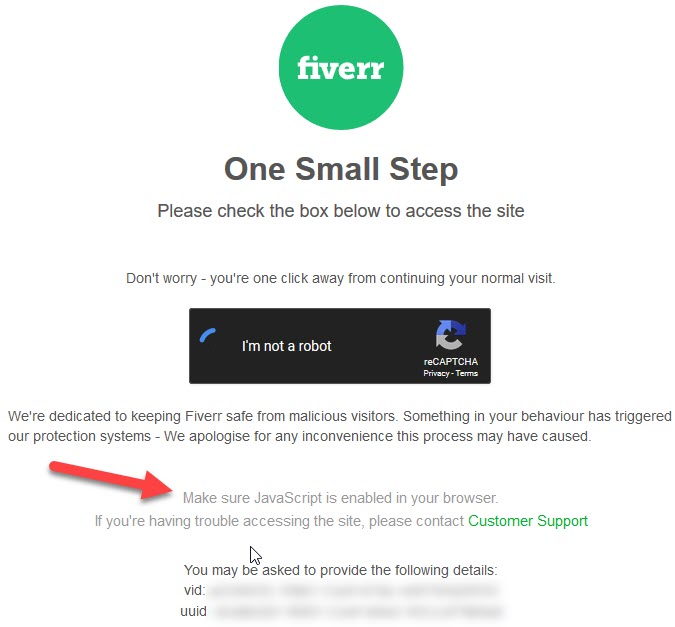
Today when making a purchase on Fiverr, after converting, I got some of this action
Hmm. Maybe I will enable JavaScript and try again.
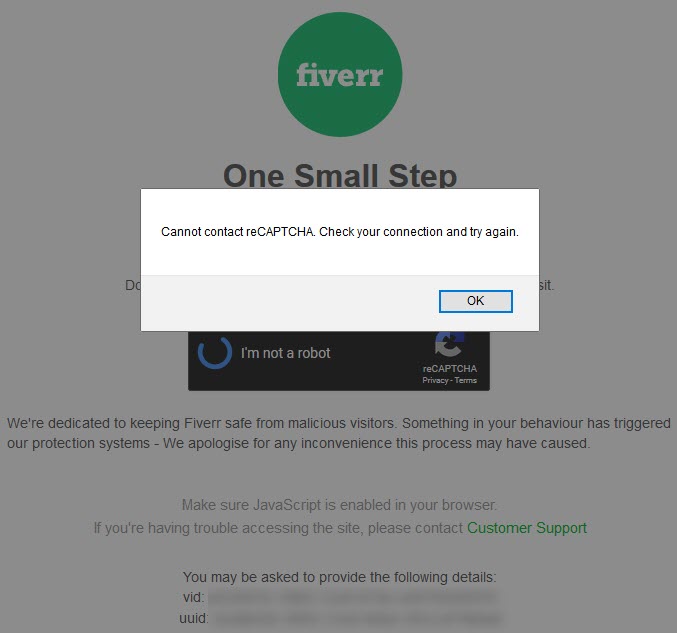
Oooops.
That is called snatching defeat from the jaws of victory.
My account is many years old. My payment type on record has been used for years. I have ordered from the particular seller about a dozen times over the years. And suddenly because my web browser had JavaScript turned off I was deemed a security risk of some sort for making an utterly ordinary transaction I have already completed about a dozen times.
On AMP JavaScript was the devil. And on desktop not JavaScript was the devil.
Pro tip: Ecommerce websites that see substandard conversion rates from using Recaptcha can boost their overall ecommerce revenue by buying more Google AdWords ads.
---
As more of the infrastructure stack is driven by AI software there is going to be a very real opportunity for many people to become deplatformed across the web on an utterly arbitrary basis. That tech companies like Facebook also want to create digital currencies on top of the leverage they already have only makes the proposition that much scarier.
If the tech platforms host copies of our sites, process the transactions & even create their own currencies, how will we know what level of value they are adding versus what they are extracting?
Who measures the measurer?
And when the economics turn negative, what will we do if we are hooked into an ecosystem we can't spend additional capital to get out of when things head south?
Anyone can argue about the intent of a particular action & the outcome that is derived by it. But when the outcome is known, at some point the intent is inferred if the outcome is derived from a source of power & the outcome doesn't change.
Or, put another way, if a powerful entity (government, corporation, other organization) disliked an outcome which appeared to benefit them in the short term at great lasting cost to others, they could spend resources to adjust the system.
If they don't spend those resources (or, rather, spend them on lobbying rather than improving the ecosystem) then there is no desired change. The outcome is as desired. Change is unwanted.
Engagement is a toxic metric.
Products which optimize for it become worse. People who optimize for it become less happy.
It also seems to generate runaway feedback loops where most engagable people have a) worst individual experiences and then b) end up driving the product bus.— Patrick McKenzie (@patio11) April 9, 2019
News is a stock vs flow market where the flow of recent events drives most of the traffic to articles. News that is more than a couple days old is no longer news. A news site which stops publishing news stops becoming a habit & quickly loses relevancy. Algorithmically an abandoned archive of old news articles doesn't look much different than eHow, in spite of having a much higher cost structure.
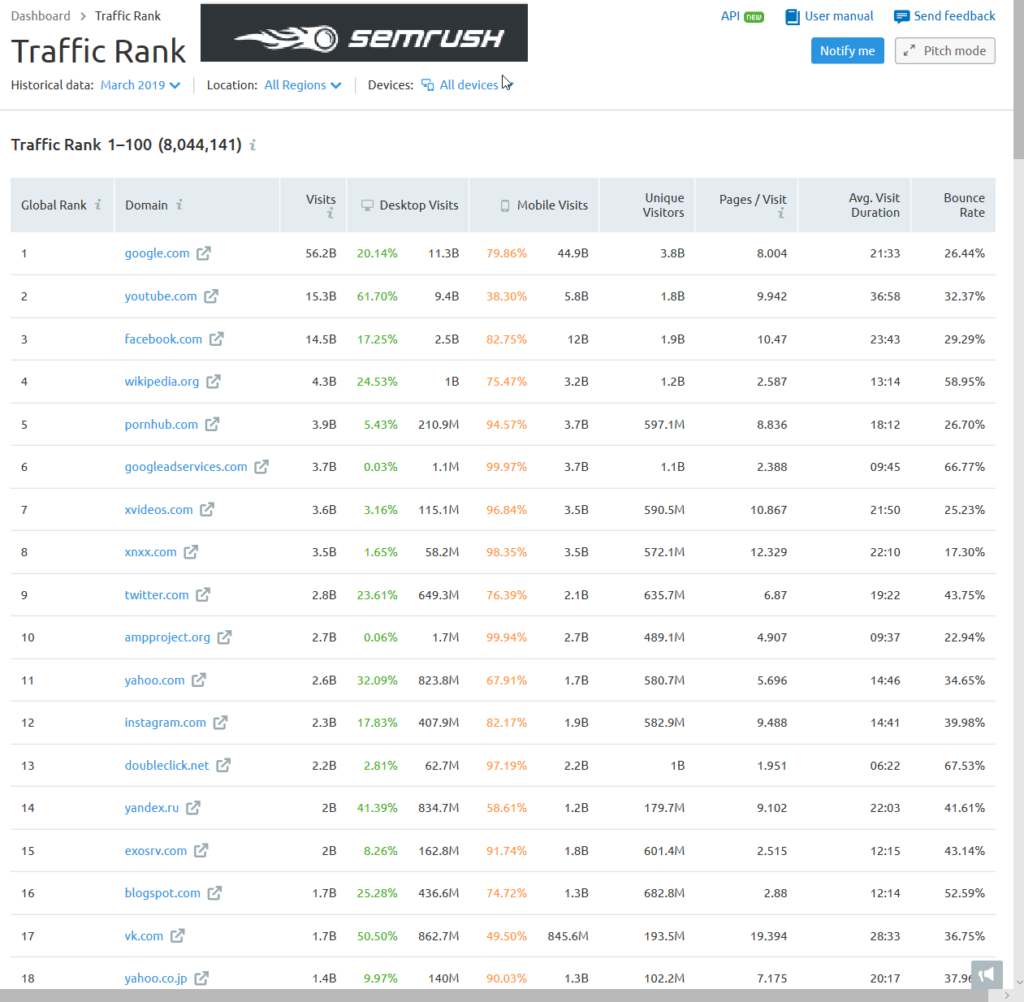
According to SEMrush's traffic rank, ampproject.org gets more monthly visits than Yahoo.com.
That actually understates the prevalence of AMP because AMP is generally designed for mobile AND not all AMP-formatted content is displayed on ampproject.org.
Part of how AMP was able to get widespread adoption was because in the news vertical the organic search result set was displaced by an AMP block. If you were a news site either you were so differentiated that readers would scroll past the AMP block in the search results to look for you specifically, or you adopted AMP, or you were doomed.
Some news organizations like The Guardian have a team of about a dozen people reformatting their content to the duplicative & proprietary AMP format. That's wasteful, but necessary "In theory, adoption of AMP is voluntary. In reality, publishers that don’t want to see their search traffic evaporate have little choice. New data from publisher analytics firm Chartbeat shows just how much leverage Google has over publishers thanks to its dominant search engine."
It seems more than a bit backward that low margin publishers are doing duplicative work to distance themselves from their own readers while improving the profit margins of monopolies. But it is what it is. And that no doubt drew the ire of many publishers across the EU.
If you spent a bunch of money to create a highly differentiated piece of content, why would you prefer that high spend flagship content appear on a third party website rather than your own?
Google & Facebook have done such a fantastic job of eating the entire pie that some are celebrating Amazon as a prospective savior to the publishing industry. That view - IMHO - is rather suspect.
Amazon generally treats consumers well, but they have been much harder on business partners with tough pricing negotiations, counterfeit protections, forced ad buying to have a high enough product rank to be able to rank organically, ad displacement of their organic search results below the fold (even for branded search queries), learning suppliers & cutting out the partners, private label products patterned after top sellers, in some cases running pop over ads for the private label products on product level pages where brands already spent money to drive traffic to the page, etc.
"Boyce’s experience on Amazon largely echoed what happens in the offline world: competitors entered the market, pushing down prices and making it harder to make a profit. So Boyce adapted. He stopped selling basketball hoops and developed his own line of foosball tables, air hockey tables, bocce ball sets and exercise equipment. The best way to make a decent profit on Amazon was to sell something no one else had and create your own brand. ... Amazon also started selling bocce ball sets that cost $15 less than Boyce’s. He says his products are higher quality, but Amazon gives prominent page space to its generic version and wins the cost-conscious shopper."
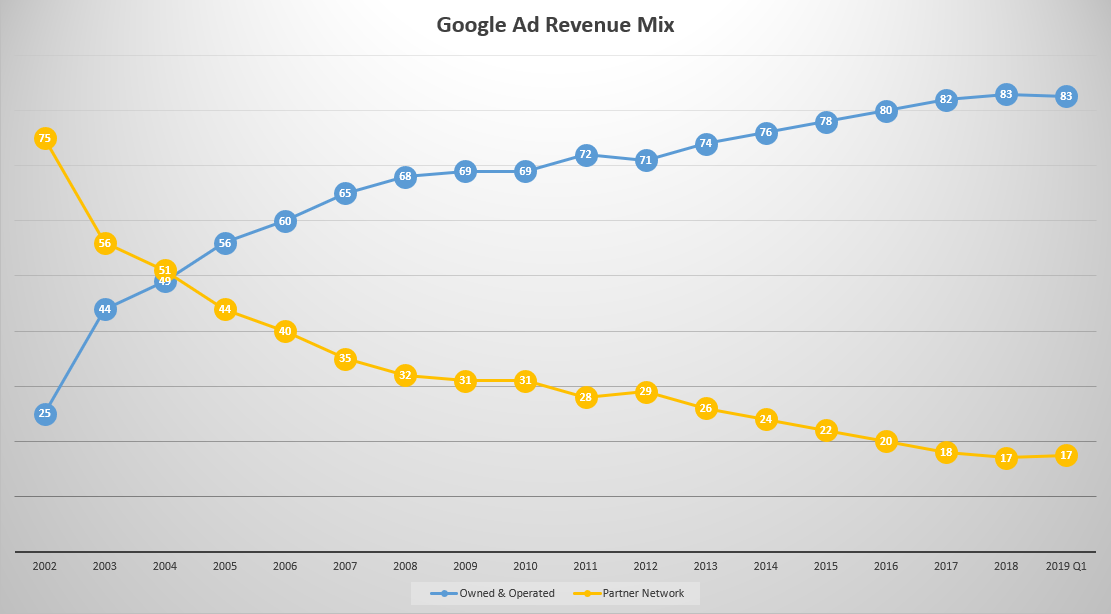
Google claims they have no idea how content publishers are with the trade off between themselves & the search engine, but every quarter Alphabet publish the share of ad spend occurring on owned & operated sites versus the share spent across the broader publisher network. And in almost every quarter for over a decade straight that ratio has grown worse for publishers.
When Google tells industry about how much $ it funnels to rest of ecosystem, just show them this chart. It's good to be the "revenue regulator" (note: G went public in 2004). pic.twitter.com/HCbCNgbzKc— Jason Kint (@jason_kint) February 5, 2019
The aggregate numbers for news publishers are worse than shown above as Google is ramping up ads in video games quite hard. They've partnered with Unity & promptly took away the ability to block ads from appearing in video games using googleadsenseformobileapps.com exclusion (hello flat thumb misclicks, my name is budget & I am gone!)
They will also track video game player behavior & alter game play to maximize revenues based on machine learning tied to surveillance of the user's account: "We’re bringing a new approach to monetization that combines ads and in-app purchases in one automated solution. Available today, new smart segmentation features in Google AdMob use machine learning to segment your players based on their likelihood to spend on in-app purchases. Ad units with smart segmentation will show ads only to users who are predicted not to spend on in-app purchases. Players who are predicted to spend will see no ads, and can simply continue playing."
And how does the growth of ampproject.org square against the following wisdom?
If you do use a CDN, I'd recommend using a domain name of your own (eg, https://t.co/fWMc6CFPZ0), so you can move to other CDNs if you feel the need to over time, without having to do any redirects.— John (@JohnMu) April 15, 2019
Literally only yesterday did Google begin supporting instant loading of self-hosted AMP pages.
China has a different set of tech leaders than the United States. Baidu, Alibaba, Tencent (BAT) instead of Facebook, Amazon, Apple, Netflix, Google (FANG). China tech companies may have won their domestic markets in part based on superior technology or better knowledge of the local culture, though those same companies have largely went nowhere fast in most foreign markets. A big part of winning was governmental assistance in putting a foot on the scales.
it can easily be argued that the last 60 years were above all the era of the container-ship (with container-ships getting ever bigger). But will the coming decades still be the age of the container-ship? Possibly not, for the simple reason that things that have value increasingly no longer travel by ship, but instead by fiberoptic cables! ... you could almost argue that ZTE and Huawei have been the “East India Company” of the current imperial cycle. Unsurprisingly, it is these very companies, charged with laying out the “new roads” along which “tomorrow’s value” will flow, that find themselves at the center of the US backlash. ... if the symbol of British domination was the steamship, and the symbol of American strength was the Boeing 747, it seems increasingly clear that the question of the future will be whether tomorrow’s telecom switches and routers are produced by Huawei or Cisco. ... US attempts to take down Huawei and ZTE can be seen as the existing empire’s attempt to prevent the ascent of a new imperial power. With this in mind, I could go a step further and suggest that perhaps the Huawei crisis is this century’s version of Suez crisis. No wonder markets have been falling ever since the arrest of the Huawei CFO. In time, the Suez Crisis was brought to a halt by US threats to destroy the value of sterling. Could we now witness the same for the US dollar?
Amazon will soon discontinue selling physical retail products in China: "Amazon shoppers in China will no longer be able to buy goods from third-party merchants in the country, but they still will be able to order from the United States, Britain, Germany and Japan via the firm’s global store. Amazon expects to close fulfillment centers and wind down support for domestic-selling merchants in China in the next 90 days."
India has taken notice of the success of Chinese tech companies & thus began to promote "national champion" company policies. That, in turn, has also meant some of the Chinese-styled laws requiring localized data, antitrust inquiries, foreign ownership restrictions, requirements for platforms to not sell their own goods, promoting limits on data encryption, etc.
The secretary of India’s Telecommunications Department, Aruna Sundararajan, last week told a gathering of Indian startups in a closed-door meeting in the tech hub of Bangalore that the government will introduce a “national champion” policy “very soon” to encourage the rise of Indian companies, according to a person familiar with the matter. She said Indian policy makers had noted the success of China’s internet giants, Alibaba Group Holding Ltd. and Tencent Holdings Ltd. ... Tensions began rising last year, when New Delhi decided to create a clearer set of rules for e-commerce and convened a group of local players to solicit suggestions. Amazon and Flipkart, even though they make up more than half the market, weren’t invited, according to people familiar with the matter.
Amazon vowed to invest $5 billion in India & they have done some remarkable work on logistics there. Walmart acquired Flipkart for $16 billion.
Other emerging markets also have many local ecommerce leaders like Jumia, MercadoLibre, OLX, Gumtree, Takealot, Konga, Kilimall, BidOrBuy, Tokopedia, Bukalapak, Shoppee, Lazada. If you live in the US you may have never heard of *any* of those companies. And if you live in an emerging market you may have never interacted with Amazon or eBay.
It makes sense that ecommerce leadership would be more localized since it requires moving things in the physical economy, dealing with local currencies, managing inventory, shipping goods, etc. whereas information flows are just bits floating on a fiber optic cable.
If the Internet is primarily seen as a communications platform it is easy for people in some emerging markets to think Facebook is the Internet. Free communication with friends and family members is a compelling offer & as the cost of data drops web usage increases.
At the same time, the web is incredibly deflationary. Every free form of entertainment which consumes time is time that is not spent consuming something else.
Add the technological disruption to the wealth polarization that happened in the wake of the great recession, then combine that with algorithms that promote extremist views & it is clearly causing increasing conflict.
If you are a parent and you think you child has no shot at a brighter future than your own life it is easy to be full of rage.
Starting around 2000, the line starts to slide. More students say it's not their problem to help people in trouble, not their job to see the world from someone else's perspective. By 2009, on all the standard measures, Konrath found, young people on average measure 40 percent less empathetic than my own generation ... The new rule for empathy seems to be: reserve it, not for your "enemies," but for the people you believe are hurt, or you have decided need it the most. Empathy, but just for your own team. And empathizing with the other team? That's practically a taboo.
A complete lack of empathy could allow a psychopath to commit extreme crimes while feeling no guilt, shame or remorse. Extreme empathy can have the same sort of outcome:
"Sometimes we commit atrocities not out of a failure of empathy but rather as a direct consequence of successful, even overly successful, empathy. ... They emphasized that students would learn both sides, and the atrocities committed by one side or the other were always put into context. Students learned this curriculum, but follow-up studies showed that this new generation was more polarized than the one before. ... [Empathy] can be good when it leads to good action, but it can have downsides. For example, if you want the victims to say 'thank you.' You may even want to keep the people you help in that position of inferior victim because it can sustain your feeling of being a hero." - Fritz Breithaupt
Many people will end up murdered by algorithmically generated empathy.
As technology increases absentee ownership & financial leverage, a society led by morally agnostic algorithms is not going to become more egalitarian.
The more I think about and discuss it, the more I think WhatsApp is simultaneously the future of Facebook, and the most potentially dangerous digital tool yet created. We haven't even begun to see the real impact yet of ubiquitous, unfettered and un-moderatable human telepathy.— Antonio García Martínez (@antoniogm) April 15, 2019
It’s particularly odd that the government is demanding “accountability and responsibility” from a phone app when some ruling party politicians are busy spreading divisive fake news. How can the government ask WhatsApp to control mobs when those convicted of lynching Muslims have been greeted, garlanded and fed sweets by some of the most progressive and cosmopolitan members of Modi’s council of ministers?
The Rohingya asylum seekers are victims of their own violent Jihadist leadership that formed a militia to kill Buddhists and Hindus. Hindus are being massacred, where’s the outrage for them!? https://t.co/P3m6w4B1Po— Imam Tawhidi (@Imamofpeace) May 23, 2018
Some may "learn" vaccines don't work. Others may learn the vaccines their own children took did not work, as it failed to protect them from the antivax content spread by Facebook & Google, absorbed by people spreading measles & Medieval diseases.
Passion drives engagement, which drives algorithmic distribution: "There’s an asymmetry of passion at work. Which is to say, there’s very little counter-content to surface because it simply doesn’t occur to regular people (or, in this case, actual medical experts) that there’s a need to produce counter-content."
As the costs of "free" become harder to hide, social media companies which currently sell emerging markets as their next big growth area will end up having embedded regulatory compliance costs which will end up exceeding any sort of prospective revenue they could hope to generate.
The Pinterest S1 shows almost all their growth is in emerging markets, yet almost all their revenue is inside the United States.
As governments around the world see the real-world cost of the foreign tech companies & view some of them as piggy banks, eventually the likes of Facebook or Google will pull out of a variety of markets they no longer feel worth serving. It will be like Google did in mainland China with search after discovering pervasive hacking of activist Gmail accounts.
Just tried signing into Gmail from a new device. Unless I provide a phone number, there is no way to sign in and no one to call about it. Oh, and why do they say they need my phone? If you guessed "for my protection," you would be correct. Talk about Big Brother...— Simon Mikhailovich (@S_Mikhailovich) April 16, 2019
Lower friction & lower cost information markets will face more junk fees, hurdles & even some legitimate regulations. Information markets will start to behave more like physical goods markets.
The tech companies presume they will be able to use satellites, drones & balloons to beam in Internet while avoiding messy local issues tied to real world infrastructure, but when a local wealthy player is betting against them they'll probably end up losing those markets: "One of the biggest cheerleaders for the new rules was Reliance Jio, a fast-growing mobile phone company controlled by Mukesh Ambani, India’s richest industrialist. Mr. Ambani, an ally of Mr. Modi, has made no secret of his plans to turn Reliance Jio into an all-purpose information service that offers streaming video and music, messaging, money transfer, online shopping, and home broadband services."
Publishers do not have "their mojo back" because the tech companies have been so good to them, but rather because the tech companies have been so aggressive that they've earned so much blowback which will in turn lead publishers to opting out of future deals, which will eventually lead more people back to the trusted brands of yesterday.
Publishers feeling guilty about taking advertorial money from the tech companies to spread their propaganda will offset its publication with opinion pieces pointing in the other direction: "This is a lobbying campaign in which buying the good opinion of news brands is clearly important. If it was about reaching a target audience, there are plenty of metrics to suggest his words would reach further – at no cost – on Facebook. Similarly, Google is upping its presence in a less obvious manner via assorted media initiatives on both sides of the Atlantic. Its more direct approach to funding journalism seems to have the desired effect of making all media organisations (and indeed many academic institutions) touched by its money slightly less questioning and critical of its motives."
When Google penalizes a no-name me-too site almost nobody realizes it is missing. But if a big publisher opts out of the ecosystem people will notice.
The reliance on the tech platforms is largely a mirage. If enough key players were to opt out at the same time people would quickly reorient their information consumption habits.
If the platforms can change their focus overnight then why can't publishers band together & choose to dump them?
CEO Jack Dorsey said Twitter is looking to change the focus from following specific individuals to topics of interest, acknowledging that what's incentivized today on the platform is at odds with the goal of healthy dialoguehttps://t.co/31FYslbePA— Axios (@axios) April 16, 2019
In Europe there is GDPR, which aimed to protect user privacy, but ultimately acted as a tax on innovation by local startups while being a subsidy to the big online ad networks. They also have Article 11 & Article 13, which passed in spite of Google's best efforts on the scaremongeringanti-SERP tests, lobbying & propaganda fronts: "Google has sparked criticism by encouraging news publishers participating in its Digital News Initiative to lobby against proposed changes to EU copyright law at a time when the beleaguered sector is increasingly turning to the search giant for help."
Remember the Eric Schmidt comment about how brands are how you sort out (the non-YouTube portion of) the cesspool? As it turns out, he was allegedly wrong as Google claims they have been fighting for the little guy the whole time:
Article 11 could change that principle and require online services to strike commercial deals with publishers to show hyperlinks and short snippets of news. This means that search engines, news aggregators, apps, and platforms would have to put commercial licences in place, and make decisions about which content to include on the basis of those licensing agreements and which to leave out. Effectively, companies like Google will be put in the position of picking winners and losers. ... Why are large influential companies constraining how new and small publishers operate? ... The proposed rules will undoubtedly hurt diversity of voices, with large publishers setting business models for the whole industry. This will not benefit all equally. ... We believe the information we show should be based on quality, not on payment.
Facebook claims there is a local news problem: "Facebook Inc. has been looking to boost its local-news offerings since a 2017 survey showed most of its users were clamoring for more. It has run into a problem: There simply isn’t enough local news in vast swaths of the country. ... more than one in five newspapers have closed in the past decade and a half, leaving half the counties in the nation with just one newspaper, and 200 counties with no newspaper at all."
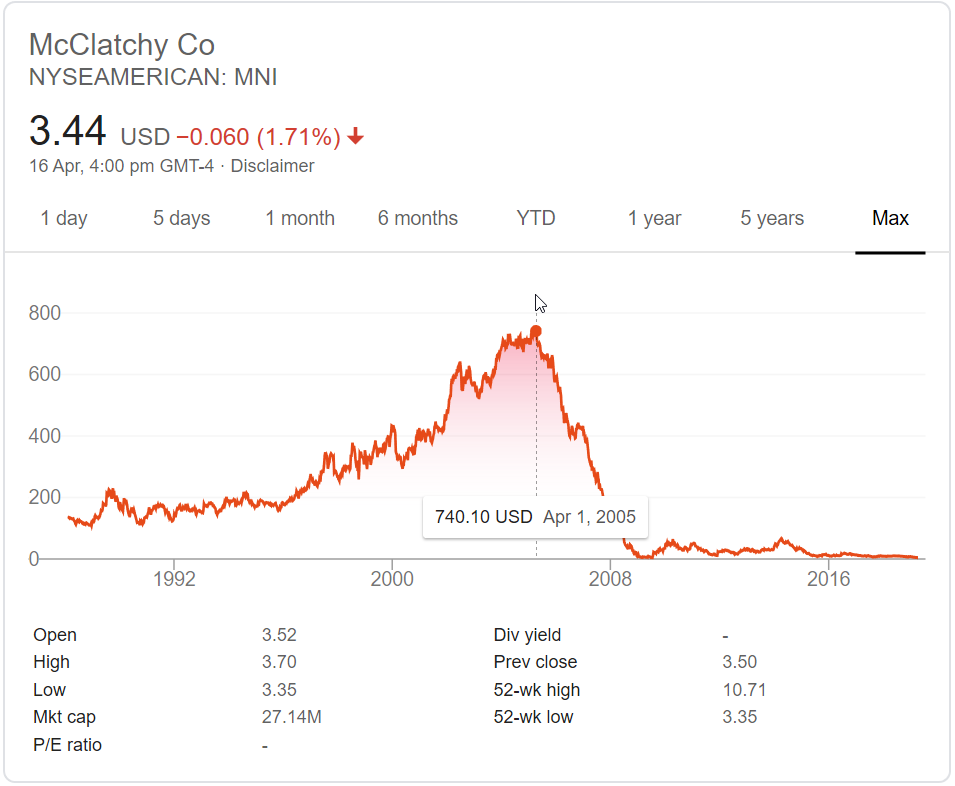
Does the above stock chart look in any way healthy?
Does it give off the scent of a firm that understood the impact of digital & rode it to new heights?
If you want good market-based outcomes, why not partner with journalists directly versus operating through PE chop shops?
If Patch is profitable & Google were a neutral ranking system based on quality, couldn't Google partner with journalists directly?
Throwing a few dollars at a PE firm in some nebulous partnership sure beats the sort of regulations coming out of the EU. And the EU's regulations (and prior link tax attempts) are in addition to the three multi billion Euro fines the European Union has levied against Alphabet for shopping search, Android & AdSense.
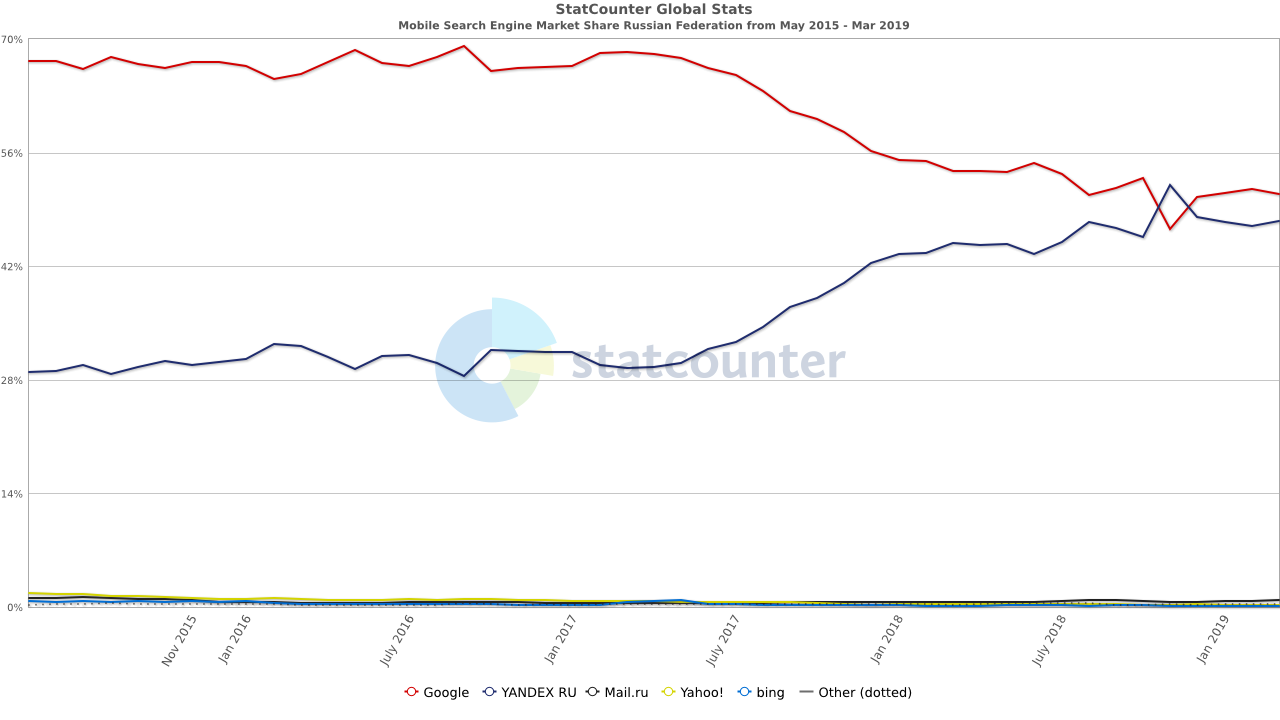
Google was also fined in Russia over Android bundling. The fine was tiny, but after consumers gained a search engine choice screen (much like Google pushed for in Europe on Microsoft years ago) Yandex's share of mobile search grew quickly.
Companies will have to fulfil their new legal duties or face the consequences and “will still need to be compliant with the overarching duty of care even where a specific code does not exist, for example assessing and responding to the risk associated with emerging harms or technology”.
If web publishers should monitor inbound links to look for anything suspicious then the big platforms sure as hell have the resources & profit margins to monitor behavior on their own websites.
Australia passed the Sharing of Abhorrent Violent Material bill which requires platforms to expeditiously remove violent videos & notify the Australian police about them.
There are other layers of fracturing going on in the web as well.
Programmatic advertising shifted revenue from publishers to adtech companies & the largest ad sellers. Ad blockers further lower the ad revenues of many publishers. If you routinely use an ad blocker, try surfing the web for a while without one & you will notice layover welcome AdSense ads on sites as you browse the web - the very type of ad they were allegedly against when promoting AMP.
There has been much more press in the past week about ad blocking as Google's influence is being questioned as it rolls out ad blocking as a feature built into Google's dominant Chrome web browser. https://t.co/LQmvJu9MYB— Jason Kint (@jason_kint) February 19, 2018
Tracking protection in browsers & ad blocking features built directly into browsers leave publishers more uncertain. And who even knows who visited an AMP page hosted on a third party server, particularly when things like GDPR are mixed in? Those who lack first party data may end up having to make large acquisitions to stay relevant.
Voice search & personal assistants are now ad channels.
Google Assistant Now Showing Sponsored Link Ads for Some Travel Related Queries
Microsoft's newest Edge web browser is based on Chromium, the source of Google Chrome. While Mozilla Firefox gets most of their revenue from a search deal with Google, Google has still went out of its way to use its services to both promote Chrome with pop overs AND break in competing web browsers:
"All of this is stuff you're allowed to do to compete, of course. But we were still a search partner, so we'd say 'hey what gives?' And every time, they'd say, 'oops. That was accidental. We'll fix it in the next push in 2 weeks.' Over and over. Oops. Another accident. We'll fix it soon. We want the same things. We're on the same team. There were dozens of oopses. Hundreds maybe?" - former Firefox VP Jonathan Nightingale
This is how it spreads. Google normalizes “web apps” that are really just Chrome apps. Then others follow. We’ve been here before, y’all. Remember IE? Browser hegemony is not a happy place. https://t.co/b29EvIty1H— DHH (@dhh) April 1, 2019
In fact, it’s alarming how much of Microsoft’s cut-off-the-air-supply playbook on browser dominance that Google is emulating. From browser-specific apps to embrace-n-extend AMP “standards”. It’s sad, but sadder still is when others follow suit.— DHH (@dhh) April 1, 2019
YouTube page load is 5x slower in Firefox and Edge than in Chrome because YouTube's Polymer redesign relies on the deprecated Shadow DOM v0 API only implemented in Chrome. You can restore YouTube's faster pre-Polymer design with this Firefox extension: https://t.co/F5uEn3iMLR— Chris Peterson (@cpeterso) July 24, 2018
As phone sales fall & app downloads stall a hardware company like Apple is pushing hard into services while quietly raking in utterly fantastic ad revenues from search & ads in their app store.
Part of the reason people are downloading fewer apps is so many apps require registration as soon as they are opened, or only let a user engage with them for seconds before pushing aggressive upsells. And then many apps which were formerly one-off purchases are becoming subscription plays. As traffic acquisition costs have jumped, many apps must engage in sleight of hand behaviors (free but not really, we are collecting data totally unrelated to the purpose of our app & oops we sold your data, etc.) in order to get the numbers to back out. This in turn causes app stores to slow down app reviews.
Apple acquired the news subscription service Texture & turned it into Apple News Plus. Not only is Apple keeping half the subscription revenues, but soon the service will only work for people using Apple devices, leaving nearly 100,000 other subscribers out in the cold: "if you’re part of the 30% who used Texture to get your favorite magazines digitally on Android or Windows devices, you will soon be out of luck. Only Apple iOS devices will be able to access the 300 magazines available from publishers. At the time of the sale in March 2018 to Apple, Texture had about 240,000 subscribers."
Several people involved in the project’s development say Apple is spending several million dollars each on most of the more than 100 games that have been selected to launch on Arcade, with its total budget likely to exceed $500m. The games service is expected to launch later this year. ... Apple is offering developers an extra incentive if they agree for their game to only be available on Arcade, withholding their release on Google’s Play app store for Android smartphones or other subscription gaming bundles such as Microsoft’s Xbox game pass.
The hosts on Twitch, some of whom sign up exclusively with the platform in order to gain access to its moneymaking tools, are rewarded for their ability to make a connection with viewers as much as they are for their gaming prowess. Viewers who pay $4.99 a month for a basic subscription — the money is split evenly between the streamers and Twitch — are looking for immediacy and intimacy. While some hosts at YouTube Gaming offer a similar experience, they have struggled to build audiences as large, and as dedicated, as those on Twitch. ... While YouTube has made millionaires out of the creators of popular videos through its advertising program, Twitch’s hosts make money primarily from subscribers and one-off donations or tips. YouTube Gaming has made it possible for viewers to support hosts this way, but paying audiences haven’t materialized at the scale they have on Twitch.
Google, having a bit of Twitch envy, is also launching a video game streaming service which will be deeply integrated into YouTube: "With Stadia, YouTube watchers can press “Play now” at the end of a video, and be brought into the game within 5 seconds. The service provides “instant access” via button or link, just like any other piece of content on the web."
When consoles don't use discs or cartridges so they can sell a subscription access to their software library it is hard to be a game retailer! GameStop's stock has been performing like an ICO. And these sorts of announcements from the tech companies have been hitting stock prices for companies like Nintendo & Sony: “There is no doubt this service makes life even more difficult for established platforms,” Amir Anvarzadeh, a market strategist at Asymmetric Advisors Pte, said in a note to clients. “Google will help further fragment the gaming market which is already coming under pressure by big games which have adopted the mobile gaming business model of giving the titles away for free in hope of generating in-game content sales.”
The big tech companies which promoted everything in adjacent markets being free are now erecting paywalls for themselves, balkanizing the web by paying for exclusives to drive their bundled subscriptions.
How many paid movie streaming services will the web have by the end of next year? 20? 50? Does anybody know?
Disney alone with operate Disney+, ESPN+ as well as Hulu.
The good news in a fractured web is a broader publishing industry that contains many micro markets will have many opportunities embedded in it. A Facebook pivot away from games toward news, or a pivot away from news toward video won't kill third party publishers who have a more diverse traffic profile and more direct revenues. And a regional law blocking porn or gambling websites might lead to an increase in demand for VPNs or free to play points-based games with paid upgrades. Even the rise of metered paywalls will lead to people using more web browsers & more VPNs. Each fracture (good or bad) will create more market edges & ultimately more opportunities. Chinese enforcement of their gambling laws created a real estate boom in Manila.
So long as there are 4 or 5 game stores, 4 or 5 movie streaming sites, etc. ... they have to compete on merit or use money to try to buy exclusives. Either way is better than the old monopoly strategy of take it or leave it ultimatums.
The publisher wins because there is a competitive bid. There won't be an arbitrary 30% tax on everything. So long as there is competition from the open web there will be means to bypass the junk fees & the most successful companies that do so might create their own stores with a lower rate: "Mr. Schachter estimates that Apple and Google could see a hit of about 14% to pretax earnings if they reduced their own app commissions to match Epic’s take."
As the big media companies & big tech companies race to create subscription products they'll spend many billions on exclusives. And they will be training consumers that there's nothing wrong with paying for content. This will eventually lead to hundreds of thousands or even millions of successful niche publications which have incentives better aligned than all the issues the ad supported web has faced.
Added: Facebook pushing privacy & groups is both an attempt to thwart regulation risk while also making their services more relevant to a web that fractures away from a monolithic thing into more niche communities.
One way of looking at Facebook in this moment is as an unstoppable behemoth that bends reality to its will, no matter the consequences. (This is how many journalists tend to see it.) Another way of looking at the company is from the perspective of its fundamental weakness — as a slave to ever-shifting consumer behavior. (This is how employees are more likely to look at it.) ... Zuckerberg’s vision for a new Facebook is perhaps best represented by a coming redesign of the flagship app and desktop site that will emphasize events and groups, at the expense of the News Feed. Collectively, the design changes will push people toward smaller group conversations and real-world meetups — and away from public posts.
When I got started on the web over 15 years ago I created an overly broad & shallow website that had little chance of making money because it was utterly undifferentiated and crappy. In spite of my best (worst?) efforts while being a complete newbie, sometimes I would go to the mailbox and see a check for a couple hundred or a couple thousand dollars come in. My old roommate & I went to Coachella & when the trip was over I returned to a bunch of mail to catch up on & realized I had made way more while not working than what I spent on that trip.
What was the secret to a total newbie making decent income by accident?
Horrible spelling.
Back then search engines were not as sophisticated with their spelling correction features & I was one of 3 or 4 people in the search index that misspelled the name of an online casino the same way many searchers did.
The high minded excuse for why I did not scale that would be claiming I knew it was a temporary trick that was somehow beneath me. The more accurate reason would be thinking in part it was a lucky fluke rather than thinking in systems. If I were clever at the time I would have created the misspeller's guide to online gambling, though I think I was just so excited to make anything from the web that I perhaps lacked the ambition & foresight to scale things back then.
In the decade that followed I had a number of other lucky breaks like that. One time one of the original internet bubble companies that managed to stay around put up a sitewide footer link targeting the concept that one of my sites made decent money from. This was just before the great recession, before Panda existed. The concept they targeted had 3 or 4 ways to describe it. 2 of them were very profitable & if they targeted either of the most profitable versions with that page the targeting would have sort of carried over to both. They would have outranked me if they targeted the correct version, but they didn't so their mistargeting was a huge win for me.
Search Gets Complex
Search today is much more complex. In the years since those easy-n-cheesy wins, Google has rolled out many updates which aim to feature sought after destination sites while diminishing the sites which rely one "one simple trick" to rank.
Arguably the quality of the search results has improved significantly as search has become more powerful, more feature rich & has layered in more relevancy signals.
Many quality small web publishers have went away due to some combination of increased competition, algorithmic shifts & uncertainty, and reduced monetization as more ad spend was redirected toward Google & Facebook. But the impact as felt by any given publisher is not the impact as felt by the ecosystem as a whole. Many terrible websites have also went away, while some formerly obscure though higher-quality sites rose to prominence.
Then in 2011 there was Panda as an extension of Vince, which tanked the rankings of many sites that published hundreds of thousands or millions of thin content pages while boosting the rankings of trusted branded destinations.
Then there was Penguin, which was a penalty that hit many websites which had heavily manipulated or otherwise aggressive appearing link profiles. Google felt there was a lot of noise in the link graph, which was their justification for the Penguin.
There were updates which lowered the rankings of many exact match domains. And then increased ad load in the search results along with the other above ranking shifts further lowered the ability to rank keyword-driven domain names. If your domain is generically descriptive then there is a limit to how differentiated & memorable you can make it if you are targeting the core market the keywords are aligned with.
There is a reason eBay is more popular than auction.com, Google is more popular than search.com, Yahoo is more popular than portal.com & Amazon is more popular than a store.com or a shop.com. When that winner take most impact of many online markets is coupled with the move away from using classic relevancy signals the economics shift to where is makes a lot more sense to carry the heavy overhead of establishing a strong brand.
Branded and navigational search queries could be used in the relevancy algorithm stack to confirm the quality of a site & verify (or dispute) the veracity of other signals.
Historically relevant algo shortcuts become less appealing as they become less relevant to the current ecosystem & even less aligned with the future trends of the market. Add in negative incentives for pushing on a string (penalties on top of wasting the capital outlay) and a more holistic approach certainly makes sense.
Modeling Web Users & Modeling Language
PageRank was an attempt to model the random surfer.
When Google is pervasively monitoring most users across the web they can shift to directly measuring their behaviors instead of using indirect signals.
"On the most basic level, Google could see how satisfied users were. To paraphrase Tolstoy, happy users were all the same. The best sign of their happiness was the "Long Click" — This occurred when someone went to a search result, ideally the top one, and did not return. That meant Google has successfully fulfilled the query."
user reactions to particular search results or search result lists may be gauged, so that results on which users often click will receive a higher ranking. The general assumption under such an approach is that searching users are often the best judges of relevance, so that if they select a particular search result, it is likely to be relevant, or at least more relevant than the presented alternatives.
If you are a known brand you are more likely to get clicked on than a random unknown entity in the same market.
And if you are something people are specifically seeking out, they are likely to stay on your website for an extended period of time.
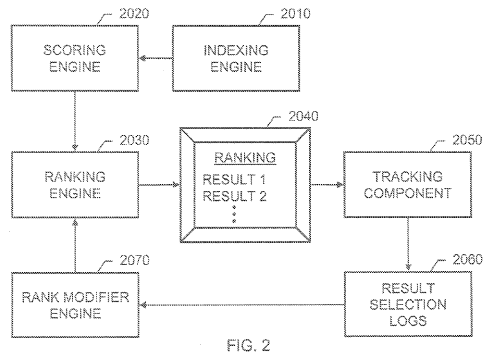
One aspect of the subject matter described in this specification can be embodied in a computer-implemented method that includes determining a measure of relevance for a document result within a context of a search query for which the document result is returned, the determining being based on a first number in relation to a second number, the first number corresponding to longer views of the document result, and the second number corresponding to at least shorter views of the document result; and outputting the measure of relevance to a ranking engine for ranking of search results, including the document result, for a new search corresponding to the search query. The first number can include a number of the longer views of the document result, the second number can include a total number of views of the document result, and the determining can include dividing the number of longer views by the total number of views.
Attempts to manipulate such data may not work.
safeguards against spammers (users who generate fraudulent clicks in an attempt to boost certain search results) can be taken to help ensure that the user selection data is meaningful, even when very little data is available for a given (rare) query. These safeguards can include employing a user model that describes how a user should behave over time, and if a user doesn't conform to this model, their click data can be disregarded. The safeguards can be designed to accomplish two main objectives: (1) ensure democracy in the votes (e.g., one single vote per cookie and/or IP for a given query-URL pair), and (2) entirely remove the information coming from cookies or IP addresses that do not look natural in their browsing behavior (e.g., abnormal distribution of click positions, click durations, clicks_per_minute/hour/day, etc.). Suspicious clicks can be removed, and the click signals for queries that appear to be spmed need not be used (e.g., queries for which the clicks feature a distribution of user agents, cookie ages, etc. that do not look normal).
And just like Google can make a matrix of documents & queries, they could also choose to put more weight on search accounts associated with topical expert users based on their historical click patterns.
Moreover, the weighting can be adjusted based on the determined type of the user both in terms of how click duration is translated into good clicks versus not-so-good clicks, and in terms of how much weight to give to the good clicks from a particular user group versus another user group. Some user's implicit feedback may be more valuable than other users due to the details of a user's review process. For example, a user that almost always clicks on the highest ranked result can have his good clicks assigned lower weights than a user who more often clicks results lower in the ranking first (since the second user is likely more discriminating in his assessment of what constitutes a good result). In addition, a user can be classified based on his or her query stream. Users that issue many queries on (or related to) a given topic T (e.g., queries related to law) can be presumed to have a high degree of expertise with respect to the given topic T, and their click data can be weighted accordingly for other queries by them on (or related to) the given topic T.
Google was using click data to drive their search rankings as far back as 2009. David Naylor was perhaps the first person who publicly spotted this. Google was ranking Australian websites for [tennis court hire] in the UK & Ireland, in part because that is where most of the click signal came from. That phrase was most widely searched for in Australia. In the years since Google has done a better job of geographically isolating clicks to prevent things like the problem David Naylor noticed, where almost all search results in one geographic region came from a different country.
Whenever SEOs mention using click data to search engineers, the search engineers quickly respond about how they might consider any signal but clicks would be a noisy signal. But if a signal has noise an engineer would work around the noise by finding ways to filter the noise out or combine multiple signals. To this day Google states they are still working to filter noise from the link graph: "We continued to protect the value of authoritative and relevant links as an important ranking signal for Search."
The site with millions of inbound links, few intentional visits & those who do visit quickly click the back button (due to a heavy ad load, poor user experience, low quality content, shallow content, outdated content, or some other bait-n-switch approach)...that's an outlier. Preventing those sorts of sites from ranking well would be another way of protecting the value of authoritative & relevant links.
Best Practices Vary Across Time & By Market + Category
Along the way, concurrent with the above sorts of updates, Google also improved their spelling auto-correct features, auto-completed search queries for many years through a featured called Google Instant (though they later undid forced query auto-completion while retaining automated search suggestions), and then they rolled out a few other algorithms that further allowed them to model language & user behavior.
Today it would be much harder to get paid above median wages explicitly for sucking at basic spelling or scaling some other individual shortcut to the moon, like pouring millions of low quality articles into a (formerly!) trusted domain.
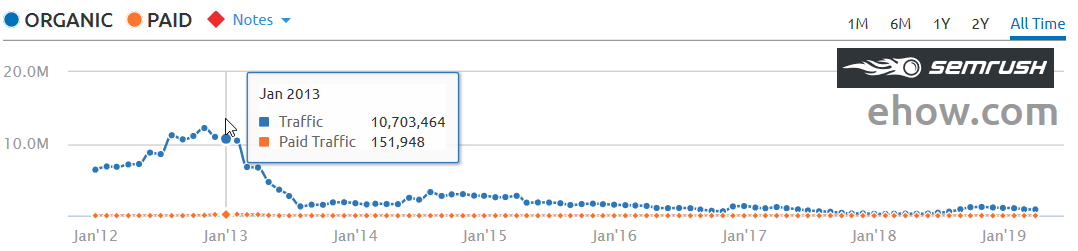
Nearly a decade after Panda, eHow's rankings still haven't recovered.
Back when I got started with SEO the phrase Indian SEO company was associated with cut-rate work where people were buying exclusively based on price. Sort of like a "I got a $500 budget for link building, but can not under any circumstance invest more than $5 in any individual link." Part of how my wife met me was she hired a hack SEO from San Diego who outsourced all the work to India and marked the price up about 100-fold while claiming it was all done in the United States. He created reciprocal links pages that got her site penalized & it didn't rank until after she took her reciprocal links page down.
With that sort of behavior widespread (hack US firm teaching people working in an emerging market poor practices), it likely meant many SEO "best practices" which were learned in an emerging market (particularly where the web was also underdeveloped) would be more inclined to being spammy. Considering how far ahead many Western markets were on the early Internet & how India has so many languages & how most web usage in India is based on mobile devices where it is hard for users to create links, it only makes sense that Google would want to place more weight on end user data in such a market.
If you set your computer location to India Bing's search box lists 9 different languages to choose from.
The above is not to state anything derogatory about any emerging market, but rather that various signals are stronger in some markets than others. And competition is stronger in some markets than others.
Search engines can only rank what exists.
"In a lot of Eastern European - but not just Eastern European markets - I think it is an issue for the majority of the [bream? muffled] countries, for the Arabic-speaking world, there just isn't enough content as compared to the percentage of the Internet population that those regions represent. I don't have up to date data, I know that a couple years ago we looked at Arabic for example and then the disparity was enormous. so if I'm not mistaken the Arabic speaking population of the world is maybe 5 to 6%, maybe more, correct me if I am wrong. But very definitely the amount of Arabic content in our index is several orders below that. So that means we do not have enough Arabic content to give to our Arabic users even if we wanted to. And you can exploit that amazingly easily and if you create a bit of content in Arabic, whatever it looks like we're gonna go you know we don't have anything else to serve this and it ends up being horrible. and people will say you know this works. I keyword stuffed the hell out of this page, bought some links, and there it is number one. There is nothing else to show, so yeah you're number one. the moment somebody actually goes out and creates high quality content that's there for the long haul, you'll be out and that there will be one." - Andrey Lipattsev – Search Quality Senior Strategist at Google Ireland, on Mar 23, 2016
Impacting the Economics of Publishing
Now search engines can certainly influence the economics of various types of media. At one point some otherwise credible media outlets were pitching the Demand Media IPO narrative that Demand Media was the publisher of the future & what other media outlets will look like. Years later, after heavily squeezing on the partner network & promoting programmatic advertising that reduces CPMs by the day Google is funding partnerships with multiple news publishers like McClatchy & Gatehouse to try to revive the news dead zones even Facebook is struggling with.
"Facebook Inc. has been looking to boost its local-news offerings since a 2017 survey showed most of its users were clamoring for more. It has run into a problem: There simply isn’t enough local news in vast swaths of the country. ... more than one in five newspapers have closed in the past decade and a half, leaving half the counties in the nation with just one newspaper, and 200 counties with no newspaper at all."
"Thanks to the convoluted machinery of Internet advertising, the advertising world went from being about content publishers and advertising context—The Times unilaterally declaring, via its ‘rate card’, that ads in the Times Style section cost $30 per thousand impressions—to the users themselves and the data that targets them—Zappo’s saying it wants to show this specific shoe ad to this specific user (or type of user), regardless of publisher context. Flipping the script from a historically publisher-controlled mediascape to an advertiser (and advertiser intermediary) controlled one was really Google’s doing. Facebook merely rode the now-cresting wave, borrowing outside media’s content via its own users’ sharing, while undermining media’s ability to monetize via Facebook’s own user-data-centric advertising machinery. Conventional media lost both distribution and monetization at once, a mortal blow."
Google is offering news publishers audience development & business development tools.
Heavy Investment in Emerging Markets Quickly Evolves the Markets
As the web grows rapidly in India, they'll have a thousand flowers bloom. In 5 years the competition in India & other emerging markets will be much tougher as those markets continue to grow rapidly. Media is much cheaper to produce in India than it is in the United States. Labor costs are lower & they never had the economic albatross that is the ACA adversely impact their economy. At some point the level of investment & increased competition will mean early techniques stop having as much efficacy. Chinese companies are aggressively investing in India.
“If you break India into a pyramid, the top 100 million (urban) consumers who think and behave more like Americans are well-served,” says Amit Jangir, who leads India investments at 01VC, a Chinese venture capital firm based in Shanghai. The early stage venture firm has invested in micro-lending firms FlashCash and SmartCoin based in India. The new target is the next 200 million to 600 million consumers, who do not have a go-to entertainment, payment or ecommerce platform yet— and there is gonna be a unicorn in each of these verticals, says Jangir, adding that it will be not be as easy for a player to win this market considering the diversity and low ticket sizes.
RankBrain
RankBrain appears to be based on using user clickpaths on head keywords to help bleed rankings across into related searches which are searched less frequently. A Googler didn't state this specifically, but it is how they would be able to use models of searcher behavior to refine search results for keywords which are rarely searched for.
In a recent interview in Scientific American a Google engineer stated: "By design, search engines have learned to associate short queries with the targets of those searches by tracking pages that are visited as a result of the query, making the results returned both faster and more accurate than they otherwise would have been."
Now a person might go out and try to search for something a bunch of times or pay other people to search for a topic and click a specific listing, but some of the related Google patents on using click data (which keep getting updated) mentioned how they can discount or turn off the signal if there is an unnatural spike of traffic on a specific keyword, or if there is an unnatural spike of traffic heading to a particular website or web page.
And, since Google is tracking the behavior of end users on their own website, anomalous behavior is easier to track than it is tracking something across the broader web where signals are more indirect. Google can take advantage of their wide distribution of Chrome & Android where users are regularly logged into Google & pervasively tracked to place more weight on users where they had credit card data, a long account history with regular normal search behavior, heavy Gmail users, etc.
Plus there is a huge gap between the cost of traffic & the ability to monetize it. You might have to pay someone a dime or a quarter to search for something & there is no guarantee it will work on a sustainable basis even if you paid hundreds or thousands of people to do it. Any of those experimental searchers will have no lasting value unless they influence rank, but even if they do influence rankings it might only last temporarily. If you bought a bunch of traffic into something genuine Google searchers didn't like then even if it started to rank better temporarily the rankings would quickly fall back if the real end user searchers disliked the site relative to other sites which already rank.
This is part of the reason why so many SEO blogs mention brand, brand, brand. If people are specifically looking for you in volume & Google can see that thousands or millions of people specifically want to access your site then that can impact how you rank elsewhere.
Even looking at something inside the search results for a while (dwell time) or quickly skipping over it to have a deeper scroll depth can be a ranking signal. Some Google patents mention how they can use mouse pointer location on desktop or scroll data from the viewport on mobile devices as a quality signal.
Neural Matching
Last year Danny Sullivan mentioned how Google rolled out neural matching to better understand the intent behind a search query.
This is a look back at a big change in search but which continues to be important: understanding synonyms. How people search is often different from information that people write solutions about. pic.twitter.com/sBcR4tR4eT— Danny Sullivan (@dannysullivan) September 24, 2018
Last few months, Google has been using neural matching, --AI method to better connect words to concepts. Super synonyms, in a way, and impacting 30% of queries. Don't know what "soapopera effect" is to search for it? We can better figure it out. pic.twitter.com/Qrwp5hKFNz— Danny Sullivan (@dannysullivan) September 24, 2018
The above Tweets capture what the neural matching technology intends to do. Google also stated:
we’ve now reached the point where neural networks can help us take a major leap forward from understanding words to understanding concepts. Neural embeddings, an approach developed in the field of neural networks, allow us to transform words to fuzzier representations of the underlying concepts, and then match the concepts in the query with the concepts in the document. We call this technique neural matching.
To help people understand the difference between neural matching & RankBrain, Google told SEL: "RankBrain helps Google better relate pages to concepts. Neural matching helps Google better relate words to searches."
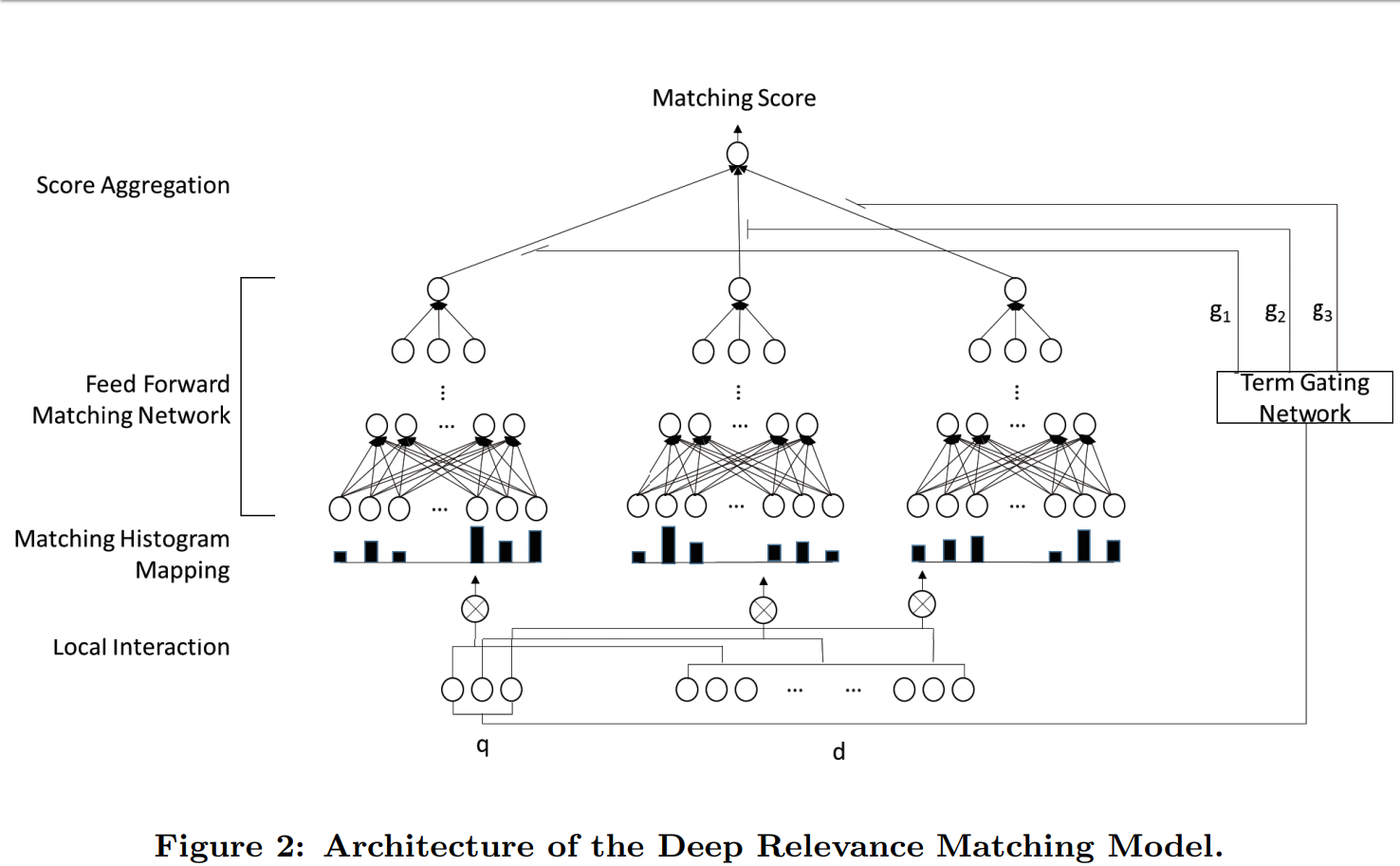
There are a couple research papers on neural matching.
"Successful relevance matching requires proper handling of the exact matching signals, query term importance, and diverse matching requirements."
"the interaction-focused model, which first builds local level interactions (i.e., local matching signals) between two pieces of text, and then uses deep neural networks to learn hierarchical interaction patterns for matching."
"according to the diverse matching requirement, relevance matching is not position related since it could happen in any position in a long document."
"Most NLP tasks concern semantic matching, i.e., identifying the semantic meaning and infer"ring the semantic relations between two pieces of text, while the ad-hoc retrieval task is mainly about relevance matching, i.e., identifying whether a document is relevant to a given query."
"Since the ad-hoc retrieval task is fundamentally a ranking problem, we employ a pairwise ranking loss such as hinge loss to train our deep relevance matching model."
The paper mentions how semantic matching falls down when compared against relevancy matching because:
semantic matching relies on similarity matching signals (some words or phrases with the same meaning might be semantically distant), compositional meanings (matching sentences more than meaning) & a global matching requirement (comparing things in their entirety instead of looking at the best matching part of a longer document); whereas,
relevance matching can put significant weight on exact matching signals (weighting an exact match higher than a near match), adjust weighting on query term importance (one word might or phrase in a search query might have a far higher discrimination value & might deserve far more weight than the next) & leverage diverse matching requirements (allowing relevancy matching to happen in any part of a longer document)
Here are a couple images from the above research paper
And then the second research paper is
Deep Relevancy Ranking Using Enhanced Dcoument-Query Interactions
"interaction-based models are less efficient, since one cannot index a document representation independently of the query. This is less important, though, when relevancy ranking methods rerank the top documents returned by a conventional IR engine, which is the scenario we consider here."
That same sort of re-ranking concept is being better understood across the industry. There are ranking signals that earn some base level ranking, and then results get re-ranked based on other factors like how well a result matches the user intent.
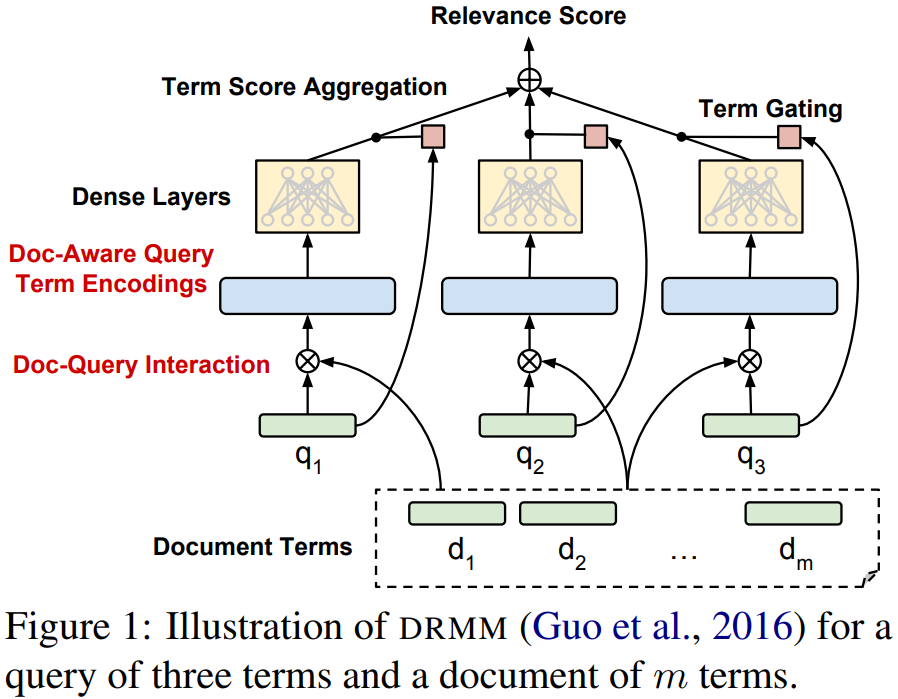
Here are a couple images from the above research paper.
For those who hate the idea of reading research papers or patent applications, Martinibuster also wrote about the technology here. About the only part of his post I would debate is this one:
"Does this mean publishers should use more synonyms? Adding synonyms has always seemed to me to be a variation of keyword spamming. I have always considered it a naive suggestion. The purpose of Google understanding synonyms is simply to understand the context and meaning of a page. Communicating clearly and consistently is, in my opinion, more important than spamming a page with keywords and synonyms."
I think one should always consider user experience over other factors, however a person could still use variations throughout the copy & pick up a bit more traffic without coming across as spammy. Danny Sullivan mentioned the super synonym concept was impacting 30% of search queries, so there are still a lot which may only be available to those who use a specific phrase on their page.
The above sort of language modeling & end user click feedback compliment links-based ranking signals in a way that makes it much harder to luck one's way into any form of success by being a terrible speller or just bombing away at link manipulation without much concern toward any other aspect of the user experience or market you operate in.
Pre-penalized Shortcuts
Google was even issued a patent for predicting site quality based upon the N-grams used on the site & comparing those against the N-grams used on other established site where quality has already been scored via other methods: "The phrase model can be used to predict a site quality score for a new site; in particular, this can be done in the absence of other information. The goal is to predict a score that is comparable to the baseline site quality scores of the previously-scored sites."
Have you considered using a PLR package to generate the shell of your site's content? Good luck with that as some sites trying that shortcut might be pre-penalized from birth.
Navigating the Maze
When I started in SEO one of my friends had a dad who is vastly smarter than I am. He advised me that Google engineers were smarter, had more capital, had more exposure, had more data, etc etc etc ... and thus SEO was ultimately going to be a malinvestment.
Back then he was at least partially wrong because influencing search was so easy.
But in the current market, 16 years later, we are near the infection point where he would finally be right.
At some point the shortcuts stop working & it makes sense to try a different approach.
The flip side of all the above changes is as the algorithms have become more complex they have went from being a headwind to people ignorant about SEO to being a tailwind to those who do not focus excessively on SEO in isolation.
If one is a dominant voice in a particular market, if they break industry news, if they have key exclusives, if they spot & name the industry trends, if their site becomes a must read & is what amounts to a habit ... then they perhaps become viewed as an entity. Entity-related signals help them & those signals that are working against the people who might have lucked into a bit of success become a tailwind rather than a headwind.
If your work defines your industry, then any efforts to model entities, user behavior or the language of your industry are going to boost your work on a relative basis.
This requires sites to publish frequently enough to be a habit, or publish highly differentiated content which is strong enough that it is worth the wait.
Those which publish frequently without being particularly differentiated are almost guaranteed to eventually walk into a penalty of some sort. And each additional person who reads marginal, undifferentiated content (particularly if it has an ad-heavy layout) is one additional visitor that site is closer to eventually getting whacked. Success becomes self regulating. Any short-term success becomes self defeating if one has a highly opportunistic short-term focus.
Those who write content that only they could write are more likely to have sustained success.
A mistake people often make is to look at someone successful, then try to do what they are doing, assuming it will lead to similar success. This is backward. Find something you enjoy doing & are curious about. Get obsessed, & become one of the best at it. It will monetize itself.— Neil Strauss (@neilstrauss) March 30, 2019
I think the quote which best the magic of the early web is
Jim Clark came from the world of machines and hardware, where development schedules were measured in years—even decades—and where “doing a startup” meant factories, manufacturing, inventory, shipping schedules and the like. But the Mosaic team had stumbled upon something simpler. They had discovered that you could dream up a product, code it, release it to the ether and change the world overnight. Thanks to the Internet, users could download your product, give you feedback on it, and you could release an update, all in the same day. In the web world, development schedules could be measured in weeks.
The part I bolded in the above quote from the book really captures the magic of the Internet & what pulled so many people toward the early web.
The current web - dominated by never-ending feeds & a variety of closed silos - is a big shift from the early days of web comics & other underground cool stuff people created & shared because they thought it was neat.
Many established players missed the actual direction of the web by trying to create something more akin to the web of today before the infrastructure could support it. Many of the "big things" driving web adoption relied heavily on chance luck - combined with a lot of hard work & a willingness to be responsive to feedback & data.
Even when Marc Andreessen moved to the valley he thought he was late and he had "missed the whole thing," but he saw the relentless growth of the web & decided making another web browser was the play that made sense at the time.
Tim Berners-Lee was dismayed when Andreessen's web browser enabled embedded image support in web documents.
Early Amazon review features were originally for editorial content from Amazon itself. Bezos originally wanted to launch a broad-based Amazon like it is today, but realized it would be too capital intensive & focused on books off the start so he could sell a known commodity with a long tail. Amazon was initially built off leveraging 2 book distributors ( Ingram and Baker & Taylor) & R. R. Bowker's Books In Print catalog. They also did clever hacks to meet minimum order requirements like ordering out of stock books as part of their order, so they could only order what customers had purchased.
eBay began as an /aw/ subfolder on the eBay domain name which was hosted on a residential internet connection. Pierre Omidyar coded the auction service over labor day weekend in 1995. The domain had other sections focused on topics like ebola. It was switched from AuctionWeb to a stand alone site only after the ISP started charging for a business line. It had no formal Paypal integration or anything like that, rather when listings started to charge a commission, merchants would mail physical checks in to pay for the platform share of their sales. Beanie Babies also helped skyrocket platform usage.
The reason AOL carpet bombed the United States with CDs - at their peak half of all CDs produced were AOL CDs - was their initial response rate was around 10%, a crazy number for untargeted direct mail.
Priceline was lucky to have survived the bubble as their idea was to spread broadly across other categories beyond travel & they were losing about $30 per airline ticket sold.
The broader web bubble left behind valuable infrastructure like unused fiber to fuel continued growth long after the bubble popped. The dot com bubble was possible in part because there was a secular bull market in bonds stemming back to the early 1980s & falling debt service payments increased financial leverage and company valuations.
TED members hissed at Bill Gross when he unveiled GoTo.com, which ranked "search" results based on advertiser bids.
Excite turned down offering the Google founders $1.6 million for the PageRank technology in part because Larry Page insisted to Excite CEO George Bell ‘If we come to work for Excite, you need to rip out all the Excite technology and replace it with [our] search.’ And, ultimately, that’s—in my recollection—where the deal fell apart.”
Steve Jobs initially disliked the multi-touch technology that mobile would rely on, one of the early iPhone prototypes had the iPod clickwheel, and Apple was against offering an app store in any form. Steve Jobs so loathed his interactions with the record labels that he did not want to build a phone & first licensed iTunes to Motorola, where they made the horrible ROKR phone. He only ended up building a phone after Cingular / AT&T begged him to.
Wikipedia was originally launched as a back up feeder site that was to feed into Nupedia.
Even after Facebook had strong traction, Marc Zuckerberg kept working on other projects like a file sharing service. Facebook's news feed was publicly hated based on the complaints, but it almost instantly led to a doubling of usage of the site so they never dumped it. After spreading from college to college Facebook struggled to expand ad other businesses & opening registration up to all was a hail mary move to see if it would rekindle growth instead of selling to Yahoo! for a billion dollars.
The book offers a lot of color to many important web related companies.
And many companies which were only briefly mentioned also ran into the same sort of lucky breaks the above companies did. Paypal was heavily reliant on eBay for initial distribution, but even that was something they initially tried to block until it became so obvious they stopped fighting it:
“At some point I sort of quit trying to stop the EBay users and mostly focused on figuring out how to not lose money,” Levchin recalls. ... In the late 2000s, almost a decade after it first went public, PayPal was drifting toward obsolescence and consistently alienating the small businesses that paid it to handle their online checkout. Much of the company’s code was being written offshore to cut costs, and the best programmers and designers had fled the company. ... PayPal’s conversion rate is lights-out: Eighty-nine percent of the time a customer gets to its checkout page, he makes the purchase. For other online credit and debit card transactions, that number sits at about 50 percent.
It has been a while since Google has had a major algorithm update.
They recently announced one which began on the 12th of March.
This week, we released a broad core algorithm update, as we do several times per year. Our guidance about such updates remains as we’ve covered before. Please see these tweets for more about that:https://t.co/uPlEdSLHoXhttps://t.co/tmfQkhdjPL— Google SearchLiaison (@searchliaison) March 13, 2019
And, over time, it was quite common for Panda & Penguin updates to be sandwiched together.
If you were Google & had the ability to look under the hood to see why things changed, you would probably want to obfuscate any major update by changing multiple things at once to make reverse engineering the change much harder.
Anyone who operates a single website (& lacks the ability to look under the hood) will have almost no clue about what changed or how to adjust with the algorithms.
In the most recent algorithm update some sites which were penalized in prior "quality" updates have recovered.
Though many of those recoveries are only partial.
Many SEO blogs will publish articles about how they cracked the code on the latest update by publishing charts like the first one without publishing that second chart showing the broader context.
The first penalty any website receives might be the first of a series of penalties.
If Google smokes your site & it does not cause a PR incident & nobody really cares that you are gone, then there is a very good chance things will go from bad to worse to worser to worsterest, technically speaking.
“In this age, in this country, public sentiment is everything. With it, nothing can fail; against it, nothing can succeed. Whoever molds public sentiment goes deeper than he who enacts statutes, or pronounces judicial decisions.” - Abraham Lincoln
Absent effort & investment to evolve FASTER than the broader web, sites which are hit with one penalty will often further accumulate other penalties. It is like compound interest working in reverse - a pile of algorithmic debt which must be dug out of before the bleeding stops.
Further, many recoveries may be nothing more than a fleeting invitation to false hope. To pour more resources into a site that is struggling in an apparent death loop.
The above site which had its first positive algorithmic response in a couple years achieved that in part by heavily de-monetizing. After the algorithm updates already demonetized the website over 90%, what harm was there in removing 90% of what remained to see how it would react? So now it will get more traffic (at least for a while) but then what exactly is the traffic worth to a site that has no revenue engine tied to it?
That is ultimately the hard part. Obtaining a stable stream of traffic while monetizing at a decent yield, without the monetizing efforts leading to the traffic disappearing.
A buddy who owns the above site was working on link cleanup & content improvement on & off for about a half year with no results. Each month was a little worse than the prior month. It was only after I told him to remove the aggressive ads a few months back that he likely had any chance of seeing any sort of traffic recovery. Now he at least has a pulse of traffic & can look into lighter touch means of monetization.
If a site is consistently penalized then the problem might not be an algorithmic false positive, but rather the business model of the site.
The more something looks like eHow the more fickle Google's algorithmic with receive it.
Google does not like websites that sit at the end of the value chain & extract profits without having to bear far greater risk & expense earlier into the cycle.
Thin rewrites, largely speaking, don't add value to the ecosystem. Doorway pages don't either. And something that was propped up by a bunch of keyword-rich low-quality links is (in most cases) probably genuinely lacking in some other aspect.
Generally speaking, Google would like themselves to be the entity at the end of the value chain extracting excess profits from markets.
This is the purpose of the knowledge graph & featured snippets. To allow the results to answer the most basic queries without third party publishers getting anything. The knowledge graph serve as a floating vertical that eat an increasing share of the value chain & force publishers to move higher up the funnel & publish more differentiated content.
As Google adds features to the search results (flight price trends, a hotel booking service on the day AirBNB announced they acquired HotelTonight, ecommerce product purchase on Google, shoppable image ads just ahead of the Pinterest IPO, etc.) it forces other players in the value chain to consolidate (Expedia owns Orbitz, Travelocity, Hotwire & a bunch of other sites) or add greater value to remain a differentiated & sought after destination (travel review site TripAdvisor was crushed by the shift to mobile & the inability to monetize mobile traffic, so they eventually had to shift away from being exclusively a reviews site to offer event & hotel booking features to remain relevant).
It is never easy changing a successful & profitable business model, but it is even harder to intentionally reduce revenues further or spend aggressively to improve quality AFTER income has fallen 50% or more.
Some people do the opposite & make up for a revenue shortfall by publishing more lower end content at an ever faster rate and/or increasing ad load. Either of which typically makes their user engagement metrics worse while making their site less differentiated & more likely to receive additional bonus penalties to drive traffic even lower.
In some ways I think the ability for a site to survive & remain though a penalty is itself a quality signal for Google.
Some sites which are overly reliant on search & have no external sources of traffic are ultimately sites which tried to behave too similarly to the monopoly that ultimately displaced them. And over time the tech monopolies are growing more powerful as the ecosystem around them burns down:
If you had to choose a date for when the internet died, it would be in the year 2014. Before then, traffic to websites came from many sources, and the web was a lively ecosystem. But beginning in 2014, more than half of all traffic began coming from just two sources: Facebook and Google. Today, over 70 percent of traffic is dominated by those two platforms.
Businesses which have sustainable profit margins & slack (in terms of management time & resources to deploy) can better cope with algorithmic changes & change with the market.
Over the past half decade or so there have been multiple changes that drastically shifted the online publishing landscape:
the shift to mobile, which both offers publishers lower ad yields while making the central ad networks more ad heavy in a way that reduces traffic to third party sites
the rise of the knowledge graph & featured snippets which often mean publishers remain uncompensated for their work
higher ad loads which also lower organic reach (on both search & social channels)
the rise of programmatic advertising, which further gutted display ad CPMs
the rise of ad blockers
increasing algorithmic uncertainty & a higher barrier to entry
Each one of the above could take a double digit percent out of a site's revenues, particularly if a site was reliant on display ads. Add them together and a website which was not even algorithmically penalized could still see a 60%+ decline in revenues. Mix in a penalty and that decline can chop a zero or two off the total revenues.
Businesses with lower margins can try to offset declines with increased ad spending, but that only works if you are not in a market with 2 & 20 VC fueled competition:
Startups spend almost 40 cents of every VC dollar on Google, Facebook, and Amazon. We don’t necessarily know which channels they will choose or the particularities of how they will spend money on user acquisition, but we do know more or less what’s going to happen. Advertising spend in tech has become an arms race: fresh tactics go stale in months, and customer acquisition costs keep rising. In a world where only one company thinks this way, or where one business is executing at a level above everyone else - like Facebook in its time - this tactic is extremely effective. However, when everyone is acting this way, the industry collectively becomes an accelerating treadmill. Ad impressions and click-throughs get bid up to outrageous prices by startups flush with venture money, and prospective users demand more and more subsidized products to gain their initial attention. The dynamics we’ve entered is, in many ways, creating a dangerous, high stakes Ponzi scheme.
And sometimes the platform claws back a second or third bite of the apple. Amazon.com charges merchants for fulfillment, warehousing, transaction based fees, etc. And they've pushed hard into launching hundreds of private label brands which pollute the interface & force brands to buy ads even on their own branded keyword terms.
Amazon.com tested a pop-up feature on its app that in some instances pitched its private-label goods on rivals’ product pages, an experiment that shows the e-commerce giant’s aggressiveness in hawking lower-priced products including its own house brands. The recent experiment, conducted in Amazon’s mobile app, went a step further than the display ads that commonly appear within search results and product pages. This test pushed pop-up windows that took over much of a product page, forcing customers to either click through to the lower-cost Amazon products or dismiss them before continuing to shop. ... When a customer using Amazon’s mobile app searched for “AAA batteries,” for example, the first link was a sponsored listing from Energizer Holdings Inc. After clicking on the listing, a pop-up window appeared, offering less expensive AmazonBasics AAA batteries."
Buying those Amazon ads was quite literally subsidizing a direct competitor pushing you into irrelevance.
Some thoughts on Silicon Valley's endgame. We have long said the biggest risk to the bull market is an Uber IPO. That is now upon us.— Jawad Mian (@jsmian) March 16, 2019
As the market caps of big tech companies climb they need to be more predatious to grow into the valuations & retain employees with stock options at an ever-increasing strike price.
They've created bubbles in their own backyards where each raise requires another. Teachers either drive hours to work or live in houses subsidized by loans from the tech monopolies that get a piece of the upside (provided they can keep their own bubbles inflated).
"It is an uncommon arrangement — employer as landlord — that is starting to catch on elsewhere as school employees say they cannot afford to live comfortably in regions awash in tech dollars. ... Holly Gonzalez, 34, a kindergarten teacher in East San Jose, and her husband, Daniel, a school district I.T. specialist, were able to buy a three-bedroom apartment for $610,000 this summer with help from their parents and from Landed. When they sell the home, they will owe Landed 25 percent of any gain in its value. The company is financed partly by the Chan Zuckerberg Initiative, Mark Zuckerberg’s charitable arm."
The above sort of dynamics have some claiming peak California:
The cycle further benefits from the Alchian-Allen effect: agglomerating industries have higher productivity, which raises the cost of living and prices out other industries, raising concentration over time. ... Since startups raise the variance within whatever industry they’re started in, the natural constituency for them is someone who doesn’t have capital deployed in the industry. If you’re an asset owner, you want low volatility. ... Historically, startups have created a constant supply of volatility for tech companies; the next generation is always cannibalizing the previous one. So chip companies in the 1970s created the PC companies of the 80s, but PC companies sourced cheaper and cheaper chips, commoditizing the product until Intel managed to fight back. Meanwhile, the OS turned PCs into a commodity, then search engines and social media turned the OS into a commodity, and presumably this process will continue indefinitely. ... As long as higher rents raise the cost of starting a pre-revenue company, fewer people will join them, so more people will join established companies, where they’ll earn market salaries and continue to push up rents. And one of the things they’ll do there is optimize ad loads, which places another tax on startups. More dangerously, this is an incremental tax on growth rather than a fixed tax on headcount, so it puts pressure on out-year valuations, not just upfront cash flow.
If you live hundreds of miles away the tech companies may have no impact on your rental or purchase price, but you can't really control the algorithms or the ecosystem.
All you can really control is your mindset & ensuring you have optionality baked into your business model.
If you are debt-levered you have little to no optionality. Savings give you optionality. Savings allow you to run at a loss for a period of time while also investing in improving your site and perhaps having a few other sites in other markets.
If you operate a single website that is heavily reliant on a third party for distribution then you have little to no optionality. If you have multiple projects that enables you to shift your attention toward working on whatever is going up and to the right while letting anything that is failing pass time without becoming overly reliant on something you can't change. This is why it often makes sense for a brand merchant to operate their own ecommerce website even if 90% of their sales come from Amazon. It gives you optionality should the tech monopoly become abusive or otherwise harm you (even if the intent was benign rather than outright misanthropic).
As the update ensues Google will collect more data with how users interact with the result set & determine how to weight different signals, along with re-scoring sites that recovered based on the new engagement data.
As early as 2005, we used neural networks to power our search engine and you can still find rare pictures of Satya Nadella, VP of Search and Advertising at the time, showcasing our web ranking advances. ... The “training” process of a machine learning model is generally iterative (and all automated). At each step, the model is tweaking the weight of each feature in the direction where it expects to decrease the error the most. After each step, the algorithm remeasures the rating of all the SERPs (based on the known URL/query pair ratings) to evaluate how it’s doing. Rinse and repeat.
That same process is ongoing with Google now & in the coming weeks there'll be the next phase of the current update.
So far it looks like some quality-based re-scoring was done & some sites which were overly reliant on anchor text got clipped. On the back end of the update there'll be another quality-based re-scoring, but the sites that were hit for excessive manipulation of anchor text via link building efforts will likely remain penalized for a good chunk of time.
Update: It appears a major reverberation of this update occurred on April 7th. From early analysis, Google is mixing in showing results for related midtail concepts on a core industry search term & they are also in some cases pushing more aggressively on doing internal site-level searches to rank a more relevant internal page for a query where they homepage might have ranked in the past.
The importance of a Web page is an inherently subjective matter, which depends on the readers interests, knowledge and attitudes. But there is still much that can be said objectively about the relative importance of Web pages. This paper describes PageRank, a method for rating Web pages objectively and mechanically, effectively measuring the human interest and attention devoted to them. We compare PageRank to an idealized random Web surfer. We show how to efficiently compute PageRank for large numbers of pages. And, we show how to apply PageRank to search and to user navigation.
Back when I got started in the search game if you wanted to rank better you simply threw more links at whatever you wanted to rank & used the anchor text you wanted to rank for. A friend (who will remain nameless here!) used to rank websites for one-word search queries in major industries without even looking at them. :D
Suffice it to say, as more people read about PageRank & learned the influence of anchor text, Google had to advance their algorithms in order to counteract efforts to manipulate them.
Over the years as Google has grown more dominant they have been able to create many other signals. Some signals might be easy to understand & explain, while signals that approximate abstract concepts (like brand) might be a bit more convoluted to understand or attempt to explain.
Google owns the most widely used web browser (Chrome) & the most popular mobile operating system (Android). Owning those gives Google unique insights to where they do not need to place as much weight on a links-driven approximation of a random web user. They can see what users actually do & model their algorithms based on that.
Google considers the user experience an important part of their ranking algorithms. That was a big part of the heavy push for making mobile responsive web designs.
On your money or your life topics Google considers the experience so important they have an acronym covering the categories (YMYL) and place greater emphasis on the reliability of the user experience. Some algorithm updates which have an outsized impact on these categories get nicknames like the medic update.
Nobody wants to die from a junk piece of medical advice or a matching service which invites a predator into their home.
The Wall Street Journal publishes original reporting which is so influential they act as the missing regulator in many instances.
Behind Care.com’s appeal is a pledge to “help families make informed hiring decisions” about caregivers, as it has said on its website. Still, Care.com largely leaves it to families to figure out whether the caregivers it lists are trustworthy. ... In about 9 instances over the past six years, caregivers in the U.S. who had police records were listed on Care.com and later were accused of committing crimes while caring for customers’ children or elderly relatives ... Alleged crimes included theft, child abuse, sexual assault and murder. The Journal also found hundreds of instances in which day-care centers listed on Care.com as state-licensed didn’t appear to be. ... Care.com states on listings that it doesn’t verify licenses, in small gray type at the bottom ... A spokeswoman said that Care.com, like other companies, adds listings found in “publicly available data,” and that most day-care centers on its site didn’t pay for their listings. She said in the next few years Care.com will begin a program in which it vets day-care centers.
Previously the company warned users in small grey type at the bottom of a day-care center listing that it didn’t verify credentials or licensing information. Care.com said Monday it “has made more prominent” that notice.
To this day, Care.com's homepage states...
"Care.com does not employ any care provider or care seeker nor is it responsible for the conduct of any care provider or care seeker. ... The information contained in member profiles, job posts and applications are supplied by care providers and care seekers themselves and is not information generated or verified by Care.com."
Care.com, the largest site in the U.S. for finding caregivers, removed about 72% of day-care centers, or about 46,594 businesses, listed on its site, a Journal review of the website shows. Those businesses were listed on the site as recently as March 1. ... Ms. Bushkin said the company had removed 45% of day-care centers in its database, a number that hasn’t been previously reported. She said the number is different than the Journal’s analysis because the company filters day-care center listings in its database through algorithms to “optimize the experience,” adding that the Journal saw only a subset of its total listings.
This statement (consisting of 7 pages each signed by me) is true to the best of my knowledge and belief and I make it knowing that, if it is tendered in evidence, I shall be liable to prosecution if I have wilfully stated in it anything which I know to be false, or do not believe to be true.
1.) I am married and have an eleven-month-old daughter. I am a US citizen. I work in the area of computing known as Search Engine Optimisation ("SEO"). I have written a bestselling e-book on this topic. SEO involves the process of improving the online visibility of a website and/or web pages.
2.) In this statement I will outline how Christopher Angus has fraudulently obtained £2,340,000.00 from me.
3.) In either 2005 or 2006 Christopher Angus ("the defendant") purchased my e-book. My first email contact with him was on 3 1 st October 2006. He is an expert in the same field of SEO as I am and is a computer programmer. In recent years he has lived at Flat 25, Grantham House, 6-1- Cranham Street, Oxford, Oxon, OX2 6BY, United Kingdom.
4.) The defendant is originally from South Africa, but is a British citizen. He has previously mentioned to me he is thinking of leaving the UK.
5.) He previously recommended me to some of his clients and I have recommended him to some of my clients. Over the course of the next few years since we first met, we became friends and regularly talked and messaged each other over Skype and email.
6.) In late 2015 and early 2016, the defendant repeatedly pitched an investment opportunity to me. He told me that he was currently trading on behalf of some private investors, but his investors constantly wanted to withdraw most of their investments and he was looking for a longer-term investor. The defendant told me that he was trading in the volatility of the
S&P 500 on the IG trading platform.
7.) The way he pitched the investment to me was that it was a low-risk investment.
8.) Extracts from some of the Skype messages where the defendant pitched the investment to me can be seen at Exhibit AW2. I am not sure what the defendant's exact relationship with IG was and whether he opened a private trading account, or had some sort of deal going on with IG. He told me that he had a friend at IG and had previously had contact with them where they had discussed putting a project in motion, Exhibit AW4. He had also recently mentioned to me in a Skype message there was a large broker that has been chasing his business, but that they were wasting his time, Exhibit AW3.
9.) On 26th January 2016 1 made my first investment of £100,000. I wired the money to his Barclays account in England. The details of his Barclays bank account he had forwarded to me so that I could wire him my investment money can be seen at my Exhibit AW3.
10.) Based on the fact that I had been informed this was a low-risk investment and on the returns the defendant showed me (see later), I invested further amounts of money. My investments are set out in the table below:
Date
USD Sent
GBP Received
26/1/2016
$144,140.00
£100,000.00
8/3/2016
$503,650.00
£350,000.00
15/3/2016
$465,855.00
£325,000.00
1/4/2016
$470,242.50
£325,000.00
2/5/2016
$518,490.00
£350,000.00
16/5/2016
$508,865.00
£350,000.00
23/5/2016
$439,500.00
£300,000.00
8/9/2016
$324,624.00
£240,000.00
Total
$3,375,366.50
£2,340,000.00
11. In total, I wired $3,375,366.50 to the defendant, which converted to £2.34 million at the time. For each wire, it cost an additional $45 to send the funds, for a total of $360. As the value of the pound has crashed since much of the investment was made, the amount I invested in pounds does not reflect the true value of the investment that I made (initially) in dollars.
12. A list of the receipts of the money transfers I had made to the defendant's account can be seen at Exhibit AW5.
13. The money I invested came from my life savings that I had put away over the course of fourteen years from investments, the sale of various websites that I had owned and my business profession in SEO.
14. The defendant created a spreadsheet I could view on-line with two tabs. One for the initial investment of £100,000 and another tab for the rest of the monies, i.e. £2.24 million, the total amounting to £2.34 million. A copy of the original spreadsheet the defendant sent me can be seen at Exhibit AW6.
15. The defendant initially updated me with daily Skype messages of the status of my investments and then after around a month, the updates would be every other day which then became weekly. With each Skype message update, the defendant would attach the latest copy of the spreadsheet that he had updated and a link to a screenshot of the current status from the IG trading platform account, which showed the amount in the IG account. Subsequent to my initial investment, I relied on these updates and the information I was being given (Skype messages, updated spreadsheet and screenshot of IG trading platform current status) as being accurate and truthful before I made each further investment. At no time did I believe the information I was being given was false, had I known that it was, I would never have made further investments.
16. The spreadsheet showed the amount I invested, the profit from the trades, any rebates and the return on the capital. The screenshots would show a picture of the IG trading platform accounts run by him for the £100,000 and the £2.24 million IG account. The screenshots can be seen at Exhibit AW7.
17. A screenshot of some of the Skype messages can be seen at Exhibit AW3.
18. Throughout my investments and all the time Chris was updating me regarding the status of my investments, he would regularly message me saying he had made 0.1% today, 0.2% today, 0.3% today etc. This added to my sense of security. It seemed to me that the risk he was taking was minimal. Everything I was reading (from looking at the spreadsheets and other data he provided to me) and was being told, led me to believe my investments were profitable and continued to be profitable.
19. The defendant had blocked me on Skype and has deleted some of the Skype messages from the conversation history, however I had downloaded some of the old spreadsheets onto my personal computer. I have added another three columns to the amended spreadsheet (Exhibit AW6) showing the date and time that the spreadsheets were updated by the defendant as the original version (Exhibit AW6) he'd sent did not include the time/date of the Skype messages. I correlated the amended spreadsheet by painstakingly going through the Skype chat history records and looking for the date and time he sent me the updates. This was typically on a Monday morning.
20. Throughout the period during which I made investments, I had requested from the defendant a contract. He avoided putting one in place by making excuses. As an example, on the 27th April 2016, I asked the defendant about the contract for my investments. I sent him a message asking when he was he done with the document from lawyer so that the next tranche of monies could be sent (see Exhibit AW3). The defendant requested I call him and during the call he told me that the contract was complete and that he would be sending it to me when he picked it up from his lawyers. As a result of the spreadsheets and other data he provided to me and now as a result of him telling me he'd had the contract drafted, I believed him and wired the next set of funds to him. Even after that time he continued to make excuses and avoided talking about making a contract with me.
21. Other excuses used to avoid a written contract included not wanting to lose a tax advantage; his lawyer was too expensive and creating a 'wrapper' in his will.
22. At the time of the initial investment the defendant promised I could make quarterly withdraws (Exhibit AW3). No such payments were ever facilitated.
23. On the 19th September 2017 the defendant talked about making an 'agreement of sorts'. This was not long before the defendant visited me on the 10th October 2017. This Skype message can be seen at Exhibit AW3.
24. On 25th September 2017 the defendant wrote, "I was thinking that perhaps we should build the fund to say E30mm to E50mm — then I'll be so tired anyway that I can't see myself wanting to continue, we can then pull all the money out, and you guys can move here without the hassle of what you're doing now, I guess it would take about a year or two without wrecking the compounding when it really matters".
25. The defendant visited me on the 10th October 2017. He appeared visibly agitated. His hair was unkempt. Previously whenever I had seen him he looked smart and took care of his appearance.
26. During his visit, we discussed the topic of me making withdrawals from the account as I was considering applying for a UK Investor visa. I work with a programmer based in Lithuania and I wanted to introduce the defendant to him so that the defendant could benefit from any advice in taking my investments forward into the future. I sent the defendant an email on the 11th October 2017, a day after he visited me, asking whether he needed anything else for his bank in order to make the withdrawals. A copy of the email can be seen at Exhibit AW8.
27. The defendant had previously told me that his bank would not let him send money to me unless there was a loan agreement in place, since his funds would be coming from a spread betting account. Thus when he visited we created a contract which satisfied that claim and a second contract which reflected the original agreement in terms of revenue sharing on the investment. Originally our deal was structured as an investment and I was not clear as to why he needed to say it was a loan.
28.There were going to be three contracts:
(i) A wrapper loan agreement, Exhibit AW9;
(ii) An agreement for my initial investment of €100,000 with shared 50/50 revenue, Exhibit AW10,
(iii) An agreement for all my other total investments i.e. E2.24 million with a 70/30 revenue share in my favour.
29. The defendant left one signed copy of (i) above after he visited me on the 10th October 2017. He said he needed to backdate it to 26th January 2016 so that his bank would allow the withdrawals. He took all the signed copies of (ii) above. Towards the end of his visit on 10th October he said he was sick & needed to leave urgently so he could sleep before his flight. He left before he signed (iii) above.
30. The defendant had talked about not wanting to create a limited company because nonprofessional traders were tax-exempt (Exhibit AW3).
31. On the 16th October 2017, when the defendant was back in the England, he sent me a message that there was a problem with the funds (Exhibit AW14).
32. On the 17th October 2017, the defendant emailed me to say "I traded badly along time ago and destroyed my accounts" (07:25; AW/ 15). He followed this up by saying, "I've lost everything" (10:33; AW/ 15).
33. This means that all the spreadsheets he sent me and the screenshots from his IG trading accounts were false. This is evidenced by the fact that the last screenshot he sent me showed there was over £9 million in the IG trading account as at 29th September 2017. This I now realise was a lie.
34. On 19th October 2017 the defendant communicated that it was "only successful in the beginning. When volatility was high it was great. But as the volatility died, I started losing and making bigger bets to make up and then bigger bets to make up those and so forth"
(05:57; AW/15)
35. In an email to me on the 19th October 2017 he said he could "go down for 10 years" for what he has done Exhibit AW15.
36. It is now clear to me that from a time very soon after the first payment was made, the investments were loss making (VIX volatility reduced significantly shortly after the first investment was made. It had a high of 30.9 on 7th February 2016 and had fallen to 13.75 by 13th March 2016). I was at no time told of any problems with the investments I had made. I now realise the IG data provided by the defendant was false. I was permitted by the defendant to rely on this data and the other information he sent me. The defendant knew that if I believed the investments were doing well I would make further injections of capital and this is what I did. Instead of my investments being used as investments, they were actually used by the defendant to try and recover the losses he had previously suffered. I was not informed of any of this until 17th October 2017.
37. In October 2017, after he informed me he had lost all my money, the defendant offered me £2,000 from the £2,340,000 invested. He has since sent me a total of £10,000.
38. Since this incident happened, my wife has lost all faith in me as a person in terms of my ability to make important decisions or lead the family in any manner. The topic of divorce has come up. We are both first time parents. Our daughter had colic and was only six-months-old when Chris informed me of his fraud. The stress has been unbearable.
Probably the single best video to watch to understand the power of Google & Facebook (or even most of the major problems across society) is this following video about pleasure versus happiness.
In constantly seeking pleasure we forego happiness.
The "feed" based central aggregation networks are just like slot machines in your pocket: variable reward circuitry which self-optimizes around exploiting your flaws to eat as much attention as possible.
The above is not an accident. It is, rather, as intended:
"That means that we needed to sort of give you a little dopamine hit every once in a while because someone liked or commented on a photo or a post or whatever ... It's a social validation feedback loop ... You're exploiting a vulnerability in human psychology ... [The inventors] understood this, consciously, and we did it anyway."
Happy? Good! Share posed photos to make your friends feel their lives are worse than your life is.
Outraged? Good! Click an ad.
Hopeless? Good. There is a product which can deliver you pleasure...if only you can...click an ad.
For “Should abortion be legal?” Google cited a South African news site saying, “It is not the place of government to legislate against woman’s choices.”
When asked, “Should abortion be illegal?” it promoted an answer from obscure clickbait site listland.com stating, “Abortion is murder.”
Excellent work Google in using your featured snippets to help make the world more absolutist, polarized & toxic.
Most users tend to focus their attention on the left side of the page: "if we were to slice a maximized page down the middle, 80% of the fixations fell on the left half of the screen (even more than our previous finding of 69%). The remaining 20% of fixations were on the right half of the screen."
This behavior is even more prevalent on search results pages: "On SERPs, almost all fixations (94%) fell on the left side of the page, and 60% those fixations can be isolated to the leftmost 400px."
On mobile, obviously, the attention is focused on what is above the fold. That which is below the fold sort of doesn't even exist for a large subset of the population.
Outside of a few central monopoly attention merchant players, the ad-based web is dying.
Mashable has raised about $46 million in VC funding over the past 4 years. And they just sold for about $50 million.
Breaking even is about as good as it gets in a web controlled by the Google / Facebook duopoly. :D
Other hopeful unicorn media startups appear to have peaked as well. That BuzzFeed IPO is on hold: "Some BuzzFeed investors have become worried about the company’s performance and rising costs for expansions in areas like news and entertainment. Those frustrations were aired at a board meeting in recent weeks, in which directors took management to task, the people familiar with the situation said."
Google's Chrome web browser will soon have an ad blocker baked into it. Of course the central networks opt out of applying this feature to themselves. Facebook makes serious coin by blocking ad blockers. Google pays Adblock Plus to unblock ads on Google.com & boy are there a lot of ads there.
Format your pages like Google does their search results and they will tell you it is a piss poor user experience & a form of spam - whacking you with a penalty for it.
Of course Google isn't the only search engine doing this. Mix in ads with a double listing and sometimes there will only be 1 website listed above the fold.
I've even seen some Bing search results where organic results have a "Web" label on them - which is conveniently larger than the ad label that is on ads. That is in addition to other tricks like...
lots of ad extensions that push organics below the fold on anything with the slightest commercial intent
bolding throughout ads (title, description, URL) with much lighter bolding of organics
only showing 6 organic results on commercial searches that are likely to generate ad clicks
As bad as either of the above looks in terms of ad load or result diversity on the desktop, it is only worse on mobile.
In an online ecosystem where virtually every innovation is copied or deemed spam, sustainable publishing only works if your business model is different than the central network operators.
Not only is there the aggressive horizontal ad layer for anything with a hint of commercial intent, but now the scrape layer which was first applied to travel is being spread across other categories like ecommerce.
Ecommerce retailers beware. There is now a GIANT knowledge panel result on mobile that takes up the entire top half of the SERP -> Google updates mobile product knowledge panels to show even more info in one spot: https://t.co/3JMsMHuQmJpic.twitter.com/5uD8zZiSrK— Glenn Gabe (@glenngabe) November 14, 2017
Here are 2 examples. And alarms are going off at Amazon now. Yes, Prime is killer, but organic search traffic is going to tank. Go ahead & scroll down to the organic listings (if you dare).
The more of your content Google can scrape-n-displace in the search results the less reason there is to visit your website & the more ad-heavy Google can make their interface because they shagged the content from your site.
Simply look at the market caps of the big tech monopolies vs companies in adjacent markets. The aggregate trend is expressed in the stock price. And it is further expressed in the inability for the unicorn media companies to go public.
As big as Snapchat & Twitter are, nobody who invested in either IPO is sitting on a winner today.
Google is outraged anyone might question the numbers & if the current set up is reasonable:
Mr Harris described as “factually incorrect” suggestions that Google was “stealing” ad revenue from publishers, saying that two thirds of the revenues generated by online content went to its originators.
“I’ve heard lots of people say that Google and Facebook are “ruthlessly stealing” all the advertising revenue that publishers hoped to acquire through online editions,” he told the gathering.
“There is no advertising on Google News. Zero. Indeed you will rarely see advertising around news cycles in Google Search either.
Sure it is not the ad revenues they are stealing.
Rather it is the content.
Either by scraping, or by ranking proprietary formats (AMP) above other higher quality content which is not published using the proprietary format & then later attaching crappier & crappier deals to the (faux) "open source" proprietary content format.
As Google grabs the content & cuts the content creator off from the audience while attaching conditions, Google's PR hacks will tell you they want you to click through to the source:
Google spokeswoman Susan Cadrecha said the company’s goal isn’t to do the thinking for users but “to help you find relevant information quickly and easily.” She added, “We encourage users to understand the full context by clicking through to the source.”
except they are the ones adding extra duplicative layers which make it harder to do.
Google keeps extracting content from publishers & eating the value chain. Some publishers have tried to offset this by putting more ads on their own site while also getting further distribution by adopting the proprietary AMP format. Those who realized AMP was garbage in terms of monetization viewed it as a way to offer teasers to drive users to their websites.
That is, after all, how monopolies negotiate - ultimatums.
Those who don't give Google their full content will soon receive manual action penalty notifications
Important: Starting 2/1/18, Google is requiring that AMP urls be comparable to the canonical page content. If not, Google will direct users to the non-AMP urls.
Being the go-to resource for those sorts of "no money here" news topics also enables Google to be the go-to resource for searches for [auto insurance quote] and other highly commercial search terms where Google might make $50 or $100 per click.
Economics drive everything in publishing. But you have to see how one market position enables another. Google & Facebook are not strong in China, so Toutiao - the top news app in China - is valued at about $20 billion.
Firefox recently updated to make its underlying rendering engine faster & more stable. As part of the upgrade they killed off many third party extensions, including ours. We plan to update them soon (a few days perhaps), but those who need the extensions working today may want to install something like (Comodo Ice Dragon (or another browser based on the prior Firefox core) & install our extensions in that web browser.
First, they signed a contract with Mozilla containing a change-of-ownership poison pill where Mozilla would still make $375 million a year from them even if they dump Yahoo!. Given what Yahoo! sold for this amounts to about 10% of the company price for the next couple years.
Second, Yahoo! overpaid for the Firefox distribution deal to where they had to make their user experience even more awful to try to get the numbers to back out.
Here is a navigational search result on Yahoo! where the requested site only appears in the right rail knowledge graph.
The "organic" result set has been removed. There's a Yahoo! News insert, a Yahoo Local insert, an ad inviting you to download Firefox (bet that has since been removed!), other search suggestions, and then graphical ads to try to get you to find office furniture or other irrelevant stuff.
Here is how awful those sorts of search results are: Yahoo! was so embarrassed at the lack of quality of their result set that they put their logo at the upper right edge of the page.
So now they'll be losing a million a day for a few years based on Marissa Mayer's fantastic Firefox deal.
And search is just another vertical they made irrelevant.
On our recent earnings call, Yahoo outlined out a plan to simplify our business and focus our effort on our four most successful content areas – News, Sports, Finance and Lifestyle. To that end, today we will begin phasing out the following Digital Magazines: Yahoo Food, Yahoo Health, Yahoo Parenting, Yahoo Makers, Yahoo Travel, Yahoo Autos and Yahoo Real Estate.
And for the key verticals they kept, they have pages like the following, which look like a diet version of eHow
Every day they send users away to other sites with deeper content. And eventually people find one they like (like TheAthletic or Dunc'd On) & then Yahoo! stops being a habit.
Meanwhile many people get their broader general news from Facebook, Google shifted their search app to include news, Apple offers a great news app, the default new tab on Microsoft Edge browser lists a localize news feed. Any of those is a superior user experience to Yahoo!.
It is hard to see what Yahoo!'s role is going forward.
Other than the user email accounts (& whatever legal liabilities are associated with the chronic user account hacking incidents), it is hard to see what Verizon bought in Yahoo!.
Much like publishers, employees at the big tech monopolies can end up little more than grist.
Products & product categories come & go, but even if you build "the one" you still may lose everything in the process.
Imagine building the most successful consumer product of all time only to realize:'The iPhone is the reason I'm divorced,' Andy Grignon, a senior iPhone engineer, tells me. I heard that sentiment more than once throughout my dozens of interviews with the iPhone's key architects and engineers.'Yeah, the iPhone ruined more than a few marriages,' says another.
"There's been essentially no dispersion of tech jobs,' said Mr. Kolko, who conducted the research.'Which metro is the next Silicon Valley? The answer is none, at least for the foreseeable future. Silicon Valley still stands apart.'
Making $180,000 a year can price one out of the local real estate market, requiring living in a van or a two hour commute. An $81,000 salary can require a 3 hour commute.
If you are priced out of the market by the monopoly de jour, you can always pray!
The hype surrounding transformative technology that disintermediates geography & other legacy restraints only lasts so long: "The narrative isn't the product of any single malfunction, but rather the result of overhyped marketing, deficiencies in operating with deep learning and GPUs and intensive data preparation demands."
A manager named LFEditorCat told the raters in chat that the pay cut had come at the behest of'Big G's lawyers,' referring to Google. Later, a rater asked Jackson,'If Google made this change, can Google reverse this change, in theory?' Jackson replied,'The chances of this changing are less than zero IMO.'
America really is undergoing a radical change in the structure of our political economy. And yet this revolutionary shift of power, control, and wealth has remained all but unrecognized and unstudied ... Since the 1990s, large companies have increasingly relied on temporary help to do work that formerly was performed by permanent salaried employees. These arrangements enable firms to hire and fire workers with far greater flexibility and free them from having to provide traditional benefits like unemployment insurance, health insurance, retirement plans, and paid vacations. The workers themselves go by many different names: temps, contingent workers, contractors, freelancers. But while some fit the traditional sense of what it means to be an entrepreneur or independent business owner, many, if not most, do not-precisely because they remain entirely dependent on a single power for their employment.
Dedication & devotion are important traits. Are you willing to do everything you can to go the last mile? "Lyft published a blog post praising a driver who kept picking up fares even after she went into labor and was driving to the hospital to give birth."
About 1.8 million workers were out of the labor force for "other" reasons at the beginning of this year, meaning they were not retired, in school, disabled or taking care of a loved one, according to Atlanta Federal Reserve data. Of those people, nearly half -- roughly 881,000 workers -- said in a survey that they had taken an opioid the day before, according to a study published last year by former White House economist Alan Krueger."
After a few years of buildup, Obamacare kicked the scams into high gear. .... With exchange plans largely locked into paying for medically required tests, patients (and their urine) became gold mines. Some labs started offering kickbacks to treatment centers, who in turn began splitting the profits with halfway houses that would tempt clients with free rent and other services. ... Street-level patient brokers and phone room lead generators stepped up to fill the beds with strategies across the ethical spectrum, including signing addicts up for Obamacare and paying their premiums.
The story says Wall Street is *unhappy* at the too low $475,000 price tag for this medicine. https://t.co/Fw4RXok2V1— Matt Stoller (@matthewstoller) September 4, 2017
When platform monopolies dictate the roll-out of technology, there is less and less innovation, fewer places to invest, less to invent. Eventually, the rhetoric of innovation turns into DISRUPT, a quickly canceled show on MSNBC, and Juicero, a Google-backed punchline.
This moment of stagnating innovation and productivity is happening because Silicon Valley has turned its back on its most important political friend: antitrust. Instead, it's embraced what it should understand as the enemy of innovation: monopoly.
Some marketing/framing savvy pple figured out that the most effective way to build a fascist movement is to call it: antifascist.— NassimNicholasTaleb (@nntaleb) August 31, 2017
Celebrate diversity in all aspects of life - exceptthoughtTM.
Identity politics 2.0 wars come to Google. Oh no. But mass spying is fine since its equal opportunity predation.https://t.co/BArOsWb1ho— Julian Assange (@JulianAssange) August 6, 2017
Mob rule - with a splash of violence - for the win.
Social justice is the antithesis of justice.
It is the aspie guy getting fired for not understanding the full gender "spectrum."
Google exploits the mental abilities of its aspie workers but lets them burn at the stake when its disability, too much honesty, manifests. pic.twitter.com/Sd1A0KJvc0— Julian Assange (@JulianAssange) August 15, 2017
It is the repression of truth: "Truth equals virtue equals happiness. You cannot solve serious social problems by telling lies or punishing people who tell truth."
Most meetings at Google are recorded. Anyone at Google can watch it. We're trying to be really open about everything...except for this. They don't want any paper trail for any of these things. They were telling us about a lot of these potentially illegal practices that they've been doing to try to increase diversity. Basically treating people differently based on what their race or gender are. - James Damore
The recursive feedback loops & reactionary filtering are so bad that some sites promoting socialism are now being dragged to the Google gulag.
In a set of guidelines issued to Google evaluators in March, elaborated in April by Google VP of Engineering Ben Gomes, the company instructed its search evaluators to flag pages returning'conspiracy theories' or'upsetting' content unless'the query clearly indicates the user is seeking an alternative viewpoint.' The changes to the search rankings of WSWS content are consistent with such a mechanism. Users of Google will be able to find the WSWS if they specifically include'World Socialist Web Site' in their search request. But if their inquiry simply includes term such as'Trotsky,''Trotskyism,''Marxism,''socialism' or'inequality,' they will not find the site.
Every website which has a following & challenges power is considered "fake news" or "conspiracy theory" until many years later, when many of the prior "nutjob conspiracies" turn out to be accurate representations of reality.
Under its new so-called anti-fake-news program, Google algorithms have in the past few months moved socialist, anti-war, and progressive websites from previously prominent positions in Google searches to positions up to 50 search result pages from the first page, essentially removing them from the search results any searcher will see. Counterpunch, World Socialsit Website, Democracy Now, American Civil liberties Union, Wikileaks are just a few of the websites which have experienced severe reductions in their returns from Google searches.
What does the above say about tech monopolies wanting to alter the structure of society when their internal ideals are based on fundamental lies? They can't hold an internal meeting addressing sacred cows because "ultimately the loudest voices on the fringes drive the perception and reaction" but why not let them distribute swarms of animals with bacteria & see what happens? Let's make Earth a beta.
FANG
The more I study the macro picture the more concerned I get about the long term ramifications of a financially ever more divergent society. pic.twitter.com/KoY60fAfe2— Sven Henrich (@NorthmanTrader) August 9, 2017
Over the past three decades, the U.S. government has permitted corporate giants to take over an ever-increasing share of the economy. Monopoly-the ultimate enemy of free-market competition-now pervades every corner of American life ... Economic power, in fact, is more concentrated than ever: According to a study published earlier this year, half of all publicly traded companies have disappeared over the past four decades.
Nike selling on Amazon=media cos selling to Netflix=news orgs publishing straight to Facebook. https://t.co/3hpVIsymXD— Miriam Gottfried (@miriamgottfried) June 28, 2017
It is no coincidence that from 2012 to 2016, Amazon, Google and Facebook's revenues increased by $137 billion and the remaining Fortune 497 revenues contracted by $97 billion.
Netflix, Amazon, Apple, Google, Facebook ... are all aggressively investing in video content as bandwidth is getting cheaper & they need differentiated content to drive subscription revenues. If the big players are bidding competitively to have differentiated video content that puts a bid under some premium content, but for ad-supported content the relatively high CPMs on video content might fall sharply in the years to come.
From a partner perspective, if you only get a percent of revenue that transfers all the risk onto you, how is the new Facebook video feature going to be any better than being a YouTube partner? As video becomes more widespread, won't that lower CPMs?
One publisher said its Facebook-monetized videos had an average CPM of 15 cents. A second publisher, which calculated ad rates based on video views that lasted long enough to reach the ad break, said the average CPM for its mid-rolls is 75 cents. A third publisher made roughly $500 from more than 20 million total video views on that page in September.
That's how monopolies work. Whatever is hot at the moment gets pitched as the future, but underneath the hood all compliments get commoditized:
as a result of this increased market power, the big superstar companies have been raising their prices and cutting their wages. This has lifted profits and boosted the stock market, but it has also held down real wages, diverted more of the nation's income to business owners, and increased inequality. It has also held back productivity, since raising prices restricts economic output.
If in five years I'm just watching NFL-endorsed ESPN clips through a syndication deal with a messaging app, and Vice is just an age-skewed Viacom with better audience data, and I'm looking up the same trivia on Genius instead of Wikipedia, and'publications' are just content agencies that solve temporary optimization issues for much larger platforms, what will have been point of the last twenty years of creating things for the web?
We've been in the celebration phase all year as Microsoft, Google, Amazon, Apple, Netflix and Facebook take their place in the pantheon of classic American monopolists. These firms and a few others, it is now widely acknowledged, dominate everything. There is no day-part in which they do not dominate the battle for consumers' attention. There is no business safe from their ambitions. There are no industries in which their influence and encroachment are not currently being felt.
The web shifts information-based value chains to universal distribution at zero marginal cost, which shifts most of the value extraction to the attention merchants.
despite a user base near the size of Instagram's, Tumblr never quite figured out how to make money at the level Facebook has led managers and shareholders to expect ... running a platform for culture creation is, increasingly, a charity operation undertaken by larger companies. Servers are expensive, and advertisers would rather just throw money at Facebook than take a chance
Those resting in the shadows of the giants will keep getting crushed: "They let big tech crawl, parse, and resell their IP, catalyzing an extraordinary transfer in wealth from the creators to the platforms."
The. Problem. Everywhere. Is. Unaccountable. Monopoly. Power. That. Is. Why. Voters. Everywhere. Are. Angry.— Matt Stoller (@matthewstoller) September 24, 2017
They'll take the influence & margins, but not the responsibility normally associated with such a position:
"Facebook has embraced the healthy gross margins and influence of a media firm but is allergic to the responsibilities of a media firm," Mr. Galloway says. ... For Facebook, a company with more than $14 billion in free cash flow in the past year, to say it is adding 250 people to its safety and security efforts is'pissing in the ocean,' Mr. Galloway says.'They could add 25,000 people, spend $1 billion on AI technologies to help those 25,000 employees sort, filter and ID questionable content and advertisers, and their cash flow would decline 10% to 20%.'
Deregulation, as commonly understood, is actually just moving regulatory authority from democratic institutions to private ones.— Matt Stoller (@matthewstoller) September 23, 2017
Practically speaking, bypassing DRM isn't hard (Google's version of DRM was broken for six years before anyone noticed), but that doesn't matter. Even low-quality DRM gets the copyright owner the extremely profitable right to stop their customers and competitors from using their products except in the ways that the rightsholder specifies. ... for a browser to support EME, it must also license a "Content Decryption Module" (CDM). Without a CDM, video just doesn't work. All the big incumbents advocating for DRM have licenses for CDMs, but new entrants to the market will struggle to get these CDMs, and in order to get them, they have to make promises to restrict otherwise legal activities ... We're dismayed to see the W3C literally overrule the concerns of its public interest members, security experts, accessibility members and innovative startup members, putting the institution's thumb on the scales for the large incumbents that dominate the web, ensuring that dominance lasts forever.
More significantly, the GDPR extends the concept of'personal data' to bring it into line with the online world. The regulation stipulates, for example, that an online identifier, such as a device's IP address, can now be personal data. So next year, a wide range of identifiers that had hitherto lain outside the law will be regarded as personal data, reflecting changes in technology and the way organisations collect information about people. ... Facebook and Google should be OK, because they claim to have the'consent' of their users. But the data-broking crowd do not have that consent.
Oath's video unit, however, had begun doubling down on the type of highly shareable,'snackable' bites that people gobble up on their smartphones and Facebook feeds. ... . What frustrates her like nothing else, two people close to Couric told me, is when she encounters fans and they ask her what she's up to these days.
When content is atomized into the smallest bits & recycling is encouraged only the central network operators without editorial content costs win.
Even Reddit is pushing crappy autoplay videos for the sake of ads. There's no chance of it working for them, but they'll still try, as Google & Facebook have enviable market caps.
Some suggest the repackaging and reposting of ads highlights the'pivot to video' mentality many publishers now demonstrate. The push to churn out video content to feed platforms and to attract potentially lucrative video advertising is increasingly viewed as a potential solution to an increasingly challenging business model problem.
Publishers might also get paid a commission on any sales they help drive by including affiliate links alongside the videos. If these links drive users to purchase the products, then the publisher gets a cut.
Is there any chance recycling low quality infomercial styled ads as placeholder auto-play video content to run prerolls on is a sustainable business practice?
If that counts as strategic thinking in online publishing, count me as a short.
For years whenever the Adobe Flash plugin for Firefox had a security update users who hit the page got a negative option install of Google Chrome as their default web browser. And Google constantly markets Chrome across their properties:
Google is aggressively using its monopoly position in Internet services such as Google Mail, Google Calendar and YouTube to advertise Chrome. Browsers are a mature product and its hard to compete in a mature market if your main competitor has access to billions of dollars worth of free marketing.
It only takes a single yes on any of those billions of ad impressions (or an accidental opt in on the negative option bundling with security updates) for the default web browser to change permanently.
There's no way Mozilla can compete with Google on economics trying to buy back an audience.
Mozilla is willing to buy influence, too - particularly in mobile, where it's so weak. One option is paying partners to distribute Firefox on their phones.'We're going to have to put money toward it,' Dixon says, but she expects it'll pay off when Mozilla can share revenue from the resulting search traffic.
They have no chance of winning when they focus on wedge issues like fake news. Much like their mobile operating system, it is a distraction. And the core economics of paying for distribution won't work either. How can Mozilla get a slice of an advertiser's ad budget through Yahoo through Bing & compete against Google's bid?
Google is willing to enter uneconomic deals to keep their monopoly power. Look no further than the $1 billion investment they made in AOL which they quickly wrote down by $726 million.
Google pays Apple $3 billion PER YEAR to be the default search provider in Safari. Verizon acquired Yahoo! for $4.48 billion. There's no chance of Yahoo! outbidding Google for default Safari search placement & if Apple liked the idea they would have bought Yahoo!. It is hard to want to take a big risk & spend billions on something that might not back out when you get paid billions to not take any risk.
Even Microsoft would be taking a big risk in making a competitive bid for the Apple search placement. Microsoft recently disclosed "Search advertising revenue increased $124 million or 8%." If $124 million is 8% then their quarterly search ad revenue is $1.674 billion. To outbid Google they would have to bid over half their total search revenues.
Regulatory Capture
"I have a foreboding of an America in which my children's or grandchildren's time - when the United States is a service and information economy; when nearly all the key manufacturing industries have slipped away to other countries; when awesome technological powers are in the hands of a very few, and no one representing the public interest can even grasp the issues; when the people have lost the ability to set their own agendas or knowledgeably question those in authority; when, clutching our crystals and nervously consulting our horoscopes, our critical faculties in decline, unable to distinguish between what feels good and what's true, we slide, almost without noticing, back into superstition and darkness. The dumbing down of america is most evident in the slow decay of substantive content in the enormously influential media, the 30-second sound bites (now down to 10 seconds or less), lowest common denominator programming, credulous presentations on pseudoscience and superstition, but especially a kind of celebration of ignorance." - Carl Sagan, The Demon-haunted World, 1996
Fascinating. Obama felt he had zero authority even while President except to ask nicely. Zero will to govern. https://t.co/935OaRpV2X— Matt Stoller (@matthewstoller) September 25, 2017
The monopoly platforms have remained unscathed by government regulatory efforts in the U.S. Google got so good at lobbying they made Goldman Sachs look like amateurs. It never hurts to place your lawyers in the body that (should) regulate you: "Wright left the FTC in August 2015, returning to George Mason. Just five months later, he had a new position as'of counsel' at Wilson Sonsini, Google's primary outside law firm."
Remember how Google engineers repeatedly announced how people who bought or sold links without clear machine & human readable disclosure are scum? One way to take .edu link building to the next level is to sponsor academic research without disclosure:
Some researchers share their papers before publication and let Google give suggestions, according to thousands of pages of emails obtained by the Journal in public-records requests of more than a dozen university professors. The professors don't always reveal Google's backing in their research, and few disclosed the financial ties in subsequent articles on the same or similar topics, the Journal found. ... Google officials in Washington compiled wish lists of academic papers that included working titles, abstracts and budgets for each proposed paper-then they searched for willing authors, according to a former employee and a former Google lobbyist. ... Mr. Sokol, though, had extensive financial ties to Google, according to his emails obtained by the Journal. He was a part-time attorney at the Silicon Valley law firm of Wilson Sonsini Goodrich & Rosati, which has Google as a client. The 2016 paper's co-author was also a partner at the law firm, which didn't respond to requests for comment.
Buy link without disclosure = potential influence ranking in search results = evil spammer SEO
As bad as that is, Google has non profit think tanks fire ENTIRE TEAMS if they suggest regulatory action against Google is just:
"We are in the process of trying to expand our relationship with Google on some absolutely key points,' Ms. Slaughter wrote in an email to Mr. Lynn, urging him to'just THINK about how you are imperiling funding for others.'
"What happened has little to do with New America, and everything to do with Google and monopoly power. One reason that American governance is dysfunctional is because of the capture of much academic and NGO infrastructure by power. That this happened obviously and clumsily at one think tank is not the point. The point is that this is a *system* of power. I have deep respect for the scholars at New America and the work done there. The point here is how *Google* and monopolies operate. I'll make one other political point about monopoly power. Democracies all over the world are seeing an upsurge in anger. Why? Scholars have tended to look at political differences, like does a different social safety net have an impact on populism. But it makes more sense to understand what countries have in common. Multi-nationals stretch over... multiple nations. So if you think, we do, that corporations are part of our political system, then populism everywhere monopolies operate isn't a surprise. Because these are the same monopolies. Google is part of the American political system, and the European one, and so on and so forth." - Matt Stoller
in recent years, Google has become greedy about owning not just search capacities, video and maps, but also the shape of public discourse. As the Wall Street Journal recently reported, Google has recruited and cultivated law professors who support its views. And as the New York Times recently reported, it has become invested in building curriculum for our public schools, and has created political strategy to get schools to adopt its products. This year, Google is on track to spend more money than any company in America on lobbying.
"I just got off the phone with Eric Schmidt and he is pulling all of his money." - Anne-Marie Slaughter
Google's director of policy communications, Bob Boorstin, emailed the Rose Foundation (a major funder of Consumer Watchdog) complaining about Consumer Watchdog and asking the charity to consider "whether there might be better groups in which to place your trust and resources."
Six years ago, I was pressured to unpublish a critical piece about Google's monopolistic practices after the company got upset about it. In my case, the post stayed unpublished. I was working for Forbes at the time, and was new to my job.
...
Google never challenged the accuracy of the reporting. Instead, a Google spokesperson told me that I needed to unpublish the story because the meeting had been confidential, and the information discussed there had been subject to a non-disclosure agreement between Google and Forbes. (I had signed no such agreement, hadn't been told the meeting was confidential, and had identified myself as a journalist.)
"You're already asking very difficult questions to Mr. Juncker,' the YouTube employee said before Birbes' interview in an exchange she captured on video.'You're talking about corporate lobbies. You don't want to get on the wrong side of YouTube and the European Commission… Well, except if you don't care about having a long career on YouTube.'
As more and more of the economy become sown up by monopolistic corporations, there are fewer and fewer opportunities for entrepreneurship. ... By design, the private business corporation is geared to pursue its own interests. It's our job as citizens to structure a political economy that keeps corporations small enough to ensure that their actions never threaten the people's sovereignty over our nation.
Google controls upwards of 80 percent of global search-and the capital to either acquire or crush any newcomers. They are bringing us a hardly gilded age of prosperity but depressed competition, economic stagnation, and, increasingly, a chilling desire to control the national conversation.
The switch is partly related to Google's transformation from a listed public company into a business owned by a holding company. The change helps keep potential challenges in one business from spreading to another, according to Dana Hobart, a litigator with the Buchalter law firm in Los Angeles.
Isn't that an admission they should be broken up?
Early Xoogler Doug Edwards wrote: "[Larry Page] wondered how Google could become like a better version of the RIAA - not just a mediator of digital music licensing - but a marketplace for fair distribution of all forms of digitized content."
In an explosive new allegation, a renowned architect has accused Google of racketeering, saying in a lawsuit the company has a pattern of stealing trade secrets from people it first invites to collaborate. ...'It's cheaper to steal than to develop your own technology,' Buether said.'You can take it from somebody else and you have a virtually unlimited budget to fight these things in court.' ...'It's even worse than just using the proprietary information - they actually then claim ownership through patent applications,' Buether said.
The following slide expresses Google's views on premium content
Google's efforts to monopolize civil society in support of the company's balance-sheet-driven agenda is as dangerous as it is wrong. For years, we have watched as Google used its monopoly powers to hurt artists and music creators while profiting off stolen content. For years, we have warned about Google's actions that stifle the views of anyone who disagrees with its business practices, while claiming to champion free speech.
"The 160-page critique, which was supposed to remain private but was inadvertently disclosed in an open-records request, concluded that Google's 'conduct has resulted - and will result - in real harm to consumers.' " But Google was never penalized, because the political appointees overrode the staff recommendation, an action rarely taken by the FTC. The Journal pointed out that Google, whose executives donated more money to the Obama campaign than any company, had held scores of meetings at the White House between the time the staff filed its report and the ultimate decision to drop the enforcement action.
Some scrappy (& perhaps masochistic players) have been fighting the monopoly game for over a decade:
June 2006: Foundem's Google search penalty begins. Foundem starts an arduous campaign to have the penalty lifted.
September 2007: Foundem is'whitelisted' for AdWords (i.e. Google manually grants Foundem immunity from its AdWords penalty).
December 2009: Foundem is'whitelisted' for Google natural search (i.e. Google manually grants Foundem immunity from its search penalty)
For many years Google has "manipulated search results to favor its own comparison-shopping service. ... Google both demotes competitors' offerings in search rankings and artificially inserts its own service in a box above all other search results, regardless of their relevance."
After losing for over a decade, on the 27th of June a win was finally delivered when the European Commission issued a manual action to negate the spam, when they fined Google €2.42 billion for abusing dominance as search engine by giving illegal advantage to own comparison shopping service.
"What Google has done is illegal under EU antitrust rules. It denied other companies the chance to compete on the merits and to innovate. And most importantly, it denied European consumers a genuine choice of services and the full benefits of innovation." - Margrethe Vestager
Quoting internal Google documents and emails, the report shows that the company created a list of rival comparison shopping sites that it would artificially lower in the general search results, even though tests showed that Google users'liked the quality of the [rival] sites' and gave negative feedback on the proposed changes. Google reworked its search algorithm at least four times, the documents show, and altered its established rating criteria before the proposed changes received'slightly positive' user feedback. ... Google's displayed prices for everyday products, such as watches, anti-wrinkle cream and wireless routers, were roughly 50 percent higher - sometimes more - than those on rival sites. A subsequent study by a consumer protection group found similar results. A study by the Financial Times also documented the higher prices.
Nonetheless, Google is appealing it. The ease with which Google quickly crafted a response was telling.
The competitors who were slaughtered by monopolistic bundling won't recover'The damage has been done. The industry is on its knees, and this is not going to put it back,' said Mr. Stables, who has decided to participate in Google's new auctions despite misgivings.'I'm sort of shocked that they've come out with this,' he added.
Google claims they'll be running their EU shopping ads as a separate company with positive profit margins & that advertisers won't be bidding against themselves if they are on multiple platforms. Anyone who believes that stuff hasn't dropped a few thousand dollars on a Flash-only website after AdWords turned on Enhanced campaigns against their wishes - charging the advertisers dollars per click to send users to a blank page which would not load.
"Monopolists can improve their products to better serve their customers just like any other market participant" <-- FTC Chair just said this— Matt Stoller (@matthewstoller) September 12, 2017
The Fight Against Rising (& Declining) Nationalism
As a global corporation above & beyond borders, Google has long been against nationalism. Eric Schmidt's Hillary Clinton once wrote: "My dream is a hemispheric common market, with open trade and open borders, some time in the future with energy that is as green and sustainable as we can get it, powering growth and opportunity for every person in the hemisphere."
We are writing to express our deep concerns about the European Union's aggressive and heavy-handed antitrust enforcement action against American companies. It has become increasingly clear that, rather than being grounded in a transparent legal framework, these various investigations and complaints are being driven by politics and protectionist policies that harm open-competition practices, consumers, and unfairly target American companies,.
The above nonsense was in spite of Yelp carrying a heavy load.
The lion's share of work on EU case was advanced by US companies who had to go to Europe after a politically captured FTC failed them. 6/x— Luther Lowe (@lutherlowe) June 26, 2017
Yelp celebrated the victory: "Google has been found guilty of engaging in illegal conduct with the aim of promoting its vertical search services. Although the decision addresses comparison shopping services, the European Commission has also recognized that the same illegal behavior applies to other verticals, including local search."
It's not a'grudge.' Extractive platforms competing with their ecosystem is the Achilles heel of the entire economy https://t.co/uLKSLC6vQy— Tim O'Reilly (@timoreilly) July 2, 2017
These reporters aren't ideologues. They're just right-thinking people who lean left. Somewhere along the line, they stopped pretending to be objective about Trump. ... People don't just disagree with each other. They can't imagine how a decent caring human being could disagree with their own view of race or the minimum wage or immigration or Trump. Being a member of the virtuous tribe means not only carrying the correct card in your wallet to reassure yourself. You have to also believe that the people carrying any other card are irrational, or worse, evil. They're not people to engage in conversation with. They are barriers to be ignored or pushed aside on the virtuous path to paradise. This intolerance and inability to imagine the virtue of the other side is the road to tyranny and chaos. It dehumanizes a good chunk of humanity and that in turn justifies the worst atrocities human beings are capable of.
The WSJ, typically a right-leaning publication, is differentiating their coverage of the president from most other outlets by attempting to be somewhat neutral.
The news is fake. Even historically left-leaning people are disgusted with outlets like CNN.
"I think the president is probably right to say, like, look you are witch-hunting me. You have no smoking gun, you have no real proof." - CNN supervising producer John Bonifield
"When you do shitty reporting like CNN, the Washington Post, the New York Times & Rachel Maddow especially. When you do that & it is revealed to be bullshit, what you're doing is building up Trump. There's no greater way to build up Trump than to falsely report on him. There's no better way to build up Trump than to make him the victim." - Jimmy Dore
"Rachel Maddow was given the facts, she ignored them, & she kept right on going. That's MSNBC, that's CNN, that's the New York Times, the Washington Post - they're all horrible. That's why we had the Iraq war. That's why we have the Syria war. That's why we are still in Afghanistan. That's why we had Libya. That's why we have the biggest income disparity since the gilded age. Meanwhile we are spending more on the military than the rest of the world." - Jimmy Dore
And, since people need something to believe in, there are new American Gods:
"A half hour of cable news delivers enough psychic trauma for a whole year. The newspapers are talking of nothing but treason, espionage, investigations, protests." ... "Stocks are rallying because of how little faith we have in the government. The Mega Blue Chip Corporation is the new Sovereign."
Current Headwinds for Online Publishing
I struggle to keep up with the accelerating rate of change. A number of common themes in the current ecosystem are:
We are moving toward a world where more things are becoming fake (only accelerated by the demonetization of neutrality & the algorithmic boost associated with reliably delivering confirmation bias in an algorithmic or manual fashion)
risk keeps being radiated outward to the individual while monopoly platforms capture the spoils (forced-place health insurance purchases where the insurance company arbitrarily drops the sick member on the policy even though that is supposed to be illegal, more temp jobs where people don't get enough hours to get health insurance through their employer, under-funded pensions, outsourcing of core business functions to sweatshops where part-time workers don't get paid for dozens to hundreds of hours of required training & get to watch beheading videos all day)
the barrier to entry keeps increasing (increased marketing cost due to brand bias, heavy ad loads on dominant platforms, & central platforms making partners do "bet the farm" moves in how they adjust distribution to drive adoption of proprietary formats & temporarily over-promote select content formats)
the increasing chunk size of competition is making it much harder for individuals to build sustainable businesses. (Yes the tools of the trade are improving quickly, BUT the central platforms are demonetizing the adjacent fields faster than publishing tools & business options improve.)
Some of this stuff is cyclical. About a decade ago the European Commission went after Microsoft for bundling Internet Explorer. Google complained about the monopolistic practices to ensure Microsoft was fined. And we've went from that to a web where Google syndicates native ads that blend into page content while directly funding robot journalism. And then Google is ranking the robot-generated crap too.
Speaking of robot journalists, check out the top 3 results for this query. All 3 are auto-written by automated insights (AI software). Yikes pic.twitter.com/ltFGFXHNiF— Glenn Gabe (@glenngabe) July 8, 2017
While Google distributes their Chrome browser as unwanted bundleware, other web browsers must display uninstall links front & center when trying to gain awareness of their product using Google AdWords. Microsoft Edge is coming to Android, but without a BrowserChoice.eu screen it is unlikely most users will change their web browser as most are unaware of what a web browser even is, let alone the limitations of any of them or the tracking embedded in them.
If you go back several years, there was celebration of the fact that the cost of doing a startup was so low. You didn't have to pay Oracle a million dollars for a server license any more. You didn't even have to rack your own hardware. Now you can just dial it up on Amazon. But there are now these gatekeepers and toll-takers. Back in 2004, you had the wide-open internet. - Jeremy Stoppelman
The Mobile Revolution
If you are an anti-social work at home webmaster who has dual monitors it is easy to dismiss cell phones as inefficient and chalk most mobile usage up to the following.
Russian man visited Chinese click farm.They make fake ratings for mobile apps and things like this.He said they have 10,000 more phones pic.twitter.com/qE96vgCCsi— English Russia (@EnglishRussia1) May 11, 2017
The reality is cell phones are more powerful than they seem if you are strictly consuming rather than working.
Deflationary impact of technology: everything in this Radio Shack flyer from 1991 adds up to $3,285.12 and can be done today on a smartphone pic.twitter.com/ONh3waWVgq— Jeffrey Kleintop (@JeffreyKleintop) June 23, 2017
And that is how the unstoppable quickly becomes the extinct!
Many people the world over are addicted to their cell phones to where viral game makers are self-regulating before regulators step in: "From Tuesday, users below 12 years of age will be limited to one hour of play time each day, while those aged between 12 years and 18 years will be limited to two hours a day, Tencent said."
In spite of all those restrictions, last year "Chinese consumers spent $5.5 trillion through mobile payment platforms, about 50 times more than their American counterparts." In the last quarter Baidu had ¥20.87 billion in revenues, with 72% of their revenues driven by mobile.
"We didn't have a choice to know any life without iPads or iPhones. I think we like our phones more than we like actual people." ... "Rates of teen depression and suicide have skyrocketed since 2011. It's not an exaggeration to describe iGen as being on the brink of the worst mental-health crisis in decades. Much of this deterioration can be traced to their phones." ... "Teens who spend more time than average on screen activities are more likely to be unhappy, and those who spend more time than average on nonscreen activities are more likely to be happy."
The web is becoming easier to get addicted to due to personalization algorithms that reinforce our worldviews even as they make us feel more isolated and left out. And the barrier to entry for consumers into one of the few central gatekeeper ecosystems is dropping like a rock due to the falling cost of mobile devices, coupled with with images & video displacing text making literacy optional. As we become more "connected" we feel more isolated:
"Social isolation, loneliness or living alone was each a significant factor contributing to premature death. And each one of these factors was a more significant risk factor for dying than obesity. ... No one knows precisely why loneliness is surging, threatening the lives of many millions of people, but it does seem that the burgeoning use of technology may have something to do with it. Personally, I would contend that technology may be the chief factor fueling it."
The primary role of the big data mining companies is leveraging surveillance for social engineering
Unsettling that according to Mark Zuckerberg purpose of Facebook is forced social engineering. From "World Without Mind" by Franklin Foer: pic.twitter.com/CHRnefg9m2— Murtaza Hussain (@MazMHussain) October 8, 2017
The reason those numbers can easily sound fake & mobile can seem overblown is how highly concentrated usage has become: "over 80 percent of consumer time on mobile devices is now spent on the apps, websites and properties" of just five companies: Facebook, Google, Apple, Yelp and Bing.
eMarketer stated Google will have more mobile ad revenue than desktop ad revenue in the US this year. They also predicted Google & Facebook will consume over 2/3 of US online ad spend within 2 years.
The central network operators not only maintain an outsized share of revenues, but also maintain an outsized share of profits. When the home team gets a 30% rake of any sale it is hard for anyone else to compete. Even after buying and gutting Motorola Google bought part of HTC for $1.1 billion. The game plan has never changed: commoditize the compliment to ensure user data & most of the profits flow to Google. Put up arbitrary roadblocks for competing services while launching free parallel offerings to drive lock-in.
For the last YEAR I've been battling App Store rejections - we made an app called Animoji with animated emojis...now I know why. https://t.co/jKJXfLMGj2— Ryan Jones (@rjonesy) September 9, 2017
it's intended to create a bizarre sense of panic among marketers - "OMG, we have to be present at every possible instant someone might be looking at their phone!" - which doesn't help them think strategically or make the best use of their marketing or ad spend.
The reality is that if you don't have a relationship with a person on their desktop computer they probably don't want your mobile app either.
If you have the relationship then mobile only increases profits.
Is iOS 11 specifically designed to make your older iPhones unusable and drain your battery so you have to upgrade to the newest phones?— Eric Jackson (@ericjackson) October 7, 2017
This year, in-app mobile ad spend will reach $45.3 billion, up $11 billion from last year, according to eMarketer. And apps are where the money is at for mobile advertising, comprising 80 percent of all U.S. media dollars spent on mobile.
But multi-tasking means doing almost everything else worse. The "always on" mode not only increases isolation, but also lowers our ability to focus:
"while our phones offer convenience and diversion, they also breed anxiety. Their extraordinary usefulness gives them an unprecedented hold on our attention and vast influence over our thinking and behavior. ... Not only do our phones shape our thoughts in deep and complicated ways, but the effects persist even when we aren't using the devices. As the brain grows dependent on the technology, the research suggests, the intellect weakens. ... when people hear their phone ring but are unable to answer it, their blood pressure spikes, their pulse quickens, and their problem-solving skills decline. ... As the phone's proximity increased, brainpower decreased. ... Anticipating that information would be readily available in digital form seemed to reduce the mental effort that people made to remember it. ... people are all too quick to credit lies and half-truths spread through social media by Russian agents and other bad actors. If your phone has sapped your powers of discernment, you'll believe anything it tells you."
Desktop ad clicks convert to purchases. Mobile ad clicks convert to ad budget burned: "marketers are still seeing few shoppers purchasing on mobile. The 52% of share in traffic only has 26% share of revenue."
For traditional publishers mobile users drastically under-monetize desktop users due to
drastically lower conversion rates (true for almost everyone in ecommerce outside of Amazon perhaps)
limited cross-device tracking (how do you track people who don't even hit your site but hit a cached page hosted via Google AMP or Facebook Instant Articles?)
lower ad load allowed on publisher sites due to limited screen size
aggressive filtering of fat thumb ad clicks on partner sites from central ad networks
For the central network operators almost all the above are precisely the exact opposite.
higher ad CTR by making entire interface ads (& perhaps even disappearing the concept of non-ads in the result set)
great cross-device user tracking
higher ad load allowed by the small screen size pushing content below the fold
more lenient filtering of fat thumb accidental ad clicks
If you look at raw stats without understanding the underlying impact, it is easy to believe the ecosystem is healthy.
Assumption: Google's ads are more prominent, so organic must be dying. Reality: As of Oct. 2016, 20X more organic clicks than paid ones. pic.twitter.com/FaEBpBZWSw— Rand Fishkin (@randfish) July 1, 2017
However the huge number of "no click" results are demonetizing easy publisher revenues, which have traditionally helped to fund more in-depth investigative reporting. Further, much of the direct navigation which happened in the past is now being passed through brand-related search result pages. You can argue that is an increase in search traffic, or you can argue it is shifting the roll of the address bar from navigation to search.
The first page is nothing but ads
Yep, and here they are in Philly. Home service ads, then AdWords traditional ads, then the local pack (way down below). :) pic.twitter.com/VOVZPWWHsg— Glenn Gabe (@glenngabe) July 17, 2017
On mobile so is the second, and most of the third
Hey, only 2.5 screens before you get to the 10 blue links. A full 4 screens if you cannot crack the top 2 organics. pic.twitter.com/bbm1pz8hyF— Jeremy Bochenek (@J_Bochenek) July 17, 2017
If a search query has lots of easy to structure crap around it, a user might need 6 or 7 scrolls to get to an organic result
Then if third parties go "well Google does this, so I should too" they are considered a low quality user experience and get a penalty.
Emailed a client one month ago when I picked up ultra-aggressive ads (especially on mobile). They just received an ad experiences warning. pic.twitter.com/QLLZci1xKW— Glenn Gabe (@glenngabe) September 25, 2017
31% ad coverage on mobile website is excessive / spam / low quality user experience for a publisher, while 301% coverage is reasonable for the central network operators.
And when a user finally reaches the publisher's website (provided they scroll past the ads, the AMP listings, and all the other scrape-n-displace trash) then when they finally land on a publication Google will overlay other recommended articles from other sites.
That feature will eventually end up including ads in it, where publishers will get 0.00% of the revenue generated.
Remember how Google suggested publishers should make their websites faster, remove ads, remove clutter, etc. What was the point of all that? To create free real estate for Google to insert a spam unit into your website?
Continuing coverage of Google's new content recos. I'm sure Best Buy is thrilled to see Amazon show up while someone is on their page. Ouch. pic.twitter.com/qpDyGKPyYh— Glenn Gabe (@glenngabe) September 24, 2017
Even politically biased outlets that appear to be nearly perfectly optimized for a filter bubble that promotes identity politics struggle to make the numbers work: "As a result of continued decline in direct advertising, [Salon's] total revenue in the fiscal year 2017 decreased by 34% to $4.6 million. Following the market trend, 84% of our advertising revenue in fiscal year 2017 was generated by programmatic selling. ... [Monthly unique visitors to our website saw] a decrease of 23%. We attribute the decline primarily to the changes in the algorithms used by Facebook."
I knew the last year was bad for online publishing, but the Salon 10K shows *just how bad* pic.twitter.com/oyH7pdCDNI— josh laurito (@joshlaurito) June 26, 2017
The above sorts of numbers are the logical outcome to this:
we've heard complaints from users that if they click on a result and it's difficult to find the actual content, they aren't happy with the experience. Rather than scrolling down the page past a slew of ads, users want to see content right away. So sites that don't have much content"above-the-fold" can be affected by this change. If you click on a website and the part of the website you see first either doesn't have a lot of visible content above-the-fold or dedicates a large fraction of the site's initial screen real estate to ads, that's not a very good user experience. Such sites may not rank as highly going forward.
As you scroll through it, you are then given travel ads for flight options through Google Flight search, hotels through Google Hotel search and restaurants through Google Local results. Then towards the bottom of the knowledge graph card, all the way at the end in a small grayish font, you have a link to "see web results."
Bad news for TripAdvisor.
Google has squeezed out SEO for travel. PCLN/EXPE SEM $ spend and higher conversion is a massive competitive advantage. Bad news for TRIP. pic.twitter.com/39QkxuN780— modest proposal (@modestproposal1) April 17, 2017
As the entire ecosystem gets squeezed by middlemen and the market gets obfuscated with an incomplete selection it is ultimately consumers who lose: "Reservations made through Internet discount sites are almost always slated for our worst rooms."
"For six years, his company has been locked in a campaign on three continents to get antitrust regulators to punish Google, Yelp's larger, richer and more politically connected competitor. ... Yelp concluded that there was no better way to get Google's attention than to raise the specter of regulation. ... something [Mark Mahaney] calls the Death of Free Google. As the internet has migrated to mobile phones, Google has compensated for the smaller screen space by filling it with so many ads that users can have a hard time finding a result that hasn't been paid for."
People can literally switch their name to "Loop dee Loop"
and leave you terrible, fake reviews.
Google's lack of effort & investment to clean up trash in their local services department highlights that they don't feel they need to compete on quality. Pay for core search distribution, throw an inferior service front & center, and win by default placement.
As AI advancements make fake reviews look more legit Google's lack of investment in creating a quality ecosystem will increasingly harm both consumers and businesses. Many low margin businesses will go under simply because their Google reviews are full of inaccurate trash or a competitor decided to hijack their business listing or list their business as closed.
Yelp said it investigated and found that over one hour, Google pulled images from Yelp's servers nearly 386,000 times for business listings in Google Maps, which Google exempted from its promise to not scrape content. Yelp then searched Google for 150 of the businesses from those map listings and found that for 110 of them, Google used a Yelp photo as the lead image in the businesses' listings in search results.
Stealing content & wrapping it in fake reviews is NOT putting the user first.
The aggregate quality of mobile ad clicks is quite low. So as mobile becomes a much higher percent of total ad clicks, those who don't have scale and narrative control are reduced to taking whatever they can get. And mainstream media outlets are reduced to writing puff pieces so the brands they cover will pay to promote the stories on the main channels.
As programmatic advertising, ad blockers, unpatched Android-powered botnets & malwarespread each day gets a little uglier for everyone but the central market operators. It is so bad that some of the central market operators offer surveillance apps which claim to protect user privacy! Other app makers not connected to monopoly profit streams monetize any way they can.
The rise of ad blocking only accelerates the underlying desperation.
I have some thoughts about why news orgs are finding that people won't read long articles: pic.twitter.com/G8Zh6GTA6w— Ben Chase (@bbchase) July 4, 2017
I feel terrible for journalists who invest time and effort into doing a hard job well only to have it presented like this. pic.twitter.com/jIZxuJqVAq— Jeff Long (@banterability) October 5, 2017
As long as news websites make their own customer experience worse than what can be found as a cached copy on the monopoly platforms there is no reason to visit the end publisher website. That is why the proprietary formats promoted by the monopoly platforms are so dangerous. They force lighter monetization & offset the lack of revenue by given preferential placement:
click through rate from Google search went from 5.9% (Regular) to 10.3% (AMP), and average search position went from 5.9 (Regular) to 1.7 (AMP). Since then, we have deployed AMP across fifteen of our brands and we have been very pleased with the results. Today, AMP accounts for 79% of our mobile search traffic and 36% of our total mobile visits.
As long as almost nobody is using the new proprietary, ghetto lock-in format the math may work out there, but once many people adopt it then it becomes another recurring sunk cost with no actual benefit:
the only voices promoting AMP's performance benefits are coming from inside Google. ... given how AMP pages are privileged in Google's search results, the net effect of the team's hard, earnest work comes across as a corporate-backed attempt to rewrite HTML in Google's image.
Even if you get a slight uptick in traffic from AMP, it will lead to lower quality user engagement as users are browsing across websites rather than within websites. Getting a bit more traffic but 59% fewer leads is a fail.
"The only way publishers can address this inexorable threat is by banding together. If they open a unified front to negotiate with Google and Facebook-pushing for stronger intellectual-property protections, better support for subscription models and a fair share of revenue and data-they could build a more sustainable future for the news business. But antitrust laws make such coordination perilous. These laws, intended to prevent monopolies, are having the unintended effect of preserving and protecting Google and Facebook's dominant position."
Wait a minute.
Wasn't it the New York Times which claimed Yelp was holding an arbitrary grudge against Google?
newspapers that once delivered their journalism with their own trucks increasingly have to rely on these big online platforms to get their articles in front of people, fighting for attention alongside fake news, websites that lift their content, and cat videos.
Well maybe that is just smaller publications & not the gray lady herself
"the temperature is rising in terms of concern, and in some cases anger, about what seems like a very asymmetric, disadvantageous relationship between the publishers and the very big digital platforms." - NYT CEO Mark Thompson
Apparently Yelp does not qualify as a publisher in this instance.
Or does it?
The Times is backing the move for what is called an anticompetitive safe haven, in part, Mr. Thompson said, "because we care about the whole of journalism as well as about The New York Times."
In the fourth quarter, the reduction in marketing that occurred was almost all in the digital space. And what it reflected was a choice to cut spending from a digital standpoint where it was ineffective: where either we were serving bots as opposed to human beings, or where the placement of ads was not facilitating the equity of our brands.
The initiative, dubbed Reporters and Data and Robots (RADAR), will see a team of five journalists work with Natural Language Generation software to produce over 30,000 pieces of content for local media each month.
Hopefully editors catch the subtle errors the bots make, because most of them will not be this obvious & stupid.
In a show of strength last year, Microsoft used thousands of these chips at once to translate all of English Wikipedia into Spanish-3 billion words across five million articles-in less than a tenth of a second. Next Microsoft will let its cloud customers use these chips to speed up their own AI tasks.
And that voice shift is happening fast: "By 2020 half of search will be via voice"
If Google is subsidizing robotic journalism they are thus legitimizing robotic journalism. As big publishers employ the tactic, Google ranks it.
Checking some Heliograf articles (AI-written) reveals once again they do rank well. Google is in a tough position here. It's inevitable... pic.twitter.com/g0Etcx3rFj— Glenn Gabe (@glenngabe) September 16, 2017
It is almost impossible to compete economically with an entity that rewrites your work & has zero marginal cost of production.
YouTube has perhaps the worst comments on the web. Some mainstream news sites got rid of comments because they couldn't justify the cost of policing them. That in turn shifts the audience & attention stream to sites like Facebook & Twitter. Some news sites which are still leaving comments enabled rely on a Google filter, a technology Google can use on YouTube as they see fit.
Any plugins publishers use to lower their costs can later disappear. It looked like FindTheBest was doing well financially, but when it was acquired many news sites quickly found out the cost of free as they now have thousands of broken articles in their archives: "Last month, Graphiq announced that features for news publishers would no longer be available after Friday."
Driving costs toward zero by piling on external dependencies is no way to build a sustainable business. Especially when the central network operators are eating the playing field:
"Between fast-loading AMP articles from major news brands hosted in its domain, full pages of information scraped from outside sites that don't require you to visit them, basic shopping functions built into ads, YouTube, and a host of other features, the Google-verse is more of a digital walled garden than ever. ... If Google continues to choke these sites out, what incentive will there be for new ones to come along?"
Unprofitable partners which were buying growth with artificially cheap pricing eventually find out investors want profits more than growth & either reprice or go away. The longer you use something & the more locked in you are to it the more aggressively it can afford to reprice. Symbiotic relationships devolve into abusive ones:
"for every pound an advertiser spends programmatically on the Guardian only 30 pence actually goes to the publisher." - Mediatel
"Google wants to cut out the middlemen, which it turns out, are URLs." - MobileMoxie
"[AMP is] a way for Google to obfuscate your website, usurp your content & remove any personal credibility from the web" - TheRegister
"Though the stated initiative of ads.txt is to stop inventory resale, it achieves this by establishing 'preferred' channels, which naturally favors the industry's most influential companies" - Ad Exchanger
Those who think the central network operators are naive to the power structure being promoted by the faux solutions are either chasing short-term goals or are incredibly masochistic.
Arbitraging brand is the core business model of the attention merchant monopoly.
we've found out that 98% of our business was coming from 22 words. So, wait, we're buying 3,200 words and 98% of the business is coming from 22 words. What are the 22 words? And they said, well, it's the word Restoration Hardware and the 21 ways to spell it wrong, okay?
They can hard-code any data type or feature, price it at free to de-fund adjacent businesses, consolidate market power, then increase rents after they have a monopoly position in the adjacent market.
Why not make hosting free, get people to publish into a proprietary format & try to shift news reading onto the Google app. With enough attention & market coverage they can further extort publishers into accepting perpetually worse deals. And free analytics & business plugins which are widely adopted can have key features get pushed into the paid version. Just look at Google Analytics - its free or $150,000+/yr.
"It's important that we be transparent about the training data that we are using, and are looking for hidden biases in it, otherwise we are building biased systems," Giannandrea added. "If someone is trying to sell you a black box system for medical decision support, and you don't know how it works or what data was used to train it, then I wouldn't trust it."
And how does Google justify their AI investments? Through driving incremental ad clicks: "The DeepMind founders understand that their power within [Alphabet], and their ability to get their way with [Alphabet CEO] Larry Page, depends on how many eyeballs and clicks and ad dollars they can claim to be driving"
No bias at all there!
Truth: Google killed publishing in 2015. What you're reading now is detritus + new junk posted by crazies walking around empty offices— 11 (@searchsleuth998) August 1, 2017
Looking at 2015 vs 2017 data for all keywords ranking organically on the first page, we’ve seen a dramatic change in CTR. Below we’ve normalized our actual CTR on a 1–10 scale, representing a total drop of 25% of click share on desktop and 55% on mobile.
SEOs who were overly reliant on the search channel were the first to notice all the above sorts of change, as it is their job to be hyper-aware of ecosystem shifts. But publishers far removed from SEO who never focused on SEO are now writing about the trends SEOs were writing about nearly a decade ago. Josh Marshall recently covered Google's awesome monopoly powers.
few publishers really want to talk about the depths or mechanics of Google's role in news publishing. Some of this is secrecy about proprietary information; most of it is that Google could destroy or profoundly damage most publications if it wanted to. So why rock the boat? ... Google's monopoly control is almost comically great. It's a monopoly at every conceivable turn and consistently uses that market power to deepen its hold and increase its profits. Just the interplay between DoubleClick and Adexchange is textbook anti-competitive practices. ... Is your favorite website laying off staff or 'pivoting to video'. In most cases, the root cause is not entirely but to a significant degree driven by the platform monopolies
His article details how Google owns many points of the supply chain
So let's go down the list: 1) The system for running ads, 2) the top purchaser of ads, 3) the most pervasive audience data service, 4) all search, 5) our email. ... But wait, there's more! Google also owns Chrome, the most used browser for visiting TPM.
He also covers the price dumping technique that is used to maintain control
In many cases, alternatives don't exist because no business can get a footing with a product Google lets people use for free.
And he shared an example of Google algorithms gone astray crippling his business, even though it was not related to search & unintentional:
Because we were forwarding to ourselves spam that other people sent to us, Google decided that the owner of the TPM url was a major spammer and blocked emails from TPM from being sent to anyone.