Major Yahoo! Ranking Changes

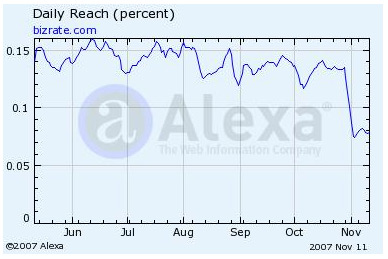
Yahoo search normally moves rather slowly with small changes, but I just saw some pretty big shifts in Yahoo rankings, including

  • botching part of a sitewide 301 redirect that they had followed for months - now both sites rank, but each ranks well for some portion of the queries
  • a bit more weight on domain names

What are you seeing?

Comcast Fined for Syndicating Fraudulent News

Any time a big media company writes about publishing ethics, just remember how much fraud is baked into their business models. Comcast was fined by the FCC for displaying fake news about a sleeping pills. Direct to consumer drug marketing wrapped as fake news. Can a company get any sleezier?

Short Term Opportunism & Online Economic Trends

Many financial and social markets are destroyed by short term opportunism. Because the web is virtually limitless, it is easy to make sales pitches that sound like everyone gains. But that is rarely, if ever, true. Every clean traffic source gets gamed. So do the dirty ones.

A recently launched blog Ponzi Scheme has more holes in it than swiss cheese. What kind of desperate people get in on the 5th tier of a Ponzi Scheme? Does it benefit your credibility to recommend low quality sites or have ads for your site seen on their sites? What type of readers do the low quality sites have, beyond the robotic community? No reason to link out to those sorts of sites, and you can probably use AdSense to buy ad space on their site for about 3 cents a click, if it even has that much value.

The reason many reciprocal link networks stink is that some webmasters marketed low quality sites they intended to get burned. Anything that has you trading with anonymous unknown parties has you trading your time, attention, and exposure with a spambot of some sort. Your site is better than that, and your time is worth more than that.

Many more programs will come out telling you how to get something for free, but if it is market exposure be leery. When I started on the web I did arbitrage on some smaller pay per click search engines and never paid me. Digging deeply for the deals has you focused on bargain hunting when your time would be better spent building value. The deal diggers keep getting made obsolete by increasingly efficient markets. The people creating real value keep making more money as the market gets more efficient.

What I have come to appreciate is that it is easier, cheaper, and more sustainable to associate with the people you want to be grouped with. If you want to link out to a bunch of other sites do it in your content, and hand select the content you reference. I have showed some projects to friends who asked "how the hell did you get X to be involved with this?" I simply asked them. Aim high, not low.

Understanding the Value of High Quality Editorial Blog Content

With an ever increasing number of ways for people to share content and an ever increasing number of competing channels the easiest way to estimate the value of a blog post is to look at the people citing it. Citations lead to new readers and subscribers...and more citations. If your posts are well cited it does not take many posts to get thousands of subscribers.

With 12 days left to go in an auction the NorthxEast blog is up to $5,500. Their blog only has 33 posts, and is a blog about blogging, which is a topic that is notoriously hard to monetize. Typically freelance bloggers get paid anywhere from $5 to $50 a post. If this site goes for $10,000 then it will be a valuation of $300 a post. Where was that extra value created? It is in the number of inbound links and number of subscribers. Over 700 bloggers link at that site and it has a couple thousand subscribers.

If you paid a freelance writer $100 or $200 per page think of the type of quality content you could create. If you value your time at $20 an hour and take 8 hours to write a post and 2 hours marketing it think of the potential return from a link perspective. You can rent average quality links for $10 to $20 a month, increase your risk profile, and get links saying nothing about your company, or you could pour that same money into getting people talking about you. If you know your topic well writing is an easy and cheap form of marketing.

If a site can go from nothing to being worth ~ $10,000 on 33 blog posts, imagine what that link equity and subscriber base would do to your brand and search rankings. If that same effort was used to market a #12 ranking site, suddenly that site might be in the top 2 or 3 and see a 10x increase in traffic.

Fresh Link Building Tips: New Search Filters = Easy Link Research

If you are looking to build links one of the easiest ways to do so is to place yourself inside a conversation that is already wildly spreading. Sites like Techmeme and Del.icio.us show what stories were recently hot, and you can find some bloggers who cited those stories using Technorati and Google Blogsearch. Google has a date based filter on news and recently launched a date based search filter for their regular search results which allows you to find fresh content on any topic. If you follow up on a popular story and contact these people you might find a few easy to acquire high authority links.

Find a Popular Idea and a Hook

Lets run through an example of how to do this. So on Techmeme right now Google vs Facebook is a popular story. The thesis of the story is that Google is going to create an open API. So I ask myself if I have an original take on Google and openness. I remember my post about Google not being very open.

Polish Your Story

I can polish that post and market it, or I can take the best bits of it and rewrite it as a new post that cites some of the popular people posting on Google vs Facebook, insert pictures and a chart comparing Google to Facebook, and then start emailing some of the websites I came across on Techmeme, Google blog search, Technorati, and recent results in Google's regular search index.

Polishing your story, aggregating data in a pretty format, citing sources, and stroking egos are crucial to helping your story spread.

Avoid Brand Damage

It might be harder for me to succeed with this on Seo Book since Google branded SEOs as being scumbags. If my site was not about SEO it would be far easier for me to get links from those other sites, but it is hard to push market an SEO site to high authority tech channels without expecting some brand damage as a result.

Even if your site covers a lovable topic you still can get burnt if your ads are too aggressive, your contact email looks automated or spammy, or you contact mean spirited people. Use your gut instincts for judgement calls on who you should contact and how you should contact them, and don't place ads on your linkbait.

If your site is brand new then you likely are not risking that much if one person responds with a hate post. I once had a person link to me from a PageRank 8 site with over 1,000 inbound .edu links as the punishment for contacting them. Sorry to offend and thanks for the high authority link worth about $500. :)

Use Blog Comments Too

Another option would be to leave blog comments or have a friend leave relevant blog comments, but these are typically much less effective than personalized emails at building links. If you leave insightful comments without looking like a link spammer you are more likely to get links from your comments.

Many Ways to Filter Blog Search Results

When you search on Technorati and Google Blogsearch you can search for people writing about a specific subject and then organize those results by freshness or authority. You can also search for blog posts that cite a specific post related to your post. Another option with using date and blog search filters is to go back to some of the people who cited one of your recently popular posts and ask them to look at the post you are trying to spread.

These Tips are Timeless

You can use all these search tips to aid your link research using seasonal stories that spread a month ago, last year, or three years ago.

How Will Viral Advertising Change the Web?

The web has long been rich in social and viral marketing elements. Email this to a friend, social bookmarking, blogging, etc. So many services have popped up that now there is a Social Media Firefox Extension and Andy Hagans is planning his fake review optimization service.

Ultimately the communities that are focused on a niche and editorially biased will be successful while aggregator websites that are nothing more than a feature that Google can add to their suite of services will die. Google quitely launched a Digg clone, and is aiming to create the underlying platform that powers most social networks. And they might bid on wireless spectrum in the US and UK.

As the leading portals collect more data they will be able to add value to more transactions and disintermediate middlemen by employing creative individuals to do jobs that were once done in offices. If people get paid for results then the quality of work goes up. Think of portals as television stations vying for a bite of your attention for as long as they possibly can, and looking to pay you for your attention with relevancy, and cash if you are really motivated.

There has always been a wall between editorial and advertising. Viral self select ads rip that down. Kevin Kelly recently posted about how he sees the new Google Gadget ads changing the face of advertising.

What happens when publishers can see what is hot right now and can create commercially oriented content targeting it in near real time? What happens when they are encouraged to track and test their results and can see the results of other ideas simply by the frequency they see it? Many current arbitrage opportunities are going to die, but others will thrive on this new opportunity.

The more third party platforms optimize revenue streams the more profitable niche attention based publishing will become. Generalist sites will be less profitable than highly specialized niche publishing. Results based distribution across large networks will force advertisers to give publishers a larger cut of revenue.The key is to scour through the ads and format them in a user friendly way to where they are looking at relevant content. You can't beat relevancy algorithms without bias, brand, focus, and strong editorial.

Why Google Hand Editing Seems Random

Many people wonder why Google hand editing seems random or incomplete, and why some of the best channels get edited while worse stuff is left untouched. Here are some of the reasons Google does a poor job equitably policing the web:

  • The web it too large to police and engineer time is expensive.
  • Policing certain segments produces unwanted blowback. How often do large corporations or influential bloggers get policed? (It is rare, and when it happens, it is sold as a side effect of feature for users.)
  • When issues become popular they get prioritized. Many times Google won't react unless they feel they are forced to. Sometimes they will lie and say they care, and then do nothing. Back in April I highlighted the Netscape search results in Google. Matt Cutts thanked me, but guess what...those Netscape lolita preteen search result pages are STILL ranking in Google, along with a bunch of other search results.
  • If they edit in an incomplete or random fashion they evoke fear
  • It is easier to control people through fear than to create a perfect algorithm
  • They have no need to hand edit the worst offenders. If they are competent programmers the algorithms should take care of those sites. They sometimes edit a leading sites in a field to send a signal. They may throw in a group of other sites if they need to create cover, but their goal is to send a message and alter behavior.

To appreciate how hard it is to police the web read Eli's recent post on how to create an SEO empire. How can Google compete with that?

As Ads Get Interactive, Selling Information Will Become a High Touch Industry

Newspapers Going Free

The NYT just went free and likely the WSJ will follow. Once something goes free it is hard to start charging for it again - just ask Prince.

Getting Real Information From Google

A few years ago some Google human review documents were leaked stating things they considered spammy at that time. Google usually gives webmasters misinfomation about organic search results, but their advice on AdWords ads is typically clearer in how they want to shape the web. The Inside AdWords blog just classified ebook sites as being similar to other types of sites that are likely to get hit by quality score issues.

Google will push selling ebooks that are published by a publisher they have a deal with, but if you are selling information outside of a large Google partner and Google is not hosting your content (and getting a cut of the action) they don't want you to be selling ebooks on their web. To be fair, for every satisfied ebook purchaser there are likely many people who paid to buy an ad formatted and sold as information, as marketers have abused the ebook format.

General Web Publishing Trends

  • each day the web collectively improves how page elements are used (example: using tabs better)
  • relevancy algorithms and ad networks make the most useful or most profitable business models easier to find while less sophisticated or lower value formats / models / businesses die
  • a near endless sea of information becomes freely available, as information gets commodified by open competitors
  • technology decreases the cost of creating interactive experiences (you can embed Google presentations in your web pages and hold live real-time chats)

Profitable Longterm Sales Growth

Given those trends I think the 4 big things we will see in selling information are

  • demise of one time sales based business models - they are nowhere near as profitable as subscription based models, and they expose the merchant to lower end customers that are less likely to invest enough to succeed or invest in recurring charge based models
  • the rise free and ad supported - if information is generic in nature and not time sensitive then it is going to get harder and harder to charge for it, especially if little value is shared before the sales pitch and Google is trying to clean these types of sites out of the advertisement slots as well
  • people paying to distribute valuable information for free - I recently saw an AdWords ad for OpenCourseWare from the Sloan Business School. They are not only giving their courses away, but now they are paying to give it away. This means that if you go to MIT you are paying for the interaction, format, certificate, and atmosphere. You are not paying for learning or information. In a couple years, in many industries, better free information will exist than what you currently pay to access.
  • subscription for interactive stuff with various formats - Google just launched their Gadget ads. As ads get richer and can show more I think the keys to selling will be to use a variety of formats to convey your messages, give people more than they want and let them consume the parts that are most interesting to them, and come up with formats that feel personalized and interactive. Publishing will become less about investing in a variety of projects until you find a hit and more about the art of investing in relationships.

International Search Engine Marketing and Arbitrage

Limited Competition in Secondary Markets

I recently took the AdWords professional exam again and the section I failed was international search. It is easy to do that because if you are primarily focused on the US market there are parts of search you can't appreciate until you see them. When I was in Canada about a month ago I noticed PageRank 4 pages dominating search results where you would need at least 100x the link equity to compete on Google.com. Some of the most valuable US keywords only have a couple advertisers in Canada.

In The Slums of Search, Gord Hotchkiss wrote:

At Enquiro we actually did studies and asked people why they were reluctant to click on sponsored ads. The most common response was that they didn't trust the advertiser. They felt that by clicking on the link they would end up on an affiliate or spam site and may get caught in a never-ending cascade of pop-up windows. Searchers were very wary. In the US, this attitude began to change as known brands began to adopt search.

If Google can't attract the right advertisers that also means that the organic search results in that geographic market are likely easy to manipulate. In many underdeveloped markets around the world, PPC offers greater opportunity than SEO because their is virtually no competition, but as the markets mature and margins get squeezed, doing SEO and owning a brand becomes more profitable than PPC. Either way you approach it, if you can compete on Google.com you should be able to dominate foreign markets. The only issue is scale.

Estimating Market Scale

Google offers an ad preview tool to show you what ads look like in various markets, and you can take advantage of their traffic estimator tool to estimate the size of a market.

If you are in a market dominated by engines other than Google (like China and Russia) then of course you have to use tools other than Google to estimate the size of the market.

How to View US Google Search Results

If you are international and do not want to get redirected to your local version of Google you can view Google.com's results by going to Google.us. While on Google.com you can append &gl=us to see the related US targeted ads. Another option to view international Google search results by using this Google global Firefox Extension or use Joost's plugins that turn off personalization.

How Google Makes Lazy US Only Advertisers Buy Foreign Traffic

While in the Philippines I have noticed that some $20 keywords (in the US) have few advertisers here, and many of the ads are for garbitrage websites. For example, one page advertising on student loans went to a page with stolen content, and had a page title about mesothelioma. If an advertiser choses US only search distribution but opts into the content network they are probably paying for exposure on that page.

When I switched Google to only search local pages the number 1 ranked page for online degrees was an off topic forum thread. Limited competition means great opportunity for those who understand the local culture and are able to gain international recognition.

Brand Keywords Create Your Long-term Sustainable Profit Margin

The Microsoft AdCenter blog posted that 35% of top search queries are brand related:

Approximately 35% of the top searches in the UK, USA and France are brand related, which gives you an idea just how brand focused our Live Search users are. If your brand is strong (and strong brands come in all shapes and sizes) include it in at least in one of your ad titles and try to get it in the descriptions too! We have often seen click through rates (CTRs) increase when brand names have been included effectively.

Brands are like attention...if your brand is healthy you have an endless number of streams of profit waiting to be unlocked. And brand keywords are easy to own because of the resonance.

  • if others outrank you for your own brand then your public relations stinks or you have major SEO issues
  • if others out monetize you for your own brand then your business model needs improved

Investing brand related profits into awareness related marketing helps reinforce your market position. Even if the ad return is at a break even point it still helps you by building additional attention that leads to additional citations.

Pages