


Vanity URLs on 3rd Party Websites Are Worth Almost $10
Best Thing Since Sliced Bread!
Recently lots of internet marketers hopped on getting Facebook vanity URLs claiming them to be a second coming of domain names. But the problem with networks like Youtube, Facebook, MySpace, Twitter, etc etc etc is that you end up being someone else's user generated content, and it is virtually impossible to move a person from content consumer on those 3rd party sites into a customer on your site.
Social Media Traffic Typically Lacks Value
Most social media traffic is too fast and shallow to build a meaningful relationship from. Rarely are social media visitors worth as much as a penny.
Sure you can drop them at the top of a sales funnel, but then you still have to convert them. And the people who are ahead of the curve with technology are often the hardest to influence via advertising, and are the least receptive of offers unless they hear of them recommended from friends.
Social Media Mentions vs Independent Reviews
If someone recommends us, then I would much rather have that recommendation point at our site from their site rather than through a 3rd party website that might go away at some point. The third party recommendations on social networks tend to be brief/short/limited in context, so they don't carry a lot of weight toward selling something, and those mentions are often people whining about free stuff not being good enough and people recommending to their friends that they just grab a torrent of your work.
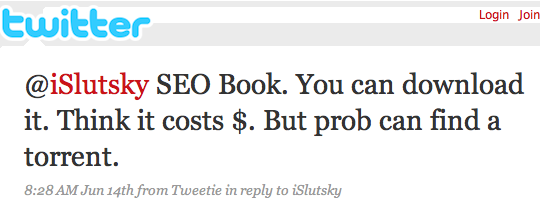
The natural bias of social media sites is toward people who value their time lowly (or else they would spend more of their time in tighter niche communities and/or in higher order business functions). Sure I have mentioned some of the recommendations for our stuff that people have done on social networks, but a link to a more in-depth review like this one is far more appealing because there is so much more context, and people who have read and followed that blogger for a while likely trust that review more than a random Twitter user trusts a 140 character recommendation.
Viral Does Not = Sales
Even the canonical example of proof of value of viral videos was not that successful. Millions of Will it Blend? video views helped the Blendtec company grow by less than a factor of 10. Many successful professional SEOs use SEO to increase the value of websites by that in less than a year, and have done so over and over again. With SEO you can create a million dollar business from scratch in about a year's time, largely because search has so much implied intent...so you don't need a huge traffic stream to monetize if you pick the right markets.
Domain Names vs Usernames
I was a bit slow to buy the seobook.org and seobook.net domain names, but recently bought the pair for less than $500. They allow me to further dominate brand related searches, while blocking potential competitors in the search results. For $500, that is not bad!
Some Facebook user named Peter Simik is squatting the facebook.com/seobook vanity URL and thinks I am stupid enough to pay $10,000 for it (assetize.com/accounts/view/210). I wouldn't give him $1 for it on principal. But there is not even a competitive threat there...people already have hundreds of connections to my real profile there, and few people are going to associate with the fake account.
More recently a couple readers highlighted that someone is on the newly launched Hunch.com website using my picture and our site logo to promote some crappy SEO website I have never heard of (hunch.com/seo-techniques/result/do-it-yourself/1928754/). That is obviously illegal, but it will only serve to undermine the trust in such 3rd party networks if they are full of fake & squatted accounts.
Protecting Your Brand
Services like KnowEm allow you to register your username on over 100 web2 sites to minimize any time wasting that might be created by someone hijacking your brand. Most of the web 2 sites will fail, but time is money, and it is hard to know which ones will be a success right from the start.
Even 1% of All Web Page Views Can be a Poor Business
Sites like Geocities , Anglefire, and Tripod were stars from about a decade ago, back when general web communities were hot then. And most of those types of sites failed.
A year ago MySpace was predicting great growth, but they have since rescinded on their big real estate deal, Google complained about how hard it was to monetize the traffic, and just earlier today the WSJ reported further job cuts:
MySpace announced plans to reduce its staff by nearly 30%, saying staffing levels were "bloated" and hurt its ability to be an efficient company. The social networking site, owned by News Corp., named a new leadership team earlier this year in an effort to reinvigorate the service. The move brings MySpace's U.S. work force to about 1,000 people.
As the Google ad deal is set to unwind MySpace, is downsizing their operation! According to Alexa, MySpace has over 1% of web's pageviews and they are struggling to make a business out of it.
How many of these general social media sites will be around in a decade?



Comments
Thanks for the reminder that traffic is just "traffic" and not "business". I thought I understood this just a few months after getting started (and was telling everyone so), but I'm really only starting to fully grasp it these days, if Im honest (somehow I used to still always be drawn to high "traffic" subconsciously)
EDIT: In Germany we got a site called studivz (basically a copy of facebook - however it has kept its theme of being a platform for college students for the most part)...They dont seem to be monetizing it well, yet, but Im wondering if that kind of thing actually has a future, as they could "sell" their users to Xing (which is the german version of linkedin ;)). Then again, if Xing's brand is strong, they will get those users anyway.
I'm not quite convinced that all traffic from social media sites, Twitter and what have you is "worthless" in the end. In my experience, if you're a retailer offering good-quality products for reasonable prices and manage to present these in a great online store which is easy to use and has lots of extra content, a personal recommendation is the best that can happen. Might be different for digital products which usually attract a kind of "freebie mentality".
Aaron
For many businesses, twitter, facebook and wordpress sites are a powerful way to push critical posts out of the top 10. That is a task which unfortunately is very time consuming and can be expensive. Grabbing a facebook vanity URL and trying to sell it to you is stupid because you have a strong brand and lots of conversations going on about you, but for a brand trying to combat a ripoff report or a pissedconsumer posting, having their vanity URL on facebook might just make the difference.
Good point Jonah...they are nice for reputation management (particularly for those who have a bit of reach and who have read the Google remote quality rater documents).
Great article. Reminded me that I really need to buy up those domain variations quick, whilst their still cheap.
Hi Aaron, i am the owner of the crappy SEO website you have never heard of.
I really can`t apologise enough for having your image within that particular question of Hunch. During the set up process of that question the UI searches the web for appropriate content related to a keyword and at the time Hunch.com was in beta testing mode.
I have ammended the page and removed your image and apologise unreservedly for this oversight.
I must also thank a reader from your mailing list who brought it to my attention.
Thanks for fixing that Dean.
Great post Aaron. My company has a very niche target audience that can be difficult to reach, so I'm always looking for new ways of connecting with the market. We've talked about social media platforms, but questioned whether sites like Facebook or Twitter are effective at driving B2B leads. You've provided an interesting perspective.
This line made me laugh hard.
I see so many SMB owners getting titillated by social media (esp. Twitter and Facebook) and rushing off to spend what little time they can spare from other business activities to become someone else's user generated content. And this while their own company websites are atrocious testaments to bad design from the late 90's. It's like picking up a girl in your BMW and taking her back to your mother's basement.
dansherman, believe it or not, I had that very same quote you used from the article in my clipboard, ready to quote myself!
It's a great line, and I totally agree with it. I've always argued that niche forums are WAY more valuable to businesses than Twitter or Facebook. The latter are hyped, and suited to the Mark Cubans/Shoemoney/Celebrity blogger types with mass follower numbers. I find Twitter SO shallow in terms of quality content/relationships - it's all people typing on the go, spamming, promoting, wanting to be followed, not following.
Business is about listening as much as wanting to be heard. I can hear only noise on Twitter. On a niche forum, I hear much more signal. If you listen carefully, you can hear your customers.
Beautiful quote Dan! :)
I believe the costs making this campaign would play a role to determine success here. As there probably was not a huge budget spent, Blentec is probably pretty happy with the outcome of the campaign.
And not to forget the branding value. I used the story today again in front of around 40 developers to make sure they get the point of how to turn something quite boring like a blender into a story worth talking about.
Great post!
Blendtec: millions of views = 10x turnover increase. How impressive that is depends on the starting turnover. And to go from amusing videos to sales of blenders is impressive. But it remains an example of the scale required for significant success.
This issue of scale applies to SEO too. So much advice ignores it. Significant financial results from SEO usually requires successfully targeting 100s of thousands of keywords with thousands of pages and a lot text. Yet people talk about targeting single keywords, one at a time.
In many cases true, but we also have a couple sites that generate over half their revenues from 1 keyword. And if you operate in areas where visitor value is north of $1 a visitor then you don't need to have too many pages to generate a significant revenue stream. We only have a couple sites with north of 1,000 pages...as most of our sites are content sites as opposed to database driven retail websites.
Excellent post Aaron,
Just a couple of days ago I was looking more closely at Twitter and couldn't help thinking how pointless and time-wasting the whole thing is from a business perspective. The niches I looked at were just full of competing or related businesses 'following' (or spying on) each other, and a distinct lack of potential customers following them. While I'm sure big brands might benefit from having a presence on Twitter, most small businesses could use their time so much more effectively than dreaming up some lame piece of 'news' that nobody is really interested in and that is unlikely to improve sales. As someone else mentioned above, improving the SEO, conversion rate, and design of their own website would provide a far better ROI.
Business aside, Twitter might be a useful tool for some to keep in touch with friends/family etc, but I find that phone and email work pretty well too!
Some time ago people noticed that wasting time on the web led to click thrus on crap ads. "channel surfing" moved over from the TV to the Internet. Sites were created to help people waste time... keep them clicking and they'll end up buying something. Failblog, Cheezburger, eBaums, etc etc etc all reflect that culture of web publisher.
These social media sites are being built on that hump of activity... serving the same mass audience that adopted the web without any real reason for doing so. Many seem designed the same way, to get people clicking while they waste time surfing the web, even if that "design" is just an artifact of the web design culture. Often they start focused on a core nich, but when designers scale the service, since they have no market focus, they simply go "for the masses" which targets that same, mindless audience.
Give it time... after a few shakeouts, we'll see these services find their audiences and re-focus.
I totally agree John. I see a lot of communities bubbling up based on more niche interests...even a colourlovers.com likely stands a better chance than most of these generic sites.
Add new comment