Building a Business by Focusing on Angry Overly Important Individuals?

I just read a WSJ article about how some hotel chains are trying to woo people leaving negative remarks publicly about their brand.

'I Hate My Room,' The Traveler Tweeted. Ka-Boom! An Upgrade!

Generally speaking, the idea is crap.

In essence they are spending resources trying to make the most unsatisfied segment of their market happy, and rewarding people for trashing their brands with free upgrades & other perks. And so it teaches more people to complain & to find arbitrary things to complain about. Hence the friendly article offering the tip on how to get free room upgrades, with tips like: "Have a lot of online friends or followers. Hotels will pay more attention to your requests."

Hey Ritz-Carlton & Shangri La ... we have 10,000's of readers and you suck! Please save my complimentary upgrades for the next time I am in town. :D

Does anybody think those leading brands got to where they are by tracking complaints on Twitter? The customers who have complaints actually worth listening to will probably give it to you directly rather than Tweeting it.

The people who are unhappy are often the type of people who shop by price and have 0 brand loyalty. And no matter what you do it is never enough. About two days after opening up our membership site (nearly 2 years ago) I got a phone call while on the road by someone who couldn't figure out how to log in. I pointed out where it was. That wasn't good enough. I spent about 6 hours digging through the PHP to try to make the login even more intuitive for them. The next day they asked for a refund because I didn't provide 24/7 phone support. The login wasn't the problem. It was just a handy excuse. The problem was that they were cheap and nothing was going to be good enough for them. And just to put a bit more salt in the wounds, about a week later someone else complained about how the login was changed. FAIL! :D

Since then we have increased our price 200% (as we have added more tools, more staff, and the value of my time keeps going up every day) and we still have many people who are happy as longterm customers at a higher price point. In fact when some people accidentally cancel their account I can get 3 to 5 emails in an 8 hour period when I sleep because they miss the site that much.

But there is the opposite end of the spectrum as well: potential "customers" who demand a free trial, beg for aggressive discounts, or have 50 "one more question" questions before joining. They probably are not sold enough on the solution to be worth the effort of selling to. No matter what you offer them its probably not going to be enough. Their lack of internal value is reflected into their perception of the works of others, and if they buy from you without being sold on you they will probably ask for a refund, or find a way to be abusive to make you want to can them.

In our support suite many non-paying non-customers mark their messages as critical. Whereas the people who are paying customers use a less extreme level, like normal. The levels that people can select are almost a filtering mechanism. Have you spent $0 with us & you mark your issue as critical & you use caps lock & rude slurs? Shift-delete.

I didn't intentionally plan it, but our old programmer even built another filter into our business model. The people who join and then cancel right away get locked out right away. We then send them refunds, but this level of filtering filters out a major type of potentially abusive customer. The type who generally won't read or research but will ask 5 different questions 8 different ways each every single day until they have annoyed your members so much that you are forced to boot them to lessen the noise. The person who makes over 100 posts in their first 2 days isn't taking any time to read or listen or implement, so they would just harm your community without getting any value out of it.

This leads to my theory of filtering: if a person needs lots of support becoming a customer (or before they become a customer) then they probably are not going to become a good customer. And if you take them on as a customer (or spend any money pushing in that direction) you will probably lose money.

The person who sends me an enraged email about "why should I install Firefox" just wasted 5 seconds of my life & will never spend a penny with me. And that is fine.

Many of the best companies aim to be polarizing. They pick their spots and define what they do, and work hard to make that market segment happy. That is how Steve Jobs views flash, and it is how Marc Andreessen likes to invest.

Find out what people smarter than you are doing and find a way to incorporate those themes into your business strategy. The smaller you are the more polarizing you can be, because you don't have to create something that feeds thousands of employees to be profitable.

You could spend every day trying to make any unhappy person happy with your offering.

... OR ...

What if you took those same resources that were spent trying to appease the angry and spent them on making those who are happy that much happier? Does the free upgrade go further when it is given to an enraged steroid addicted customer, or does it go further when given to someone who has stayed with your hotel multiple times in the past? Where are they on this circle?

The concept to think about here is that if someone is already fairly loyal it doesn't take much more marketing or attention to make them *super* loyal. And then they spread the word.

There is a concept of fairness which is preached in school, but you should overweight your business toward your best customers.

The person who has been a paying subscriber for years is worth thousands to tens of thousands of Dollars to our future business interests.

And for clarity purposes, I agree with Chris that their can be great value in being a guide & helping people out. But angry high-maintenance people are rarely where sustainable profit margins come from (unless, of course, you are a divorce lawyer OR a PR firm who gets paid to give hotels bad advice).

From the above WSJ article's comment section

It wasn't enough. It never is. :D

An Interview with Johns Wu

Internet success stories rarely get any sexier than the story of Johns Wu. 

In 2006, while still an undergraduate research student in neuroscience, Johns started a Wordpress blog he named Bankaholic.com. A one-man-show, Johns used an SEO/SEM-focused approach to build traffic and revenue. Just over 3 years later, he sold Bankaholic to BankRate for a reported $14.9 Million.

He was 22 years old.

Recently, we caught-up with Johns. This proved to be a bit of a challenge, as he is currently enjoying the ability to travel all over the world. He graciously stopped just long enough to answer some questions about his success and what it takes to create a multi-million dollar website these days.

So what leads a guy like you from studying neuroscience into SEO?

My original inspiration was the story of Anand Lal Shimpi and Anandtech.com. When I was in middle school, I saw a news report about how he became a media-tycoon when he was only in high school. Since then, I have always been fascinated by online media. In college, I was originally on track go to medical school, but the deeper I got into science, the more I realized that I hated it! I explored some computer and business classes on the side, and in 2005, I started a stock blog called thebulltrader.com. I had a good time blogging and running the site, and a year later, in 2006, I started Bankaholic. After getting my first AdSense check of $50+, I became interested in getting more traffic, and the rest is history! ;)

Online affiliates tend to do really well in areas that are either directly or closely tied to finance. Do you evaluate the proximity to finance when considering an area or niche where you'd like to build?

Not at all. The Internet is huge and there are tons great niches out there.

Is topical expertise required to compete in a valuable market?

It definitely helps, but it isn't 100% required.

What are specific things you feel might substitute for topical expertise?

Being Internet savvy definitely helps. More specifically, understanding how SEO and SEM works will grow your business and give you a shot even if competitors have more topical expertise.

Do you like to operate in markets where there is passionate competition, or markets where people tend to approach it with less passion?

I always steer clear of competitive niches. Always. There is so much money out there that you shouldn't be wasting your time chasing over-saturated/impossible niches like ringtones and online poker.

Let's talk a bit about how you grew Bankaholic. What was your original vision for the site?

In 2006, it was the peak of the financial bubble. Banks were very aggressive with marketing so they were paying easy sign-up bonuses to new customers. Any average Joe with a social security number could make a couple hundred bucks a month by taking advantage of these deals.

My goal was to aggregate the best deals and create a SlickDeals/Fatwallet kind of site that was exclusively about banking. My vision was to create an online cult of "bankaholics" that would come to my site every day for the latest deals.

Great domain name, BTW. What led you to create a uniquely brand-focused name opposed to using a direct-match or keyword-rich domain within the finance sector?

Picking a domain name was incredibly frustrating because (as you can imagine) all the good names were taken. I remember the day I thought of the word "Bankaholic" very clearly. I was in the neuroscience lab waiting for one of my lab experiments to finish, so I went on the computer and used NameBoy.com to brainstorm some names. I saw the word "Bankaholic" and I thought hey, this sounds alright...so then I quickly registered it on GoDaddy.

Given the size of the sale {$14.9 Million}, it would seem you were quite ambitious and narrowly focused to build that much market leverage so quickly. Were you always focused on reaching that level of success?

Yes, after I graduated college, Bankaholic became my life. I knew that I was sitting on a goldmine and that it was my one shot in life to make it big, so I took it very seriously and spent every free moment obsessing over how to grow and improve my business.

Did you employ any offline strategies to help drive your success?

The only offline strategy I ever attempted was printing Bankaholic t-shirts and giving them out. Since the ROI was so dismal, I never did this again!!

Did you have any specific priorities that you feel contributed in a meaningful way to your success?

Measure and optimize. You can't optimize what you don't measure.

Are you still writing regularly on the site? (One of the current authors in particular seems to share your love affair with culinary treats).

LOL! I continued writing for a few months after the sale, but after the transition, Bankrate has totally taken over.

The social media scene was emerging as Bankaholic grew, but is a much stronger presence today. Has this changed the way you are approaching new ideas or projects?

I'll be honest. I HATE social media. I admit, it can be powerful, but it is so unpredictable and uncontrollable that it is more of an afterthought for my online strategy. I personally would much rather spend my time on SEO since it is predictable, measurable, and (most importantly) 100% profitable.

However, Twitter and Facebook are valuable tools because they allow you to reach a fresh demographic that hasn't yet descended into the 'conversion funnel'... So in that respect, yes it is important to have a level of fluency in SMM depending on your niche and business model.

If new to a niche with limited resources, how does someone tackle bigger, more challenging markets?

Experience is everything. Learn from your mistakes, and don't be afraid to fail your way to the top.

Do you feel a success story like yours is something that anyone can do, or what makes the difference?

Not just anyone can do it, but there are many who can. To be a successful affiliate marketer, you need to be a jack of all trades. You gotta be able juggle and excel at many disciplines: creativity, design, business, project management.

You can only pick one: which is the most valuable asset for a young webmaster starting a competitive website (with all things being magically equal):

  • capital to invest,
  • passion for the subject matter,
  • expertise on the subject matter,
  • SEO savvy,
  • technical/graphic/content development skills

Definitely expertise. If you are a true authority in your niche and you create remarkable content, your website will naturally attract links, advertisers, and business development opportunities.

How has the money affected the way you're approaching new business interests?

I'm very active in domaining because it is a great place to put my money. I think premium domain names are great for my situation. Since I understand the Internet better than anything else, I know what valuations are attractive. Buying domains also leaves me the option to get into more web development in the future.

You've created an amazing "Rags to Riches" story with this entire effort. How does this affect the way you're viewing future challenges?

Unfortunately, I have a lot less motivation these days. I am a lot less 'hungry' for success but it's okay... eventually I will get back into my Internet marketing groove.

So what's next for Johns Wu?

These days, I've just been traveling and relaxing. Once I get the travel bug out of my system, there is no doubt that I will continue chugging away at domain acquisitions and development.

Thanks for taking a moment to talk, Johns - safe travels, and here's to your continued success!

Marty Lamers owns a Freelance SEO Copywriting company you can visit at Articulayers.Com. Since 2001, Articulayers has been fixing the world, one word at a time.

SEO Competitive Intelligence Strategy

It's bad enough having to compete with Google's engineers.

But to win the search game, you need to out-compete your competition, too!

Back in the dark, distant past - around the turn of the century - there was an "us" vs "them" mentality in search. "Us" being webmasters, and "them" being search engines.

Back then, in those simple times, in-the-know webmasters gathered in dark forums to discuss and share cunning strategies to crack the algorithms. There was a time when the postings of the secretive GoogleGuy were a big deal. Imagine - a search engine rep actually fraternizing with the enemy! How strange was that!

Times have changed.

These days, webmasters are more likely to work with the search engines, in the form of Adwords and Adsense. GoogleGuy is now the non-mysterious Matt Cutts, who helpfully announces indexing changes before they happen, even if he is still rather vague on detail.

Unfortunately, the collective "us" - webmasters - do not share the same level of camaraderie we once did. As search marketing is now above radar, competition levels have become fierce.

It's more dog eat dog.

Winning The Search War Against Your Competitors

Once we've figured out what Google wants, or we think we know what Google wants, we then need to out-compete everyone else who thinks they've figured it out, too.

Typically, webmasters reverse-engineer competing sites. Who is linking to them? What pages are linked? How old are the links? What keyword terms are they targeting? What are their most popular keywords? What Adwords are they running? What meta keyword tags are they using"? ;)

Good questions - apart from the last one, obviously - and a legitimate strategy for emulating high ranking sites. Tools like SEMRush provide a valuable insight into what our competitors are doing. BTW: Not pimping, I've been using SEMRush a lot recently, and I think it's a great tool :)

However, there's more to it. We also need to look at some other, non-technical factors that reveal something much more lucrative and interesting.

Competitive Analysis

Competitive intelligence is an ongoing, systematic analysis of our competitors.

The goal of a competitor analysis is to develop a profile of the nature of strategy changes each competitor might make, each competitor's possible response to the range of likely strategic moves other firms could make, and each competitor's likely reaction to industry changes and environmental shifts that might take place. Competitive intelligence should have a single-minded objective -- to develop the strategies and tactics necessary to transfer market share profitably and consistently from specific competitors to the company.

The essential question underlying competitive analysis is this: "why do some web businesses do a lot better than others?"

In terms of search, we not only need to look at the technical aspects of the sites positioned above us, but we also need to analyse the markets in which they exist, what our competitors goals are, their pricing and products, and even obscure details, such as who they are hiring and firing, and why.

As you can see, it's not just about getting ranked higher for a certain keyword term. It's about getting ranked higher in terms of overall business performance. It's about seeing what market they capture, and where that market is heading in the future. Once you've figured out that, you might be able to discover new keyword streams that your competitors have missed, and may never think of.

Ok, so how?

How To Undertake Competitive Analysis

It would be nice if you could call up your competitors and ask them exactly what they're doing, and where they are heading. But we all know that's not going to happen.

We have to do a little investigative digging.

The problem is we don't want to do too much digging, as it is time consuming and can be expensive. Thankfully, a lot of the answers we need are sitting right in front of us.

Ask these questions:

  • What is the nature of competition?
  • Where does the competitor compete?
  • Who does the competitor compete against?
  • How does the competitor compete?

The nature of the competition is the overall market, and market forces. Take a look at Google Trends, trendwatching sites and other market research tools to figure out where their market is now, and where it heading. Does the market require significant resources? Why are these competitors in these markets? What related markets have they avoided, and why?

A concrete example. A few years ago, many SEOs competed as service agencies. Market trends showed that a lot of SEO was moving in-house, particularly at the top end. As SEO moved in-house, demand rose for training. A lot of SEOs are now engaged in training.

Ask yourself where your market will be in five years time.

Where does the competitor compete?For example, are they limited to a certain geography? Culture? Language? Do they have an offline presence?

Who does the competitor compete against? Make a list of the, say, top ten competitors in a niche. Compare and contrast their approaches and offerings. Compare their use of language and their relative place in the market. Who is entrenched? Who is up-and-coming? Who has the most market share, and why? Can you grab some of this share?

How does the competitor compete. What are the specifics of the products and services they are offering. Lower prices? High service levels? Do they provide information that can't be obtained elsewhere? Do they have longevity? Money, staff and resources? Are they building brand?

Whilst we could go into great depth, the value of even a basic competitive analysis is considerable.

By doing so, we can adjust our own offering, like altering price and service levels or by targeting a specific niche. We may slice a new niche in order to avoid direct competition with a highly resourced, entrenched market leader. We might make a list of all the things we need to do to match and overtake that fast rising new challenger. We then position against keywords aligned with the competitive realities we face.

There's much more to search competition that algo watching, keywords and links. And many more diverse ways to compete, too :)

How To Combine Brand & SEO

In 2008, Eric Schmidt let slip that Google would use brands as a signal to clean up the "internet cesspool.

SEOs ears twitched.

Quoted by CNET at the time:

Web crawlers aren't particularly good at making judgments about the truthiness of digital matter, and the wisdom of the crowd can't keep up with the river of data streaming online. Schmidt gave the magazine publishers hope for their future. Brands, he said, are the way to rise above the cesspool...

Schmidt was talking to magazine executives who were concerned about competition they faced from low-cost publishers, like you and me :)

Whilst we can't know exactly what aspects Google's algorithms will reward, it's not difficult to see brand factors becoming increasingly influential in search results, both directly and indirectly. Schmidt may be talking about a level of authority that the brand possesses, so is therefore trusted as an "editor", but there may be something else going on, too.

It might also be a question of clear subject/topic focus.

Establish A Brand

If your site has a very clear focus, in terms of brand identity, a number of search and social media benefits naturally follow. On-topic linking, context, and more. I'll discuss this shortly.

A brand is more than a name, graphic or logo. A brand is everything you do, from the way your position yourself in the market, to how you answer your emails. Brand is the total sum experience you offer. It's also a collection of keyword terms people naturally associate with you and your site.

Whilst it is expensive to create a national or international brand, you can create well-known brands in niches. Consider SEOBook, Webmasterworld.com and SEOMoz. Those brand identities are clear, and I'm sure that a number of unique qualities for each brand springs to mind when those names are mentioned.

Ways To Establish A Brand

Philip Kotler, Professor of International Marketing at the Kellogg School of Management, identified the steps to developing a brand. Amongst those steps were:

  • Develop The Value Proposition
  • Choose A Broad Positioning For The Product

This sounds like marketing guff, but what does it mean in practice?

The Value Proposition

No one can be good at everything - there isn't enough time and resources - so what is the one thing you are really good at? Is this a value people are willing to pay for?

Broad Positioning

Kotler identifies three alternatives:

  • the product differentiator
  • the low cost leader
  • the nicher

Which one are you?

It's possible that a business can be all three, but such generalist businesses tend to be outgunned by businesses that are superior in one way. For example, Versace *could* do cheap items, but it would compromise their focus and confuse their brand identity, which equates to luxury.

Here's how to translate these brand ideas into an SEO advantage.

The value proposition is based on the demand you identity. For example, if a business owner found keyword demand for the phrase "SEO services in Los Angeles", then the value proposition is:

  • A locally focused SEO service provider

The business owner would be suited to providing "SEO services in Los Angeles", presumably by virtue of their location, contacts, focus and experience.

The broad positioning would be "niche". A catchphrase/byline may emphasize regionality, locality and accessibility for clients located in Los Angeles. The terminology used in the copy should reflect this niche approach - again, use words and phrases associated with both the service and the locality. When people link to such a site, they would naturally use terms that reflect locaility, because it's an intrinsic part of the brand identity the owner has established. When people talk about this business on Twitter/Facebook etc, they will hopefully use the terms consistent with the brand identity. Whenever people talk about your site in a certain way, Google will surely follow.

All the ducks are lined up. Business focus, keyword text, link text and the frame of reference in which people can talk about the business. Simple, right? But how many sites lack this type of focus, and thus miss out on keyword associations?

Brand can also be about personality. Danny Sullivan may know a lot about general tech, but to most people, Danny is "the search guy". He gets keyword-rich links, without having to ask. Aaron is "the SEOBook guy". It's hard to not link to Aaron without using the term SEO. Whenever people talk about them, people will naturally use search terminology in the same breath - in their keyword copy, link text and so on, which all flows through into SEO advantages. This benefits flows from having a tight brand identity.

The alternative is to be all things to all people, and this doesn't work so well in 2010, either online or off. There's just too much noise.

Building a brand is about building a a clear and established identity, and in terms of SEO, it's about being associated with a specific list of keyword terms relating to that identity.

Could you sum up your brand identity as a list of keyword terms?

BlueGlass LA

I spoke to Loren from Search Engine Journal today and he mentioned a conference he is helping put together in Los Angeles.

The conference is BlueGlass LA.

It's on July 19/20 in LA. The speaker line up is pretty awesome and takes a business / start up approach on top of the killer search & social media tactics he will be reviewing. Tickets are only $495, and he has put together a 15% discount for SEObook readers/members. It's seobook

SEJ is also running a contest to give away a free pass. Many years ago I got my start in going to SEO conferences at the 2003 Boston SES conference by Danny giving me a free pass for help packing the schwag bags. And on the last day of the conference it snowed and snowed & was a scary snowy drive home. Years later I got to pass the free pass favor onto Patrick (who now has a great view).

If you have any questions about the conference, you can comment below and Loren will catch them.

Google Maps Devours Second Click

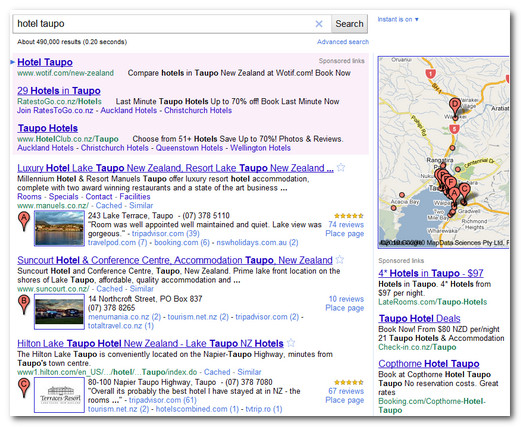
In the past when I claimed that the Google Maps insertion in organic search results wasn't more organic search but rather a Google promotion, I was met with skepticism by some, who argued that Google Maps was just another flavor of organic search and visitors would still be able to go to the end ranked website.

If you search for something on Google and click on one of the end URLs you can still visit them, but Google made one step in the opposite direction today. If you click on the map now the Google Maps section lists a bunch of places on the maps, rather than giving you the URLs. You then have to click onto one of the locations to see it on the map and open a pop up area which contains information including the URL. More clicks to do the same thing.

How long until Google replaces the URL listings in the search results with links to locations on the Google Maps or links to Google Places pages? It is the next obvious step in this transition.

Originally Google wanted to send you to the destination as quickly as possible, hoping that in doing so they would encourage you to come back again. This year Google's strategy has changed to one that wants you to stay for a while. There is no better example of that shift than Youtube Leanback:

Jamie Davidson, a YouTube product manager, says that the 15 minutes of daily viewing by a user typically involves six videos, with the conclusion of each presenting "a decision point, and every decision point is an opportunity to leave. We’re looking at how to push users into passive-consumption mode, a lean-back experience."

New Google AdWords Training Course

Back when I got into SEO part of the reason I wasn't too into PPC back then was because I had limited cash, but another big reason I wasn't big on it was because it seemed so simple and boring. Over the past couple years that has changed a lot!

Today Google AdWords is far more complex than SEO was in 2003.

With that complexity there are additional opportunities for some & additional expenses for others. But keeping up with all the changes is easily a full time job.

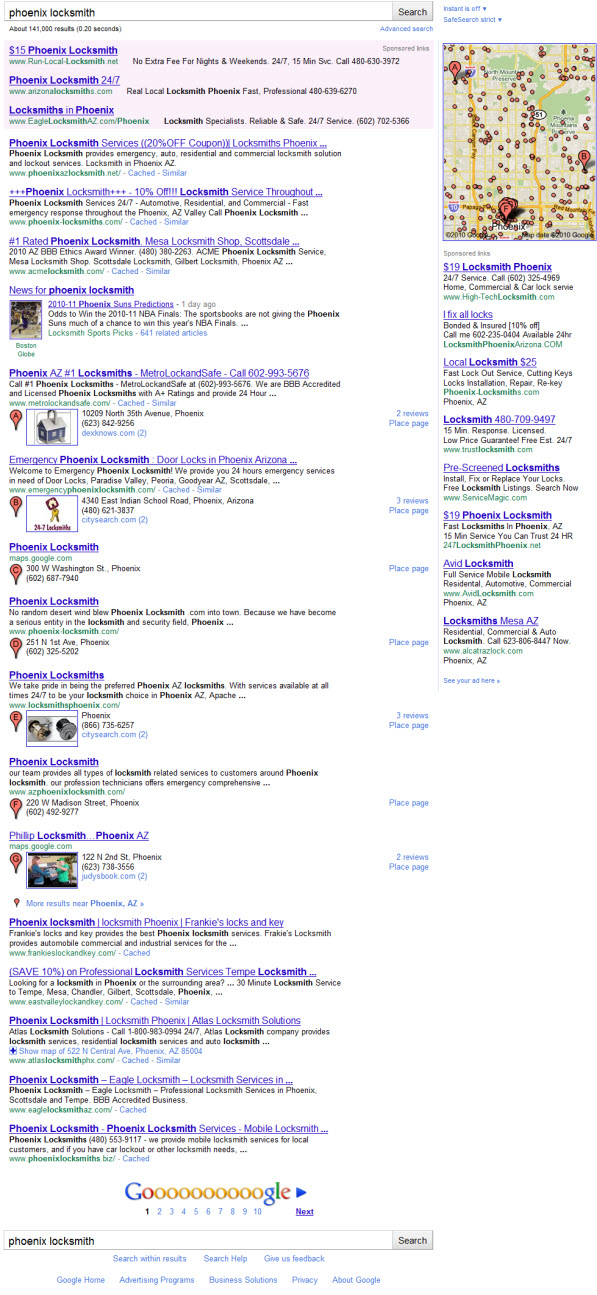
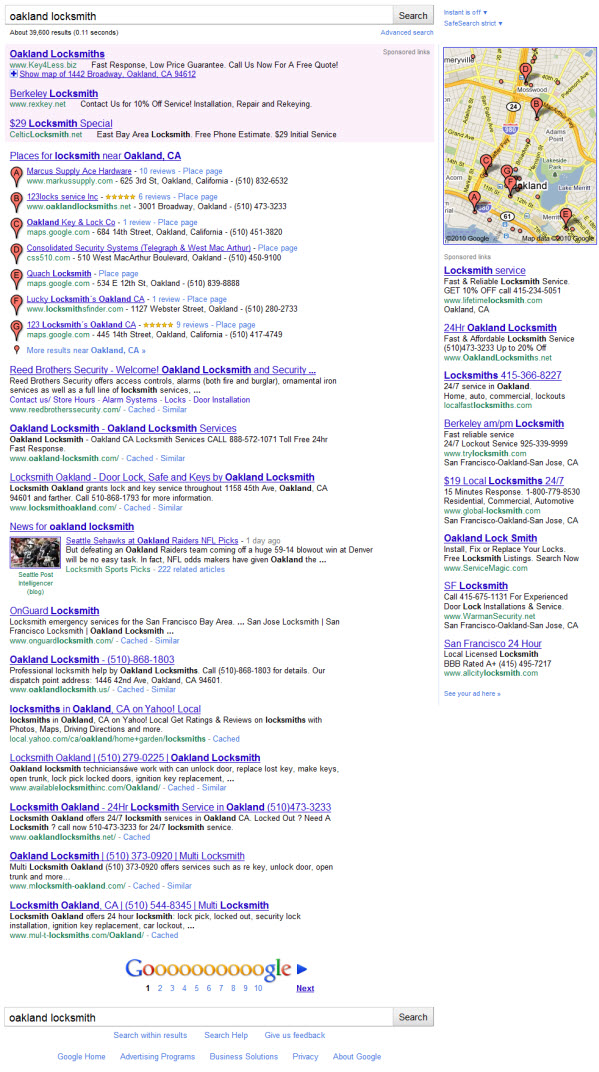
Noticing that trend, and seeing stuff like the below image, I thought it made sense to try to create something great servicing the AdWords / PPC market.

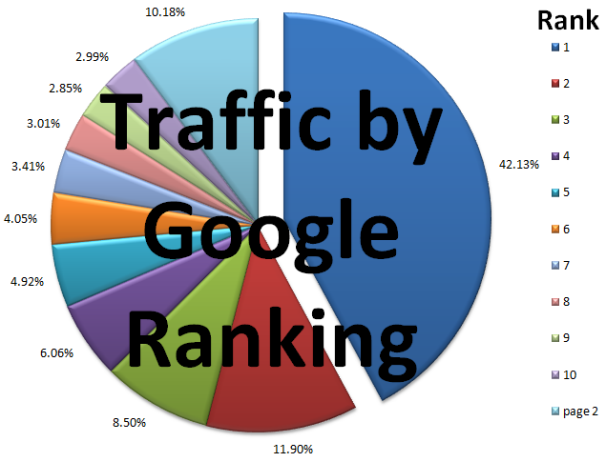
Google keeps controlling more real estate, and if you are not leveraging AdWords then there is a chance your business could eventually get pushed "below the fold" - perhaps not for longtail keywords...but certainly for the highest traffic and most valuable keywords in your industry. Google recently launched their vertical search panels, and to some degree you can think of many of these as what will eventually amount to some form of an ad channel (or a channel which promotes content from premium related partnerships with Google).

I am decent at AdWords, but my level of proficiency is nowhere near my level with SEO, and so we needed the help of someone else if we were going to make sure that we had bar-none the best product/service on the market. And so we decided to partner with Geordie to turn PPC Blog into a great membership website which mirrors this one.

Off the start access costs $179, but Geordie and I wanted to offer SEO Book blog readers a recurring 30% discount off of that, by using this code
EF0

This coupon will work for the first 100 subscribers, and then after the discount will no longer be available.

You can join here
http://ppcblog.com/member-tour-seobook/

Just like with SEO Book, you can cancel anytime and are under no obligation to stay any longer than you find it valuable to do so. If you do any serious amount of PPC it is quite easy to find a few tips that help you save $5 or more a day, especially when you consider how much PPC stuff Geordie has done (he has managed millions/yr in ad spend for the past 4 years & has brain dumped everything he knows) & how high quality the membership will be.

60+ training modules and a friendly PPC focused forum await you :D

eHow Aggregating Bulk Register.com & eNom Data

The third reason we really like [eNom] is because the data, right. Almost 10% of the entire web hits our servers. At least 10 million domains. In a world like the web, where everybody is everywhere, trying to figure out what people are doing, particularly in the longtail this is a really exciting source of data.

If the domain name data leakage from eNom & BulkRegister is "exciting" for him that means sharing it must be "not exiting" for their customers.

One more from the "competing against yourself" series. ;)

A few other recent examples: giving away your analytics data, giving away your most valuable keywords, and doing link research for competitors.

Keyword List Comparison Tool

This video is a review of one of our online SEO tools - the keyword list comparison tool, which makes it easy to compare up to 10 keyword lists against each other. This can be used to help determine the quality of keyword data sources, to pool data into a handy unified list, or to help understand the overlap in keyword strategy from competing sites when using competitive research tools.

LiveStrong OR SpamStrong? You Decide!

Want to Live Strong?

  • You have to look strong. Start with a nice manly high & tight haircut livestrong.com/business_barber/
  • You have to be strong. Drink propane. 3 times daily. livestrong.com/propane/
  • You have to bulk up. Not steroids! Feed the search engines their own search results. livestrong.com/business-don-and-tennas-hair-place_563-326-2277/

I think Google is getting the message on what the search results would look like in a couple years if they let the above continue.

Sure they own the search category, but if they let the rot set in too much then people will shift to other modes of discovery. Google realizes that search may splinter - its why they bought Youtube, why the offer a mobile operating system, etc.

Google may not be 100% responsible for the above trend. But they will be 100% responsible for cleaning it up.

I won't be surprised to see a lot more of this in the near future. Such a shame, as Jason is such a great guy. :(

Pages