Google's Move Away From Direct Marketing to Selling Branded Ads

Ad Relevancy & Quality Scores

Google has again and again touted the value of their targeted marketing, but most of the fortune 500 ad dollars are not spent on targeted marketing. A couple weeks ago in a WebmasterWorld thread many advertisers complained about getting killed by another quality score update.

What quality score actually means probably comes down to one of two things

  • your site is a thin affiliate site or something else they once needed to fill a market niche but now is viewed as noise

  • you have not created enough organic value and/or have not yet spent enough money building your brand

Google Hates Most Affiliate Websites

Some key quotes from the WMW thread...these two show the trend against affiliate sites in general

Too many outgoing affiliate links and you are toasted

So on my basic two types of sites, when I send the visitor to another domain to buy, I'm getting severly penalized ( a new affiliate "penalty"), but if I have a another party's lead form on my domain, I didn't get hit.

and this one shows that the change is not a short term one

A Google Adwords customer service rep said that they do not systematically target affiliates as a whole, nor sites with affiliate links. But, she said they are taking more steps with each landing page tweak to weed out sites that do not add a certain level of "value" to their visitors (as other posters to this thread have mentioned). She wouldn't tell me if this "value" is human-determined or algo-determined, again saying that she didn't know.

If your site is not the type of site they would white-list in the organic results eventually they are going to look to dispose of your position in the ads as well. As soon as enough brand advertisers find your space you are no longer needed. Thanks for sharing the keyword data needed to tell the brands what to bid on, and best of luck getting traffic from somewhere else.

If you want to see where paid search quality filtering is headed, look at how the organic algorithms have changed. Nothing better to glimpse the future of PPC than to read the documents about how they expect humans to rate organic search results.

Expanding the Role of Brand Related Advertisements

In that same WMW thread Skibum posed the following question

Why attack long time advertisers regardless of their business model who are providing consumers with what they are looking for while using broad match to show more ads triggered by keywords they were not intended to run on?

I recently saw a Dollar rent a car ad at the #1 ad position for Forex, which is not a cheap keyword.
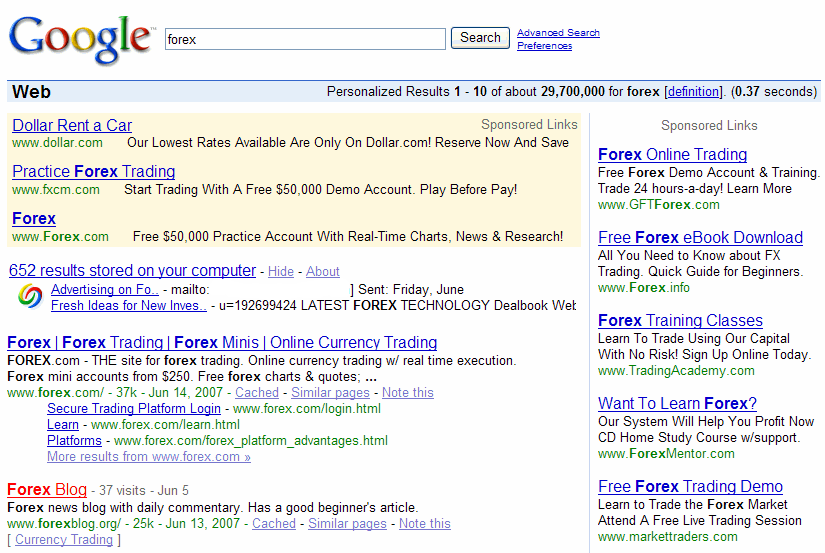
Google Expanded Broad Match Going too Far.

As the day passed Google's CTR numbers showed they expanded that ad out too far and they made that ad less broad. They can automate spreading out brand ads too far, and then pull them back if the relevancy scores are too poor.

When it comes down to it, it is all about money. As Google commoditizes everything that is not a brand they need to collect more money from brands. The reason Google is pushing video hard is because they want to lead that ad market. It is no suprise to see Google leading in innovation in the video ad field. There is no better way to create inventory than to get it from your already established near infinite traffic stream.

The Cadillac Escalade video ads are taking the place of the textual Ford Explorer ads. Google has no brand allegence. Whoever is willing to overpay for exposure right now can buy all they want from Google.

Even when Google can show relevant ads, they still prefer to show brand ads if they think they will pay more. Consider a Michigan counties page where Google shows the following ad links.

Relevant Google AdLinks.
Those are relevant. But what ads does Google also target to that page?

Google Car Donation Ad.
A lot of car donation charities are non-profit shells wrapped around dirty high margin auction houses (just look at the $20/clicks ad pricing).

Google Drug Related AdSense Ad.
A pharmaceutical ad from a company with a patent an a marketing budget larger than their research budget.

"The most startling fact about 2002 is that the combined profits for the ten drug companies in the Fortune 500 ($35.9 billion) were more than the profits for all the other 490 businesses put together ($33.7 billion)." - Marcia Angell

Given that ad targeting, it doesn't seem that Google is so pure, does it? One of the guys at WMW said the following

You guys are AdWords arbitrageurs. Although I'm sorry that your little gravy grain went off the rails, as a Google user, I can say good riddance to your garbage Web sites. Google, and users, want actual retailers to come up top in search results for sellers of a product, not parasite Web sites linking to actual retailers.

In a few years that same guy will probably be whining about how Google destroyed his business, but just like the other websites that died, Google doesn't care about him. What they want is decent relevancy WITH as much profit as legally possible. The more they cut out middle men the bigger they can make their chunk, even if doing so hurts relevancy and result diversity.

How do they get any more efficient than automating ad targeting while turning the text link into an unmarked ad unit? And they have patents for ad targeting based on how big of a risk taker you are:

"Examples of information that could be useful, particularly in massive multiplayer online RPGs, may be the specific dialogue entered by the users while chatting or interacting with other players/characters within the game. For example, the dialogue could indicate that the player is aggressive, profane, polite, literate, illiterate, influenced by current culture or subculture, etc. Also decisions made by the players may provide more information such as whether the player is a risk taker, risk averse, aggressive, passive, intelligent, follower, leader, etc. This information may be used and analyzed in order to help select and deliver more relevant ads to users."

How can anyone else compete in the ad market?

Andy Hagans is Desperate for Links...

That is the reason I can think of to describe this flatering posts, which explains why Andy thinks this site became successful.

How to Make an Automated Search Spamming Tool

Eli goes through the thought process of how to create automated search spam generator software. His recent launch of SQUIRT (a much expanded version of his free quick indexing tool) seems to have went quite well. Great marketing on the launch.

He also posted about recycling content, which is a bit aggressive for high brand sites, but probably quite common on thinner spammier sites.

If My Mom Read This How Would She React

Most linkbait tends to focus on controversy, flavor of the moment hot items, or various forms of regurgitated content. Short term sites can get a spike from such activities, but real longterm brands are not built exclusively off them. Many people ask me how to create something remarkable and linkworthy. You can research just about any market and come up with a few ideas in 10 minutes. See what ideas spread in the past, and see what news stories were popular in parallel markets. Look at

  • what people are talking about in the market right now

  • the top search results
  • popular related searches
  • terms in the same field that are often covered by the mainstream media (or others who point authoritative links at competing sites)
  • bookmarked results on social media sites

You can take it one step further and create something you would be proud to show your mom. Certainly cliche to say that, but if you are creating that kind of content then you are on the right path. And if your mom hates your market or is no longer around, see who the leaders are in your market and impress them. From their perspective, is what you are doing unique and original enough to be comment worthy. Be honest.

There is also one other way to tell if what you are doing is going to be highly linkable or a passing fad. Imagine you were the person in the market who is seen as the leading authority for the keyword or idea you are going after. Is your idea good enough that the person you want to replace would be willing to link at it or try to copy it (depending on the type of person they are)?

If they are likely to recreate your idea what tangible assets can you leverage to make it hard to duplicate? Is there a way you can brand the idea as your own to where others market your brand by even mentioning the topic? Is there a domain name that adds credibility to your offering? Is there a way you can ask for community involvement to get other topical gurus to help spread your idea?

It doesn't matter if you try and fail. You at least learn from it. Eventually something will stick, and you only need to be right once.

Business.com Directory Coupons - 20% Off Promotional Code

Update: The below coupon code no longer works, but we have found a couple new 2011 Business.com coupons. :)

In a recent interview Jessica Bowman offered the following Business.com coupon code: AVIVA, which is good for 20% off Business.com directory listings. Inclusion typically costs $299 a year, so with the coupon you would pay $239 for your submission.

Another nugget from the interview:

We currently have five editors and one editorial manager out of a total staff of nearly 100 employees, and all Business.com listings, whether pay-per-click Featured Listings or internet directory Standard Listings, are reviewed by a member of our Editorial Team.

Not bad margins on that business model if all the listings are wrapped in Google PPC ads and it only takes 6 editors to review it.

Inside Google's Black Box

A bit slow to mention this article that came out while I was at SMX, but it is worth mentioning. The NYT ran an article about Google's relevancy algorithms titled Google Keeps Tweaking Its Search Engine, which talks about how Google reacts to relevancy problems. The article should be required reading for all SEOs and search lovers. Rand offered a great overview of the article, highlighting that Google noticed their age weighting was too heavy when Google Finance was not ranking where they thought it should, Google changes their matching algorithms to place more weight on phrase matching for some queries, and that Google has created a query deserves freshness (QDF) algorithm which determines how well to mix in new and old results.

Matt Cutts, who was quoted in the New York Times article, also commented on it on his blog, confirming that

The search-quality team makes about a half-dozen major and minor changes a week to the vast nest of mathematical formulas that power the search engine.

Google is not the only search engine heavily focused on the human elements of search. In one of Tim Mayer's slides he showed a Yahoo! search result which said something along the lines of Yahoo! employees see bad results? Report spam.

The two things Google does more aggressively than the other engines are:

Build as many quality signals as you can, such that if they ever impart intent on your sites you can get away with more dirty stuff than a spammy sounding unbranded site can.

Subliminal Advertising Video

Frank pointed at this subliminal advertising video, which goes to show the power of Google's preferences in a SERP full of personalized recommendations, and a web of automated and personalized ads posing as standard text links.

Google Shows You Who is Willing to Sell You Quality Links Cheaply

Google recently added the ability for you to report link buyers, which is probably nothing more than a mind control game and a complete waste of time. I recently saw what looked like obvious link buying by Discovery.com. Do you think Google would do anything about it if I reported them? Nope.

Google also recently starting a phased launch of their position placement reports, which is far more beneficial to webmasters, as it shows what sites your AdSense ads are syndicated to. Most sites monetized via AdSense only make a fraction of their full potential, so sharing this data presents more arbitrage opportunities. How you can use this data to profit:

  • refine your AdSense ad buys to only target the best performing sites and pages

  • better learn who has your desired traffic stream and create things that appeal to their ego / belief system / audience
  • buy custom ads direct from the best converting sites (including text links)
  • find out what pages on competing sites get the most traffic and see how easy it is to rank for the terms those pages target
  • survey a competing site's traffic profile to find out which entire sections or sub-sections you should duplicate
  • if a site is getting a lot of traffic but an exceptionally poor CTR, consider buying the site outright and better integrating the ads into the content

Answer Engines

A friend named Brent sent me a link to the Cyc project page on Wikipedia and a background video on Google Video. Cyc is an AI project which aims to enable AI applications to perform human-like reasoning.

What happens to the value of your content when search engines get better at providing answers directly in the search results? Is your site the type of site they would like to cite, or does it fall further down the list on another category of queries? What can you do to make them more likely to want to source your site? Does your site have enough perceived trust and value to draw clicks after they put your content directly in the search results?

As search engines work harder at things like universal search, search personalization, and cyc any sites which are only facts and filler won't get much exposure.

Don't Trust Blog Comments From 24.208.220.xx

I generally get mostly positive feedback here, but sometimes I stir stuff a bit and get negative feedback. Over the last year nearly half of my negative feedback has came from the IP address 24.208.220.xx. The funny thing is, no positive comments come from that IP address, and nearly every comment they leave has a different name signed to it.

  • John was worried about me having a Trojan in some software. So worried, in fact, that he also left another comment on the same post under the name Matthew.

  • Mark claimed SEO for Firefox violated Firefox's trademark.
  • Robin claimed I was an idiot for saying that AdWords was less stable than SEO.
  • Stacy made the ignorant comment that search spamming is against the law.
  • Marty thought Elite Retreat looked way overpriced.
  • Steven called me a jackass.
  • Shawn stated he thought I was afraid the Internet was affecting my job security.
  • Big John claimed that I had wrote yet another whiny post.
  • Steve, Kyle, Talk Radio, Mary J, kind of funny, and Charles Tomey all thought SEO Elite was the best thing since sliced bread, which might explain why they so adamently hate Backlink Analyzer and SEO for Firefox.

If they thought they were so clever with all the rude comments, why were they too stupid to change their IP address when they wrote them?

If a lot of people are throwing hate your way make sure to check the IP address. In some cases it is just one person who really hates you. :)

Pages