Scott Smith, also known as Caveman, is one of my favorite personalities in the SEO business. I recently have done work with him on numerous projects (look for an official announcement of some sort soon), and Scott always seems to have a slightly different (and far more brilliant) angle than I on many SEO and marketing related issues.
I wanted to interview him for probably at least a year, and I finally got him to say yes :)
What is your background prior to getting into the SEM space?
Oh, you're start off by making me feel like a caveman huh? Lemme see, I spent 20 years in marketing at several large ad agencies in New York, working on a variety of very well known brands. As I got to thinking about my career, I was faced with the prospect of becoming a lifer in the ad world, because once you get into profit sharing you never leave. I couldn't see spending another 20 years doing the same work I'd already done for 20 years, so I off I went "in search of..."
In search of what?
Hehe, I didn't know really. Just something new and interesting. I was working on a book. I also like outdoor photography and won a big photo contest put on by Canon cameras [Aaron, can you insert my affiliate code there please?] ;), but photographers don't make much money so that dream didn't last long.
Anyway, I was researching a book project, and in the process, became completely mesmerized by the Web (that was back in 1998). Next thing you know, I was trying to figure out how to code a Web site. I'm still not very good at that. I don't think a single one of my sites actually validates. Shhh, don't tell anyone. Actually, a few of them do. You gotta watch out for footprints you know.
Now I run a bunch of Web sites and it's all great fun.
How do offline brand, marketing, and public relations experience relate to search marketing?
They are hugely related in my opinion. Classic marketing training and analysis teaches you to see things...connections and opportunities that are easily overlooked by others.
Web marketing is really no different from other kinds of marketing, conceptually - only the tactics and implementations are different. The engines are all about trying to show SERP's that best address the interests of the searcher. They use on-site and off-site data to sort out best pages to show, just like we do in the real world. For example, to choose a restaurant. I look for reviews (both professional and amateur, both of which are external to the restaurant), I consider how long the restaurant has been around and if it's busy most of the time. I ask personal friends. I look for signals of quality and reference, and context matters. It's very like how the algo's function.
So when I build a Web site, it's like building a good restaurant. You want a nice façade and lighting. Good recipes. Good ingredients. Good presentation. And you do what you can to get good reviews - like PR, talking to people, inviting VIP's, getting mentions in local gossip columns, whatever.
Gee, are we talking about search marketing or restaurants?
Not sure, but I'm getting hungry.
In my old advertising and marketing days, I'd always start by collecting deep knowledge of the product or service, and of the category. That included always trying the product for myself, or getting some I know and trust to try it.
Then I'd work with the brand marketing people to ensure that the product or service was up to snuff and functioning properly according to its goals, and that brand or line extensions were in place to address various users' needs or tastes.
We'd learn as much as possible about what the users think, and what they want. Car manufacturers can put all the technology they want into a car, but if a consumer wants a RED car and the manufacturer doesn't offer RED in that model, the sale is lost. You gotta know stuff like that. Knowing the category is essential to maximizing potential revenues and profits.
When, for example, you've got a real estate Web site, here's the question: Are you selling homes? Or are you selling status, comfort, the quality of local schools, a finished basement, proximity to the train station, or what?
Or, if you're selling VoIP, are you selling phone service or are you selling better ways to connect to friends.
If you understand the importance of knowing all this stuff, and make it your business to know the answers in your categories, it makes selling and positioning a brand within a Web site whole lot easier. Just like it makes creating great advertising easier. It informs everything you work on, from the name of the sited to the color of the site to the way the site is organized. All of which contribute to achieving the ultimate goals of search marketing.
And what are those in your opinion?
Increasing revenue and improving ROI.
So for you it's all about the understanding the customer, and profit?
No actually, hehe. I haven't even started talking about competition. That's a huge area. When you really learn a category, and learn what the consumers really want, and what sorts of decision trees they employ, it's tremendously helpful. What if, knowing all of that, you then see that some sites are completely missing certain important areas of appeal? Bam! New site idea.
And the Web is so great because site ideas and page ideas can get so granular that you can go after targets within targets within targets, and you have the option of doing that with one site or many.
Here's an easier one: What if you see a bunch of competition, and all of 'em are doing some things right, but not a one is doing it all right? That happens ALL THE TIME.
Do I need to be technical to be a good SEO? Do I need to be a good marketer to be a good SEO?
I dunno. You got any bagels? I'm still hungry.
C'mon now, answer the question.
I think that there are lots of ways to skin a cat. There are successful engineer/programmer types out there who've made a fortune with little or no knowledge of marketing.
Up until recently it was tougher for non-techies. But now, I'd say it's becoming easier for those who are savvy about marketing or promotion, as long as they have someone who can build an SEO-friendly site ... or at least avoid building an SEO-unfriendly site. Lots of those out there.
It also depends on if you're talking about smaller affiliate sites or bigger company/branded sites.
If you want to be really successful with the bigger stuff, I don't see how you do that in the future without strength in both tech and marketing.
You've almost got to understand Web site code, and at least the basics of search engine algo's. That doesn't mean you have to be an engineer but it sure requires a head for tech, or math, and algorithmic concepts. At the same time, it is a HUGE advantage to understand consumer marketing. You know, stuff like user behavior and motivation, decision trees, analytics, purchase cycles, buying patterns, brand development, price/value relationships. Just one major insight in any of those areas can dramatically grow revenues, especially on the Web, where opportunities are so plentiful.
And as far as Web sites go, rapid-fire communication strategies (in the way TV and print and billboard ads must grab you in seconds or lose you), ease of use and navigation, hierarchies of importance within a category, abandonment issues, conversion issues, etc.
Obviously, you can put sites up and make money without knowing much about any of that stuff. But those who know both tech and marketing have what I perceive to be an obvious advantage.
And as the Web grows up and the big money rolls in, man, you better have some kind of edge.
Speaking of which: As more of the offline brands aggressively move online how will that change the SEM space? Will individuals still be able to compete against major corporations with affiliate sites, personal blogs, etc.? Or will launching such sites be nothing more than a blissful excursion?
One thing it's been doing for a while now is pushing up PPC prices. The natural result of that is that companies who were scared or uncertain of organic search are getting more into it all the time. I can't attend a business event any more without hearing people talk about SEO or SEM.
As for smaller players competing, certainly there will always be some clever individuals getting rich. But, it's going to keep getting harder if you're a one-man-band. Small businesses on the other hand will always have an advantage or large companies, in some respects: Speed and nimbleness, local knowledge, face-to-face contact, high levels of expertise in niche markets (most of the world is niche markets you know). These will always be advantages for the little guy.
In the offline world, small business has always accounted for far more of GNP than big business. I think the number is something like 70% or 80% in favor of small business.
And getting back to the tech and marketing theme, little guys on the Web who know tech AND marketing will have the edge over those who don't. Same at all levels of competition. It's like a matrix, with size or lack of it on one axis and knowledge on the other. You can be large or small, but you the more knowledge you have, the better off you are.
Do you use any personal sites as practice for the game, or are all of your sites earners?
If there are ways to gain advantages then I use them. That applies to sites too.
Why would a successful affiliate marketing SEO consider working for SEO clients?
I give up. Why?
Umm, I mean, you.
Oh. Hehe. Well I don't think of myself as an affiliate marketer. Just a marketer whose focus for now is the Web.
The funny thing is, now that I've had a break from my old marketing career, I miss working with clients. And I rarely see a site that doesn't need both marketing and SEO help. Since I'm in a position to offer both in a highly integrated way, it seems like a good idea for me to do that. Plus, I'm a big believer in diversity, as long as you stay within your area of expertise.
You have often mentioned trying to position your site and brand near at least one authority in your vertical. What are some litmus tests for how easily you can align your site with existing sites? Which authoritative sites should you consider trying to align your site with?
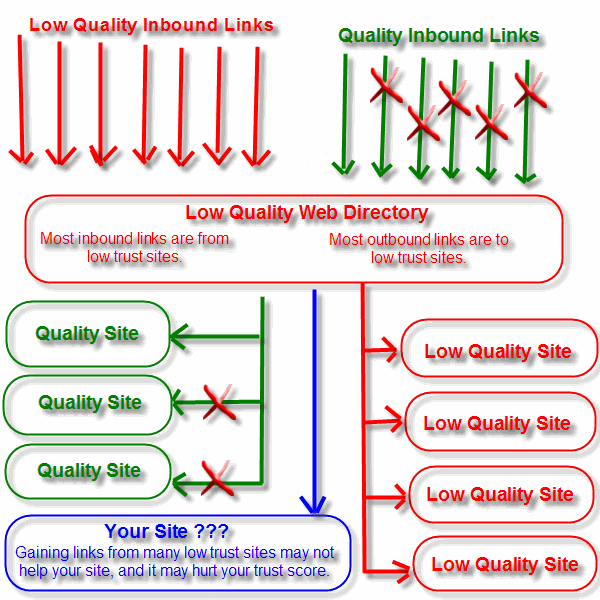
I think it's critical. And it's one advantage that the smaller players are losing, which is a major failing of Google these days. But in a way the social Web is offsetting this I think. Anyway, yes, the SE's and especially Google are a lot about proximity to core sites. Read the papers on TrustRank and seed sites. You've got to get in with other sites that matter in your niche. And this gets back to an earlier question. Getting integrated into your category is a WHOLE LOT EASIER if you pay attention to two things: Site quality, and marketing of all kinds...social, viral, niche, PR, and basic branding even.
Do search engines try to match site profiles with sites in a category? How would that work, and what might they look for?
I don't know. Do you know?
Well, I have my thoughts, but this is your time.
Tell me your thoughts.
No?
Well, I think Google does what you're asking about, sorta. Actually let me say that we behave as though it's true, which is not at all the same thing. But sometimes it helps to draw conclusions, and then behave in accordance with an assumption, for simplicity's sake, if the assumptions lead a team to the place you want to go.
Let's take both technical and comparative approaches to it.
Technically the search engines have a number of tools at their disposal. I hate always saying this, but the caveat here is that I have no way of knowing what the SE's are really doing. I'm just offering educated guesses.
So, I'm of the opinion that Google use semantic analysis of a kind related to their CIRCA technology.
Ever noticed how sometimes, especially for newer sites, you can't rank for a main keyword but you can for secondary terms? Using semantic analysis, a phrase that is used in all documents of a Web site could be filtered out from a sites pages for ranking purposes (or at least I assume so, having read the papers). So immediately that raises lots of possibilities. Let's say that you run a simple site about "hiking boots." If the site is rather "me too," and or doesn't have much link juice, Google may filter our "hiking boots" as a rankable phrase for that site, so you're only left with "small hiking boots" if you're lucky, or maybe only "small brown hiking boots."
But here is an second possibility. You have lots of link juice, and from other hiking boot sites, no less. Whoa. Now all the sudden, G starts ranking you on page three for "hiking boots." If you see that happen, you know you're in the game.
And just to stay on track, how does that relate to matching site profiles with a category?
Well, it doesn't exactly. But it does sorta. It relates to LocalRank. What if you don't have links from related sites, and as a result, maybe you don't get past the semantic filters.
But, that's not all. G knows that of the sites that rocket to the moon in terms of link pop right after launch, many are spam but some are not. So, how hard would it be to take a "cluster" of sites (read about LSI again if you don't know what that means) and associate that cluster with growth patterns, LocalRank patterns or any other number of patterns?
Answer? I have no idea. But it seems eminently logical to me.
Listen, part of search marketing is analyzing existing data and observations, and part of it is understanding the mindsets of the search engines and sussing out what they are likely thinking about. And this is also where my marketing side kicks in. Why wouldn't a site that really wants to rank just assume that everything just mentioned is true? What's the worst case? That you are wrong and kick the competitions' butts anyway? Hehe.
And here's a related question for you: What if the SE's are simply mimicking all that is there? What if it becomes a self-reinforcing circle, with the top sites holding all the power. Where does that lead you, in terms of finding an edge? Almost to the same place, that's where.
This line of thinking relates to Google's new customizable search product too, I think. They are very clever about getting people and sites to provide information on perceptions of quality. If you have top sites in a given vertical using Google's new customizable search engine on their own sites, and defining the search universe, now you've got trusted sites providing Google with mountains of new information about "best sites" out there. It scares me frankly.
What makes a page look overly optimized? What tools can you use to improve on page optimization without hurting the credibility or conversion potential of the site?
Hey man, I rely on you for what tools are best to use. But as far as sites or pages being overly optimized, I've been yelling about this issue in my role as a mod over at Webmaster World, pretty much since before Google's Florida update several years back. Actually I guess that means was yelling about it before being a mod. Whatever. If, for a given page, you line up your backlinks, title, description, H1, high level text and internal links against a single two word phrase, unless you've got major link juice, you're likely going to run into some trouble there.
The tricky thing is that, and the papers tend to confirm this, the way the algo's work is sorta like a point system. You can get positive points and negative points, and also yellow and red cards like in soccer. Very few things are absolute. So the SE's try to assign levels of probability to things they encounter and an easy way to do that is to assign positive and negative points and get a sort of overall score.
So, if your site or your page does some things that yield negative scores, your rankings can suffer to a large or small extent in the rankings, and you have no idea if you're just not ranking as well as you'd like, or if you're actually ranking less well than you should because of crossing one or more important lines ... infractions that creative negative points so to speak.
How important are unique page titles and Meta description tags? What type of sites should hand craft each? What types of sites can automate creating them via formulas? Where and when is duplication acceptable?
Ah, another pet peeve of mine. Everyone's running around these days saying that titles are still hugely important and that Meta descriptions don't matter much. Blech. Of course descriptions matter. Is it logical that author created titles are hugely important, and author created descriptions not at all? Not to me. Plus we see evidence that descriptions matter. Slight evidence, but evidence. And, we see a lot of evidence that getting them wrong can hurt you. The duplication and "over optimization" issues again.
But all that aside, people don't seem to get that these descriptions are used by the engines in the SERP's. Good descriptions affect click through's in positive ways. What else does a person need to know? It's so fundamental yet so many people dismiss them. It's beyond me.
No worries. Scott, you mentioned in a recent interview on WebmasterRadio.FM with GoodROI that you build links to achieve objectives. What are the important objects every Webmaster should consider when building links? What links should they wait to build? Which ones should they build right away?
Personally I think it depends on the site and the category. We build links to achieve a variety of objectives and it varies with the needs of the site. In most cases, getting more traffic is an important goal. So is developing a presence in key pockets of a category, sometimes. If you're building a brand, you lean one way, if you're really just going for traffic, you go another way. And if you simply want to build link juice for a site, that implies yet another approach. This is such a huge topic it's hard for me to know how to summarize it very well.
One thing I do think is worth noting is the process and chronology of building links with respect to Google's so called "sandbox." Getting back to that question about does your site have to "look like" other sites in category, think about this. Google knows that different kinds of sites have different kinds of patterns. This applies to both site structure (an e-commerce site looks different from a directory site structurally), and link patterns (blogs launched by well known personalities have very different link accumulation patterns than new hobby sites launched by amateur hobbyists). It's also not hard to imagine that Google can cross-reference this sort of data. So, if a site displays a certain kind of link development pattern, which encompasses both speed and rate of accumulation, and nature of the linking sites and pages, it tells them a lot about what kind of site it might be, and how important or "trusted" the site might be.
So rather than spewing out lots of tactics, I encourage people to consider all of that and let that thinking lead them to developing strategies that make sense for the kind of site they want to have.
Do you ever see engines moving away from using linkage data as a core relevancy criteria? What other signals might they promote, and how are you preparing for future shifts?
Well again, that new customizable search functionality that Google just made available to sites might be viewed as a step away from links, although it's still a site voting mechanism. Then there has been all of the talk about toolbar data. I'm just not even close to convinced that it's very usable. There are so many ways click data can be interpreted. As just one overly simplistic example, if a user lands on a site and stays only a 12 seconds, and then moves on to another site, is that a bad site? Well, not if it was a brilliantly designed directory that solved the users needs that fast. Or, what if a very good site somehow lands in a stream of users that are all on drugs. Does the fact that they stay on each page for a long time mean the pages are great, or that the users can't see straight. I know, these are wacky examples, but to make a point. Hopefully anyway. Errr, maybe not.
As a self-professed algo junkie, how do you prevent yourself from excessively worrying about the effects of making small changes? How do you prevent over thinking yourself?
That's a great question. In my mind anyway. It's a personality defect of mine to get too into all of this sometimes. Hmmm, I think you knew that already didn't you?
What I try to do is get clear on the value and context of a given SEO/SEM element by scanning the marketplace and then doing some testing. But my rule of thumb is, I try to be 80% confident or more, and open to new information. I don't need to be right all the time. Just more often than not. It's like my basic approach to the algo's. I love looking at it all. Partly I enjoy the challenge of figuring it out, but it's mainly about business results. So, we develop our working assumptions, and treat them like gospel until we see evidence that causes us to challenge our assumptions. And the truth is, I don't even care if I'm right. Only that my assumptions lead the sites to good places, and don't get me in trouble. That keeps me sane, more or less.
But it can get me in trouble. Before I was a mod at WebmasterWorld, I felt more free to throw out ideas and opinions without qualifying them as such. Partly I like to share my thinking and experience to help younger Webmasters, but also, tossing out points of view that are wrong is a great way to find out when you're way off base. Only now if I do that, I get a lot more snarky comments, so I'm a bit more careful about expressing opinions. But people would do well to remember that in search almost all of it is opinion, at best based on experience, observation and hopefully a little intelligence. The best thing for everyone is to get in there and get some experience of their own.
Thanks Scott, err, do you prefer "caveman"?
Either is fine. Hehe. Thanks Aaron.