Updated Firefox SEO Extension

Yahoo! recently announced they are moving some of their link queries over to Site Explorer. The problem with that is that now there is no way to get .edu and .gov backlink data from Yahoo!

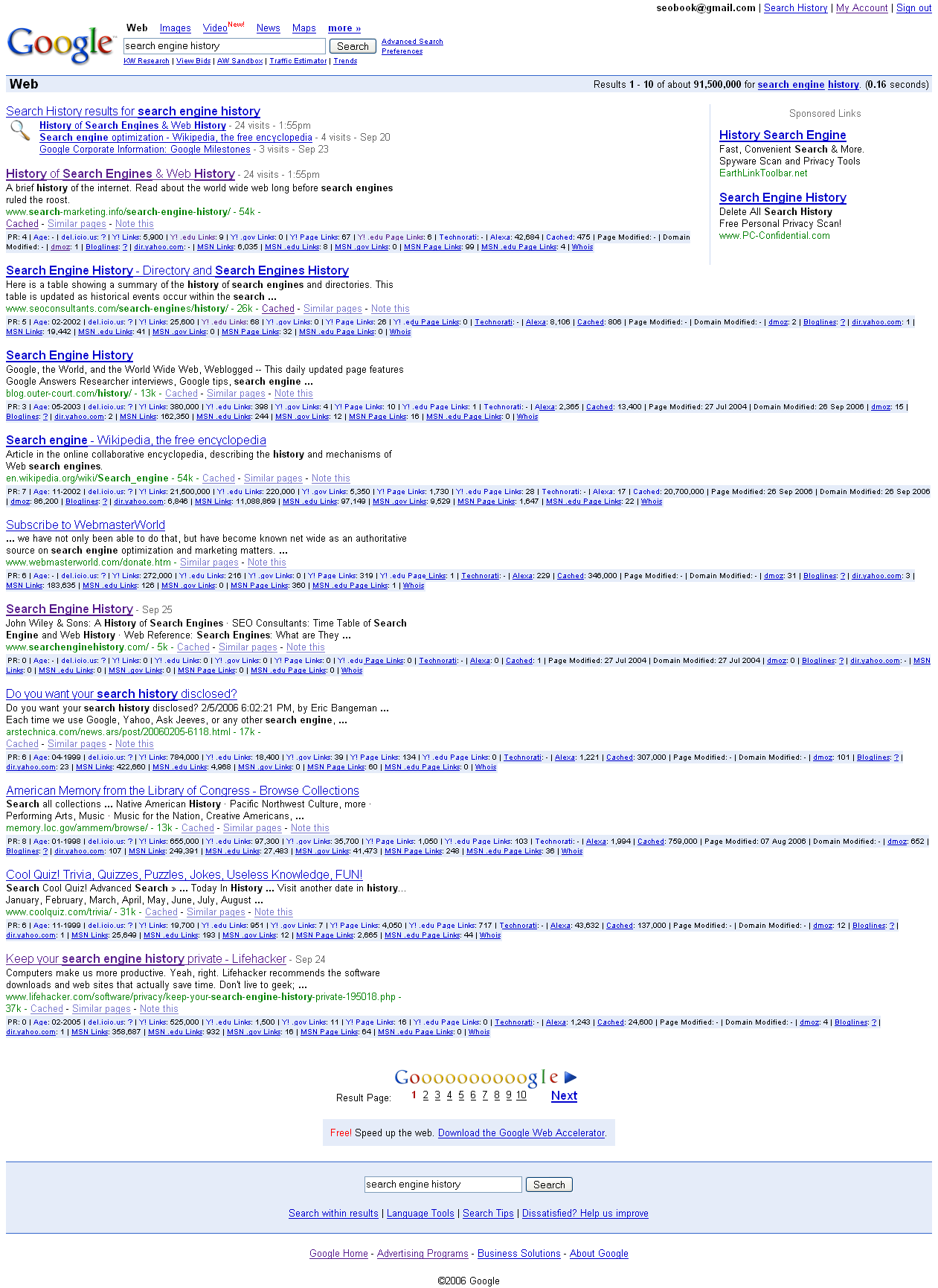
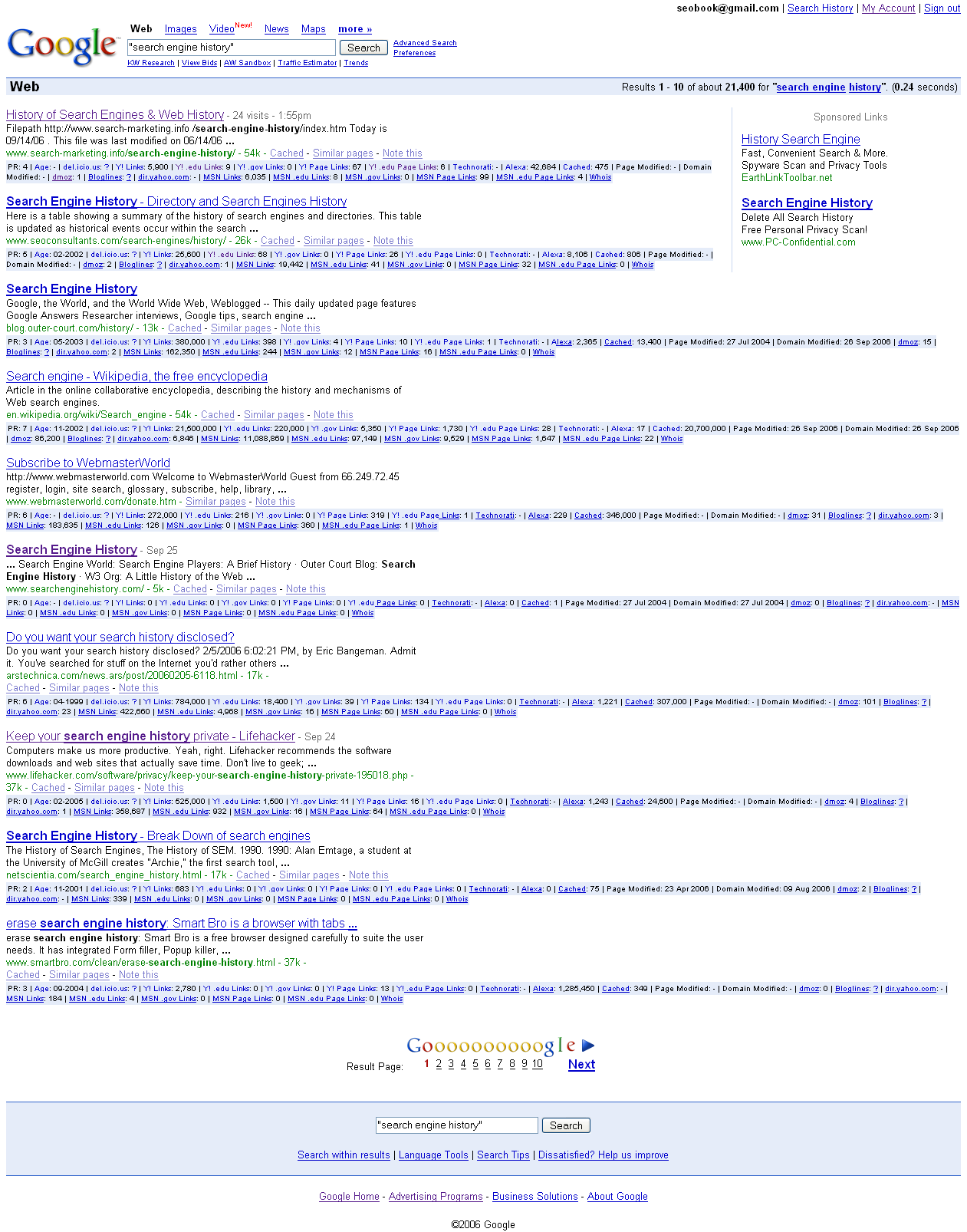
I had my programmer update SEO for Firefox to pull linkage data from MSN Search. In addition, he added some of the features that are in SEOpen and SearchStatus, such that you can highlight nofollows on a page and right click on a page and pull in some of the relevant link and other SEO related information.

After Yahoo! (hopefully) restores the ability to sort linkage data by TLD we will re-enable Yahoo! as a data source. There might be a few bugs in the newest version of SEO for Firefox as well...like if you query MSN Search automatically too quickly they may end up blocking your IP address.

Google's Depreciation of Anchor Text

I only attended a couple panels at SES, but Greg Boser was on one of them, and he always has a way of saying things in a clear way. He mentioned in the past that a divide and conquer technique was a great way for small sites to compete with larger rivals. He then went on to say that with Google's current reliance on site age and link related authority that it may no longer make sense to use a divide and conquer method to rank well in Google. If you look through Google's search results for competitive insurance related phrases typically they are dominated by old sites, government and education sites, news sites, and/or sites which are focused on all 50 states. In the past it might have made sense to make sites for each of the most important states, but with the current Google one site with an authority rank of 8 is probably going to be worth far more than a half dozen sites in the same vertical that only have an authority rank of 6 (there is no AuthorityRank meter...just assume it is some arbitrary value based on age and link equity).

Another thing which Greg mentioned in his speech was that it seems Google is really moving away from trusting anchor text as much as they used to. I recently bought an old domain from a friend that was just wasting away. It was old and had a few average type links from related websites, but had no relevant anchor text for the terms I wanted to rank.

I changed the internal link structure to focus the home page on a moderately competitive term. Just doing that ranked it in the top 20 for that term. I then got it a couple low-to-average-quality links with the plural version of that anchor text and got it ranked in the top 10 for both versions. In the past that site might have required either higher quality links or many more descriptive link anchors to rank.

In the past (say a year or two ago) I was way more focused on getting specific anchor text from external sources and probably went a bit far with it. Now it seems all you need are a few relevant decent quality descriptive links and your site will rank so long as your site has a bit of age and a few legitimate links.

Google Vertical Search Canibalizing Google's Organic SERPs

I searched to see if the movie An Inconvenient Truth was playing in a local theater. Google not only showed the Movie OneBox result, and offer a movie search feature, but they also rank the Google Video trailer in their search results and are caching the movies result page. Loren recently posted an in depth article showing how much Google is doing to add interactivity to and exposure for Google Video.

As Google adds features and consumer generated media to Google hosted vertical content pages many review sites and thin sites in high margin verticals will lose a good portion of their value, link equity, and traffic. A big thing that places Google ahead of most review sites is that they will not only collect and structure their own feedback, but their knowledge of language and the web graph makes it easy to access some of the best review information on other sites.

In a couple clicks I can go from reading feedback on Google to reading aggregated feedback snippets from other sites to reading some of the other best reviews on the web. For example, it takes little effort to see the official site, the contempt some sectors show the film, a more objective review, and a speech which inspired the creation of the film.

Indexed Page Quality Ratio

Large websites tend to have many useless pages associated with them. They may be caused by any of the following

  • poorly structured or poorly formatted user generated content
  • content duplication due to content management issues
  • canonical related issues
  • dangling nodes which act as PageRank sinks
  • navigational pages which are heavily duplicated and soak up link authority and do not provide a clean site structure

I recently have had a couple SEOs show me various navigational techniques which made thousands of thousands of somewhat similar mid level navigational pages.

Some pages make sense to be indexed and provide a great user experience if searchers land on them. Others provide a poor user experience.

Search engines do not like indexing search results from other engines, so if your navigational scheme has an element which acts similar to an internal search engine you probably do not want all those search pages getting indexed if they are heavily duplicates of one another.

I was talking to Stuntdubl the other day, and he stated one of the main things he likes to look at to get a general indication of the health of a site is to look at the ratio of quality pages indexed to total pages indexed from your site.

If lots of your indexed pages are heavily duplicated and/or of low value that may cause search engines to crawl or index your site less deeply and not index all your individual product level pages.

Bite ¿Byte? Sized Content

Recently Google allowed you to link to an exact minute and second of video. They also give each page of a book its own URL.

More Fun With AOL Keywords

A few people have created free cool web based tools which allow you to search through the 20 million keywords AOL recently shared with the marketing community. http://www.aolsearchdatabase.com/ - allows you to sort data by:

  • User ID
  • Keywords
  • Date of search
  • URL

http://www.askthebrain.com/aol/

  • allows you to sort data by TLD
  • allows you to sort data by keywords leading to a specific domain
  • by default the tool also displays the top few thousand URLs, the number of referrals to a URL, shows the top keywords leading to a URL, shows the keyword diversity ratio

http://www.dontdelete.com/ - search by keyword, keyword stem, or part of a keyword to find related keywords. For example, if you searched for dati it would return all keywords that had dating in them.

Anyone think I should add a link to any of these tools on my keyword research tool?

Growing Up

The traits which caused you to be teased as a kid may be the same traits that cause you to be successful as an adult, if you let them.

Good theory, or bollocks?

F*ck, I am Not on the List

So I went to a party last night, and a friend of mine was not on the list, but got there before me and said he was my guest. Fair enough, and good for him. Usually being on the list is a good deal, but with internet marketing using the default list is a bad deal. Let's say there is a place that does cheap article submissions that has 50 places they submit articles to. Even if they did a kick ass job of it, no way would I want to submit my site to all 50 places if that list of submission places was the default one used by the industry.

I might consider submitting to the top 10 or 20 article sites, but the deeper you go the more abstract and lower quality of a link you are getting, and the more likelihood there is that those sites would probably be in a bad web neighborhood (ie: have low quality inbound AND low quality outbound links). In most fields only the top few sites are typically going to have many high quality links.

Also, if there is a potential gem that is not on the list (just for a rough example, say Buzzle.com as a decent article submission site) then maybe getting a few links from those types of sites that are not on default lists are worth more than just pushing to do what is easy to replicate and widely done by those using a default list.

That is part of the reason I do not keep my directory list up to date so much anymore. IMHO, many of the search engines have evolved far beyond that. Sure a Yahoo! Directory link is great, a Business.com listing could be money well spent, and maybe there are a half dozen or so other general directories that are going to be longterm useful and valuable to be listed in. But if you submit to 400 directories from a commonly used (and abused) industry list do not be surprised if your site does not rank as well as you would like.

As long as your mindset is stuck on a list, if you keep going deeper you may be digging a deeper hole. The more your marketing strategies, data sources, link sources, niche market selection ideas, keyword ideas, and content creation ideas are hidden from the common lists that everyone use the easier it will be to quickly create value and extract profit from your work.

If you go to an affiliate convention and see a merchant advertising all their offers to top affiliates that is a sign that their market already is or may soon be saturated beyond profitability.

I have even heard some people who sell AdSense keywords lists scrub the words with the highest easily accessible profit potential from their keyword lists.

And, this really is what makes writing a book about SEO and trying to keep it up to date somewhat hard. People want easy, simple, and straightforward lists that guide them toward success, but the more your marketing strategies, data sources, link sources, niche market selection ideas, keyword ideas, and content creation ideas are hidden from the common lists that everyone use the easier it will be to quickly create value and extract profit from your work.

The easiest way to get quality citations is through social relationships and unique original marketing ideas, but you really can't put those on a list unless people can infer how to extrapolate how an idea relates to their core strengths, potential customers, and/or marketplace.

Shmooozing

Not really directly SEO related, but I have been going to lots of conference parties of late, and it is quite interesting to view the social interactions that occur. Some people are really good at schmoozing, while others are average, and some linger in a corner hoping nobody will talk to them. Friends = recommendations = links. I still wouldn't describe myself as being a great schmoozer, but I know lots of people who are, and I think the most common traits of people who are successful at talking to and meeting new people are:

  • they are confident and comfortable with their identity and state of being

  • they are not afraid of being rejected or trying new things
  • they make it easy for others to laugh, and also laugh at themselves
  • they make eye contact and mirror body language
  • they tend to largely focus conversations on the interests of the people they are talking to
  • they can anticipate conversations, but do not skip ahead of those they are around
  • they tend to make the people they are talking to feel comfortable with their identity, and important for being a great person or doing a great job at what they do

The more you know about a person than what an average person off the street would know about them the more likely they are to find you interesting.

I think the feeling of love is when other people feel more complete, happy, or as a better person when they are around you. If you can do things which create those sorts of feelings in other people then they will reciprocate, and (link) love is all you need. :)

For consultants SEO is probably more about sociology, psychology, and healthy social relationships than algorithms.

What good schmoozer traits did I miss?

Inside the Mind of a Searcher: Free Keyword Research Search Data

AOL proved stupid by potentially violating the privacy of 650,000 searchers and the 20 million searches they did over a 3 month period earlier this year. While seasonal and limited to AOL data, this ties data together between searcher and search patterns as well as searches and relevant sites.

Imagine combining Alexa, Hitwise, and Wordtracker, and making it all free :)

The original data source has been pulled, but mirrors are up.

Pages