About a month ago I was chatting with Rand via email. He explained that he thought that the perception that SEO is manipulative was harming the industry, in part to justify his outing strategy. I explained that I thought the goal of most media was manipulation (with attention sold to the highest bidder) and promised him that I would write a post along those lines.
It is not going to be an easy post to write. It will eat thousands of dollars of my time. And I most likely will not make any sales from it, but it is a nice introduction to how media works for anyone who has not yet seen or read Noam Chomsky's Manufacturing Consent.
Self-survival is the First Goal of Any Organization
Parking meters are needed to add cost to a finite good (parking places) to decrease demand. Recently in Oakland they went from $1.25/hr to $1.50/hr. The meter man explained inflation to me, right before I read a bunch of news about the potential horrors of pending deflation. Why was I talking to the parking meter guy? I talked to the parking meter guy long enough that the person he was going to write a ticket for got away. I had done my good deed for the day. :)
The payment gateway for that particular area was broken. I pointed that out to him and he said "oh yeah I will call it in" with a matter-of-fact tone. So he knew the meters were broke, but didn't get them fixed because he knew he would be able to write more parking tickets that way.
About a week later, parking in a nearby area, I put a quarter in a regular pay meter and went in to pick up food that I had ordered. When I came back to the car the meter showed a minute left, but there was already a parking ticket on my window. Probably the same corner cutting public servant hooked me up on that deal.
Fraud can happen at the individual level, but as an organization grows bigger it...
requires more capital to be sustained
has more stakeholders (employees, partners, investors, & customers - each having unique goals and interests)
finds additional incremental growth opportunities are harder to come by
Bob Massa mentioned being at a business meeting where the CEO was told all our KPIs point south...to which the CEO replied "sounds like we need some new KPIs."
Which leads us to the inverse law of business ethics: the larger a business grows the more hypocritical it must be to sustain its growth and please its stakeholders.
The Media Sells What is Hot
Best. Bubble. Ever.
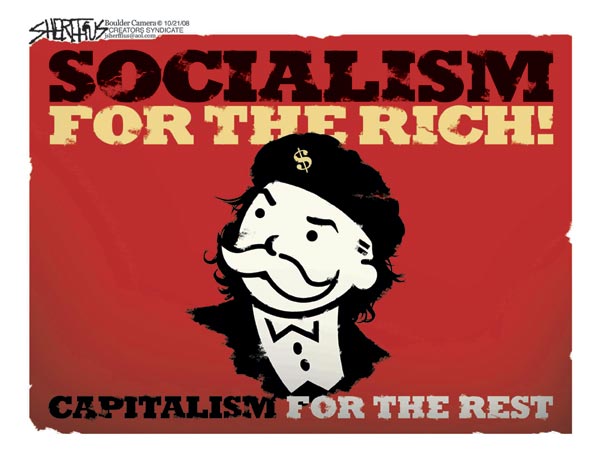
The US society is largely based on instant gratification, consumption, and debt. To keep growing we need to build bubbles (and promote them via the media), hoping to make each bubble larger than the last. Mortgage fraud replaced the tech bubble. And the next bubble will likely be related to green energy.
Media Pandering
"If it bleeds it leads." The press is always pandering the story of the day to make it seem more important than it is in an attempt to capture attention
The media lemmings, the same ones that encouraged you to get a second mortgage, buy a McMansion and spend, spend, spend are now falling all over themselves to out-mourn the others. They are telling everyone to batten down, to cut back, to freeze and panic. They're looking for stories about this, advice about this, hooks about this.
Or as a commenter named Mike, on one of my favorite investing blogs, wrote:
Some idiot on Bloomberg is talking about how irrational consumers had been and how they are now getting rational. Judging someone's rationality depends on what they knew at the time. And, Joe the Plumber was bombarded for years with propaganda about how your house was your best investment, stocks always go up, we are the kings of the world, etc. They did what you would expect.
Now, if those of us who look behind the curtain had bought into the hype, that would be irrational.
Media is usually selling you up the river to some advertiser interest.
Currently, the predominant business model for commercial search engines is advertising. The goals of the advertising business model do not always correspond to providing quality search to users. For example, in our prototype search engine one of the top results for cellular phone is "The Effect of Cellular Phone Use Upon Driver Attention", a study which explains in great detail the distractions and risk associated with conversing on a cell phone while driving. This search result came up first because of its high importance as judged by the PageRank algorithm, an approximation of citation importance on the web [Page, 98]. It is clear that a search engine which was taking money for showing cellular phone ads would have difficulty justifying the page that our system returned to its paying advertisers. For this type of reason and historical experience with other media [Bagdikian 83], we expect that advertising funded search engines will be inherently biased towards the advertisers and away from the needs of the consumers.
Years later, after Google became the world's largest ad network by scraping that content and wrapping it in ads, how did their view of that same web change? Eric Schmidt explained:
The internet is fast becoming a "cesspool" where false information thrives, Google CEO Eric Schmidt said yesterday. Speaking with an audience of magazine executives visiting the Google campus here as part of their annual industry conference, he said their brands were increasingly important signals that content can be trusted.
"Brands are the solution, not the problem," Mr. Schmidt said. "Brands are how you sort out the cesspool."
"Brand affinity is clearly hard wired," he said. "It is so fundamental to human existence that it's not going away. It must have a genetic component."
But Google has obscene profit margins and market leverage and does try hard to strike some level of balance. No other large media company has similar profit margins or market leverage, and thus they tend to be more controlled by advertiser interest.
Consider Fox News, which fired some of its reporters for wanting to report the potential link between rBGH and cancer. Why were the reporters fired? They refused to be silent about the research they had done, and as an advertiser pushing rBGH onto ignorant consumers, Monsanto was going to cut their ad spend if the truth about their product came out. Killing people with cancer for a dollar...that is how low some media standards are.
Many companies live by telling multiple stories simultaneously. When Google was promoting PageRank they talked about how it leveraged the "unique democratic structure" of the web. But when the Department of Justice sued Google for search data, Google's response stated that "Google only attempts to crawl the "best of the Web" to create a useful repository of Web pages." And when they feared GoogleBombing potentially causing negative blowback during the 2008 election cycle, Google tried to defuse the practice.
Sensationalism
Sensationalism works. Write something that is factual and nobody cares. Twist is just a bit and it is press worthy. That is why guys like Jason Calacanas are so fond of writing lines like "What you do in the next 30 days will probably make or break your company."
Distortions
Just about everyone knows that magazine cover and billboard photos are edited.
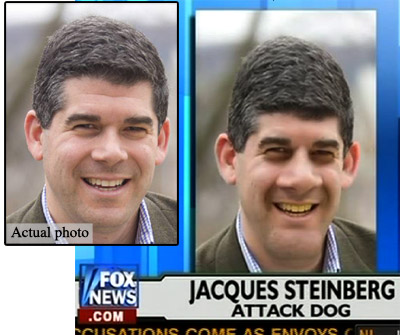
But did you know that when Fox News producers are angry at someone they will edit their photo to yellow their teeth and make their nose larger?
Reductionism
Alan Greenspan was known to speak in "Fedspeak" in an attempt to guide markets without causing panic. But in some cases he was crystal clear with his messaging. When asked of the Bush tax cut plan, Alan said that if US economic surpluses remain, then a tax cut at some point might make sense. And the next day the newspapers flooded the stands with the message "Greenspan endorses Bush tax cut" (ignoring the if surpluses remain part). Alan Greenspan discussed this reductionism in detail in his The Age of Turbulence.
Lies
If your budget is large enough and your sample data pool large enough it is not hard to lie with statistics. Some business models are based on pushing through biased research and hoping that their solution is so ingrained in society that by the time the truth comes out nothing changes.
In almost any area where Google talks about their being "spam" there are brands built off of sleight of hand marketing.
Finance
The bogus consumer bankruptcy bill was pushed using biased stats highlighting a subset of people that filed for bankruptcy because they did not pay their credit card debts. But the real leading cause for personal bankruptcies in the United States is medical issues. The same bankers that pushed that garbage are now at the trough begging for handouts amounting to $7,400,000,000,000 ($24,000+ for every man, woman, and child in the US).
Want to know what that taxpayer money is being spent on? They are not sharing that information! Bloomberg is suing the government in an attempt to find out. Gerald O’Driscoll, a former vice president at the Federal Reserve Bank of Dallas, had this to say: "Nontransparency in government programs is always associated with corruption in other countries, so I don’t see why it wouldn’t be here."
The examples are so abundant it is hard to pick one. But as an example, here are pre-election stories blaming high oil prices AND low stock prices on the market pricing in the likelihood of an Obama presidential victory. Such analysis is usually thin on research.
Greed and Fraud Are Fundamental Parts of Capitalism
I could list dozens more categories here if I took the time to do the research. Kickbacks and misinformation are everywhere because capitalism promotes short term gain at the expense of future generations. When a company goes public so much is driven by making the numbers and getting your bonus. Some media companies even carry fake video clips created by public relations companies.
Even the US Government Actively Manipulates the Media
The US government actively manipulates the media to mislead and misinform consumers. If you watch Robert S. McNamara's Fog of War you will see him talk about how they timed Vietnam War related releases to play them down and minimize blowback.
30 years later the media is still being used to propagandize war. What ever happened to those weapons of mass destruction that were central to the lies that started the Iraq war? George Bush thinks their absence is funny. So does the press corps
As one Youtube commenter puts it:
As repulsive as Bush is, we shouldn't forget some of the people laughing at his "humor," notably the press corps who helped him sell his phony war and who derided, as naive or unpatriotic, those who raised doubts about the WMD issue before it started. But hey, war makes for great great TV and big profits for the military-industrial-media complex. They're a big part of the reason why America is so frequently at war.
Back when we were pushing to go to war there was nothing but cheer leading from the media, and now the same media reports how the Pentagon used (and still uses) TV analysts that have equity stakes in defense contractors to sell the Iraq war to the US public:
Collectively, the men on the plane and several dozen other military analysts represent more than 150 military contractors either as lobbyists, senior executives, board members or consultants. The companies include defense heavyweights, but also scores of smaller companies, all part of a vast assemblage of contractors scrambling for hundreds of billions in military business generated by the administration’s war on terror.
...
Analysts have been wooed in hundreds of private briefings with senior military leaders, including officials with significant influence over contracting and budget matters, records show. They have been taken on tours of Iraq and given access to classified intelligence.
...
Members of this group have echoed administration talking points, sometimes even when they suspected the information was false or inflated. Some analysts acknowledge they suppressed doubts because they feared jeopardizing their access.
There are laws against inside trading, and yet somehow it is legal for the government to give defense contractors classified information so long as they are willing to lie to the US public in exchange for it. Mind blowing!
In 2004 (just before the US elections) the BBC aired Adam Curtis's The Power of Nightmares - a documentary showing that Al-Qaeda is a fictitious organization created and promoted to scare US citizens for the political gain of neoconservatives. The US TV networks refused to give it air time:
"Something extraordinary has happened to American TV since September 11," says Curtis. "A head of the leading networks who had better remain nameless said to me that there was no way they could show it. He said, 'Who are you to say this?' and then he added, 'We would get slaughtered if we put this out.'" Surely a relatively enlightened broadcaster like HBO would show it? "When I was in New York I took a DVD to the head of documentaries at HBO. I still haven't heard from him."
I think humans tend to be somewhat dismissive of or scared of technologies they do not understand. That is why Lori Drew was tried on 3 counts of accessing computers without authorization, rather than being tried for psychologically abusing a child.
Reporters should be skeptical because in some cases people are willfully feeding reporters inside details that are false to try to push a stock (or some other business interest). The sheer level of detail in The London Times's report on the false Microsoft Yahoo deal last weekend is mind-boggling. Those sorts of lies are embarassing and make reporters cautious.
Some reporters know their stuff and do in depth research, but some go into writing their pieces with an end goal in mind, looking to misquote you to drive home their point...asking leading questions and making you the focus of them. For example, I was asked about how I could use Google Knol for spamming. I responded with something like "I don't consider myself nefarious, but for sake of argument lets say you or I were the nefarious type..." and that got quoted as "lets say I am the nefarious type."
Why do People Buy SEO?
SEO is Worth a Lot of Money
I gave a presentation at an investor conference and ended up charging somewhere around $1,000 a minute for the presentation.
I recently charged a CEO $300 for a 30 minute speech and hung up feeling guilty that I under-charged him. I taught them all sorts of advanced topics like conditional site structure alterations based on crawl information and traffic levels all other sorts of goodies. I estimate that call will add at least $1,000,000 of search traffic to his business if he executes on 50% of what I taught him.
Nobody Wants Average Rankings
While I have had well over 10,000 paying customers, not a single one of them has ever paid me with the goal of "rank them where they deserve to."
Everyone who has paid me a large sum of money (say 5 figures or more) wanted to rank better than they were, and in most cases (all but 1 so far) better than they would deserve to from an objective view of the web. And those who were already clear category leaders wanted to know how to create a second or third white labeled high ranking site.
Search Can be a Cheap Distribution Channel
If you are already paying for the cost structure of running a brick and mortar business, there is little incremental cost to gaining more organic search traffic...the medium is still exceptionally under-priced.
Search Exposure Builds Real Value
If you are one of 400 insurance brokers or real estate agents selling the same recycled stuff, then you don't want to rank where you deserve...even if you are number 12 out of 400 you are probably getting less than 1% of the potential traffic. That is pretty crappy relative to how well you would do with just a bit more effort.
A thin affiliate site with little to no editorial content was recently bought for $34 million. That site was not bought out because it was above average, but because it had above average rankings. The CEO even stated that they bought the site based largely on its search engine rankings.
Isn't SEO Manipulative?
As referenced above, most of the entire media ecosystem is heavily manipulated. Why? The intersection of 2 key points. ;)
Many people who claim to be against manipulative SEO practices have no problem with being manipulative and lying with their public relations. Both have the same end goal of profit, but renting a link to try to rank one spot higher is nowhere near as toxic as lying is.
Almost every public facing person in media is a salesman, electioneering for their own self-interests.
Even Search Engines Hire SEOs
Large media organizations like the NYT employ SEO tactics. Even search engines have internal SEO teams. Laura Lippay is the SEO program manager for Yahoo!. I know Microsoft has an SEO team because a couple years ago a headhunter contacted me wanting to hire me to work on that team.
If search engines employ SEO then you should too. Why not help your company rank the best it can?
Why Outing is Bad
For many webmasters profitability comes from leveraging new platforms along with creativity and innovation...often within the gray area where marketing strategies are not yet abused. But when a well known SEO outs something they are intentionally trying to make the search engine look stupid, forcing the search engineer's hands into banning something or making something 'not count'.
As an industry will we fare better building each other up or advocating knocking each other down?
Want to Help Google Clean Up the Web?
Google Sells Ads to Spammers
Google sells ads that promote virtually anything. All a person needs to do to get exposure through their ad network is open up their wallet.
Eric Schmidt said that the internet is fast becoming a "cesspool" where false information thrives. Here is how you can make the web a better place! Anytime you see a Google AdWords/AdSense advertisement that does any of the following...
makes a false claim
engage in cookie pushing, reverse billing fraud, or push spyware
promotes something that is illegal or immoral
is published on a copy of stolen copyright work
make sure you file a Google spam report AND out it on your blog. Google needs more help cleaning up their ads than the organic search results (as the paid search algorithm is much less complex and is directly influenced by payment). That is, of course, unless Google likes promoting infidelity while cleaning up the web.
Part of planning a SEO campaign, especially for anyone involved in B2C retail, is to optimize with holiday events in mind. Obviously, gift giving is a tradition that no retailer can miss out on, so SEO campaigns for the holiday season are often planned and executed well in advance.
Let's take a look at some of the keywords and trends associated with the upcoming holiday season, and look at a few strategies you can adopt in order to cash in.
1. Historical Research
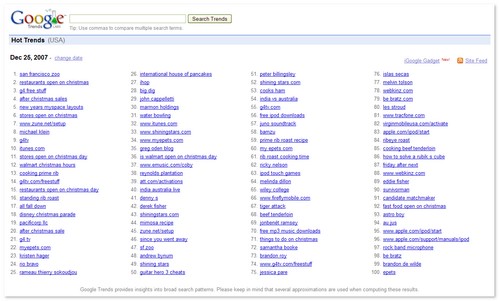
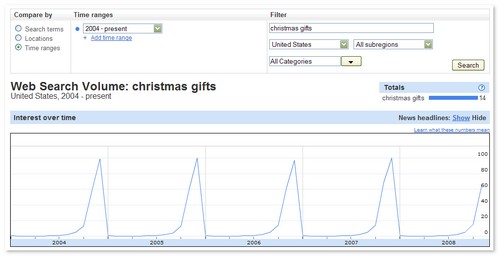
It is fascinating to look at keyword trends, especially around this time of year. Go to Google Trends, and flip the date back to December last year.
Notice any patterns?
For starters, a lot of people are looking for recipes. If you have a food oriented site, include a section focused on preparing common Christmas meals.
People are also looking for stores and restaurants open on Christmas Day. Think about other holiday specific information you can include to capture this type of search traffic.
The other interesting thing to note is that people are still in the mood for shopping on Christmas day. Either they're looking forward to the after Christmas sales, they're looking for something to do, or they're looking for tunes to put on their shiny new Ipod. Think about how the nature of shopping changes on Christmas day, and the few days following, which should help you earn a bit more revenue than your competitors.
Notice how these types of pages pretty much optimize themselves. You can create all sorts of gift lists. Gifts for him, gifts for her, gifts for mothers, budget gift ideas, etc, etc. It is a good idea to personalize the list. Add a human touch, such as a photo, or commentary, or both.
gift ideas for guys
gift ideas for geeks
christmas gift basket ideas
gift ideas for christmas
gift ideas for dad
cheap christmas gifts
unique gifts
corporate christmas gifts
romantic christmas gift
unusual christmas gift
unique christmas presents
Often, people don't know exactly what to buy. They're hunting around for ideas. Organized gift lists solve a genuine problem, and they're a great addition to your SEO campaign. They can convert very well, because the buyer intent is closely aligned with the sales process. Think about the sales funnel and incorporate the hunting stage - not just the buying stage - into your site.
Use sales data to help you decide on your list. What are the most popular and/or high margin products? Can you group these together into the type of list people search for? Link to these lists from prominent pages, like your home page, and try to get links from other sites. This will help drive sales, increase Page Rank, and rankings. And not just for this year - hopefully for many years to come. Can you come up with the definitive Christmas list for "gift ideas for *insert term here*"? You can swap out the products each year.
3. Start Early
If you're only just thinking about SEO for this holiday season, you're probably left your run a little too late. In fact, anyone who didn't have their campaign good to go by July probably left it a little late.
Year after year, people start as early as July on their Christmas shopping! They really start to go for it in October and November.
Start planning early for next year :)
4. It Isn't About Brand, It's About The Offer
Because Christmas has a set deadline, and a lot of people leave things until the last minute, brand is the last thing on people's mind. They're focused on solving a problem.
At times such as these, the offer is the most important thing. Your copy should reflect this. This may mean rewriting some pages, or adding new pages that specifically target this time of year.
Be sure to include delivery times, and assure people that their gifts will arrive in time, else they'll be going to your competitors who do emphasize this point.
5. Coupon Codes & Discounts
There was a time when retailers didn't offer sales and discounts during their most profitable time of year, but there's too much competition these days. People will respond to discounts and coupons, same as they do at other times, so try to work them in. Given we're in a recession, and people are likely to be feeling the pinch, discounts and incentives will be especially important this year.
Check out keywords relating to:
bargain christmas gifts
cheap christmas gifts
cheap christmas gift ideas
christmas coupons
sale christmas
etc....
Speaking of which, and since Aarons clearly already in the holiday mood, we are offering all SEOBook readers $25 off their first month's subscription fees by subscribing to SEO Book through this link.
First in, best dressed. :)
6. Seasonal Imagery & Details
Stores are awash with Christmas imagery, and with good reason. It compels people to spend. If you're selling gifts direct to the public, you should do likewise.
Test pages, using PPC, as early as July. Does the Christmas imagery increase conversion rates? What wording and topics produce better conversion rates at this time of year, compared to other times? Feed this data through into your SEO campaign.
The advantage you have over PPC is that PPC bid prices are going to go higher and higher as Christmas day approaches, whilst your bid price remains the same. Zero.
When I was about 1 year into the field of SEO my friend brought me over to his parent's house for a winter break for a few days. His dad is a genius (in about every way possible) and worked at the time as an archivist that digitized old content collections for media companies. I told him of what I did (SEO) and he told that I should learn XSLT, and that Google would soon kill the field of SEO.
The Anarchist
I believed just the opposite...that SEO was an extension of marketing (which will only increase in demand as the web grows older), and that as Google's profits grew, they would use them to forge partnerships with content creators and build their own mini-web to supplement the greater web and give themselves a second bite at monetizing searchers. In the past few years Google added news results to their organic search results, bought YouTube, digitized a ton of books, settled a publisher and author lawsuit with books, created a books API, created Google Maps (and local), created Google Earth, created Google Maps, created Google Local, and Google just purchased 20 million digitized historical newspaper pages from PaperofRedord.com.
So far I am winning that bet, but only because I view SEO as an extension of marketing and have aggressively re-invested profits toward growth...which got me to thinking of publishing trends that will grow in the years to come.
Publishing truths for the digital age
Many forms of scams and spam will look so much like real information that most people will not be able to distinguish between them.
The web has a deep and rich memory. But most people's use of it will remain shallow.
As the world gets more complex, we will increasingly question authority and seek out experts to turn to for alternative view points and advice.
We will subscribe to niche channels that largely match our biases and worldview. Information retrieval tools (search engines), information consumption tools (feed readers), and the social structure of the web (links, comments, how we use language) will further create a self-fulfilling prophecy on this front.
Curiosity and the ease of publishing will turn a half billion people into experts connected to a passionate audience.
Amongst that competition, there will always be an unquenchable demand for marketing, branding, and public relations.
If you sell information, accessibility and marketing will matter much more than being deep and/or factually correct.
It is easier to build a large profitable revenue stream selling what is new rather than selling what is old.
Information without personalization and context will increasingly become commoditized. The average web page will be worth less than a cent unless there is a strong editorial voice associated with it and/or there are explicit votes for it.
Your Turn
What do you see changing as the web ages and grows?
While it focuses on non-profits, much of the advice could apply to just about any website. We would love to get your feedback on it. If you find it useful or know some charities that might like it, please share. Thanks to Dominic Mapstone for early feedback and advice. :)
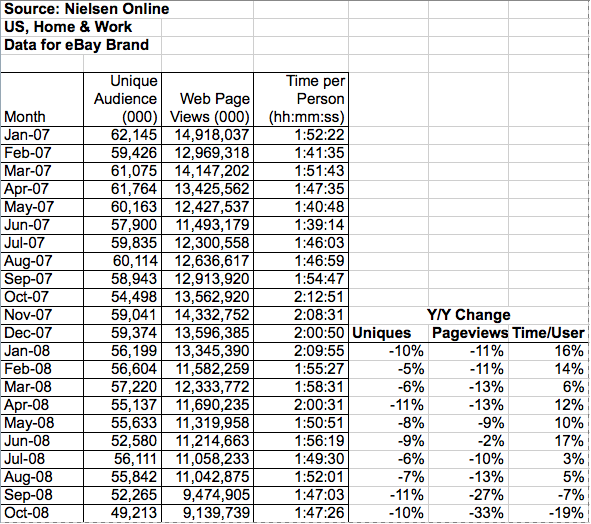
eBay has recently seen a sharp drop in traffic as they cut their affiliate stream and Google ad spend.
When you are a default category leader you no longer compete against others in your category. You compete against other categories. Google and Amazon.com understand that. Microsoft maybe. eBay no.
eBay could have used the last decade to create communities around buying, selling, and collecting...taking a slice of any transaction as they turn buyers to sellers or sellers to buyers.
They could have offered awards for collector of the month, seller of the month, buyer of the month, and done interviews with the winners.
They could have a section called deal hunting where they offer tips on how to find the best deals.
They could have a section called "good as new" where people talk where people talk about old items that are a bargain, and in some cases even better than new.
They could have allowed sellers and buyers to build editorial communities and collections on the eBay site. Control the conversation and control commerce.
What if eBay could have got you to tag just about everything you owned, and then told you roughly what it was worth (based on recent transaction data) and had you put a buy it now price on it? CueCat was a failure, but eBay has a much better platform to market such a device on.
Instead they did nothing. They lost a decade to improvements in search, Amazon.com, open source software, blogs, and the rest of the web.
Rather than improving their network feedback mechanism and making a deeper network, the new eBay strategy is to try to be more like Amazon, but that won't work. While eBay spent a decade alienating buyers and sellers (with no innovation, shifting fees, encouraging a market lemons, etc.), Amazon was off building user loyalty. And now Amazon is out working public relations with a holiday customer review team and extending their platform in new dimensions - offering digital downloads, the Kindle, selling utility computing, and selling their shopping platform.
Staying competitive is more of a mindset than an event. The decay happens long before it impacts revenue. And by the time it impacts revenue there isn't a lot of time to fix things.
"All Truth passes through Three Stages: First, it is Ridiculed...
Second, it is Violently Opposed...
Third, it is Accepted as being Self-Evident."
- Arthur Schopenhauer (1778-1860)
A business model that contains subtle white lies that are familiar and easy to like is often far more profitable than a business model built around attempting to change people's identities. This is precisely why so many business models are built around for Christians, for bloggers, or for charities.
As an entrepreneur it is worth considering the above quote when thinking about new business models, new platforms, new formats, and new algorithms. You could spend all your time trying to prove your vision of the truth, or modify it slightly so that others are willing to do the work for you. Your choice. :)
Start with a socially active core that identifies with what you have to offer and give them the tools to help spread your message.
The Inside AdWords blog announced the beta launch of Google's Search-based Keyword Tool. To some degree the tool is a Compete.com knock off, but with a number of exceptions
this tool is free
Google has more search data than Compete.com does
this shows bid prices and search volume estimates next to keywords (like the Google Traffic Estimator)
this shows your current page titles and keywords
this shows the % of organic and paid traffic going to a URL
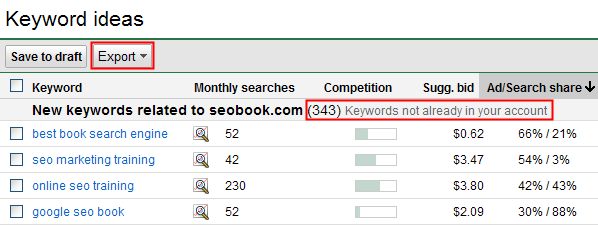
For any keyword, the Google Search-based Keyword Tool will show up to 800 related keywords with cost and search volume estimates. This tool also works to show you 100 keywords related to a site, and if you own a website they will show you thousands of keywords that they think you could bid on which are not already in your account. In addition they show your search share of voice (via ads and organic search results) for keywords. This data is easy to export using a handy export button.
There are a variety of cool extra filters that can be applied on this tool, including...
minimum or maximum search volumes
bid price range
low, medium, or high competition
keyword in URL
combining URL and keywords as filters
keyword + general category
negative keywords
Using a variety of different combinations for these filters you can see many different sets of 800 keywords even within the same subset. Export these different lists a variety of times and you can quickly build a list of thousands of high value keywords.
Alexander Hamilton's face is on every $10 bill, but his brand isn't doing so hot. Thomas Jefferson, meanwhile, has a strong brand, and he's only on the 2, and there are hardly any of those in circulation. What is a fair CPM rate for either gentleman to pay for this type of exposure?
I did a couple interviews recently. If interested, here is on on GottaQuirk, and another on PalatnikFactor.
I was also interviewed in the recently published book Blog Blazers. I have a couple copies of the book to give away...if you want one just comment below...first come first served :)
There is a big difference between working on your own sites, and working on sites that belong to others.
When you work on your own sites, you can execute changes quickly, and you don't need to convince anyone else of the merits of your actions. However, within an organization, SEO requires significant buy-in on a number of levels. Failure to get that buy in can severely compromise the effectiveness of the SEO, which might - rather unfairly - see the SEO out of a job.
In this article, we'll take a look at the problems the SEO who is either in-house, or working on a clients site, faces, and a few ideas on how to deal with them.
Embedding SEO Into The Culture
In-house SEO is just as much about politics as it is about execution.
There will be various stakeholders, many of whom man not be be familiar with SEO. There will be people who will be openly hostile to someone else insisting they change the way they work.
No matter what, you're going to ruffle a few feathers.
The first step to achieving good SEO outcomes within an organizational structure is to get management buy-in.
Given that management have probably already hired you, this should be a relatively straightforward step. Management will want to see facts, figures and strategies that support the business case. Prepare presentations that demonstrate your proposed strategy, how it supports the business case, how long it will take to achieve, and what your measure of success will be.
Once these factors are agreed to, you'll have the backup you'll need to undertake the hard part.
Convincing The Minions
Various people need to buy into SEO in order for it to work.
Some companies locate their web team within IT, whilst others place them within marketing. Sometimes, the two business units share ownership of the strategy. The important thing to determine is who has the control, especially over aspects such as site structure, content production, and overall strategy.
Look to establish rapport with, and train, the various people who occupy these important roles.
1. The Manager
You must have buy-in from the person with the most control over the business unit responsible for web strategy. They will be able to provide the support and backup you'll need.
Managers tend to respond well to anything that helps them achieve departmental goals. These goals have probably been set by upper management.
Look for areas synergy exists. For example, marketing managers often have traffic goals, and similar visitor metric milestones. Show them how SEO will help meet those objectives.
This is why it is important to frame SEO in business terms, as opposed to just a technical process. Without management buy in, and aligned business goals, you're unlikely to get support for the technical changes you need to do.
2. The Designer
The designers are responsible for the look and feel of the site. They will probably also be responsible for site architecture. Architecture and design are two areas where you are likely to experience a lot of push-back.
There is good reason for this.
What is good for SEO might not be good for users or brand aesthetics. This area that needs to be carefully balanced. If the designers think the SEO is compromising the look, feel and operation of the site, then you're not going to get very far, no matter how good your intentions are.
If your designers are familiar with usability, and good designers will be, you're in luck. There are a lot of usability integration points that work for users, designers and SEOs. For example, breadcrumb navigation can be great for usability and SEO, as they allow for the propagation of keywords, and provide internal link structure. Be on the lookout for other areas that require little change and provide natural synergies.
Once you've built up trust, you may be able to get bigger concessions.
3. Writers & Content Producers
The writers provide the words. The content producers may provide video, pictures, and other media. You'll probably be dealing mostly with the writers.
Writers, especially if they have been writing professionally for a long time, can often be very set in their ways. Writers schooled in journalistic and copy writing techniques use methods that predate internet search engines, and often the internet itself.
Old habits die hard.
Once again, a way to get around this is to align their goals with yours. Show writers how much potential traffic there is out there and how keyword research can be used to suggest article topics and title ideas. Show them that by following a few SEO principles, they can get more readers reading their stuff.
Writers often have communications objectives i.e. to achieve wider reach and exposure, so there might be some obvious, natural synergies to be had.
Check out this tactic, used by Rudy De La Garza Jr at BankRate Inc to help convince writers to adopt SEO practices:
At Bankrate, Mr. De La Garza showed editorial employees that, for some articles, deciding on about 10 main keywords before writing could help increase their number of page views. Writers were already vying for bragging rights to the most popular articles. He told them: "You know what, guys? If we apply a few SEO tactics here, I can help you win the weekly battle," he says
4. The Developer
The developers are responsible for the technical aspects of the website. Developers need to be aware of the need for site response speed - they probably are already - and ensuring the site is crawlable. This job has been made somewhat easier, of late, given the introduction of Google Site Maps.
There might be various coding practices that can be changed in order to enhance SEO. For example, try replacing JavaScript behaviors, particularly for menus, with CSS techniques. Are there other coding aspects that could be enhanced? It might provide an opportunity for the developer to train in new technologies.
I've yet to meet a developer who didn't want to learn new ways of coding. It all adds to their CV.
Political Concerns
In any change process, there are a lot of political battles to fight. SEO is no exception.
This is where training and evangelism comes in. The more people who understand what you do, and how and why you're doing it, the easier your job will be. There is no one way of achieving this, other than to communicate as often as possible.
Using external metrics can help. Suggest that other companies are doing this, and what you're telling them is industry best practice. Create a sense of jeopardy that if they don't do it, they'll be left behind. Show people how having knowledge of SEO adds to their skill set, and thus increases their value to the employer.
Outside consultants can be very useful here. Short-term contractors usually aren't part of the political machinations of fighting for position and internal power plays, and can often be more successful at implementing change. Because their tenure is limited, they don't tend to be seen as a threat to career paths.
Ongoing SEO Best Practices
Once you've got people onside, you need to start building procedures into the work-flow itself. Amend and rewrite guidelines to make SEO part of the day to day process.
For example, when writing articles, writers should search for existing published articles, and include them in a related articles section. Have the designers build a "Related Articles" section into the template, so it becomes a natural part of the article creation process. Developers should use technologies that allow for crawling. Designers should use SEO friendly formats and templates, where possible.
In this video, Marshall Simmonds discusses, amongst other topics, how to create an in-house search team from scratch:
The best SEO is when people aren't aware they are doing SEO.
The SEO has simply become part of the furniture.
Have your Say
Have you worked as an in-house SEO? Or worked on SEO within a large organization? What challenges were you faced with? How did you overcome them?
Under-monetize to buy mindshare. (almost every category Google is in)
Offer a free version to make sure everyone who may want to has a chance to experience your product and/or service. (almost every category Google is in)
Offer something that forces people to keep coming back to your website. Alternatively, bundle your stuff into the browser. (the Google Toolbar is huge.)
Invest heavily in distribution deals and public relations. Keep making small changes and talking about how important they are so you stay in the media. Maintain that your success is because superior products even while you are buying marketshare.
If a business model competes with your model, try to guide the conversation and get market participants to attack each other to your own benefit (this, above all other reasons, is why it is not smart for "professional" SEOs to publicly endorse outing each other...nobody wins but Google).
Offer free or low cost versions of cash cows of competing services to distract them and/or force change upon them. (Google Docs)
Even when you have a market leading position, keep investing heavily in complimentary markets to reinforce your position as the default. Become ubiquitous. Become a verb. (mobile operating system)
When you tap out the potential of your product or service look for ways to make it deeper is select high value verticals. (onebox, universal search, site search)
When you have enough leverage and a large enough lead, change the market to put yourself at the center of it. (the Omnibox in Google Chrome)
I Missed Many Ideas...
What marketing lessons have you learned from watching Google?