In A Down Economy, Add Value

When an economy is booming, companies can risk being sub-optimal.

They can get away waste and inefficiency. They can get away with providing less value, because customers aren't as focused on the bottom line as they are when cash is tight.

In a down economy, it is less likely people will be prepared to pay too much for things they don't really need.

So now we're in a down economy, how will things change? What can the webmaster do to adapt to these changes?

Here are a couple of interesting articles:

One on Gapingvoid.com, which predicts a return to value. Another on UnlockTheGame, where a 96 year-old ex-business woman talks about what happened during the last depression.

.... I remember seeing bankers standing in their fancy suits at street corners selling apples......there are millionaires made in good times and in bad times.so the lesson there is the "times" have nothing to do with it.......If you're going to read the news, it's important to read it separating yourself from it. .....Read between the lines and look for the silver lining, because behind every negative news story is a turnaround success story waiting to happen.

While the Gaping Void article makes a number of broad assumptions, the important points of those two articles are that things are going to change, and where there is change, there is opportunity.

So where is the opportunity going to come from?

The Gaping Void article points out:

It was quite a disconnect for me to hear the guys on CNN yapping endlessly on about THE RECESSION, in contrast to all the groovy cats I met at SXSW, who told me how their businesses were booming. It was like two alternate universes colliding. Which one was the real one?"

Been hearing those stories a lot lately? So have I.

It is probable that traditional marketing money (i.e. television, radio, print) is shifting to internet channels, because the internet is seen as providing better value. Also, people may use their cars less often, and shop on the internet to save money. Bad for brick n mortar retailers, good for internet stores.

The UnlockTheGame article talked about surviving the last depression by adding value i.e. selling a freezer stock full of meat.

A good approach in a down economy, especially for the little guy who seldom does enough volume to compete on price alone, is to think about ways to add value.

It is good we're in the internet game :)

How To Add Value

1.Re-Focus On User Needs

What do users really need? As money gets tight, people focus more on their needs than their wants. If you're selling a "want", can you twist it round into being perceived as a need?

For example, one of the first areas to get cut from corporate budgets during a downturn is marketing spend. But a company still needs to talk to consumers. If you sell internet advertising, you could address this need by comparing various channels i.e internet vs tv/radio/print.

Frame your message in terms of results and benefits. In a down economy, positioning is often a lot less important than the bottom line.

2. Segment Your Market

Typically, the wider your market, the more average your service or product. By being all things to all people, chances are you aren't delivering excellent value to some.

If customers are more driven by excellent value because cash is short, the generic products and services may miss out to a competitor more focused on a segments needs. Look for ways to segment your existing market.

3. Improve

Can you be more timely? More convenient? More accurate? Can your offering be customized? Can it be made more usable?

What more can you do for people?

4. Seek Feedback

Your users and customers know what their needs are. Do you make it easy for them to tell you? Ever asked them about it? How do you currently evaluate their needs?

5. Partner

Are there opportunities you see, but can't act on because you don't have the resources? Does someone else have those resources? Are there opportunities to partner up to create more value?

How about within your own company? Is every member of your team focused on providing customer value? Make every team member a partner in the adding value process.

6. Assess The Value Of Existing Relationships

It might seem like a strange time to cut customers, but the customers that aren't making much money present a huge opportunity cost to provide real value to someone else. Assess which customers make you the most money and focus on their needs. What extra value can you create for them?

Which Form of Advertising is More Efficient & Effective?

The above billboard's ad inventory (behind the tree) promoted an important charity. But less than 1 in 1000 people who passed by it knew what was being advertised. They couldn't see it even if they wanted to, but few people wanted to, which is why they could only afford the discount billboard inventory. Almost all traditional advertising is heading in that direction - noise to be ignored.

Worse yet, when you buy ads you usually end up paying for some such ad inventory...

  • the phantom distribution created by newspapers and magazines that were printed then burned (or never even printed in the first place)
  • the newspaper website that creates inventory by refreshing the page every 5 minutes
  • the TV ad that runs at the wrong time and/or is delivered to the wrong audience
  • the niche clean traffic source that pads their numbers with low value & low cost social media traffic
  • the ad unit at the bottom of the page that nobody sees
  • the incidental ad clicks in Gmail
  • the social media and warez junk your AdWords account subsidizes if you stick with default settings
  • the "cheap" AdSense ad clicks that are clicked on by nothing but robots
  • the shady Yahoo! Search "partners" which make AdSense look like a clean source of traffic and allow Google to charge 3X as much per click

By the time there is a standard ad unit advertisers and publishers are busy perverting it while everyone else is learning to ignore it. The best advertising typically looks more like information than advertising.

The liquor store looks like something right out of the white pages. Simple, direct, effective. They could have a fancy sign that is hard to read, but the clarity and location of the sign makes it compelling.

I think that picture is a strong analogy when comparing the efficacy of advertising elsewhere versus making your own website better and creating a service that is worthy of word of mouth marketing. Make your site better & deliver more value and anyone who finds you has an opportunity to benefit from it. There are a lot of ways you can improve your authority, but the stuff you do on your site is generally going to have the best ROI

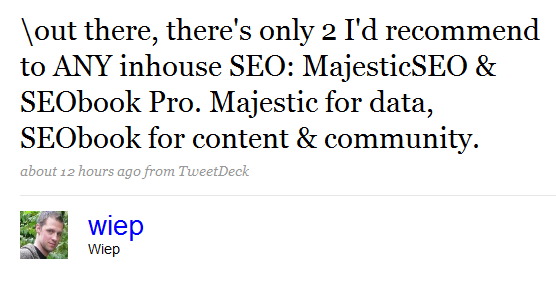
Advertising that looks like advertising is rarely as effective as the type of advertising you can generate by creating something remarkable. People spend money with the goal to influence and manipulate. But when you get word of mouth coverage it is more like helpful tips, advice, and information from a friend. Just yesterday there were 2 unsolicited Tweets about our membership program.

Each of their kind reviews is worth far more than 20 or 50 or 100 typical AdWords clicks because we don't trust advertisers - particularly in the internet marketing space. A customer who bought something and likes it provides independent social proof of value. Customer recommendations become a form of advertising that resonates.

Advertising That Resonates

In the 1960s, advertising was all about the faceless masses.

The idea was that you devise and build a product, throw it over the wall to the marketing department, who would figure out an angle, then engage in a marketing blitz. They'd try and get in front of as many eyeballs as possible, for the lowest CPM.

In the cynical, jaded 00's, advertising works on a more personal level. People are bombarded with messages, so instinctively tune most of them out. The most effective messages are those that people internalize, make personal, and pass on.

Marketing Models

Traditional marketing looked like this:

Very linear.

Modern marketing looks more like this:

Who controls the message now?

The audience.

The audience is no longer a passive recipient. The audience can pass a message on. They become a vector by which your message travels. If people don't pass your message on, chances are your message is dead.

The audience has control, because they have their hand on the remote, and on the mouse, so bombarding them or interrupting them no longer works. This is why companies try to engage people on a personal level, Google being a fine example.

Word of mouth, in other words.

Why Is Word Of Mouth King in 2009?

Word of mouth advertising is powerful because it resonates on a personal level, and it travels via established, personal networks. Those networks by-pass the mass marketing blitz, which people have long since tuned out, as those channels are low trust. They aren't trusted because they are impersonal, and politics in the 00's is all about me, me, me.

And my friends.

Word of mouth is how social media marketing is going to work. It isn't going to work using interruption or mass market techniques.

Review you message to see if it has a word of mouth quality. Is it remarkable enough for people to repeat to their friends?

Seth Godin, who I like to quote, because he puts his ideas in such a way as you want to repeat them, illustrates it like this:

First, Ten

This, in two words, is the secret of the new marketing.

Find ten people. Ten people who trust you/respect you/need you/listen to you...

Those ten people need what you have to sell, or want it. And if they love it, you win. If they love it, they'll each find you ten more people (or a hundred or a thousand or, perhaps, just three). Repeat.

If they don't love it, you need a new product. Start over.

Your idea spreads. Your business grows. Not as fast as you want, but faster than you could ever imagine.

This approach changes the posture and timing of everything you do.

You can no longer market to the anonymous masses. They're not anonymous and they're not masses. You can only market to people who are willing participants. Like this group of ten".

The thing I often find frustrating about Seth Godin is that he offers few practical examples. Perhaps his goal is to make us think.

Let's start with a checklist:

  • Is you product or service remarkable? If not, can you twist and shape it so that it is? If not, start again.
  • Who are the ten people in your niche who matter? Identify them. You need to spend your time and money being remarkable to them
  • Who are the ten people who are really resonating with your brand? Survey them. Find out why they are attracted to your service. Give them tools and reasons to spread the word

One example that springs to mind is the MLM sales launch.

These launches often target trusted industry players first, who in turn spread the message to their readers. It's celebrity endorsement. The tools are the free giveaways and marketing collateral.

Social media marketing is going to work in much the same way. In social media, people listen to people, not networks. So find out who the ten people are you need to talk to, and make your message remarkable to them. Hopefully, they'll do the rest. Handing a bottle of expensive water to Paris Hilton was no doubt a good idea.

Check out this post on developing a social network platform. Notice how he integrates outside people into the internal processes of the company.

Perhaps that's the new version of MLM.....

Differences Between Word Of Mouth And Going Viral

One of the differences between word of mouth and going viral is that in order to go viral, people need to become part of the network in order to pass the message on.

Roelof Botha, the guy behind PayPal and YouTube points out:

Many people think the word "viral" is interchangeable with "word of mouth"--implying that the product or service is so good that people are compelled to talk it up with their friends. But there's more to it than that. Google and Amazon.com are both great Internet companies, but they aren't viral businesses....word of mouth is when I tell you to shop on Zappos because I think the service is great," explains Botha. "It becomes viral when you have to be ‘in the system’ to use it. For example I can post a video on YouTube but then you would need to go to the site in order to see it

Where Does SEO/SEM Fit?

But hang on, I hear you say. I'm an SEO/SEM, what does this have to do with me?

You're already slicing up the niche and targeting via keywords. But if you're buying clicks, or targeting SERPs, you're wasting a valuable opportunity if people visit your site and forget you the moment they click away. Perhaps that person didn't buy or sign up now, but they might tell someone else about you if your message resonates with them. Your message could then skip from the search channel into their closed social networks - Twitter, Facebook, et al - which increases your exposure and reach.

To do this, your message needs to be remarkable on a personal level.

Does your site convey such a message? If I click on it for the first time, do I know the one unique thing you do that no one else can? The problem you solve for me? And would I tell my friends about it? And will you provide me with the means/tools to do so?

Shining a Light on The Dark Arts of Search Engine Optimization

I recently read a story in Forbes about how Rupert Murdock thinks Google is undermining copyright

"Should we be allowing Google to steal all our copyrights?" asked the News Corp. chief at a cable industry confab in Washington, D.C., Thursday. The answer, said Murdoch, should be, " 'Thanks, but no thanks.' "

and came across a quote about how SEO is some dark art, which kinda annoyed me. In the past I have posted examples of how media is often corrupted, but I figured another round wouldn't hurt.

Google Manipulates the Media for Profit

Direct Manipulation

Have you been negative about some of Google's new products? They might blacklist your organization.

Google Inc. has blacklisted all CNET reporters for a year, after the popular technology news website published personal information of one of Google's founders in a story about growing privacy concerns for the Internet search engine, according to a CNET statement.

Have you generally been fairly positive in covering Google's new products? Google might accidentally land the mother of all linkbaits in your lap a day early. They were keen to promote early users of Google Checkout as well. After Google bought Youtube they heavily promoted the service directly in Google's organic search results via their "universal search" strategy. They also promote select news sites directly via "universal search" in spite of how many of those newspapers complaining about allegedly getting a raw deal.

Indirect Unofficial Partnerships With Thieves

Google strategically undermines copyright, but not just in the way that guys like Rupert Murdock think. The way they *really* do it is through ranking whoever stole your content if you chose not to be indexed. Simply put, Google has partnered with virtually every online content thief (as needed) to force premium content providers to make their stuff available. Either you get credit for your work, or someone else does.

To quote Google's leaked internal review documents:

Lyrics, poems, ringtones (that the user programs rather than downloads), quotes, and proverbs have no central authority. When you see pages with this content, you cannot judge it to have been copied, and the pages should not be assigned a Spam label.

Unfortunately, some content is written specifically for Spam pages and you will not find it on another source. Although you may be convinced that the intent is to deceive, if the content makes sense and appears original, you will not be able to label such pages Spam.

If you brand something and build up perceived value and demand for it Google will offer customers "solutions."

Google further harms intellectual property holders by recommending search suggestions, and not cleansing the suggestions of illegal activities. 70% of the population doesn't care that much that 30% of the population is involved with music or software piracy, but when they conduct a Google search for "Stylewriter" and see that the some of the most popular searches for that software program are torrents then that adds social proof of value to the concept of stealing (and distributing) that copyright software. That forces publishers to offer a free trial download, or lose out on the opportunity to engage with many potential customers intercepted and misdirected by Google.

Offer Matching

Google's ad network is optimized to agnostically maximize earnings. Earnings are often optimized through the promotion of scams, fraud, and offers with hidden costs in them. Machines do an excellent job of maximizing earnings, in large part because machines have no morals.

A month ago the Google public relations team lied about cleaning up the scammy reverse billing fraud government grant ads that were polluting the web via AdWords and AdSense

"Our AdWords Content Policy does not permit ads for sites that make false claims, and we investigate and remove any ads that violate our policies," said Google in a statement e-mailed to ClickZ News. "We have discussed these issues with the Federal Trade Commission and reaffirmed our commitment to protecting users from scam ads."

In spite of allegedly being handled a month ago, those scam ads (Google's words, not mine) are still on Google today!

In spite of such scams in broad daylight, how often do you here of the dark arts of AdWords?

If you look at their video game patents they want to go so far as understanding personality flaws and character weaknesses such that they can target ads against them.

The dialogue could indicate that the player is aggressive, profane, polite, literate, illiterate, influenced by current culture or subculture, etc. Also decisions made by the players may provide more information such as whether the player is a risk taker, risk averse, aggressive, passive, intelligent, follower, leader, etc. This information may be used and analyzed in order to help select and deliver more relevant ads to users.

What might behavioral ads target at your flaws? How much could that cost you in your lifetime?

The Media Manipulates the Media for Profit

Shaping News to Generate Favorable Public Policy

In the following video Rupert Murdock mentions that he attempts to shape the news to promote some of his goal and promote things like the bogus war in Iraq.

Such "free" media campaigns had a hidden cost of about a trillion dollars and thousands of lives.

In spite of such scams in broad daylight, how often do you here of the dark arts of mainstream media?

Ads as Content

About a year ago I remember seeing a local Fox News affiliate site in Google News, and when I clicked into the "news" article, the page was actually nothing but a lead generation form. :)

Have you looked at WebMD recently? Look at how the line between ads and content has vanished with custom "sponsored content" sections published on their site. If you didn't look closely you would think that this webmd.com/learning-manage-depression/ was editorial content. As many bad health practices as there are, it is quite scary to think of all the bad health practices still practiced, and how filtered public health information is.

Shady pharmaceutical advertising is getting so bad that the FDA is warning about it.

SEO Manipulates the Media for Profit

SEO = Dark Arts

From the Forbes.com article that forced me to write this entry:

Sites like WSJ.com rely on Google to send them readers, working hard to game how they appear on Google through the dark arts of search engine optimization

If the media is employing the tactics and seeing results then why are they still using that stupid dark arts lens to describe SEO? Even Forbes.com is selling text links to pass PageRank (example pictured below).

Forbes.com = the Darth Vader of SEO

Forbes has worked with at least 3 different SEO firms, has hosted many high profit doorway pages, blatantly violate search engine guidelines by selling links to drive PageRank, and yet they still call SEO "dark arts" as though it is some type of voodoo.

How ignorant can a reporter be of why his job is going away and why their employer can not compete? If you were a reporter by trade, wouldn't there be a mite of curiosity that causes you to actually research what you are writing about, especially if it involved your own job security?

What can we do to cure reporters of their SEO ignorance?

Amazon Cans PPC Affiliates

Via an email to affiliates, Amazon.com announced they are scaling back their associates program in North America by disallowing direct linking from paid search results:

After careful review of how we are investing our advertising resources, we have made the decision to no longer pay referral fees to Associates who send users to www.amazon.com, www.amazon.ca, or www.endless.com through keyword bidding and other paid search on Google, Yahoo, MSN, and other search engines, and their extended search networks. If you're not sure if this change affects you, please visit this page for FAQs.

As of May 1, 2009, Associates will not be paid referral fees for paid search traffic. Also, in connection with this change, as of May 1, 2009, Amazon will no longer make data feeds available to Associates for the purpose of sending users to the Amazon websites in the US or Canada via paid search.

As the paid search market has matured and competitive research tools have improved the value of using affiliates for discovering new keywords has been sharply reduced. Other merchants will follow Amazon's lead. Some might wait for the economy to pick up first, but the fact that Amazon is trimming this in a down market (recession/possible depression) shows how little they feel they benefit from affiliate arbitrage of paid search results.

Yet another reason to find SEO based affiliate work more stable than PPC affiliate efforts. Any PPC-based affiliate that is sick of having to rebuild from the ground up over and over again would be smart to (and is welcome to) taking the enlightened path :)

Secret Matt Cutts Video Unveiled

Proven Instant Automatic Wealth Attraction Secrets - Autopilot Cash

Everywhere you look on the internet, there are people who try to convince you that marketing success can be reduced to a formula.

Get rich quick ebooks are a classic example. Hand over $97, follow the guaranteed steps, and you'll get the exact results the author claims. Yes, you, too, will be able to hold up a huge, comedy check, featuring lots of zeros!

SEO forums are filled with questions that presume prescriptive answers: "what keyword density should I use?", "How many links do I need to rank #1?" "How many words should I have on a page?" "How many outbound links are too many? "

Unfortunately, a successful internet business can't be reduced to a simple, paint-by-numbers prescription. If it could, those e-books would be selling for a lot more money, and nobody would be giving away tips in forums.

Paint-by-numbers marketing produces a facsimile of where someone has already been, but the market has long since moved on.

Take A Holistic Approach

The way to approach internet marketing is to do so in a holistic manner.

Once you understand the underlying philosophy of various tactics and strategies, you'll be more likely to apply them successfully, and adapt them to devise new strategies.

There are underlying patterns common to the most successful sites. Once you identify and and internalize these patterns, you can easily out-maneuver any competitors who may be locked into a more inflexible, prescriptive approach.

Bad Artists Borrow, Great Artists Steal

That quote is often attributed to Pablo Picasso. What I suspect he was getting at is that bad artists copy surface techniques. Great artists, on the other hand, get inside an idea. They internalize it. Then they innovate to produce something genuinely new.

For example, many people will advise you to start a blog.

Whilst that might have been an attention-getting idea in 2001, starting a blog today isn't worth remarking upon. Blogs generated a lot of attention early on because they provided an easy way for people to become citizen journalists, and the writing style was somewhat new, at least in when compared to conventional journalism.

Blogging used the personal voice of the opinions pages, as opposed to impersonal voice to the reporting pages. Blogs also provided immediacy in the days before Google News. Twitter has now leap-frogged blogs and news outlets to provide that very function.

These days, the biggest sites on the internet use nothing but the personal voice i.e Twitter, Facebook etc - and the barriers to producing content are very low. Anyone can publish web content. So the blogging Cluetrain has long since left the station.

Instead of copying the format - the surface - try to provide the type of information people want. That's where the idea for blogs came from. That's where newspapers came from. They solved an information problem for people.

One trend right now is social networking, but this results in a shallow surface of unreliable information. There is a growing flight to quality information, which people will pay to read. Some of the best information on the web is now being locked up behind pay walls.

Ask yourself the fundamental questions. What need is your site serving? Is that need changing? Where will your sites audience be in six months or a years time?

That's where you should aim now.

The future is where Google focuses their efforts:

We started with the early-adopter crowd. That was on purpose. We wanted to build a product for people who were getting hundreds of e-mails a day, because we believe by focusing on the power user, you're designing the product the rest of the market will want in a couple years when everyone's usage habits catch up to the most active users.

Barrier To Entry

When some guru tells you "a secret" - i.e. to get into mobile ring tones - he's safe in the knowledge the area is already saturated and he has moved on.

Once you see that sort of information published in the public domain, it's too late. The horse has bolted. But he will still tell you the market is ripe and that you should sign up under his affiliate link. Even if you lose money he still profits from your efforts. You are the key ingredient of their wealth generation formula, you just don't know it yet. ;)

One good way to evaluate the worth of such prescriptions is to evaluate the barrier to entry. A barrier to entry is some condition that makes it difficult for late entrants to enter a market. An example of a barrier to entry would be, say, the start-up cost of an airline. The capital investment required is significant, which disqualifies most of us ever starting one.

On the internet, if anyone can copy a technique cheaply and easily, then it almost certainly won't work. Once a technique is out there, too many people will copy it, which dilutes the market to the point where it fast becomes uneconomic. Do you think starting a blog today and running Adsense on it will make you money? It might, but it will also require a lot of work, luck and a significant point of difference. Without those fundamentals, it will remain unread, and is highly unlikely to make money.

So look for areas that have a barrier to entry. Do you have an established brand you can leverage? Can you partner with someone who does? Can you spot a niche where none of the players are spending much? What happens if you throw some money at it? Do you have a means of grabbing attention that other people don't have?

What is your point of difference? And can you make it defensible?

Steal A Business Plan, Apply It To A Different Niche

In the financial world, investment firms often use forensic accountants to deconstruct the tactics and strategies of their competitors.

One famous example is Harry Markopolus, who worked out that Bernie Madoff was running a Ponzi scheme. Markopolus bosses wanted to learn how they could match Madoff's double-digit returns. He was assigned to deconstruct Madoff's strategy to see if he could replicate it.

If you've found a new niche, try applying a model that has already proved to be successful in another niche. Deconstruct the features, tactics and philosophies of the successful site, and either go head to head, or even better, apply those same strategies to a new niche.

For example, one characteristic common to many successful sites is that they were first movers. They were in the niche early enough to command attention simply by existing. Can you slice the niche you're in even finer in order to be seen as a first mover?

You could also try the same idea in different geographic locations. TradeMe is a New Zealand version of Ebay. New Zealand is a tiny market, but TradeMe recently sold for $700 million, mainly because it was a big fish in a small pond. The business idea was the same proven idea as Ebay, simply applied to a different regional niche.

Show Leadership & Connect People

As Seth Godin notes, what works today is leading:

Leading a (relatively) small group of people. Taking them somewhere they'd like to go. Connecting them to one another....a tiny sliver of the market is enough. Bill Niman used to run Niman Ranch, a cooperative raising meat for fancy restaurants and markets. That was already a sliver of the huge huge market for meat. He moved on to start BN, a 1000 acre farm raising goats for a subset of that subset. It's enough. It's enough if the tribe you lead knows about you and cares about you and wants to follow you.....go down the list of online success stories. The big winners are organizations that give tribes of people a platform to connect.....People want to connect. They want you to do the connecting.

If you look around the search niche, you'll find the biggest sites have very clear leadership. These sites also serve as connectors for the community. The least significant search blogs follow others and repeat information. But the audience doesn't want that. Someone who follows the followers isn't valuable to them.

You don't need to pull in a big community, you simply need to lead whatever niche you happen to be in. Look for ways you can carve out you own leadership niche, then connect people within that niche.

People want to be led. They want someone to follow.

What can you teach others? What can you help them to do? How can you connect them to each other?

If You Don't Rank, Did You Fail?

There's a great Nike commercial starring Michael Jordan.

I’ve missed more than 9000 shots in my career. I’ve lost almost 300 games. 26 times I’ve been trusted to take the game winning shot and missed. I’ve failed over and over and over again in my life. And that is why I succeed

How many SEO goals are aimed at winning the battle, and not the war?

Rankings vs Profits

One of the big mistakes those new to SEO make is to focus too much attention on rankings. It's easy to see why, as rankings provide such an obvious scorecard. You either rank or you don't.

The trouble is, rankings are seldom an appropriate measure of success, just as Michael Jordan shooting or missing an easy shot doesn't make him a success or a failure.

For example, I recently saw a comment on a leading SEO site whereby the commenter chastised the site owner for not appearing top ten for the phrase "search engine optimization". As far as the commenter was concerned, this meant the SEO was a failure at SEO, because he didn't rank for that industry-defining phrase.

What the commenter failed to grasp, of course, was the big picture.

What is Your Primary Objective?

I would estimate the site in question receives 100s of thousands of visitors, and that their business model delivers significant revenue. The fact they don't rank for the phrase "search engine optimization" is pretty much irrelevant in terms of their primary objective, which is to make money.

Secondly, the term "search engine optimization" isn't the prize some might imagine. The people who use the term "search engine optimization" may well be optimizers, not potential customers. That's fine if your target market is other SEOs, but not if you're selling services to customers.

Thirdly, you would need to put a lot of effort into ranking for such a term, and you'd have to question whether it would ever pay off. Contrast this with the effort required to rank well for a wide range of related keyword terms that, when aggregated, produce more highly targeted traffic than "Search engine optimization" ever would. This site may well have lost the ranking battle for that keyword term, but they're probably winning the war.

Business is About Making Money

The guy who focuses too much on ranking as an end goal will ultimately fail, because ranking is not a business goal. This is not to say rankings aren't important - a number one ranking for a lucrative term is worth a lot of money - but if the ranking isn't tied into your business goals, then how do you really know if you're succeeding or not?

Michael Jordan's is probably the greatest basketball player of all time. The greatest SEO of all time probably doesn't care that much about rankings day to day, s/he probably cares about the overall goal, which is almost always to make money.

What an Online Business Needs to Succeed

There's an interview here with Shoemoney where he talks about the three things an internet business needs to work:

  • Has To Make Money
  • Has To Grow Virally
  • Provides A Needed Service

Note that those goals are all business orientated. He doesn't say rank well, or get the most traffic, or appear in Technorati's Top 100. Those aspects might be part of a strategy, but if those are an SEOs end goals, then they're probably not going to be in the internet game very long.

Creating Engagement

That second point is one often overlooked by SEOs. If you rank well, and get traffic, and that traffic only engages with you once, then does that really support your business goals? Someone who visits once and leaves is not nearly as valuable as the visitor who returns often, or helps spread the word about you. Does you strategy focus on achieving that very valuable outcome?

Consider the value of an average site visitor to this site versus a person who subscribes to the RSS feed, sets up a user account, installs our SEO tools in their browser, and hopefully becomes a premium member. The average visitor comes and goes - thousands of them, every single day. Most of them are worthless to our business objectives, but those who commit to repeated engagement generate word of mouth marketing and are more likely to become customers. We give our visitors about a half dozen ways to engage with us. The increased engagement builds trust. That leads to subscriptions, and anytime we have an important announcement, we know over 100,000 people will see it.

In the book "The Dip", by Seth Godin, Seth offers some practical suggestions on how you can turn failure to your advantage. Just as Michael Jordan probably learned a lot from the shots he missed, so can we by redefining failure as an inevitable part of success.

when you see failure as a learning event, not a destination, it makes you smarter, faster

In this interview, Seth illustrates how big companies can focus on the wrong (expensive) battles, and lose the war:

Here's an easy one—Bud TV. They've spent more than $40 million on it so far, yet if we look at their traffic numbers they do worse than a site on sheet rubber sales. What happened? Budweiser had a top down, we-speak-to-the-public mindset when it comes to commercials. They buy Super Bowl commercials for $2 million or $3 million each because they can. Bud TV was all about "let's send messages straight to consumers." Hold that up next to YouTube, which was built from the ground up around individuals sharing with each other, and Bud TV lost. Wouldn't it have been better if they had just embraced YouTube and used it for what it was good at, rather than trying to build their own channel and invent their own form of new media?

We Have Failed, Just Like Bud

Not every site we launch is profitable. Sometimes we start a site and then realize we lack the passion to go through with it, other times major algorithm shifts and/or competitors shifting strategies have made sites heavily reliant on certain models/ideas/strategies no longer profitable.

The beauty of failure online is that it costs almost nothing to leave a failed website running, and you can always come back to it later, or use it nepotistically to help make it pay for itself. If you lose $10,000 on building a website then it only needs to about 3 years for it to pay for itself if it makes $10 a day - and less time if you are using it nepotistically. How much does it cost to rent a good link from the clean parts of the web?

And that leads to one of the best tips in the SEO space. If you are successful somewhere, try to work related markets such that you can take best practice knowledge to make your future projects much more successful. You are better off dominating a market than being an average to slightly below average playing in a dozen markets.

And we have sites that have worked far better than expected. Tools like SEO for Firefox give you a good idea of roughly how competitive a market is, but it is hard to know what lucky breaks you will get or be 100% certain you will rank a brand new site in a competitive market. Strategy and experience increase your odds of success, but algorithms can and do change. Take what the search engines give you and keep doing what is working. Sometimes that means buying a site they already like. Don't hate Google, simply create (and replicate) what they want.

What Are Your Goals? Why?

Constantly re-evaluate your marketing strategy to see if it is leading you towards winning the battle, but losing the war.

What are you measures of success and failure in terms of SEO? What are you measuring, and how?

Related Reading:

SEO For Start-Ups

In a startup, people usually adopt a variety of roles through sheer necessity. You switch from writing killer code to making the coffee and sweeping the floors. Along with everything else you need to do, you've got to find a way to market your company.

Does your start-up have a plan for SEO?

SEO is a strategy often ignored by startups. However, with millions of searches performed daily, good SEO can drive people to your door for little expense. By working smart, you can achieve marketing results that big companies often struggle to deliver. One of the biggest advantages a start-up has, in terms of SEO, is starting from scratch, thus avoiding many of the legacy issues that affect established sites and brands.

Let's take a look at a cheap and effective SEO strategy geared towards startups.

Background - Why SEO Is Valuable

SEO, like any other form of marketing, is about connecting with an audience.

Unlike PR and other forms of marketing, SEO isn't about affecting change in the mind of the consumer. Search is conservative in that searchers must already be aware of an idea in order to formulate a search query. People cannot search for something of which they aren't already aware.

This notion would seem to run counter to the marketing goals of a startup, as startups often seek to promote new ideas and approaches. However, start-ups often refine services or products that already exist .

For example, QuickBooks produces accounting software. By appearing under keyword terms, such as "accounting", "accounting software", etc, QuickBooks could sell to people who aren't aware of the Quickbooks brand simply by aligning their site with concepts the potential customer is already familiar with, in this case "accounting software". This approach is especially important for start-ups because they usually don't have a great deal of brand awareness.

Check out the Google Keyword Research tool. You'll discover ists of keyword terms your potential customers have used to describe problems they have, and services and goods they wish to find.

Generate a few keyword lists relating to your niche. What phrases are people looking for? What terminology are they using? How many searches are being conducted? This tool can give you a valuable insight into the minds of your customers. The take-away point is that in order to do well in SEO, you should look to orient your site around the terminology already used by your prospective customers.

Here's a specific six step plan for implementing SEO at a startup. We'll cover the high level concepts, and link to technical demonstrations.

1. Nail The Basics

A lot of companies hamper their SEO efforts in the site design phase. Big companies, due to the conflicting requirements of various stakeholders, often compromise SEO efforts by implementing designs that aren't conducive to high rankings.

There are three main areas you need to nail:

  • Crawablilty - can the spider crawl and index your site?
  • Terminology - are you using the same terminology that your audience is using?
  • Remarkability - do people link to your site?

In order to be crawlable, keep the site design and architecture as simple as possible. Search engines like simple. Simple means standard html links, body text, and clear, hierarchically ordered pages. Search engines don't particularly like flash, lengthy URLs, scripting, Flash, Ajax and other whirls and flashes. The closer you are to W3C conventions, the better.

Wikipedia is an example of a search friendly site. This is not to say your site need be encyclopedic and graphically sparse, however you do need to pay particular attention to your internal linking methods, body copy and site architecture. Wikipedia uses a lot of cross links to other content on the site. A good test of crawlability is that the site can be viewed using a text-only browser.

Your site should use terminology your audience uses. We'll look at ways to find this information out shortly.

Your site should be remarkable. You want people to link to you, as links are one of the most important factors in Google's ranking algorithms. Seth Godin talks a lot about about "being remarkable" in his book "The Purple Cow", which is essential reading for any start-up looking to make a mark.

Cows, after you've seen them for a while, are boring. They may be well-bred cows, Six Sigma cows, cows lit by a beautiful light, but they are still boring. A Purple Cow, though: Now, that would really stand out. The essence of the Purple Cow -- the reason it would shine among a crowd of perfectly competent, even undeniably excellent cows -- is that it would be remarkable. Something remarkable is worth talking about, worth paying attention to. Boring stuff quickly becomes invisible

Do you have a strategy to produce content that is worth talking about?

2. Know What Your Audience Is Thinking

Do you know what terminology your audience uses?

If you know this information, you can integrate keywords into your pages, headings and titles, which will improve the likelihood of your results showing up in search results.

Using free tools, such as the Google Keyword Research Tool & the SEO Book Keyword Research Tool, you can gain a valuable insight into the minds of your prospective customers. Here's a video showing how to use them.

The aim is to create lists of keyword terms your audience is already using, and align your site with those keyword streams. Given that most searches are unique, you can create variations on these keyword terms to capture as much traffic as possible.

The Value Of Pre-Testing Keywords

Because search engine optimization can take time to show results, it's often a good idea to test keyword terms using PPC. Once you have a list of prospective keywords, you can set up a PPC campaign, run it for a short period of time, see which keyword terms you had the most and least success with, then use the most successful terms in your SEO campaign.

For example, let's say a fictitious company, CoolBabyBuggies.com is a start up that manufactures a trendy baby buggies. They brainstorm keywords, and comes up with the following list:

baby buggies
strollers
prams
mountain buggy baby
baby jogger

If we put each term into the search tool, we get a lists of potential keyword terms, and the frequency with which they are searched:

If you scroll down to the bottom, you can also see synonyms and related terms:

After such a session, we might end up with a more comprehensive list that looks like this:

Such lists can contain hundreds or thousands of closely related terms, covering the variety of terms people use to describe the same thing.

Next, start a PPC campaign that incorporates these keyword terms.

After a week or so, you'll get an idea of how many people search on each term, and what snippet information they will likely click on. You can use the most successful keyword terms in your SEO campaign. Integrate the most successful terms - successful meaning terms people search on and are closely aligned with the commercial aims of your site - into page titles, headings, and sprinkle them throughout your body copy. Use them as topic starters. Be sure to use semantic variations, too.

If this company really wanted to test the effectiveness of certain terms, they could set up a page that measured a desired action. For example, if they tracked a searcher from the ad click through to a sign-up on an inquiry page or a sales page. Here's a step-by-step guide on how to use analytics.

You then use the most lucrative terms in your SEO campaign.

Of course, if the PPC campaign pays dividends i.e. the cost of running the campaign is less than the return, then by all means keep it going. If you appear in both the PPC and search engine results listings for the same terms you increase the likelihood of getting the click. As you can see from this screenshot, FreshBooks ranks well and advertises under the same keywords, boosting their chances for a click.

3. Seek Attention - And Links

News, by it's very nature, is oriented towards the new and different. "News" is something worth remarking upon.

A startup, by definition, is new, and hopefully different enough from existing services to be remarkable. Your traditional PR efforts - appearing at conferences & demos, press releases, news items, etc - can be leveraged for advantage in the search engines.

Search engines place a lot of emphasis on links, and the keywords contained within those links. Whenever you appear in media, try and get a link back to your site. If you have a name or byline that includes the nature of your service, all the better.

For example," FreshBooks - Online Invoicing". The byline in the link that describes the service, if it appears in a link, will help FreshBooks.com rank for the term "online invoicing". A searcher wouldn't need to know the name of the company, only the nature of the service they provide. So be descriptive, especially in your linking.

4. Make Your Content Remarkable

What type of site do you think has more chance of gaining search engine traffic - a brochure site or a site based on a publishing model?

When fishing, you can catch more fish with a net as opposed to a single line. The same is true for sites in search engines. The more pages you have, the wider your net is cast, and the more search visitors you'll receive. So, consider adopting a publishing model. Think about ways you can regularly publish remarkable information. Ways of doing this include blogs, forums and how-to articles.

Search engines reward fresh, rich content. They're less enamored by the sales pitch of the online brochure. The exception is if the brochure site has very strong inbound linking from external sites. Trouble is, it's difficult to get those links unless the service you offer is truly unique and game changing.

Your content also needs to be unique. Search engines have filters that weed out duplicate content. If you don't have the time to produce content, consider starting forums where users ask questions. If the community thrives, they'll provide fresh content for you.

Is there offline documentation you can incorporate into your web site, such as manuals and case studies? Even if such content doesn't form part of the your main navigation, it's a good idea to include as many pages as possible. Link this content back to your money pages, and be sure to use keywords in the links.

5. Get Outside Help

What networks do you have in place? Who are your suppliers, venture capitalists, customers and other partners? Tap them on the shoulder and ask for links.

Write articles and ask your partners to publish them on their sites, then link those articles back to your site. Leverage any presence they may have to increase your own.

Are you part of a broader movement? Is there a bandwagon you can jump on? Web 2.0 was a marketing term dreamed up by O'Reilly Media to describe a wide range of sites that loosely shared a common approach to web development and collaboration on the web.

In reality, these sites weren't doing anything particularly new of revolutionary, but by defining themselves as part of a revolutionary movement, this group made their marketing job easier. Sites became worth remarking upon simply because they declared themselves part of the Web 2.0 club. Look around to see if you're part of a broader collective, and leverage any newsworthy, and link-worthy, opportunities that come your way as a result.

Another approach for those short of money is to form a co-op. Can you swap services with other companies? When you do so, be sure to write about it and swap links.

Whenever you make connections, think links. Once you get into a habit of regularly producing rich remarkable content, and getting links, rankings will naturally follow.

6. Competitive Intelligence

Who outranks you in your niche?

You can learn a lot about SEO by looking at what your high ranking competitors are going .

Use (mostly) free services like Compete.com for the leading sites in your niche. What approach are they using? How often are they publishing? What type of content are they publishing? What does their external link structure look like?

You can reverse-engineer your competitors SEO strategies using the SEOBook Toolbar. Aaron explains how to use it in the video.

One area to focus on is the inbound links your competitors have gained from external sites. If you can get links from the same sources, you'll be able to compete with them on keyword terms. You also might discover some alliances and customers you might not know they had.

Mike Grehan Interview

Many thanks for talking with us today, Mike. We've spent a few messy evenings drinking girly Merlots, but for those who don't know you, can you be so kind as to introduce yourself?

Ahhhh… those halcyon Merlot fuelled days… I remember them well… (truth be known, with all that Merlot, I don't remember much at all!).

So for those folks who are new to the industry, I can give a little background.

I first invented the Internet back in the 1960s. I had a young whippersnapper working for me as my assistant at the time. Al Gore was his name. I believe he grew up and took some sort of job with the government. Not sure where he is now.

In about 1965 I coined the term “hypertext,” which I was thrilled about. It didn't actually mean anything, but it sounded really cool. I used to drink with a guy called Ted Nelson who thought this was a pretty cool word, too. Ted's an old scientist living here in New York. And we do laugh when we get together about all of those people who have assumed that it was him who coined the term. Boy, must we have been drunk that night.

After messing around in physics (it being the new rock and roll, of course) I moved to Geneva, Switzerland and took a job at the European Organization for Nuclear Research. It was a pretty dull job actually – same thing day-in, day-out. Atomic nuclei can get pretty boring to interact with. Plus I didn't like the special suit.

On one occasion, I was working with a complete dunderhead by the name of Tim Berners Lee. He was one of those guys that you just knew was never going to amount to anything in life. I explained to him that, during my morning shower, I had this brilliant idea to apply hypertext to the internet. He was so excited.. Mike, he said, I think you've just invented the… interweb!

Stupid boy!

Anyway, after being knighted by Her Majesty the Queen for my sterling work inventing what we now know as the “World Wide Web,” I thought I'd better do something practical with it. By now there was a lot of stuff out there and it was getting difficult to find anything. I was a visiting lecturer at Stanford University at the time and hooked up with a couple of kids called Larry Page and Sergey Brin.

This was not a good experience for me. These guys came to my dorm one night and stole a paper I had written called, “The Anatomy of a Large-Scale Hypertextual Web Search Engine.” I even had a pet name for it. I called it “Google.” I thought that was quite cool and trendy, what with Google being a play on the word goggle, which means to ogle women. Some time later, I read some bullshit from these guys who stole my idea that it had something to do with "googol," which is the Californian pronunciation for a word which also means to ogle women… er… I think.

I'm in the process of suing these Google jokers for almost 600 bucks to cover the amount of time it took me to write the paper. I'm not stupid… I'll get every penny of it, I bet!

Eventually, I moved away from search, mainly because it doesn't work properly and never will. So, I invented my latest toy, which I call Twitter. I called it Twitter because it's full of twits talking bits of shit to each other. Shitter.com had already gone by then, unfortunately.

Oh! Fancy me forgetting to mention Wikipedia! I actually invented that as a joke and people started taking it seriously. What fun!! People are failing exams because it's full of false crap. Some people have been seriously injured for the rest of their lives for taking some of the medical advice… ROFL

I'm on the verge of leaving the internet space to work on my new invention, which is very much a green thing. Imagine this: Reusable toilet paper! Heh! How cool is that. Some people have called it a flannel. In fact, some have called it a face cloth. Dood, I wouldn't want that near my face knowing where it had been before. Eeeuuwww!

Anyway… these are just some of the excellent things I've done in my extremely interesting life. What other brilliant things do you need to know about me? Being as modest as I am, I may not be able to answer all of your questions of course…

Every word Mike says is true :)

In your paper "New Signals To Search Engines", you frame search in a historical context - where it has been, where it is now, and where it might be going. What are the major changes coming up that will have the most impact on current SEO practices and goals?

Grehan now puts serious head on…

I've talked about how search engine optimization evolved in the first instance. It was driven by the limitations of the technology used by search engines. Basically, the World Wide Web was developed to do one thing – but everyone wants it to do another. So, crawling the web using the HTTP protocol was the obvious route to go for search engines back then.

But if Google is saying they now have seen a trillion URLs and have no certainty that they'll ever be able to crawl them in a timely fashion, maybe we've reached the zenith of the crawl. Not only that, the end user is expecting a much richer experience. So if the main job of SEO was to optimize static web pages and make them available to crawlers, it's all becoming a little passé now.

Have we seen the end of HTML and the crawler? Absolutely not. But the level of requirement for SEO work is going to diminish, rather like that of the blacksmith when motorized transport was introduced. Do we still have blacksmiths today? For sure, but they're not as required as they used to be.

The main changes will be in existing SEO shops either moving into other technical/development work or retraining in other online marketing disciplines. It's a very exciting time in search. Most marketers can see that. But those people from a purely technical background and used to just doing geeky code for a crawler don't see it that way.

You mention that user trails - as provided by the toolbar, tagging etc - will become some of the strongest signals. That's pretty much the death knell of traditional SEO, isn't it?

If we take what I said in the answer to the last question, you can see that traditional SEO as we know it has had to evolve anyway. I don't really think of link building as SEO, to be honest. For me, link building is the by-product of good marketing. Whereas fixing pages for a crawler is purely a technical process.

What needs to be taken into account most importantly is not where SEO goes to next, or whether it survives at all. It's about where search goes to next and how the end user evolves with those changes. Making pages for crawlers and getting links for the sole purpose of getting links omits one thing from the equation: the end user experience.

So, now that search engines can follow end users they can see where they started and where they dropped off. That kind of data is so important. It's the wisdom of crowds. It's the people's vote. So how does a marketer get involved there? It's going to be a little clichéd, but create an experience - not a web page.

Last year, Eric Schmidt CEO of Google, said an interesting thing in an interview. He mentioned - and I'm paraphrasing here - "that the Internet is a "cesspool" where false information thrives, and that "brands are the way to rise above the cesspool". Do you think brands might be an important signal of quality?

I read that interview too.

He was stating the obvious to be honest. People have long bemoaned the fact that smaller businesses don't get the same shelf space in search as the big brands (the same applies offline, of course). Brand building is all about good marketing. It's all about building trust and reputation. But wait for this… It's not just about the big boys. A local store can build up as much trust and reputation within its community as well as a high street chain.

Social networking sites are all about people building up trust and reputation on a personal level. So, I think the notion of brands as we've known them – such as multi-nationals like Exxon – is going away. I think we're moving more into social search and that's all about tapping into a network of trust.

Addressing your question directly: "Do you think brands might be an important signal of quality?" As long as those brands belong to the end user and not large corporations, and that's certainly what's happening, then yes, a great signal of quality.

Social media, for want of a better term, is a "place" where most content is being generated, and increasingly where many people are spending their time. What are your thoughts on, say, Twitter? What are the implications for Google and other big search engines when people rely on real-time wisdom-of-crowds, and communities, for answers?

So we've already touched on this a little when talking about tapping into a network of trust. Absolutely this is a very important move. The results you get at search engines are hardly verified results and they can be manipulated. That means you have what a mathematical formula (the algorithm) believes are the best ranked documents. And then you have a little re-ranking going on when Ralph Tegtmeir gets to them!

However, if you tap into a network of trust, such as a parenting group, and ask them a about a child's allergy, the information is likely to be much more verified. If 500 parents all agree that a certain method works then that's more trustworthy information than a search engine algorithm can provide.

But there's a whole lot more to it than me Tweeting my followers and asking which is the best Irish pub in New York and wanting an answer now!

Can we talk a little about formats. You make the point that HTML may have served us well up to now, but things are changing. The web is becoming media rich. What does this mean for SEO? Do search marketers become multi-media positioners?

I saw a quote from a senior scientist at Google where he said we’re moving "away from a web of content to a web of applications." So it's more about the end user experience and the method of delivery, as opposed to one protocol over another. I don't think HTTP/HTML is going away anytime soon. But it's not going to be the primary method for internet search going forward.

People are already talking about new platforms. One idea is Flash. I like that. Or maybe pure java. Most certainly social search into networks of trust and live search via apps such as Twitter will further develop in the future.

We spend a lot of time on SEOBook connecting-the-dots between areas such as seo, brand and traditional marketing. You've said "connected marketing" is the future of marketing. Can you talk a little about this? This is the point where big worlds collide, isn't it?

Connected marketing is a kind of generic term for the new audience of always-on, 24-hour-a-day networks. I use the iPhone as a primary example of how to connect with your audience in so many different ways. Sure, it could be the HTTP/HTML route as it comes with a browser. But there are also so many apps you can download. You can get to your audience via email, txt, Twitter. You'll be surprised at this… you can even use it as a telephone!

It is about big worlds colliding. It's not just that technology has changed so we market via different channels to the same people. It's more about how the audience has changed. And so we have to change the way we connect with them.

I don't think that conventional methods such as the 30-second spot are going away anytime soon. But we need to examine all areas of this new marketing mix and get our messaging aligned.

If traditional SEO is at a point of diminishing value, what are the things an SEO can do to adapt to this brave new world?

First of all, stop using just SEO. The job we've been doing to help search engines do a job they should have been doing themselves is not as critical as it was. Crawlers are getting smarter and the communication between search engines and SEOs is much more transparent now. Search engines provide many tools to make the process of letting them know that you have good indexable content available.

But as the end user demands a much richer experience, search engines need to know a lot more about other types of content. Not just the textual HTML pages that SEOs labor over.

It is a brave new world of marketing. It's tremendously exciting. But you do have to start and think more about smart marketing and less about smart HTML coding.

There's a plethora of books and information on social media, optimizing video and perhaps, more importantly, analytics which open up this whole new world of marketing. As the value of providing pure SEO services diminishes, the value of new services increases. This is not a bad time for search marketing: It's the best it has ever been!

Many thanks, Mike.

Mike Grehan is Global KDM Officer with Acronym Media, a leading search marketing company based in New York's landmark Empire State Building. Follow Mike on Twitter here.

Pages