Sustainable Business Models
Most Sustainable Businesses Charge Recurring Fees for a Recurring Service / Relationship
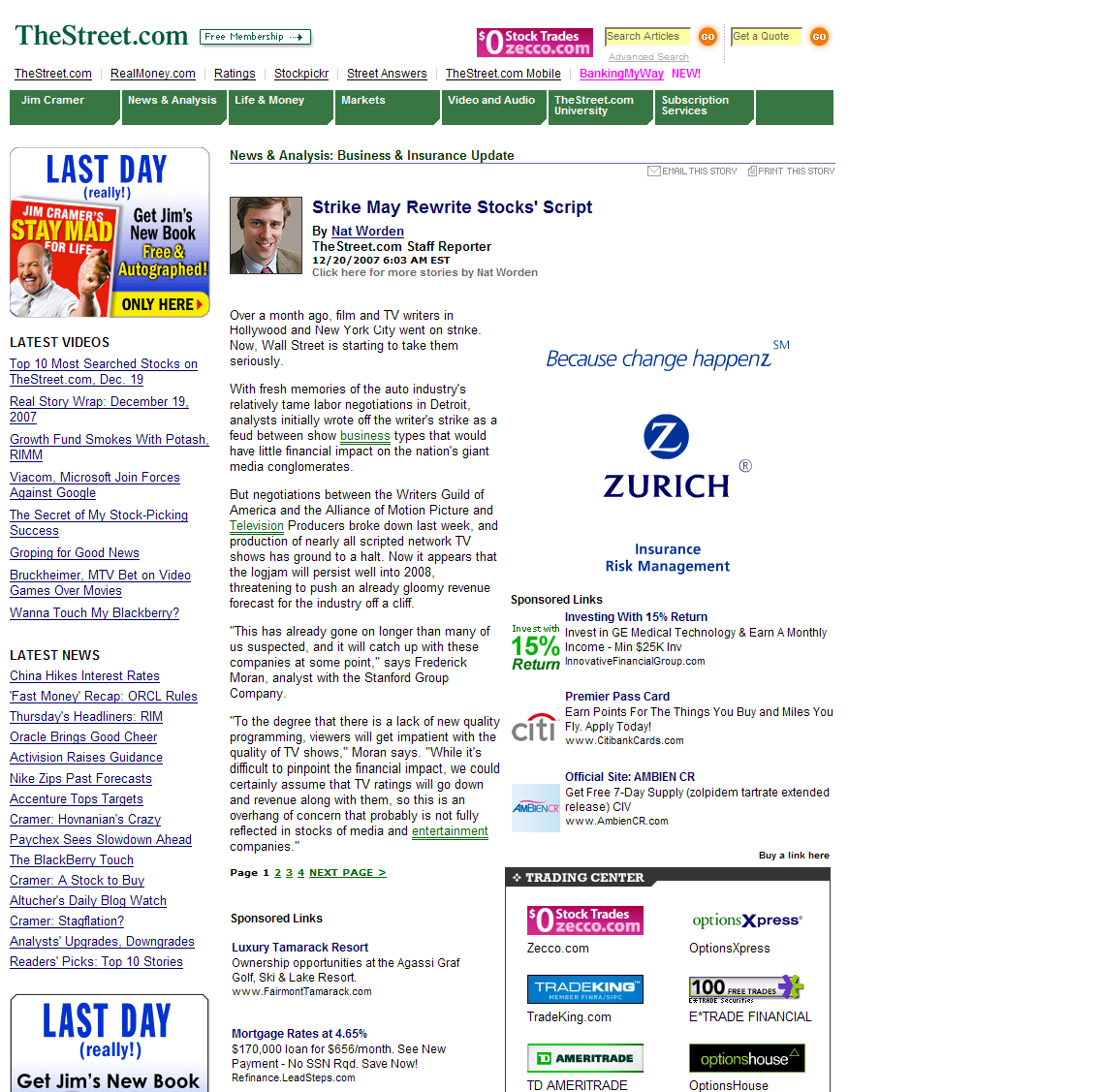
Lots of sites, even more mainstream traditional publishing businesses, are deciding that the effective model to publish is to give everything away free, and charge recurring for anything you sell. Take a look at this image. Notice how in the top left there is an ad for house content offering a free gift that signs you on to a recurring subscription.
Charging More Can Increase Quality
Sometimes by charging more and making things less accessible you can make them better. Take the comment quality on this site. Requiring registration to comment is a cost in time and effort. Now that we require a user account to comment, people who interact with the site have stated that the conversation quality has improved:
I remember all the trolls that were here before the new login system went into affect and it seems to have helped. I know what spam can be like on my blog and I know that's nowhere how much attention you get here.
Making Sense Out of Complexity
Search Keeps Increasing in Complexity
As Graywolf stated, it is getting harder to profitably run thin affiliate sites:
In the coming months smaller publishers are going to have more competition from more and more larger publishers. Instead of the default one Wikipedia listing to contend with, you’ll now have one Wikipedia, one knol, and maybe a squidoo or Mahalo listing as well. Unless you start building good linkable content that builds your link equity it’s going to become more and more difficult to rank.
Not only is the competition increasing, but with Google aggressively hand editing their search results the answers to many questions about the best strategy to use depend on the site, its vertical, its design, its age, its brand, who owns it, how long it has been around, and how clean its link profile is. In other words, search (and thus SEO) keeps getting more subjective.
But Do People Want a More Complex Book?
The only way to counter this increasing complexity with a book is to write a book that grows to 1,000 pages thick. But who wants to read that much in one sitting? I had trouble getting through books half that size covering topics that were much less subjective and much less complex.
The web allows us to jump from idea to idea and consume as we like. Shouldn't information about web marketing be structured in a way similar to how the web is structured? One of the people who took my recent customer survey said:
I really like your book, great stuff. The only negative is that it's too long, kind of overwhelming.
I really think to stay successful in online markets you have to sell an experience more than information or an item. As an individual, it is hard to create an experience for 20,000 people unless there is a community or some form of interactivity to it. You have to let people learn a bit if they want to, or dig in where they really want to learn. Different people learn different ways. What might be easy for you and me might not be so easy for others to learn.
Interaction & Perceived Value
The Product Dialog
Creating a book is like a monologue. You are able to convey a lot of knowledge in a linearized format, but I don't think everyone prefers to learn that way.
In a single day I got
- a refund request telling me that my book had no useful information in it,
- a refund request telling me that my book was overwhelming, and
- an email from a head of search quality at a major search engine telling me that "he bound my ebook, and it is required reading for everyone on his team."
If the problem existed only on one end (too complex or too shallow) that would be solvable, but it being claimed an issue on both ends is something much harder to solve, which hints at the growing irrelevancy of the format (relative to how we desire to learn and the vast array of potential customers).
The Perceived Value of Ebooks is Dropping
Ebooks, by and large, are perceived to be of low quality because most are of low quality. If that wasn't bad enough, Google made a blog post essentially voting against ebooks, grouping ebook sites amongst sites that may merit a low quality score. While the strength of my blog and brand means that Google is not likely to ban my business model, their indictment of the ebook field as a whole, and their power over the web, indicate that there is great risk is staying branded as an ebook author / publisher.
Add to that a leading not for profit organization in the search marketing field writing a 3 part series on how you can't learn SEO from a book, and that further lowers the perceived value of a book on SEO.
To appreciate how price-point can change the perception of the value of a product, compare the feedback here from a person who bought my book to a person who won it.
Copyright is Growing Irrelevant
My Current Format Encourages Theft
Some people who buy my ebook tell me that they "accidentally" purchased it. Others send me berating emails calling me a thief within 2 to 3 minutes of purchase AFTER they downloaded the ebook AND subscribed to updates. Of course I take them off the update list before giving them a refund, but there is a big issue with my current price point and format. It encourages people to steal from me by allowing them to keep the value without payment.
As more of the old school Internet marketers have started hyping SEO some of the people who could not afford their programs decided to buy mine and then ask for immediate refunds when they found out I was not selling a get rich quick scheme. The Clickbank return rate was over 50% (while the Paypal return rate is much closer to 1%) so I simply stopped selling via Clickbank. But that still does not stop thieves from buying my product and immediately calling me a thief minutes later. And while I have thick skin it still makes my outlook on humanity a bit bleak to have to deal with that stuff.
Who wants to read questions like this
What do I do if I don't have $79 dollars?
or this
I don't want to be negative, but I have frequently been disappointed with offerings like these. So is your 90 day guarantee real - no service charges etc?
i.e. I pay you only $79 and if I don't find the book useful you give me back $79
every morning?
Could you lower the price? $70 is a lot of money! I'd buy it for $5, but $70
Those people are not prospective customers...they are not sold on me. My price point and format are encouraging some of the wrong types of people to enquire about my site, and making some people think the quality is lower than it actually is:
I have not purchased your book because I have had a lot of warnings it is a beginners approach. Would like to see a professional approach ebook from you.
The Tragedy of the Commons
When 12,000+ people buy and read your book it becomes common knowledge (at least amongst that group of customers). If you aim to layer higher value businesses on top of it (say consulting services) then having a broad base of customers helps you. But, some customers end up diminishing the value of your product.
How do I monitor eBay, Digital Point, the Google index, and torrent sites effectively? People in China sell outdated versions of my ebook for $10 and it is not easy to stop them as long as I am selling only information. All types of information, sold and packaged as information, are seeing much of their value transfer to aggregators that profit from encouraging the erosion of copyright. There is a tragedy of the commons effect to all information based businesses unless you have some sort of network advantage.
This blog is a Technorati top 100 blog which covers a topic that is generally hated amongst a large portion of the web. To achieve that with an SEO blog requires knowledge beyond the field of traditional SEO, branching into publishing, blogging, viral marketing, and traditional marketing. But it is hard to put all that transferable knowledge in one book. And I would rather have one great product than many watered down ones.
If I sold a service it would be much harder - impossible - to put that on a printing press or copy machine.
Fulfillment Issues
When I was new everyone who bought my book knew it was an ebook. But as my brand grew I started getting shipping questions on a no ship item. I could create a print version of SEO Book, but that would likely only lower the perceived value because most books sell for $20 to $30. Plus it is much harder to offer a money back guarantee when I am paying to create and ship product.
When I did updates some people requested individualized addendums. Updating a 350 page ebook is not only time consume, but also emotionally draining. If I got the latest news and analysis and strategies out in a more timely fashion, greater value would transfer than offering personalized addendums would. Email updates highlighted the major changes, but it is virtually impossible to offer individualized adendums without making the purpose and the structure of the book a bit arbitrary. Again, this suggests greater value in breaking the book into modular pieces.
Sales Trends
My Sales Are At All Time Highs
The above statement would indicate that I should not be worried about my business model. But there is a side effect of ever-increasing growth. I am but one person. My wife helps me with some stuff, but I get hundreds of emails a day. Some of them are 5 or 10 pages long, and if I answer all the email I get that is all I would do...email - no blog posts, no testing SEO strategies, no reading, no learning, no exercise ... just email.
And, while I try to answer most all of my email, sometimes I miss some. Consider the two following pieces of feedback
I would like to say that not only is your information helpful, your attention to customer service is one of the best I have dealt with since 1995 when I first started. Thank you
and
You never answer customers questions or request.
I got both of those emails the same day but from different people. And clearly they both believe what they wrote and I made each of them feel that way. In part by providing great service, and in part by having more customers than any one person can possibly handle.
How I Can Easily Drive Sales Higher
When I first started publishing how to videos to this site my sales doubled. And I thought it was maybe an anomaly. So I tested it again and again. Almost every time I published video content to this site my sales doubled, which is my customers and prospective customers telling me they prefer that content format more than what I was traditionally publishing.
Honestly Analyzing Opportunity Cost
I Have Too Many Customers
I am not asking anyone to cry me a river and I realize that having too many customers, as it is a problem most people would love to have.
I could hire employees to handle customer relations, but I don't think I could hire someone to talk to my customers who has as much SEO knowledge as I do, and pay them a wage above opportunity cost for both them and I while using the current business model.
The Economics of My Situation
SEO Book was not even a search term until I created this brand, and now it goes for $3 a click. What happens when people with recurring business models start to create similar products and bid on similar terms? Would my current model be simply driven out of those ad markets?
I make about 1/3 to 1/2 of my income from this site. But this site takes over 90% of my work time. One of my income streams that took less than an hour to set up produces 30% of what this site produces. There are many other similar opportunities I could explore if I did not have 1,000+ emails in my inbox. My wife, who I have helped teach, has been on the web actively about a year, and she is starting to come close to my earnings on much less work or effort than it takes to run this site.
I sold consulting on this site for $500 an hour, but stopped promoting it because I was spending hours a day everyday doing consulting. I increased the price and sell it on another site to lower demand. But I do not know how to effectively deal with hundreds of emails a day, when some people buy my book after their site is banned, and/or write me a 5 to 10 page email with their purchase. Just reading a 10 page email can take 20 minutes...which was $166 I turned down by demoting my high selling consulting by the hour model.
In spite of increasing prices and virtually hiding the offer, I still have another paid consult to do bright and early tomorrow morning.
The Need to Improve SEO Book as a Service
Does My Ebook Still Offer Value?
Based on feedback like this
A 25 year old affiliate marketer here. First read your ebook about 2 years ago, had no idea how to do SEO, read it, and in my second year netted over $2 million.
I have to say yes. And many other people have offered similar feedback
Thank you once again for being so generous with your time.
I downloaded your book a few years ago and it was a turning point in my life, I was an average salesman selling very competitive products and to be honest it was really tough work, I kept missing my sales targets and getting fired.
After reading your book, I decided to give SEO a go and it just clicked for me, I fell in love with search.
A few years later I'm making $100,000 a month, reading your book changed my life for the better. - Christopher Angus
Solutions to Improving My Service
A customer who reads every updated version of SEO Book in full told me this
In my personal opinion - you've done everything really, really well - you've built up authority with the book and media coverage, credibility (probably most important) with your peers and customers, a massive customer list and subscriber base, and popularity amongst your readers (because your a likable, genuine, intelligent guy - this really comes across in your writing).
I think your only problem was entering the market with a perceived 'cheap' product (______ ______ & ________ charge way more for much less) which may be a result of not valuing yourself highly enough... and destroying any continuity income by updating your book for free (I would have happily paid for every update).
My feeling is that your customers value you very highly - and actually want to spend more money on your information and advice. Your main job is deciding 'who' you want to be your customer.
I could drastically increase the price but use the same format. That would create fewer customers and make the average customer perceive greater value, and give me more time to spend on each customer, but that alone may not necessarily deliver greater value. Part of value is down to how it is perceived., but another big piece of value is not just perceived value but actual value transference. The easiest way to increase value transference is to
- raise prices and charge recurring such that I have fewer customers and can give more attention to each of them
- build an exclusive interactive community forum
- make the content more modularized, and more interactive, published using a wide variety of formats
Ensuring that value transference not only allows one to establish more meaningful relationships and charge higher rates, but it also fosters the creation of brand evangelists. I already have over 3,000 affiliates right now, but most of my sales come from unpaid word of mouth recommendations. How much better positioned might my brand be if I offered a more interactive service?
Why Now?
The Web is Getting More Polluted
Each day when we wake information pollution is at an all time high. There are an unlimited number of fake reviews, more malware stealing commissions, lower AdSense payouts, affiliate programs are getting saturated, and more people are lying to gain 15 seconds of fame.
But all the noise, lies, and garbage only increases the value of an exclusive moderated community which fosters the free flow of information without the noise that appears on most public forums.
Why Did it Take so Long to Change My Business Model?
Many businesses that charge recurring are sleazy...drug companies that get you hooked on addictive antidepressants, or internet marketers offering low quality propriety platforms with baked in multi level marketing scams that keep up-selling you more garbage AND steal all your information if you don't keep paying them and marketing them on your website.
But high touch businesses require recurring payment. When I got sued in a bogus lawsuit that cost me $40,000, and I have offered many of my customers far greater value than that lawyer offered me. I pay many hosting bills every month, and I subscribe to many $10 to $100 a month information services that offer far less information and value than I intend to deliver.
And I believe there was some truth to my customer's suggestion that I was underselling myself. Since getting married to the most wonderful woman in the world though my sense of self is much better, and I have no problem charging more if I feel I can deliver greater value.
My past jobs did not fit me well either. I have been doing internet stuff as long as any other job I have ever had, and know I want to stick with it long term. In many ways I feel I am just warming up to the web's potential.
Thinking Through the Future
Who Do I Want My Customers to Be?
That question offered by one of my customers puts it in great perspective. I like to think I can change the world, and I set out with the goal of dominating any market I enter. After working on some large corporate sites that were doing just that, and many entrepreneurs who were doing the same, I decided I want my customers to be market leaders, people with a deep found passion expressed through their websites and businesses, and people who aspire to dominate their market but are just a couple good marketing ideas short of getting there. I want to sell a service that helps them change their lives.
If You Can’t Seem to Make Enough to Quit Your Day Job
This is where I was in December of 2006 when I attended the first Elite Retreat, and by March the things I learned there had enabled me to put all the pieces together and finally take my business to the next level. Check out this revenue graph for just one of my sites:
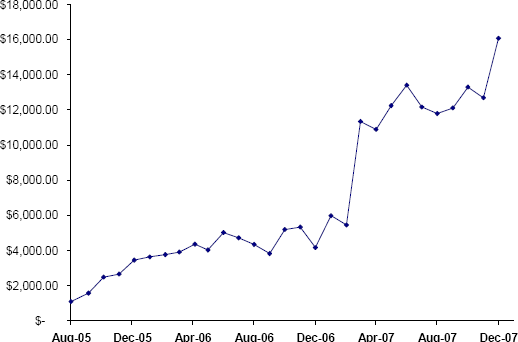
On that one site, we jumped from $5,461.50 in revenue to $11,3501.51 in just one month — and that was pure profit.
Not only that, but it was right there under my nose the whole time. It just took Aaron Wall to put the pieces in place for me at Elite Retreat.
If I can cause that sort of a change with an ebook or a 2 day conference, what more if I offer a more personalized higher value service?
Years ago Microsoft figured out that service based business models were disrupting their business model. I don't think selling information is a safe long-term strategy. Publishers need to become digital media artists who sell an experience that can't be copied.
What Next
As a starting base for my offering I have already created an exclusive online training program with over 100 modules and a community forum. I am still working on setting up the account permissions and determining price points, but am hoping to launch before the month is out. Perhaps as soon as next week.
I still have about 200 customer surveys to read through and respond to get the feedback needed to decide how and when to launch. I am also thinking about limiting membership to something like 2,000 people to ensure I can spend time with everyone who needs or wants it.