Worth Sharing...

Andrew Goodman offers a free 40 page guide to Google AdWords.

Dave Winer and Paul Graham published articles about how complexity and corporate thinking increase the cost of doing business and stifle innovation. Worth reading both of them.

Michael Gray offers great tips on how to do SEO for video content, and recently published a guest article by Gab Goldenberg on how to be creative.

Weip offers some great link building tips.

Vanessa Fox offers a ton of great Geotargeting tips, and highlighted Nathan Buggia's great post on issues associated with URL referrer tracking.

Allegedly searching stimulates the brain. Smashing Magazine offers tips on search box design. And Yahoo! is testing ways to make search ads pop by using graphics.

Paypal modernized allowance by making it automated, and giving you the option to send extra on demand.

Editorial Integrity & Publisher Control of Ads

Chris Brogan and John Andrews both wrote great posts about how you do not lose your editorial integrity just because you exercise editorial control of your ads.

Lets look at the flip side of the equation. Most networks do not want full transparency because it would harm their profit potential. Google claims to want to police the cesspool that is the web, and yet it shows ads for black hat SEO and deceptive ads that contain misleading prices which hide the true cost of a transaction. Automation promotes whatever makes the most per impression. In many cases that means promoting fraud (legal, or otherwise).

In time web users may become blind of most text ads the same way they became banner blind. And then publishers will have to fight harder to make a living. Free buys distribution, but it doesn't put food on the table. Our other sites (which take much less time and effort than this site) earn way more money. If this site didn't have a revenue engine on it, do you think I would have worked 70 hours a week on it for over 5 years? I don't.

My point is not that ad networks are bad, but if bloggers and independent webmasters want to make a living online we are going to need to get better at mixing ads and editorial...and one of the lowest risk and highest value ways to do that is to promote the things we really believe in - either create your own product or promote affiliate offers for products that save you time and money.

People that promote garbage should be policed by their peers, like Jerry West did to The Arbitrage Conspiracy:

Don’t Buy The Arbitrage Conspiracy

Don’t get sucked into the hype. It isn’t real. I was there and I walked out after 40 minutes because the material was very basic. I even talked to many people (other solid CPA marketers) who stayed for the entire presentation and they said there wasn’t anything new, it was all recycled material from past systems.

People promoting hyped up junk should be rightfully flamed, but we shouldn't consider it a crime to share good relevant offers. What would be a crime is if many of the best sites went offline because they didn't pay for themselves.

Google Chrome Adds Search Pre-roll Ads

Google Chrome's biggest change from an SEO perspective are that it...

  • combines the address bar and search box into 1 box
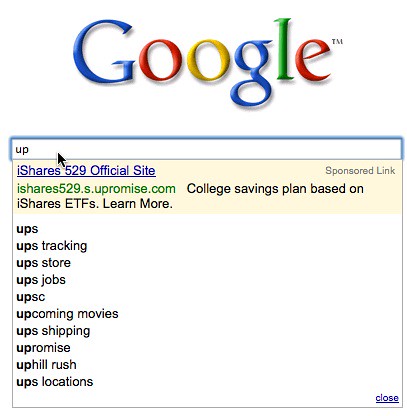
  • that search box shows search suggestion results before searchers see the organic search results

The combination of those 2 means that if Google gains significant browser share SEOs will need to optimize for search suggest.

Chrome recently came out of beta, so Google can begin buying marketshare from OEMs. With the product only a few months removed from its announcement they are adding advertising to it, as highlighted by Danny Sullivan:

If Google can buy significant browser marketshare then such ad positions might add a lot of curiosity clicks for the top ranked advertiser, lower the ROI for the top advertiser.

If this gains traction most brand advertisers should not bid on their brand (unless perhaps they do so using an embedded match - which allows them to block advertising on the exact match but show up for other brand searches). Bidding on your brand's exact match and appearing in such ad positions for brand related search queries would be paying Google for adding zero value to the process.

Keyword Research Strategy Flowchart

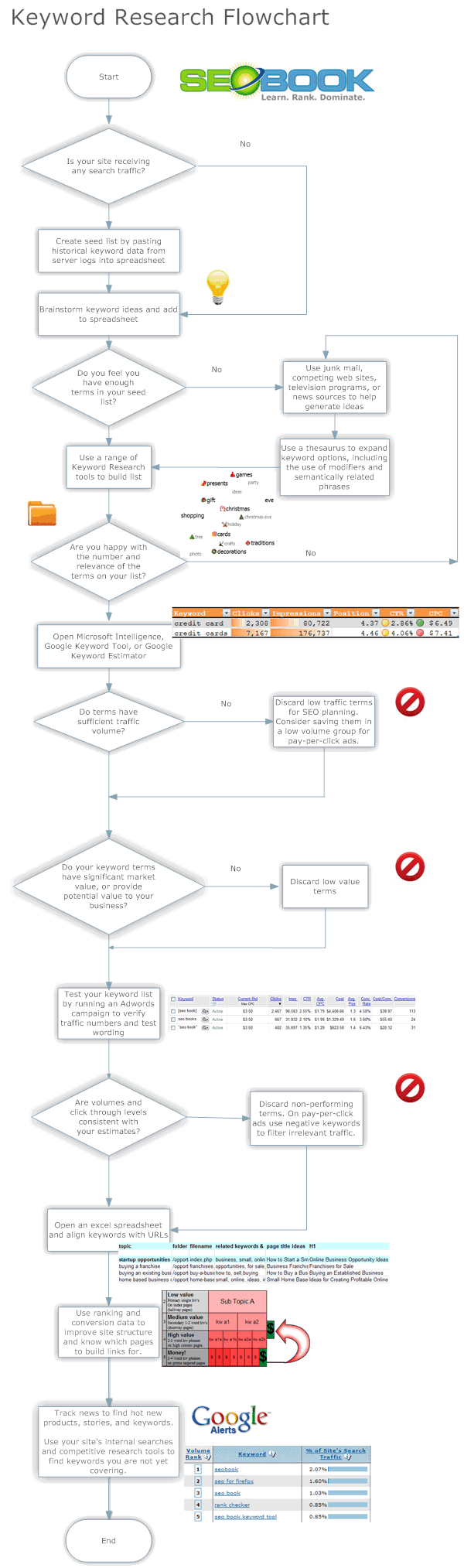
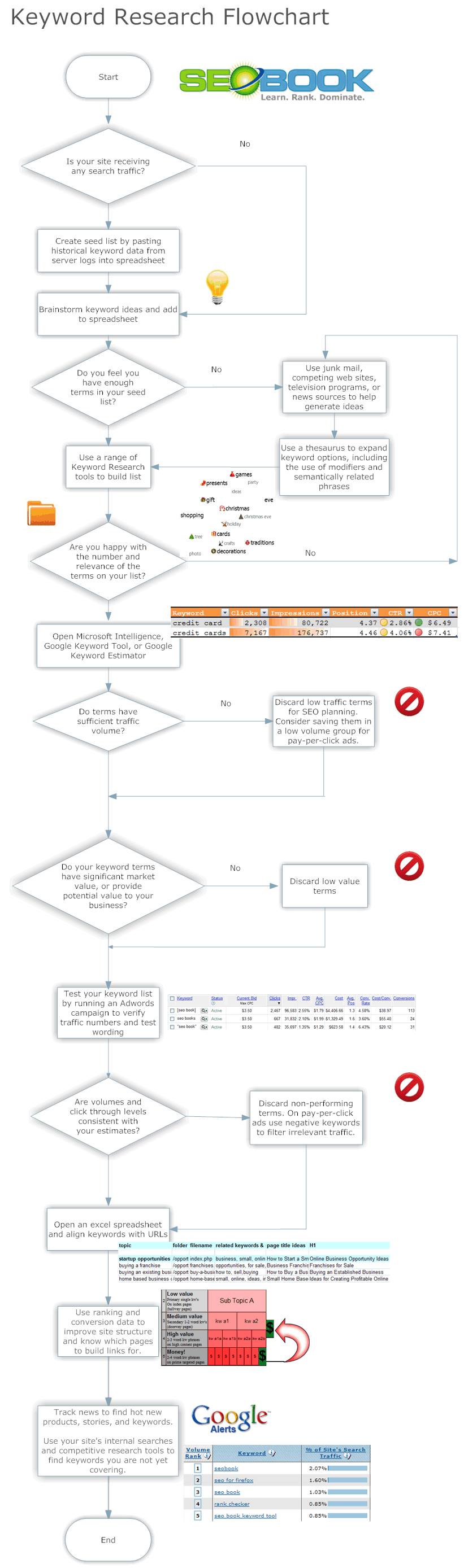
PeterD and I recently put together the Keyword Research Flowchart. Interactive image below, with a larger image here and a downloadable PDF also available.

We hope you find it as valuable as we found it fun to make, and your feedback is appreciated. :)


Subscribers may also access our new AdSense and SEO analytics flowcharts.

YourYoutubeMillions.biz - Make Easy Money on YouTube, Guaranteed

Remember seeing all those ads about making easy money with AdSense? Pretty soon those hucksters will be displaying ads on how to make easy money on YouTube, based in part on this NYT article about how a couple YouTube video creators are making $20,000 a month. As Cory Williams said "I didn’t start it to make money, but what a lovely surprise."

When evaluating such "opportunities" one must remember that there are mathematical outliers on every large social network. Generally it is a fools game to chase such a position, because many who are at the top accidentally ended up in the position (see above quote), and your odds of being 1 in 1,000,000 are precisely 1 in 1,000,000.

Many more people chasing that "opportunity" will only pollute the medium and force their relevancy algorithms to show less diversity, making it even harder to get noticed in a noisy market. Google encourages cut throat competition to create diversity, and then filters out the bottom 95% to 99% to maintain quality. Pet rocks may be fun (for a while), but nobody wants to be a pet rock ;)

The NYT article mentions that one of the two people they profiled openly admitted to using product placement in his videos to generate half of his income. Google believes that buying/renting links that get your site placed well in the search results is evil, but it also believes that selling links by the click and unmarked product placements in videos are fine business strategies.

Google Expanding in All Directions

As both an SEO and a Google shareholder, I have a love hate relationship with the company. More recently I have been feeling love when buying up shares of their stock, especially seeing how they are still buying marketshare while competitors are downsizing.

Increased Monetization

Google has been showing more ads on search results, and accidentally leaked some AdWords click volume numbers for Cyber Monday.

Google paid click volume was also up, year over year, in categories like Department Stores (39%), Books & Magazines (28%), Comparison shopping (25%) and Sports & Fitness (24%). Even categories like Apparel (9%) and Home Furnishings (14%) were up.

They recently announced they are accepting ads promoting hard alcohol, have started running credit card arbitrage ads on their own network, and created an additional chunk of targeted inventory by allowing advertisers to target ads to the iPhone and G1.

New Distribution Channels

Google is buying marketshare for their browser, which is soon to leave beta (so Google can start doing bundling deals). I recently saw this ad on the New York Times

How many more Chrome ads will we see across the AdSense network in the coming months, especially when considering that the Google brand is still cherished AND most brand ad rates have dropped sharply over the past couple months.

And some Google computers have the OS stripped off their user agent string, leading to some speculation that they might be working on creating an operating system or a more advanced infrastructure to build network applications on. The also released their native client, aiming to allow web browsers to interact with client computer resources.

Google just created a ton more inventory on YouTube by placing a search box on syndicated videos. And they just made their database deeper and more valuable by indexing a lot of archived magazine content.

Replacing the Media

Web Growth

President elect Obama is looking to push web growth hard:

It is unacceptable that the United States ranks 15th in the world in broadband adoption,” Mr. Obama said. “Here, in the country that invented the Internet, every child should have the chance to get online.

But many of the leading media companies may not be around to see that growth.

Bankruptcy

The Tribune Co. filed for bankruptcy and the New York Times is expecting that 2009 digital ad revenues might be below 2008 revenues.

Advertisers Becoming the Media

As the debt laden media companies die off, some advertisers are finding it cheaper to become the media rather than advertise on it and support its bloat:

one day cosmetics companies will perhaps start beefing up their own Web sites — with makeup videos and click-to-buy options — just as kraftfoods.com has done with its hugely trafficked recipe site and walmart.com has done with its popular blogs by mothers. When advertisers become content providers, magazines lose ads and finally drop off newsstands.

Advertisers are also investing in analyzing the potential for media to go viral. When they own their own distribution channels and build a large audience, the cost of real-time testing drops to zero.

Media Unbound

Some content creators are testing technologies that allow DVD watchers to chat with friends while watching the movie, perhaps creating yet another gathering spot for fans - like Buddy TV.

As Google brings archived magazine content online it seems the form of content containers is dying, and the media is becoming more aware of the link economy:

That currency is the hyperlink, a pointer to somewhere on the internet that holds some information that someone else might find useful. Like any currency, it can be debased, and lose its value. You've heard of the dollar/yen/pound/euro exchange rate, of course (and watched in amazement as they gyrate, and yet the price of American hardware and software never alters from a $1 = £1 translation). But in the link economy, when everyone's passing around links, every person is their own central bank, determining the value of their own currency.

The Blend

In an attempt to increase revenues some media sites (like CNN Money) are blending ads so aggressively that they look editorial. To me this ad looks more like editorial than an advertisement.

Many of the mainstream media sites will need to become much more like eHow.com, Mahalo.com, and About.com if they want to weather the storm...use the brand to attract readers, but have a lot of cheap backfill content monetized by affiliate ads and contextual ads to subsidize the editorial that builds the brand.

Recent Media Successes

Not all media based business models are in the hurt locker.

As many traditional media companies head toward bankruptcy they will have their staffs cut, making it easier to influence them through public relations.

uTest has built a functional business model out of crowd sourcing by selling pay for performance bug testing.

Andy Hagans explained how they grew Tip'd by hiring a well known star to run the brand, partnering with leading independent editorial sites, and pushing most of the value out to the editorially featured sites. As a result of those actions it looks like Kiplinger's might syndicate the Tip'd widget, which will offer Andy's site a lot of great brand exposure. Start small and keep building momentum...using each point of growth and each partnership as validation to reach the next level.

Is JupiterMedia a Cheap Domain Play?

Years ago JupiterMedia owned Search Engine Watch and Search Engine Strategies, but sold them off (along with ClickZ) for $43 million to raise funds to binge on buying stock image companies. Why? According to Alan Meckler, JupiterMedia's CEO:

Why the sale? The simple reason is that Jupitermedia has evolved from being a media company with images into an Image company with media. A good part of the evolution came from the acquisition of 7 image companies since June 2003. Over a 25 month period we have spent close to $200 million making the above referenced acquisitions along with dozens of photo library collections. Most of these deals were done with cash. The cash came from our treasury and from bank borrowings. We plan to make more acquisitions and we plan to continue using cash. So how do we get more cash? Simple, we either go to the public market and offer our stock for cash or we sell assets such as the Search Engine trade shows and ClickZ network in order to raise more funds for acquisitions.

Recently I would have been prone to go to the public market and sell equity to raise cash. But even with our stock closing price yesterday of $22.80, I think Jupitermedia was undervalued based on what I believe the company will be worth over the coming years. So I chose asset sales and additional borrowing based on the fact that I think Jupitermedia should be more valuable tomorrow.

After spending a couple hundred million dollars buying image companies, JupiterMedia built up too much debt to service in this credit crisis and was forced to sell off their images division to Getty for $96 million - up to $40 to $45 million less than they were offered in August.

That image sale should allow JupiterMedia to pay off all their debts, but the company is off about 99% from when they were "under-priced." They are trading at 27 cents a share, and have a market value under $10 million. They own a ton of great domains like Internet.com, InternetNews.com, Javascript.com, Developer.com, WebDeveloper.com, Jumbo.com, MediaBistro.com, and dozens of other valuable domain names and websites.

Will they start selling themselves off in chunks? Will a private equity investor try to take them private? Or will they go to $0?

* As a disclaimer, I bought a few thousand shares recently...though it was a bet more than an investment with conviction.

Is SEO Worth the Cost & Effort?

A couple years ago I helped a friend set up a website, and tried to teach them SEO, but they never really took it to heart. Their page titles are not that descriptive, and their writing typically aims to be clever rather than direct. They have published just over 100 pages of content. I built a few links for them to help get them going, but their site has failed to achieve a critical mass. Over the last year their traffic has been precisely flat with about 20 unique visitors a day. It is hard to monetize a traffic stream that small.

About 2 months ago another friend set up a website in the exact same vertical. They published a small website and got it a few links to get the age clock going. About 2 weeks ago they expanded the site out to about 70 pages, which have since been indexed by Google. Rather than writing winding and non-descriptive content, each article on this site is on target and direct.

If anything the link profile for this site is inferior to the link profile for the older site, but this site is already getting 50 unique visitors per day. Many of these visitors come from page 2 of the search results, in international versions of Google, and/or for misspelled queries that this site ranks for (though the site does not have misspelled content on it). These rankings can be seen as signs of progress, and hint to future rankings the site will have for more competitive keywords.

The audience is still too small to monetize, but as this site ages and gains search engine trust, it will likely develop into a site with ~2,000 unique visitors a day.

One site was mapped out against the search traffic, has targeted descriptive page titles, and uses well structured categories. The other does not. And inside of a year the site that employs SEO will out-perform the other site 100 to 1. With similar backlinks, similar quantity and quality of content, similar domain names, and similar site designs the sites have 2 different outcomes. One is at best a hobby, whereas the other can (and will) grow to become a flourishing business.

Give me an average market participant who has a passion for a topic and I can help them dominate the search results. Whereas the person that knows 10x as much but ignores SEO advice will get stuck in the mud, failing to build a critical mass, not getting the exposure their knowledge and content deserve.

SEO as a Change Process

In a previous article, Baking SEO Into The Workflow, we took a look at the problems faced by in-house SEOs. Most of those problems occur because SEO forces a change in work process. Change - any change - is often met with resistance.

We received a lot of great feedback on that post, so we thought we'd delve a little deeper into this topic.

The Change Process

Change managers highlight three crucial factors in any change process:

  • Start at the top
  • Address the human side
  • Approach change systematically

"Any significant transformation creates “people issues.” New leaders will be asked to step up, jobs will be changed, new skills and capabilities must be developed, and employees will be uncertain and resistant. Dealing with these issues on a reactive, case-by-case basis puts speed, morale, and results at risk. A formal approach for managing change — beginning with the leadership team and then engaging key stakeholders and leaders — should be developed early, and adapted often as change moves through the organization. This demands as much data collection and analysis, planning, and implementation discipline as does a redesign of strategy, systems, or processes.".

Let's take these ideas and apply them to the world of professional SEO.

Management Strategy

Start at the top.

Management buy in is also the most crucial element. Without their support, it's unlikely you'll get anything else done at the lower levels. That's why change processes start at the top. So, how specifically does one approach getting management on-side?

Analysis

First, do a complete audit of the existing website and web strategy, and make a list of the problem areas that need changing. Order this list in terms of importance. i.e. crucial changes, nice to have, phase one, phase two, etc. Also make a note of how easy, or how difficult, each item is to implement. Think of it as a proposal, which is really what it is. This type of analysis will show that you're serious, organized and thorough.

Management are going to be looking for you to deliver more benefit than it costs to provide that benefit. If you can show you'll achieve this, you're half way there.

Sell It

Use factors such as competitive advantage and disadvantage. Show them where their competitors - specifically their SEO savvy competitors - rank. Estimate the level of search engine traffic their competitors receive.

Create value propositions. Try to get management to place a value on each visitor. What is the opportunity to get in-front of a customer worth to them? How much does it cost to get that same attention via existing channels, such as direct marketing, print, radio or television advertising? Compare this with the cost of implementing your strategy. Show them how they can both save money, and get more return.

Managers also want to get some idea of the following factors:

  • What is the cost?
  • What is the time to delivery?
  • What should your performance metrics/kpi be?

Be prepared to answer such questions.

Use case studies. Show before and after situations where seo has made a remarkable difference. Something that has been tried and proven carries less risk than the new and different. Remember, SEO is probably going to sound new and different to all but the most web savvy organizations.

Get management to commit to your strategy on a point by point basis. Insist that you'll only be able to deliver outcomes if this strategy is followed. Outline the risks of removing any element.

This achieves two things: it gets them to commit to your course of action. They'll back you if you receive push back from designers, developers and writers. Secondly, it provides a get out of jail free card. If you miss KPIs because you couldn't achieve all of the strategy i.e. the other areas pushed back, you can show them why you couldn't deliver.

The Human Side

You go into a meeting.

There is one of you, there is a small team of designers, and there's a manager who thinks he needs SEO, but doesn't have an understanding of what is actually involved. So how do you tell them that their strategy is all wrong, to stop building everything in Flash, and start designing to your exact specifications?

You could use the direct approach: "Listen up! Your strategy is all wrong, stop building everything in Flash, and start designing to my exact specifications!" A tough road, but if your daddy owns the company - certainly worth a shot :)

More likely, however, the design team has more authority than the SEO, especially if you're new to the job.

Softly Softly, Catchee Monkey

There's an apt British phrase: "Softly Softly, Catchee Monkey".

It means play it gently and carefully in order to achieve the outcome you seek.

If you lack sufficient authority to get your way on all decisions, as is the case with most SEOs who work within large organizations, then the softly, softly approach might be more likely to produce results than the my-way-or-the-highway approach.

Consider how people react to change. How did you feel when you were forced to adapt to change? Empathy goes a long way.

For example, try putting yourself in the designers shoes.

She may have graduated from a graphic design course. During her years of study, SEO wasn't mentioned once. She has been working as a web designer for a few years, and she's acutely aware that web design is a very poor second cousin to print design. In print, the designer has free reign, and can specify everything to their exact requirements. The colors, the size, the fonts, the look and feel.

On the web, however, she has to think about how her design is going to display on different screen sizes, how the colors are going to look on various monitors, and how different browsers are going to render the layout. She has to incorporate widgets and forms from the developers. She's got to present to management in a few weeks time. The top manager, who controls her bonus, likes to be wowed by cool, cutting edge designs. She jumping through all these crazy hoops that get in the way of her graphic vision.

Then in walks this new SEO guy and demands she retool the site so a search engine spider can see it.

If there's a fan in the office, it will soon be covered in something unpleasant.

How To Make SEO Fit In

One way is to not do anything.

Not every battle is worth winning. For example, lets say you're working in house at an agency, and the work is for an external client. The client wants a spectacular site, because he wants to impress his colleges and boss. The designer is happy to design it, because she might win an award. The client hasn't specified seo as a delivery requirement, as the clients customers usually find them by word of mouth, not via search engines. Is SEO really important here?

No, it's not.

The best approach, when SEO comes late in the piece, might be to inform the manager in charge of delivery that this site is unlikely to receive much in the way of traffic from search engines in it's existing form. You could specify changes, but is that really in the best interests of everyone? Does the cost/benefit stack up at this late stage?

Insist the person with the authority makes that call. If the client comes back latter and wants to know why their site isn't showing up in search engines, you can refer back to the meeting. Most intelligent people will come to their own conclusions that their process needs to change.

But lets say SEO is something the client wants, but is not knowledgeable enough to know that their web strategy won't deliver it.

If you're experiencing a lot of resistance, try splitting the work into phases. Make phase one low impact. If it's a Flash site, or some other major SEO headache, how about suggesting they add a print -friendly version of the site, with a link from the home page?

The designer will probably go for it, because in her head, the only people likely to see a print version are those who have already seen her flash version. They are simply choosing to print it out. You know better, of course. This is the version search visitors will see. Once these pages start drawing traffic, you then have some leverage for Phase Two. You've demonstrated the power of SEO, and if only they did more of what you request, then they'll get more search visitors.

Their call.

Once you can demonstrate proof of concept, you're on track to winning the war.

Natural Synergies

In my earlier article, I recommended that you keep a look out for natural synergies. Thankfully, not all designers are flash loving design heads. Web design trends have, thankfully, moved away from graphic-heavy approaches, and have moved towards providing ease of use and utility.

Suggest incorporating SEO-friendly elements that are also design elements. Examples include breadcrumb navigation, site organization and hierarchy, most important pages closest to the front, duplicate navigation schemes if the main navigation scheme is uncrawlable, and using Google site maps. None of these elements interfere with look and feel too much.

Attend the meetings where they map out site structure. If the structure is designed with SEO in mind, a lot of other elements fall naturally into place. Emphasize the fact you need to be brought in early, not late, on site design decisions.

Content Writers

In the web industry, content writers are most likely to slot into one of two schools of thought.

One is journalism. Journalism often consists of a top down approach, or inverted pyramid.

"The "pyramid" can also be drawn as a triangle. The triangle's broad base at the top of the figure represents the most substantial, interesting, and important information the writer means to convey. The triangle's orientation is meant to illustrate that this kind of material should head the article, while the tapered lower portion illustrates that other material should follow in order of diminishing importance"

The second is copy writing. Copy writing differs from journalistic styles in that the writing is crafted to elicit a specific response from the reader, rather than to simply inform. There is often a specific objective the copywriter needs to fulfill, and every word is likely to be carefully deliberated over.

Legal

A side complication is legal. Lawyers, as a profession, tend to be risk adverse. Their job, in this context, is to prevent libelous, defamatory, or untruthful copy from being published, which could expose the the company to financial risk.

There's no simple advice I can give on how to get around legal. They carry a lot of weight. Just be aware of the legal requirement, and keep in mind that the "aggressive link baiting technique" you had planned might not be an appropriate strategy for this particular company ;)

Will It Blend?

The easiest road is with the journalists. They are trying to answer the questions Who,' 'when', 'where', 'what' and 'how' . Try to frame your SEO requests in this language.

For example., say if your keyword term is "buy house in San Francisco". A reporter could work this into his copy by asking the "what" question, s in "what is happening?" e.g. "Recently, people looking to buy a house in San Francisco have had to contend with...." etc etc.

This is very much an on-going education process, but it helps if you're already talking their language. Provide them a list of keywords, and specific examples of how they can be incorporated into the article formats they already use. Writers might actually like you feeding them article and story topics. It makes their task a little easier. Try to think of ways you can frame your keyword research as article topic suggestions, or article research.

In terms of structure, try and devise templates that encourage SEO friendly formats i.e. short paragraphs with big headings to break up the copy. You could also argue this increases readability and usability.

Have designers and developers code the templates so related articles are suggested automatically. Include a related articles section. Build the SEO right into the article structure, so that a lot of the SEO happens without the writer having to think about it.

Guidelines For Developers

Developers are used to working to guidelines and specifications, so try and work SEO requirements into these documents.

Here's a sample guideline. There is some overlap here with design, so split them up accordingly:

  1. Use descriptive file names. i.e. dog.jpg, as opposed to image568765.jpg.
  2. Include title and meta description tag in all templates. Auto - populate fields from teh templates i.e. document title - where no over-ride exists.
  3. Use CSS to control font sizes, particularly header tags.
  4. Links should, wherever possible, include keywords
  5. Titles should use text, as opposed to graphics.
  6. Specify an alt tag for images
  7. Create a Google Site Map
  8. Use the following URL format: domain/page-title-name
  9. Avoid frames. If using frames, use the the noframes tag
  10. Create a custom 404 page that links to the site's main pages, or sitemap.

I'm sure there are plenty of other rules you can think of, and depending on how co-operative the developer is, there is a lot more detail you could go into. I find that the shorter the checklist, the more likely developers are to incorporate the changes required. Long lists just create headaches, so often go ignored.

Make sure they do the important things, and don't sweat the small stuff. At least, not in your first week!

Real Life

In real life, things are never this simple.

Humans are messy and complicated creatures, so there are few hard and fast rules, nor is there a prescription you can follow. Be flexible. Be aware. Communicate. A lot. Hopefully, the ideas above will help you formulate your own approach.

You're not alone. Most professional SEOs know exactly what you're going through :)

Related Reading

Pages