Who Benefits From Following Google's Guidelines?

Some of you may have been hit by Google's 20 October algorithm change.

And some of you wouldn't have noticed any difference.

On 20 October, a number of sites got trashed. Rankings, and traffic, plummeted through the floor. The webmaster forums lit up. Aaron noticed it. I noticed it. Yet, other webmasters wondered what all the fuss was about.

As many of you know, there is not just one ranking algothimn. There are many algorithms. What affects one site may not affect another. Rather interestingly, Google's John Mu dipped into this thread on Google's support forum, offering these words of wisdom (HatTip: Barry)

It looks like the changes you're seeing here may be from an algorithmic change. As part of our recent algorithmic changes (which the outside world sometimes refers to as the "May Day update" because it happened primarily in May), our algorithms are assessing the site differently. This is a ranking change, not any sort of manual spam penalty, and not due to any technical issues with regards to crawling or indexing your content. You can hear more about this change in Matt's video: "

...and....

Various parts of our algorithms can apply to sites at different times, depending on what our algorithms find. While we initially rolled out this change earlier this year, the web changes, sites change, and with that, our algorithms will continually adapt to the current state on the web, on those sites. While it might be confusing to see these changes at the same time as this issue, they really aren't related, nor is this a general algorithm change (so if other sites have seen changes recently, it probably doesn't apply to them as well).

Matt's video, made four months ago, was talking about the algorithmic MayDay change. John Mu adds: "Various parts of our algorithms can apply to sites at different times" In other words, whatever happened in May may not affect your site in May, or June, or July, but might hit you many months later. This implies that your site may trip a threshold, and be judged quite differently than it was the day before.

This still doesn't completely explain why so many sites were hit on the same day, but then Google don't typically explain things in detail.

To complicate matters, there was an acknowledged indexing problem, affecting new content, particularly on blogs. Again, John appears to suggest this was a separate issue.

Forget About Search Engines, Just Publish

Now, all SEOs are used to algorithm changes. Nothing new. But this one has me genuinely perplexed, mainly because of the type of sites that got hit.

Time for some self-searching Q&A about one of my own sites:

Q: So, how many links did you buy?
A: None.
Q: Are you selling links?
A: Nope.
Q: Linking to "bad neighborhoods"?
A: Not that' I'm aware of.....
Q: Did you link-build in an aggressive manner?
A: No. I did no link building, whatsoever.
Q: Huh?
A: That's not a question.
Q: So you just published content?
A: Right.
Q: And people linked to your site, of their own accord?
A: Yep. I guess they liked it.
Q: Was your content heavily SEO'd?
A: No. In fact, I gave writers specific instructions not to do anything resembling "SEO copywriting". It ruins the flow for readers.
Q: All original content?
A: All original. Hand written. No machines involved anywhere.
Q: So this site conforms to Google's Webmaster Guidelines?
A: I'd say it lies well within them. "Be useful to end users", was the guiding principle.

Yet it got hit hard.

What's also interesting is the nature of the sites that replaced it. I checked keyword after keyword, and found script driven, aggressive black-hat, content-free sites in top positions. Not in all cases - there are certainly useful sites that deserve to be there, and deserve to appear above mine. Fair play. However, there were plenty of sites of - shall we say - dubious merit- occupying high positions.

Curious.

Be Useful. Perhaps

Now, I believe in publishing useful, unique content, and not paying too much attention to SEO, other than covering the basics. SEO is one strategy amongst many, and sites should, first and foremost, prove useful to people.

Clearly, no site is immune. You can stay within Google's Webmaster guidelines, and get taken out. I knew that anyway, but when the sites that don't follow the guidelines replace you...

....I'll admit - it grates.

Presumably, Google rewards the sites it likes with high rankings, and if we see a lot of aggressive sites filling the top page, should we therefore assume that aggressive sites are what Google actually wants?

I'd like to think not.

Perhaps they are just trying to mess with our heads?

Or they messed up?

Or the changes are still bedding in?

Or they really do want it this way?

I'm still watching, and considering. Perhaps the site will just pop back up in due course. Or perhaps I need to go back to the drawing board. I'll let you know how I get on.

If you've noticed something similar on your sites, chime in on the comments.

Low Cost SEO

If you're considering getting some SEO work done, but working to a tight budget, here's a look at the key issues, and trouble-spots to look out for.

Buying Professional SEO Services

If you're short on time, or SEO skills, or inclination, then you may be looking at getting an eternal supplier to undertake SEO work. Like anything in life, you get what you pay for, and SEO is no exception. There is also a danger you could get a whole lot less, of course.

Like any profession, there are many great operators, and many poor ones.

Set Clear Business Goals

Start by writing down the goals you want to achieve. What business problem are you trying to solve? Do you need more conversions? More traffic? Higher rankings? Only one of those requirements is likely to make you any money.

Traffic and higher rankings can make you money, but can just as likely make no difference to your business, whatsoever, unless they are tied into your website strategy. For example, you may receive more traffic after engaging an SEO, but if this traffic isn't interested in what you offer, they will click back. Likewise, you could gain high rankings for keywords that no one searches on. This will result in no traffic increase, and no new business.

Devise your own metrics for success. Some SEOs will devise metrics for success that are easy for them to achieve, but make no real difference to your business.

Watch Out For Hidden Costs

If you have an existing site, you may need to make changes to your design and layout. Depending on how your site has been built, these changes may be minor or significant in terms of cost to rectify.

The Problem With Cheap

Whilst high cost alone will not guarantee you good results, there's a high probability that low cost will almost guarantee poor results.

SEO is labour intensive and requires skill and knowledge. As a rough ballpark, a small site, that doesn't have design issues, that has had no previous SEO work, could take, at very least, five days of full-time SEO work. This work involves link building, adding keywords and content to the site, and other external promotional activities. Get the SEO to breakdown the work into hours and tasks, and see if the amount charged equates to the work required.

If the SEO is pricing significantly under their competitors, there may be a legitimate reason. They may use cheaper labour, often located in emerging economies. This is fine, however make sure any firm you do use has a good knowledge of the country and culture in which you operate. Marketing, SEO or otherwise, requires an intimate knowledge of language use, culture and location, so ask to see previous work, and check references.

On the other hand, there are agencies that will charge like a wounded bull for essentially the same tasks as everyone else. Obtain a few quotes and compare, as pricing can be all over the place. The industry is not standardized.

Do It Yourself

Anyone can do SEO. However, that doesn't mean that everyone should.

What does SEO involve? It can involve restructuring a site, coding, content creation, marking up content, market research, strategy, link building, and public relations. Do you have the time, or the inclination to do this? The learning curve, for the beginner, is steep. It's also time consuming. How much is your time worth?

However, there are many aspects you can do yourself. Start with a good, solid SEO course ;) Join forums where other SEOs hang out. Look for content management software that is reasonably SEO friendly, out of the box, such as Wordpress (free). Using SEO friendly software means you'll avoid a lot of technical problems that can be expensive to rectify if you use software the search engines find difficult to crawl.

Search engines like content. Generally speaking, the more pages you publish, the more chances you'll have to be seen. If appropriate, adopt a strategy similar to that of magazine publishing. Publish often.

Once your business case and site content are established, you need to build links. A site without links is pretty much invisible. Here are a few link building strategies. In summary, submit your site to directories, get your partners to link to you, issue press releases featuring links back to your site, put links in your online signature. You can never have too many links, so long as they accurately represent the content is on your site, and they appear in places your audience hangs out.

Hybrid Approach

You can go a long way by buying in some help, and doing the rest yourself.

Pay for a few hours of consulting where an SEO evaluates your site and your market niche. It's well worth paying top dollar, for someone good, for this part - as it most likely only takes a few hours. Setting off on the right course can pay high dividends, whilst heading down the wrong path can be difficult, and costly, to recover from. Engage them in an advisory-only role, and ask them to provide you with a strategy. Some SEOs will do this, some won't.

The most important thing is to ensure they establish your site has no technical issues that will prevent it being crawled, and that your content is structured correctly. Once these problems are ironed out, SEO becomes a lot less troublesome.

Only you know your skills, but the following areas are reasonably straightforward for those with a little web knowledge. Keyword research is easy enough to do yourself, using readily available keyword tools, as is content generation.

Simply write on topic and sprinkle keywords through your content and headings, or have your copywriter do so.

You may also wish to undertake link building yourself. This involves requesting links, submitting your site to directories, and building effective partnerships. It can be a good idea to get consultancy as to where you should focus your link building energies. Some links are worth a lot more than others, and there is a strategy to it.

Like any complex professional service, you'll still need to monitor and measure, even if you do opt for expensive, comprehensive outsourced options. There's no sitting back with marketing, and that includes SEO.

Whatever path you choose, make sure the SEO work is aligned with your business goals.

Google's Profits: to Infinity & Beyond

Marin software manages about 5% of Google AdWords spend for clients, and they noticed that since Google Instant was unveiled, AdWords ad clicks are up 5%. Since the launch Google's Jonathan Rosenberg has mentioned that the impact on AdWords was "not material."

I found the repeated use of those exact words suspicious and diversionary, and, as it turned out, with good reason! When Google Instant launched I highlighted what Google was doing to screen real estate & predicted this shift.

Turns out that the "tin foil hat wearing SEOs" were right once again.

And that 5% lift in AdWords clicks is on top of the lift Google has seen from

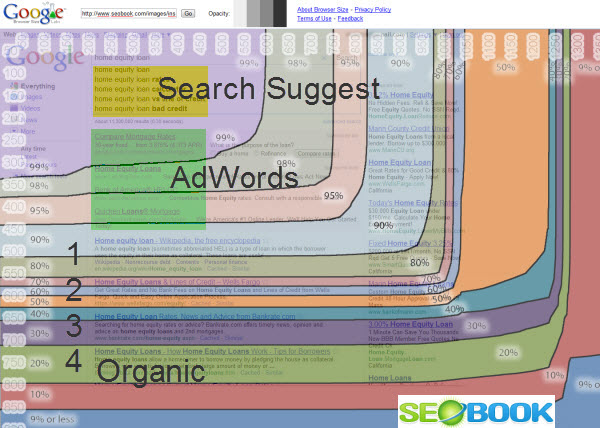
  • creating a 4th ad slot for comparison ads (in high paying verticals like "credit cards" and "mortgage")
  • sitelinks, merchant ratings, and other ad extensions, that gave Google another lift. On the last quarterly call Jonathan Rosenberg stated: "These ads appear on more than 10% of the queries where we show ads and people like them. We see this because click-through rates are up for some formats as much as 10% and up more than 30% on some others."

It is thus no surprise that Google's move into other verticals is met with resistance. The travel industry recently put together the Fair Search site to oppose Google's purchase of ITA Software.

The Google as Monopoly meme continues to grow.

Is Google a Monopoly?Graphic by Scores.org

As Google continues to make enemies this is a great time for the launch of a back to the basics approach to core algorithmic search. Blekko is launching publicly on November 1st.

WordTracker's Free SEO Videos

Mike Mindel from Wordtracker has put together some nice free SEO overview videos for beginners in the industry. Check them out:

Exact Match Domains

Are exact match domains "too" powerful?

Not in my humble opinion. :)

Sure across the entire web exact match domains can rank for a wide variety of keywords, but there are a couple things to think about when stating that...

  • those rankings are spread across many different domains
  • the bonus any domain gets is only relevant to their 1 exact match phrase
  • Many domains are seen as exact match, but the keyword is popular precisely because the keyword is a brand (like eBay, Amazon.com, Monster.com, Google, Yahoo!, or Bing).
  • Many brand owners (especially small & local ones, where there are few signals of quality) are not heavily engaged in SEO. If Google doesn't show the official site on a brand search they look bad (in 2005 there was a brief period of time when Paypal.com wasn't ranking for "Paypal" due to botched aggressive Google link anchor text filters), whereas if they rank an exact match domain where it is relevant it doesn't really significantly detract from the searcher's experience.

At SES San Jose 2009, Nick Fox stated that Google has about 30 million words in the AdWords advertiser database. In spite of their database being that large, they keep trying to push advertisers toward broad match (and searchers down a well worn path with Google Instant) because roughly 25% of searches are unique.

Adam Lewis highlighted how advertisers can get a glimpse into the endless sea of words searchers use & how impractical it is to presume they can know everything in advance:

One of the most impactful new features lies within the keywords tab and is called "see search terms". This option allows advertisers to choose one or more keywords and see the search term users typed in to trigger that keyword. It also shows which ones are being clicked most often and which are not being clicked.

Often the exact keyword it not what users are actually typing in. Guessing all the possible variations that a user might enter to find your product is essentially impossible. "See search terms" gives you the most popular user queries that triggered your ads. Not only does it help people learn about their user, but it can also potentially save money on SEM by exposing highly specific keywords with less competition and better quality scores.

Note the sentence that I bolded...guessing everything that is searched for that is relevant is roughly impossible. In SEO there are a variety of implications associated with that, but one of the most important ones is this: when you pick an exact match domain it is mainly only helping you with that 1 main keyword that you chose.

Yes there are implications in terms of perceived credibility and such, but those impacts can be created through brand building. With an EMD you pay thousands of Dollars (sometimes 10's or 100's of thousands) to target that one keyword. If a person were to buy MyKeywordStore.com (or similar) for $8 & spend that $10,000 on marketing, then in many cases that $10,000 would generally / typically more than make up for any advantage MyKeyword.com gets.

Much like often overstated type-in traffic, when you look beyond brands, there are not many individual keywords that represent a huge market by themselves.

We have built a database of 10 million + keywords & few of them (less than 10,000 of them) have a combined CPC * estimated search volume of $1,000 or more per month (presuming you captured 100% of the search traffic for that keyword & monetized it as well as Google does).

However, those numbers overstate the market ...

  • many of those valuable keywords *are* brands (seo book wasn't much of a keyword until *after* it was a brand, which is why the domain name was available to me for $8)
  • brands that are created on keywords can be forced to change due to market conditions (FreeCreditReport.com ---> FreeCreditScore.com, legislation whacked the student loan consolidation market, Google Instant promotes some keywords at the expense of others, the US government has launched names like Cars.gov, StudentLoans.gov, Change.gov, etc. ... who wants to compete directly against the government when they control legislation, can create an EMD on the fly, and can cross-link new sites in their network ... allowing them to outrank you in a couple weeks)
  • If you are not a brand & rank #1 in the organic search results (with 3 AdWords ads above you) then you might only get about 25% to 40% of the search traffic. Worse yet, in some of the largest markets Google puts a 4th "Google comparison" ad above the organic search results, further driving down the organic search results.
  • Google's search volume data & suggested bid prices have typically overstated the market (because they want to create bidding wars on core keywords & drive bids upward)
  • Almost nobody monetizes as well as Google does. In many cases when their number shows $100,000+ per month the actual publisher earnings for that keyword might only be a few thousand Dollars.

There are at most a few hundred exceptionally potent keywords where the single word will build a business for a generalist webmaster. That number would be higher if you combined them with professional training in an area and significant industry knowledge, but if you know your industry well and have access to capital and are investing into a premium domain name then odds are good you are investing heavily elsewhere and doing quality work elsewhere. The idea that there are tons of lucrative exact match domains on the market which anyone can use to build thriving businesses on and are available at a discount is somewhat (perhaps completely?) inaccurate.

Exact match only gives you that bonus on exact match. Not a collection of keywords - just that 1 word. And tying your business to 1 keyword can be risky. Just ask anyone who is on a singular version of a domain name where Google Instant promotes the plural version of that keyword. Some of those folks likely had chunks of cinder block falling out their pants the day that launched.

Whereas brand allows you to keep spreading ... but it can take a lot of work to turn a generic keyword into a brand. And by the time you do, your business model and/or the market may have already moved elsewhere. An exact match domain name can sorta box you in and make your business less flexible. SEO Book is a bit of a weird fit for a private SEO community & training website, and Oakland Pizza will *never* become Dominoes or Pizza Hut.

And (when compared against generic keywords) brands are not only more flexible, but they are more memorable, make it easier for you to differentiate, allow to engage at a deeper emotional level & charge more for your products or services.

I don't regret choosing SeoBook.com in 2003 (it certainly worked out awesome in the short run), however if I had more foresight I would have shifted to a different domain in the 2004 to 2005 timeframe. So often when people join our community they are amazed by the depth and breadth of discussion outside of SEO, but a rebrand at this point would be brutal. ;)

Owning SearchEngine.com doesn't really do much for you when there is a Google or a Bing in your market. Owning Auction.com (or maybe Auctions.com) doesn't do much against eBay. Owning Portal.com (or maybe WebPortal.com) isn't going to compete against Yahoo!. Microblogging.com is no Twitter, SocialNetwork.com is no Facebook, VideoHosting.com is no YouTube.

It is basically a choice of short-term vs long-term goals:

  • do you want to pick a specific keyword & try to sell something relevant today (with less flexibility going forward)
  • do you have the assets available to build a brand that will remain flexible under changing market conditions

While exact match domains can box you in, it is a sign of relevancy for that specific keyword: as you have tied your business to it!

Either you got to the market early, or you shelled out thousands of Dollars. OnlineKredit.org just went for $36,400! Whoever bought it is not probably going to be signing guestbooks / comment spamming / auto-generating content /etc. And the guy who paid $1 million for Poker.org wouldn't have paid that unless he planned on building something sustainable there.

Even Matt Cutts recommends buying relevant domain names as gifts :)

The one area of exact match domains where I think Google has been (and will continue to) tighten up is some of the longtail cybersquatting, but...

  • tightening up can be tricky because the same word can have different meanings in different markets (perhaps continued efforts into localizing results will solve some of these issues)
  • earlier this year Google did whack some longtail EMDs that had few other signals of quality
  • more recently, Google has been showing far more results from 1 domain on navigational queries, and has been ranking official sites for related queries even if they didn't have some of the keywords in their content or link anchor text
  • even for generic search queries (like "cameras") Google sometimes lists suggested related brand navigation in the search results
  • trademarks protect usage & legislation is moving in the direction of making it easier / cheaper / faster for brand owners to whack cybersquatting

Ho Ho Ho, Go Google Go

Some sites have seen pretty drastic drops in Google search traffic recently, related to indexing issues. Google maintains that it is a glitch:

Just to be clear, the issues from this thread, which I have reviewed in detail, are not due to changes in our policies or changes in our algorithms; they is due to a technical issue on our side that will be visibly resolved as soon as possible (it may take up to a few days to be visible for all sites though). You do not need to change anything on your side and we will continue to crawl and index your content (perhaps not as quickly at the moment, but we hope that will be resolved for all sites soon). I would not recommend changing anything significantly at this moment (unless you spot obvious problems on your side), as these may result in other issues once this problem is resolved on our side.

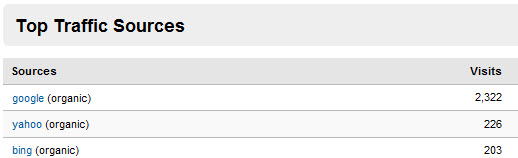
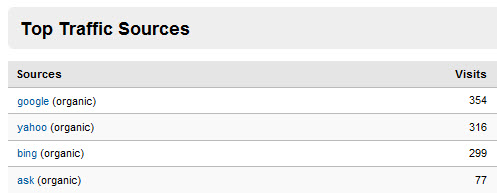
An example of one site's search traffic that was butchered by this glitch, see the below images. Note that in the before, Google traffic is ~ 10x what Yahoo! or Bing drive, and after the bug the traffic is ~ even.

Not that long ago I saw another site with over 500 unique linking domains which simply disappeared from the index for a few days, then came right back 3 days later. Google's push to become faster and more comprehensive has perhaps made them less stable, as digging into social media highlights a lot of false signals & often promotes a copy over the original. Add in any sort of indexing issues and things get really ugly really fast.

Now this may just be a glitch, but as Tedster points out, many such "glitches" often precede or coincide with major index updates. Ever since I have been in the SEO field I think Google has done a major algorithmic change just before the holidays every year except last year.

I think the reasons they do it are likely 3 or 4 fold

  • they want to make SEO unpredictable & unreliable (which ultimately means less resources are spent on SEO & the results are overall less manipulated)
  • they want to force businesses (who just stocked up on inventory) to enter the AdWords game in a big way
  • by making changes to the core relevancy algorithms (and having the market discuss those) they can slide in more self promotion via their vertical search services without it drawing much anti-trust scrutiny
  • the holidays are when conversion rates are the highest, so if they want to make changes to seek additional yield it is the best time to do it, and the holidays give them an excuse to offer specials or beta tests of various sorts

As an SEO with clients, the unpredictability is a bad thing, because it makes it harder to manage expectations. Sharp drops in rankings from Google "glitches" erode customer trust in the SEO provider. Sometimes Google will admit to major issues happening, and other times they won't until well *after* the fact. Being proven right after the fact still doesn't take back 100% of the uncertainty unleashed into the marketplace weeks later.

Even if half your clients double their business while 1/3 lose half their search traffic, as an SEO business you typically don't generally get to capture much of the additional upside...whereas you certainly capture the complaints from those who just fell behind. Ultimately this is one of the reasons why I think being a diversified web publisher is better than being an SEO consultant... if something takes off & something else drops then you can just pour additional resources into whatever is taking well and capture the lift from those changes.

If you haven't been tracking rankings now would be a great time to get on it. It is worth tracking a variety of keywords (at various levels of competition) daily while there is major flux going on, because that gives you another lens through which to view the relevancy algorithms, and where they might be headed.

Shit Justin Halpern Says

or: How Shit my Dad Says Happens

An online definition of Shit My Dad Says states, "In 2009, Justin Halpern, an aspiring comedy writer, was dumped by his girlfriend and moved back in with his parents. He began using Twitter as a way of keeping track of the brutally funny, off-color things his father said around the house."

The popularity of Halpern's Twitter feed spread quickly. Soon, he had hundreds of thousands of followers. Today, almost two million people follow this feed to hear the shit Sam Halpern says. But this hardly tells the whole story.

The popularity of Halpern's Twitter feed brought in bigger offers, and helped him to land a book deal in September of 2009. Released in October to universally warm reviews, it quickly became a bestseller. But it still doesn’t stop there.

In November, Halpern signed a deal with Warner Brothers. Halpern and his writing partner, Patrick Schumacker, were paired with the creators of "Will & Grace" to write a pilot episode (“Bleep My Dad Says,” when spoken in polite company). Picked up by CBS, it stars none other than William Shatner. (Shatner!) It's part of the current Fall Line-up, and you can see it now airing on Thursday nights, prime time on CBS.

To say Justin Halpern has made the most of moving back in with his folks is a bit of an understatement.

No longer living at home these days, we were able to recently reach Justin for a few quick questions about his success.

When you chose Twitter, did you trim your dad's statements to fit the medium? Do you ever paraphrase him, or are his quotes always literal?

Sometimes I'll tweak a word here or there to get it to fit in to the 140. Other times I'll take the first sentence and the last sentence of a paragraph's worth of stuff and put them together to make the thought more concise, but honestly, it's basically just exactly what he says. I wish I could say I had more to do with it.

How long after you started posting did you start getting any feedback?

I would say about three weeks, after Rob Corddry tweeted it. Then it sort of went viral.

What made your Twitter stream so different?

Well, I wasn't giving updates about what I was doing, because I know I'm not interesting. And I wasn't linking to anything, or trying to sell anyone anything. It was just simply a voyeuristic look into my life with my dad.

When I found your twitter feed, I referred to it as the best use of Twitter I had seen. Do you think that it would have been as effective in any other medium? How responsible is the vehicle for the spread of your work here?

Oh, I think the vehicle was unbelievably vital to the success of this. Could it have existed somewhere else on the web? Maybe. Would it have achieved the same success? Probably not. Can I ask myself more questions and then answer them in a paragraph? Yes, but I won't.

It's been widely reported that Rob Couddry's interest is what catapulted the Twitter popularity. Can you talk a little bit about what happened?

Well, I actually ran in to Rob months after he had sent my site viral, and I asked him how he found it and he couldn’t remember. He was the nicest guy you'd ever want to meet, especially since I was just this spaz coming up to him in a best buy being like "Hey, I'm the shit my dad says kid!" I would have punched myself in the face if I were him, but he sat there and had a fifteen minute conversation with me. Basically he said he saw it, thought it was hilarious, and just tweeted it and then everyone started retweeting and that’s what did it. Essentially, I owe Rob Corddry shitpiles of money.

Reports of your work status (at the time you began in 2009) vary pretty widely on the web. Were you still writing for Maxim.com at the time? How much time did the feed take?

I was still working at Maxim.com at the time, yes. The feed took up eleven seconds of my day. The time it takes to hear my dad say something, then type 140 characters on a computer.

How did you view the extra attention being paid to the feed? Did you feel any obligation in what you posted, or how regularly? Do you now?

I don't really feel an obligation. I post less now because I see my dad less. It's funny, the feed is the same now as it always was, but when stuff gets popular, people are like ""e sold out,” but the funny thing to me is that I'm just writing down what my father says and he doesn't care, just like he didn't care a year ago.

What was the first request received that made you realize there might be something really special here?

An agent Direct messaged me and said "there might be a book here." That blew my mind.

How does your dad seem to like William Shatner playing a character based on him?

He seems to enjoy it. He and Mr. Shatner don't really care to have anything to do with one another, but he really seems to enjoy Mr. Shatner's performance.

You've found success in writing for a mainstream website, a microblog, on a regular blog, in a book, and on a television show. Is time to revisit screenwriting now, or what future plans are you developing?
I plan to write another book in the next two years, and although I'm focused entirely on the show right now, I had been developing a show with Comedy Central before all this happens and I liked the idea and someday I’d like to go back and revisit it. But not as long as this show is on the air.

When success in one medium happens, it is rare to have an ability to leverage it across a variety of mediums and not diminish the quality while crossing them. To what do you attribute the ability of your work to move across media channels and find a welcomed place in all of them?

Well, before the project went in to a different medium, I tried to think of a)why should it even be in this medium, and b)If it should, how will it need to change. With the book, I had stories I wanted to tell, and thought I could give people a more thorough detailing of who my dad is, but at the same time, do it in a way that was concise so that it wasn’t this monumental leap from 140 character sayings to this dense book. As my dad says, "You’re not Hemingway. Just write something fun." I felt as though with the book, I had given the raw, uncensored version of my relationship with my dad, and that if this transferred to television, any attempt at trying to accurately depict that would seem really strange to me. So instead, we looked at TV as a chance to use the tone of my father, but in a way that would speak to more people. The book sold well, but if a show got the books numbers, an executive would put a gun to his head and end his life. Therefore we tried to appeal to a greater number of people by easing them in to a character and a relationship that had a similar tone, but was relatable.

It has been a fast ride, and it certainly is creating great opportunities for you. How have you balanced taking full advantage of the possibilities being offered, and yet not jumping into too much, too soon?
To be honest, I have no idea. I haven’t really had time to sit back and think about that.

You've done phenomenally well with something that didn't start as anything pre-calculated. Yet, at the same time, you had projects where you were definitely investing more time and care into developing something that weren't finding the same levels of success. How does this experience now affect your approach as an artist, or does it?

Well, the one thing I think I've learned is that you have to keep doing stuff you think is funny, or interesting, and hopefully it sticks.

Do you have a favorite quote from your dad?

Yes. One time he came home from the dog park with our dog and he steps inside the house, and takes a deep breath and goes "Well, we're banned from the dog park. I guess it’s okay to bark, and it's okay to hump, but doing both at the same time freaks people out." I think I'm the only one who likes that one, but the image of my dog humping and barking other dogs and my dad being told he was banned made me laugh harder than anything.

Thanks for your time, Justin – and here’s to your continued success!

You can See Bleep My Dad Says airing Thursdays on CBS at 8:30/7:30c. Justin's bestselling book is on Amazon, and is called Sh*t My Dad Says. And of course, you can join the millions of readers that regularly follow him on Twitter.

Marty Lamers is an SEO copywriter you can visit at Articulayers.Com. Since 2001, Articulayers has been fixing the world, one word at a time.

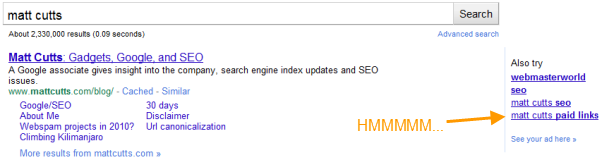
Is Google Recommending You Try Paid Links?

Friday fun. Search for Matt Cutts and Google recommends paid links. ;)

What Is SEO, Really?

Lisa Barone wrote an interesting piece entitled "Are SEOs Responsible For Rankings Or Money?". At a recent SMX conference, Matt McGee posed the SEO myth "SEO is about rankings”. Lisa was relieved when the panel concluded that SEO was really all about the money.

I agree, but then all business activity is ultimately about money. We could say car racing is all about money, but it's also about engineering. It's about skill, excitement, and winning the game.

So what is SEO these days, anyway?

A Very Brief History Of SEO

Back when SEO started, SEO wasn't called SEO. It was probably best described by those who did it as a form of hacking.

The first search engines weren't particularly clever, so it was relatively easy to figure out their sorting algorithms. There was a time when Infoseek's algorithm was almost entirely based on keyword density and keyword position.

Whilst this hacking was still ultimately about money, it was as much a game as anything else. I'm sure many old school SEOs remember those days with a sense of nostalgia. It was more of a pure technical pursuit back then.

As search engines got more sophisticated, and more money flowed online, the nature of the game changed. SEO moved beyond technical hacking to an exercise in making connections.

In Googles early days, you could buy a few high PR links - or beg for them - and that was enough to get you ranking top ten in most keyword areas. Buy a few more if you really wanted to go hard. Saturate the long tail with auto-gen, just like your competitors were doing, and it was game on. Some may say we haven't completely left this phase, but the sun is setting on this approach.

These days, a more holistic approach is required. The search engines, Google in particular, have become more and more oblique, which means systematic technical approaches are less effective than they once were. This begs the question - what is a client hiring an SEO to do, exactly?

BTW: For those who want to read deeper on a history of SEO, check out this excellent Danny Sullivan interview. He knows more than most about the history of SEO.

Explaining SEO

Ever had trouble explaining to people what you do?

I've worked out a succinct answer that is easy for non-technical people to understand. When people ask me what I do, I tell them "I'm a drug dealer".

It isn't true, of course, but I just figure it's easier for people to grasp. If pushed, I'll launch into a detailed explanation of SEO, internet advertising and web publishing models - an explanation which is universally guaranteed to be met with the response "huh"?.

Often, they'll conclude: "so you rank web sites in Google, then?".

To which my reply is "well, that's part of it". As I explain further, I'm still not sure I'm making any headway, so figure it's time everyone had another drink and talk about something else.

The SMX panel is right. SEO is not about just about ranking websites, it's about so much more. Some SEOs, myself included, use SEO as part of a business strategy, a strategy that is just as much about publishing, domain names, brand building, marketing and traffic acquisition. It involves metrics, tracking, conversions, split/run testing, adwords, adsense, writing, researching, managing and changing the light-bulb in the office when it blows. The commonality is that it is oriented around the search ecosystem. Except for the light-bulb.

Some SEOs focus on very specific areas. It is their job to take a site from nowhere in the search engines to achieving desirable rankings. Their job ends there. I suspect such a role is becoming less common as search companies like Google extend their tentacles into every corner of the web, and search consultants invariably follow.

Ask ten different SEOs what they do, and you'll probably get ten different answers. None of which the lay person will likely understand, unfortunately.

Learning SEO Today

If you're starting out in SEO now, I don't envy your challenge. If you're reading this, and you're an SEO veteran, please feel free to add your comments below. What is your advice to those starting out?

Here's mine. ;)

It helps to understand the big picture first. The reason people engage in SEO is ultimately about making money. Even a non-profit may make money from SEO by saving money they would have spent on some other marketing channel.

They want people to find their web site. They want people to connect with them, rather than their competitors. They want people to do this so they can convert these people to buyers, of their goods, their services, or their ideas. If a site were only to rank - say, on keyword terms no-one searched for, or that weren't directly applicable to the objectives of the business, then the SEO work is largely useless. It matters not if a site appears in Google's index. If no one visits via a search in Google, then all that's happened is the bandwidth costs have increased i.e. Google's spider visits and digests pages, and the ROI for the SEO spend looks dire.

So SEO isn't about rankings.

The rankings must translate to something tangible. In most cases, this means gaining qualified visitor traffic. To get this traffic, a site must do more than rank, a site must appeal to visitors. A visitor who clicks back isn't really a visitor. To appeal to visitors, the SEO must first understand them. What do they want? What problem do they have?

Once the SEO understands visitor intent - and they can do this by getting clues from the search query itself, and testing pages against alternatives - they then direct that visitor around the site in order to turn the visitor into something else i.e. a buyer, a subscriber, a reader. Some might say this goes beyond the job description of an SEO, however whether an SEO works on this part or not, they do need to understand it. If the client doesn't see a positive benefit from an SEOs work, they are unlikely to keep paying for the services.

So, yes, SEO is about money. But it is also about the long process by which money is made.

Facebook Vs Google: No Contest

So the conversation in tech media of late is that Facebook is set to become a bigger cash cow than Google.

Why?

People spend more time on Facebook. Facebook has users locked-in (kinda). Facebook "owns" the social map. Facebook is popular. Facebook is everywhere. Facebook is big.

Uh-huh.

Facebook may be all those things, but when it comes to translating "viewers" into revenue, Google currently wins hands down.

Google wins because Google's advertising is closely aligned with the users primary activity, which is to seek topics and click links. The primary activity of a user on Facebook is to socialize. Translating this activity to a commercial imperative, in a way advertisers find profitable, is the challenge Facebook faces.

The primary user activity on Facebook isn't yet as conducive to effective advertising as the topic-matching system used by Google. This shows up in the revenue data.

Google's revenue, with supposedly fewer users than Facebook, is $23.531 billion - and rising. Facebook, with more users, who reportedly spend more time on the site, has estimated revenues around $1b. Admittedly a bit of an apples-and-oranges comparison, but useful to get the two entities in perspective. Facebook is nowhere near Google in terms of advertiser revenue.

In short, being popular doesn't necessarily translate into revenue, or marketing value. Ask any popular blogger who is blogging on a non-commercial topic. It can be difficult to convert some audiences, and some activities, into revenue and advertiser value.

As a commenter, Chris Norstrom, on the TechCrunch page I linked to above pointed out:

500 Millions users does not mean those users want to accomplish EVERYTHING on your site. Facebook already tried their own version of "yahoo.Answers" and it failed. People come to facebook to lol with friends and waste time, nothing more. Not to check inboxes, not to ask questions, not to participate in groups, not to rate stores or check into places, not to send or receive money, not to edit documents.

Is he right, do you think?

Like Button Replacing The Link

Some commentators have suggested that the "like" button on Facebook will replace the link

Enter the Like button, the social solution to search, and the replacement of the link as a voting mechanism. The people as a whole are more effective at determining what content is relevant and most of those people are unfortunately not effective at creating links

A "thumbs up" system doesn't say much. It may help people find out what is most popular amongst the heard on any given day, but as anyone can see from Digg, exploding pancakes doesn't mean much, popular as the topic may be. I suspect Facebook users will use the Like button even less when they come to realise it's a form of permission marketing.

Google, on the other hand, is oriented around topical queries. Relevance is decided by alorithms that measure over a hundred different factors. It's fair to say that if a simple "Like" button worked as a means to determine relevance, Google would have implemented it years ago. They pretty much have one, but who really uses it?

In short, user voting is fraught with problems. It won't replace sophisticated algorithms. The link, the basis of the web, isn't going away.

Fit The Message To The Medium

Which, in a rather long-winded way, brings me around to my point.

The Google vs Facebook contest doesn't really matter as far as marketing is concerned. Both environments are valuable to marketers. Both need to be approached in different ways.

As we discussed in Google Keyword Research Tool: Not Popular, search is suited to concepts and services of which the searcher is already aware. Facebook is better suited to distraction media, viral campaigns, and marketing targeted at specific demographic groups.

Facebook may be useful at introducing people to new concepts - especially if those concepts fit into an existing social activity, as defined by members of a specific demographic i.e. the group "Porsche Owners Club" may be interested in new Porsche merchandise, whether they're actively seeking it or not.

Keep in mind the core function of Facebook. The Facebook user isn't likely to be actively hunting for something. They are killing time, or socializing. As a result, Facebook is less suited to direct sales, as it is difficult to determine which phase the buyer is at in the sales funnel. Facebook is more suited to brand building and awareness campaigns. It is suited to relationship building. Adjust your marketing approach accordingly.

For further reading on the specifics of Facebook marketing, SEOMoz offers a great overview of marketing approaches on Facebook.

Pages