Google P2P Network? (or, Its Easy to Score Relevancy When You OWN the Network)

Google, already has a near infinite number of data points to compute relevancy for the active parts of the web, and is looking to gather even more user data information. The WSJ has background on the story:

Google is preparing a service that would let users store on its computers essentially all of the files they might keep on their personal-computer hard drives -- such as word-processing documents, digital music, video clips and images, say people familiar with the matter. The service could let users access their files via the Internet from different computers and mobile devices when they sign on with a password, and share them online with friends.

They also mentioned the C word:

Google will likely have to address copyright issues. Allowing consumers to share different types of files such as music with other users could trigger the sort of copyright complaints the company already faces over videos on its YouTube video sharing site. One person familiar with the matter says Google is discussing with copyright holders how to approach the issue and has some preliminary solutions.

This is going to move Google up the value system by

  • giving them a unique data source
  • giving them unique relevancy signals
  • keeping users locked into their services and using their services longer
  • shift power from copyright holders to Google
  • eventually allow Google to sell content (if they want to - the Google Video trial did not work too well)

But there will also be a big upside, especially to marketers and content creators who are willing to give away high value content to gain mindshare and marketshare. By creating content that people would want to store and share on Google, you get cheap or free exposure for your business interests.

As DaveN said, Google eventually has to move away from links because links are too polluted. What better relevancy signals can they come up with than attention data and how often people cite and share data ON THEIR NETWORK? Feedburner, Google Reader, iGoogle, Gmail, and Youtube are already part of the Google network. Soon your hard drive will be too.

Free Guide to Optimizing Your Blog for Google

Giovanna recently said that it would be a good idea for us to create a guide to doing SEO for blogs, so we did just that. Please give us feedback on what you think of The Blogger's Guide to SEO.
The Blogger's Guide to SEO.

If you like it please Stumble it, Sphinn it, and Del.icio.us it.

Update: #2 on the Del.icio.us popular list! Thank you. :)

Buy Compete.com Credits For Half Price - Today Only

I have been giving Compete.com a lot of coverage, but that is because they offer a great service. Today they are offering credits for half price.

Do You Design Banner Ads?

A couple years ago a friend of mine who sold ad inventory for premium publishers told me the key to making his banner ads work was to not make them look like banners, unlike the below tongue in cheek effort:

For how many years was the banner the standard format for online advertising? As the web evolves and each of us learn better business practices many standards become irrelevant relics of the past. Every business person is a creature of laziness. Sometimes laziness prevents us from changing, and sometimes it helps us make ourselves more efficient. If a macros can do the job then why not let it?

What ideas have you held on to for far too long? What information and productivity tools convinced you to break those habits?

The SEO Book Blog is Now Creative Commons Licensed

Creative Commons License
This work is licensed under a Creative Commons Attribution 3.0 United States License.

When I published the SEO glossary I made it creative commons licensed. I wanted to do that with all the blog posts on SEO Book too, but just got around to doing so. If you like any of the blog posts here feel free to do what you like with them.

I also made the how search engines work article CC licensed too.

Download Camtasia For Free

Via Dan Thies, I noticed you can download and register Camtasia 3 for free. Camtasia is the screen capture software I use when I make SEO videos.

When Will Wikipedia Rank for Everything?

The Wikipedia ranks for a lot of competitive keywords because they are cited everywhere while acquiring the back links to be envious of. They also keep most of their link juice by linking to their internal pages and placing no-follows on external links.

I found out recently that they rank for competitive key phrases on Google such as:

  • Loan - #1 and 2
  • Mortgage - #3
  • Insurance - #4 and #5

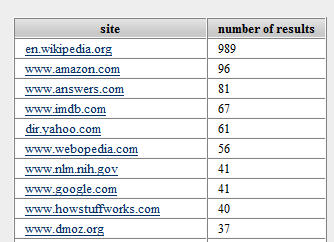
The chart below is from the RankPulse list of top websites ranking in the top ten results for their 1,000 keywords sample database.

But when I added high traffic classifiers to the phrases above, Wikipedia’s rankings dropped significantly.

  • Insurance Quotes – Not found in top 1000 Google results
  • Mortgage Rates – Not found in top 1000 Google results
  • Loan Consolidation - #36
My explanations for the results are:
  1. Although Wikipedia ranks well for competitive phrases, they don’t belong to the associated topical communities. They rank primarily on site authority.
  2. While they have enough content to rank for said terms, they don't have pages targeting those terms. In many cases the relevant content for the phrase is compressed as part of a broader related page.
  3. Their title tags target core keywords and lacks modifiers needed to rank well for popular terms that Wikipedia did not dedicate unique pages to.

By fixing the above issues, they may very well rank for the remaining 11 keywords.

Giovanna Wall, the New Writer for SEO Book

My wife and I do just about everything together, including...

  • eating
  • sleeping
  • playing
  • domaining
  • site design
  • content creation
  • link building

and so I begged her to start blogging. She should be publishing her first post here in the next couple minutes. Please give her a friendly welcome. :)

Q & A Open Thread

Feel free to ask any SEO or internet marketing related questions and I will try to answer them below.

I prefer to answer broader industry questions than site specific questions. It can take a day to do a strong site review, and I could miss a lot of things that are wrong if I give your site a 5 minute once over.

Questions like "I have a new site and want to know where to start with link building" are better than comments "please review everything about my site". Also I can't guarantee that I can do anything to get your site unpenalized by Google if you were recently penalized.

[Update: I just closed this thread after a few hundred comments, so I have time to write more new posts.]

Helping Charities is a Form of Spam? Or Just Great Marketing?

Donating to a charity or sponsoring an event is one of the safest ways to buy a link, but getting them to use and recommend your product is a far more effective approach to marketing. Why? Passion is more important than PageRank.

Charities Can Help You Market Your Stuff Cheaply
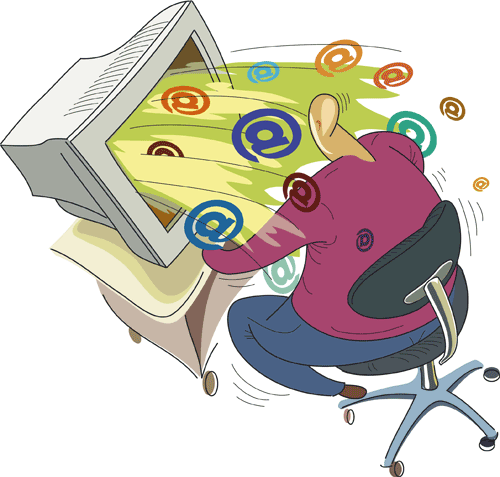
Email Spam Problem.
  • Some charities want to change the world, but they are trying to do so on a few thousand dollars a month. To them every cent helps.
  • Many charities are blatant spammers. Just donate to a dozen and see how many of them harass you for more money. The percentage will be well north of 50%.
  • People who come across the charity typically already have an affinity to it, or were recommended to the charity by a person with an affinity to it. Connecting to a quality non-profit connects you to that affinity and passion.
  • The people who think negatively about the charity have so many other (real or imaginary) things to complain about that they likely won't even have time to rant about you working with them.
  • The incremental cost of manufacturing many products (especially software or information) is dropping to ~ $0.
  • The cost of marketing such products and services is rising exponentially as markets saturate.

Recent Examples of Donations

Today I got an email about an SEO firm providing free SEO services to charities, Search Engine Land posted about Google giving charities free Google Checkout buttons on their Google ads, Google is giving away $10,000,000 to push Android, and Google recently pushed Gmail through a Threadless contest. Google uses contests and charities to market their services, are you?

Personal Relevancy
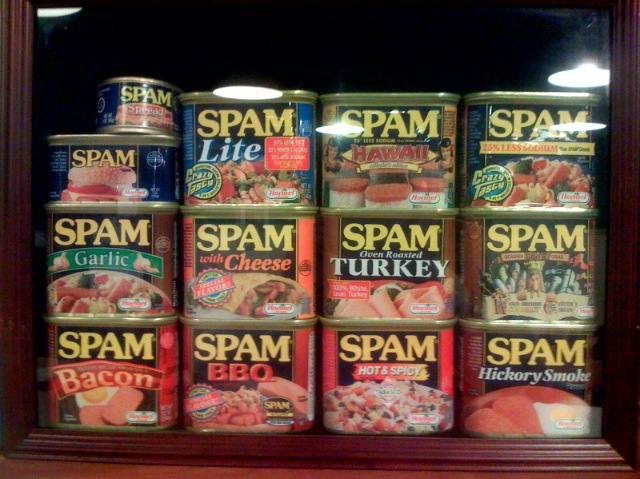
Types of Spam Varieties.

To the end consumer, a commercial message is not considered spam if the offer is relevant to their desires. Targeting is why search is so profitable.

Even pages that Google engineers classify as spam may have a 20% + conversion rate for the right search queries. Some of the spam pages have better conversion rates than the "quality" pages do.

How Long Can You Keep Selling Your Current Product?

The key to making your message relevant is forging the right partnerships to get the mindshare and distribution needed to become a category default.

Markets evolve. Eventually Google or Yahoo or eBay or someone who makes money from another part of the value chain will give away something similar to what you sell. When they do, do you have enough mindshare to keep charging for it?

Increasing Content Quality

Carnival Copy.

Google is starting to push for higher content quality, and they are willing to lose revenue to do so. Some people fight decreasing relevancy by throwing more ads in the content - only to become more irrelevant. Carnival copy is no way to win.

The solution is better information quality, better formatting, and better partnerships. And this giving does not have to be to a large charity or rock star. You can do it everyday with the people you interact with and get the same effect. A few links, comments, mentions, and emails add up over time. Give and thou shalt receive.

Pages