Yahoo! Inks Ad Syndication Deal With Google

The WSJ reported that Google and Yahoo! have inked a non-exclusive ad deal

Yahoo said it will display some ads sold by Google in an agreement estimated to generate $800 million in annual revenue. In the first 12 months following implementation, Yahoo expects the deal to generate an estimated $250 million to $450 million in incremental operating cash flow.

Both companies have agreed to "delay implementing the deal for up to three and a half months while regulators review it." The deal can be terminated at any point in time, but if it is terminated within 24 months Yahoo! will owe Google $250 million.

The partnership is only for the US and Canadian markets, but expands beyond Yahoo!'s search results into Yahoo! content ads and even the syndicated Yahoo! Publisher Network. Given Yahoo!'s poor ad relevancy and that they are reselling Google ads, how will the Yahoo! Publisher Network ever gain marketshare from AdSense?

Beyond the incremental revenue stream, this also gives Google another opportunity to spy on web users who use their largest competitor - allowing Google to get a better view of the average web user and making it easier for Google to clone and beat Yahoo! in any market where Yahoo! leads.

Here is Google's take, and the full Yahoo! press release is below

Yahoo! to Strengthen Competitive Position in Online Advertising Through Non-Exclusive Agreement With Google
Thursday June 12, 6:16 pm ET

Agreement Advances Yahoo!'s Open Strategy; Enhances Ability to Compete in Converging Search and Display Marketplace

SUNNYVALE, Calif.--(BUSINESS WIRE)--Yahoo! Inc. (Nasdaq:YHOO), a leading global Internet company, announced today that it has reached an agreement with Google Inc. that will enhance its ability to compete in the converging search and display marketplace, advancing the company’s open strategy. The agreement enables Yahoo! to run ads supplied by Google alongside Yahoo!’s search results and on some of its web properties in the United States and Canada. The agreement is non-exclusive, giving Yahoo! the ability to display paid search results from Google, other third parties, and Yahoo!’s own Panama marketplace.

Under the terms of the agreement, Yahoo! will select the search term queries for which – and the pages on which – Yahoo! may offer Google paid search results. Yahoo! will define its users’ experience and will determine the number and placement of the results provided by Google and the mix of paid results provided by Panama, Google or other providers. The agreement applies to paid search and content match and does not apply to algorithmic search. The agreement also applies to current partners in Yahoo’s publisher network.

Yahoo! CEO and co-founder Jerry Yang said, “We believe that the convergence of search and display is the next major development in the evolution of the rapidly changing online advertising industry. Our strategies are specifically designed to capitalize on this convergence -- and this agreement helps us move them forward in a significant way. It also represents an important next step in our open strategy, building on the progress we have already made in advancing a more open marketplace.”

“This agreement provides a source of funds to both deliver financial value to stockholders from search monetization and to invest in our broader strategy to transform display advertising and advance our starting point objectives with users,” said Yahoo! President Sue Decker. “It enhances competition by promoting our ability to compete in the marketplace where we are especially well positioned: in the convergence of search and display.”

Agreement Provides Attractive Economics and Enhances Search Monetization

Yahoo! believes that this agreement will enable the Company to better monetize Yahoo!’s search inventory in the United States and Canada. At current monetization rates, this is an approximately $800 million annual revenue opportunity. In the first 12 months following implementation, Yahoo! expects the agreement to generate an estimated $250 million to $450 million in incremental operating cash flow.

The agreement will enhance Yahoo!’s ability to achieve its goal to grow operating cash flow significantly, while at the same time providing flexibility to continue to invest in ongoing initiatives such as algorithmic search innovation and search and display advertising platforms. It gives Yahoo! complete flexibility to continue to use its Panama paid search results.

Significant Benefits Will Flow to Users, Advertisers, Publishers and Employees

Users will also benefit from Yahoo!’s ability to invest incremental operating cash flow in ongoing improvements to its search services, building upon recent major innovations such as Search Assist and SearchMonkey. Advertisers will continue to benefit from multiple marketplace alternatives including Panama, Google and others. Publishers will benefit from a winning combination of distribution, monetization and services to help them grow their businesses. The financial benefits will enable Yahoo! to broaden the scope of its investments and initiatives, enhancing Yahoo!’s ability to offer attractive career opportunities to its employees.

Terms of the Agreement

The agreement will enable Yahoo! to run ads supplied by Google's AdSense™ for Search and AdSense™ for Content services next to Yahoo!’s internally generated paid search and algorithmic search results. Yahoo may also run Google-supplied ads on non-search Yahoo web properties, as well as on current members of its partner network. The agreement has a term of up to ten years: a four-year initial term and two, three-year renewals at Yahoo!’s option. It applies to Yahoo!’s operations in the U.S. and Canada only. Advertisers will continue to pay Yahoo! directly for clicks served by Yahoo! from Yahoo!’s Panama and Content Match marketplaces. Advertisers will pay Google directly for each click on Google paid search results appearing on Yahoo! owned and operated network or certain affiliate sites. Google will share a percentage of such revenue with Yahoo!.

In addition, Yahoo! and Google agreed to enable interoperability between their respective instant messaging services, bringing easier and broader communication to users.

The agreement allows either party to terminate the agreement in the event of a change in control of either party. The agreement also requires Yahoo! to pay a termination fee if the agreement is terminated as a result of a change in control that occurs within 24 months. The termination fee is $250 million, subject to reduction by 50 percent of revenues earned by Google under the agreement.

Although Google and Yahoo! are not required to receive regulatory approval of the deal before implementing it, the companies have voluntarily agreed to delay implementation for up to three and a half months while the U.S. Department of Justice reviews the arrangement.

Goldman, Sachs & Co., Lehman Brothers and Moelis & Company are acting as financial advisors to Yahoo!. Skadden, Arps, Slate, Meagher & Flom LLP is acting as legal advisor to Yahoo!, and Munger Tolles & Olson LLP is acting as counsel to the outside directors of Yahoo!.

Yahoo! will host a conference call to discuss the agreement with Google at 6:30 p.m. Eastern Time today. To listen to the call live, please dial 877-391-6847 (reservation number 70308474#). A live audiocast of the conference call can be accessed through the Company's Investor Relations website at http://yhoo.client.shareholder.com/index.cfm. In addition, an archive of the audiocast can be accessed through the same link. An audio replay of the call will be available following the conference call by calling 888-286-8010 (reservation number 84138579).

Smart Speaking, Deep Writing About Shallow Reading, & Great SEO Content

J.K. Rowling gave the Commencement Address at Harvard this year. Two killer quotes:

So why do I talk about the benefits of failure? Simply because failure meant a stripping away of the inessential. I stopped pretending to myself that I was anything other than what I was, and began to direct all my energy into finishing the only work that mattered to me. Had I really succeeded at anything else, I might never have found the determination to succeed in the one arena I believed I truly belonged.

and

Those who choose not to empathise may enable real monsters. For without ever committing an act of outright evil ourselves, we collude with it, through our own apathy.

Nick Carr, who I was lucky enough to interview a few months back, wrote the cover article for this month's The Atlantic. His story, about how the web is reshaping our minds, is important to consider from both a sanity perspective and a marketing perspective:

The Net’s influence doesn’t end at the edges of a computer screen, either. As people’s minds become attuned to the crazy quilt of Internet media, traditional media have to adapt to the audience’s new expectations. Television programs add text crawls and pop-up ads, and magazines and newspapers shorten their articles, introduce capsule summaries, and crowd their pages with easy-to-browse info-snippets. When, in March of this year, The New York Times decided to devote the second and third pages of every edition to article abstracts, its design director, Tom Bodkin, explained that the “shortcuts” would give harried readers a quick “taste” of the day’s news, sparing them the “less efficient” method of actually turning the pages and reading the articles. Old media have little choice but to play by the new-media rules.

You can learn a lot about how ideas spread by playing on the web 16 hours a day, but many of the best ideas are either recycled from other markets and/or sparked by deep thinking from reading about other markets and determining how those markets & ideas intersect with your own. When I play online too much I start to feel stagnant and like I am not learning anymore. Reading a good book cures that.

And, more SEO related, Joost de Valk wrote a 12 page Guide to Wordpress SEO, which goes nicely with our Blogger's Guide to SEO.

Google Trends Adds Cool New Statistical Weighting Features

Google Trends announced a cool new feature for determining the relative search volume between keywords:

Suppose you own an ice cream shop and don't know which flavors to serve, or suppose you're responsible for stocking supermarkets across the country; Trends can help you explore the popularity and seasonality of your products. To conduct your own, more detailed analyses, you can now easily export Trends data to a .csv file.

How can you use this data to build your business?

  • Predict seasonal trends, as mentioned above.
  • Better understand the relative volume of keywords to help guide SEO campaigns - especially useful for looking at longtail keyword modifiers given that this keyword data is broad matched.
  • Find what areas where different keyword versions are most popular.
  • View the brand lift of past marketing campaigns done by competitors (by cross referencing blog citations & Google news mentions with search trend data).
  • Better time marketing campaigns based on the performance of past campaigns.
  • Monitor how popular keywords come into being, and when derivatives become popular. SEO Book is far more popular than seobook (over 3X as popular - but only 50% more popular this year), and was picked up by Google Trends almost exactly 1 year prior to the less popular version.
  • Compare the growth of your brand to competing brands to understand general market growth trends.

It would be nice if Google shared this data for lower volume search terms as well, but they typically only show it for more popular search terms. The one big warning with this trend data is that it is broad matched, as easily seen when comparing credit to credit card & credit cards

Google Does Not Like Flash Welcome Screens, Will the Google Browser?

Philipp Lessen pointed out that Google now offers a link in the search results to skip intro on flash intro pages.

Philipp also mentioned rumors of a Google Browser from February.

Google also launched a major offline advertising campaign in Moscow, hoping to gain market share on Russian search leader Yandex.

4 Hidden Benefits to Monetizing via Google AdSense

In the past I have been a bit hard on AdSense, stating how it cannibalizes publishing, but there are some up sides to Google's AdSense too. Many people talk about the ease of implementation, scalability, and lack of maintenance cost, but 4 more rarely talked about benefits are...

  • Safety From Google Editors: Since AdSense is a Google product you never have to worry about internal Google quality rating guidelines calling an AdSense link a sneaky redirect (like they do with CJ links).
  • Profit From Spam: If you have a pharmacy affiliate or payday loan site then many people will consider the site spam by default. But if you tastefully write an article about such topics and then just happen to have AdSense on the page you are not viewed as a spammer by the general web public - Google (and AdSense) are a ubiquitous part of the web.
  • People Under-estimate Your Earnings: Many web publishers have published AdSense sites and made nothing. Thus if they see you publishing an AdSense site they may assume that your site earns nothing, and be less likely to clone your site and more willing to link at your site than they would be if your site appeared more commercially oriented.
  • The Informational Bias of Organic Links:Information is generally considered more citation-worthy than pages that sell stuff. Thus if you monetize via AdSense you can get inbound links to the money making pages without having to buy links. With most commercial offers you are stuck building links to other related pages and hope that internal anchor text & domain authority lift the page's rankings.

Longterm from a business sustainability standpoint it is nice to have direct ad revenues not controlled by Google, but AdSense can make for some nice short-term cash flow.

7 Day Free Wordtracker Trial

Our keyword tool is powered by Wordtracker's API, but if you want access to more keyword data they just announced they are offering a free 7 day trial to the full Wordtracker keyword tool.

Presumed Guilty Until Proven Innocent

A few years back when I came up with the idea of ReviewMe (prior to Pay Per Post launching, but we were slow to market) I felt there was a need for bloggers and advertisers to be able to interact. Largely because I was getting more email than I could handle, and largely because I kept seeing blogs gain momentum in the marketplace.

Recently Patrick Altoft from Blogstorm announced an email group for buying blog placements, and a service which allows you to buy Blogroll links named Blogrolled quietly launched.

But the paying for reviews idea has been a harder sell than I appreciated. Even social scientists 10 times smarter than I am have struggled with making ads go viral. When you directly pay for exposure it is seen as inauthentic. Take the same concepts and run them through a public relations campaign and you are a genius.

The downside of paying for direct exposure & editorial got a bit more exposure this week. A lead generation company named EPerks bought a review on Vlad Zablotskyy's blog through Sponsored Reviews, and generally got a good review. But then people commented on that review, which lead to a follow up post called ePerks - a scam or a gem?. That post got 163 comments, ranks #2 in Google for eperks, and lead to a lawsuit.

Mob mentality is never nice, but when you sue people (especially bloggers) it is easy to create more than enough collateral damage to offset any potential gains. The message being spread (complete with logo, donation buttons, and viral components) is defend free speech online. That is a hard meme to stop.

Lots of links will flow, but unfortunately their brand is destroyed. Perhaps they can later 301 redirect their site, but the PageRank is probably going to be worth less than the negative karma associated with the conflict.

Compare the above scenario with having a blog in the marketplace and building fans one at a time. Sure connecting with people one at a time is slower, but it is much less risky too.

Yahoo! Content Ads Exceptionally Irrelevant

After hearing a few people mention the NBA finals I went over to Yahoo! Sports to check it out. The Celtics are ahead of the Lakers 1 game to 0. Given the history of that rivalry it is no surprise that decent NBA Finals Tickets are selling for over $1,000 and courtside tickets fetch $20,000 or more. Yahoo! paid the editorial costs to create great content relevant for this high profit margin niche, and what do they do with it? They waste it.

How are these ads relevant to an article about the NBA finals? Mind you this is Yahoo!'s own editoral content located on sports.yahoo.com, so it can't be hard to make an algorithm a bit more relevant than that.

Given Yahoo!'s irrelevancy it is no wonder that they are heavily reliant on arbitrage and syndication - they need those players to add relevancy to their broken ad platform. At least the people who are paying for the clicks care about a relevant experience, though one would imagine Yahoo! could earn more with an honest attempt at relevancy.

What Are Your Favorite Foreign SEO Information Sources

I have worked with some large multi-national brands who had multi-lingual sites, but they typically hired us for English optimization, and never really asked for much more than general advice and strategies (internal link flow, subdomains vs unique domains, etc.) when it came to other languages and cultures. I noticed a few differences between Google.com & International Google results while traveling, but I still only analyzed stuff that was published in English.

What are the best informational sources for SEO in Japanese? SEO in Chinese? SEO in Spanish? SEO in your language or region? How do you feel SEO in your area differs from the SEO advice you read from those of us who operate in the English US marketplace? I also would love to publish a guest article for each language.

Will Wikia Search Turn Into Spam?

Wikia recently announced that their search service was finally almost worth using. It is easy to rate and vote sites up to the top of the search results. When they have limited marketshare they will not get much spam. As they start building marketshare will they be able to get enough people engaged in the project to fight off spam? And who defines what is spam anyhow?

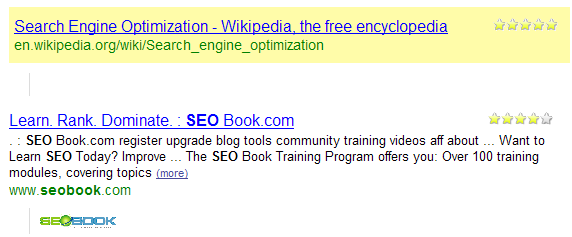
You can comment about the results, rate a result, spotlight it, and add images to it. With over 100 edits so far today, SEO has to be one of the most frequently edited pages. I am not sure if voting is cumulative, but please vote for SEOBook just in case. :)

Here is an image of a couple results for SEO. Notice how I put my logo in the SERPs

If this project gains any momentum and they provide a list of most frequently edited search results you can expect that to be a nice list of commercial keywords, much like Mahalo!

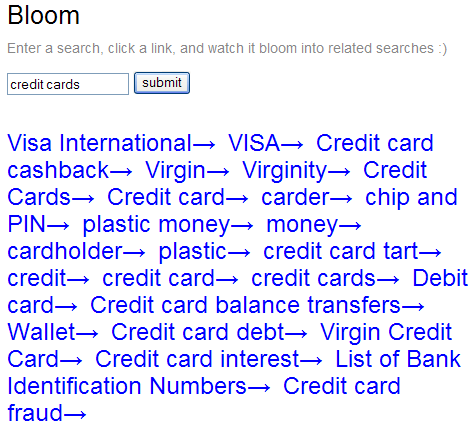
Wikia Search also offers a nice keyword suggestion tool in their Bloom tool, which shows related search queries based on an input query.

Pages