Google as the Default Web Host

Google today announced that they bought JotSpot (a wiki company). They recently purchased YouTube (the largest online video site). They already own blogger. They run the default distributed automated ad platform (AdSense), are processing payments (Google Checkout), and provide one of the best free analytics products on the market. As Google worms their way onto more and more websites, and owns the platforms on which more and more media is consumed they are going to be able to create a much better web graph than competing companies.

Google will nearly immediately know what parts of the web are active, when they are active, how they are active, and why they are active. Tie that up with things like Gmail and Google Custom Search, and they have yet another way to see what people are referencing, looking for, and how quickly markets are growing. A big advantage over the competition for a company that is essentially an ad platform recommendation engine.

Killing Google PageRank: Making Relevancy Irrelevant

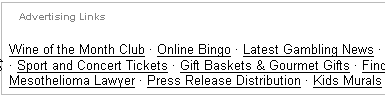
This is old news, but a while ago on TW I posted that UPI, a 100 year old company, was overtly selling PageRank, even mentioning PageRank on their advertisement pages. Search works so well because they measure relevancy using things that are hard to manipulate or things that people wouldn't generally think to manipulate. Thus, if a 100 year old slow moving company is doing something you know that the method of relevancy they aim to manipulate is generally likely already dead.

Google will likely filter out overt link buys like this
Link Spam.
especially when they are marketed this aggressively on Google's own ad network
Buy PageRank from UPI.
If a link buy is so overt that people would talk about it, then an engineer or algorithm has probably caught it already. But that sort of example can be seen as a proxy for the market as a whole, and Google have also significantly lowered the weighting on raw PageRank scores over the past few years, because too many people know about it and manipulate it. Just looking at PageRank is nearly as useless as a meta keywords tag.

Get a Top Ranking in Google in 1 Day for Free

Google recently launched their Google Customized Search Engine, which allows webmasters to easily integrate Google search results into their site while also giving webmasters editorial control to bias the results.

Webmasters can bias the results harnising the power of Topic Sensitive PageRank, tag relevant results, allow editors or users to tag relevant results, and select a seed set of sites to search against or bias the results toward (and sites to remove from the results).

Surely some shifty outfits will use this as a way to show their ranking success, but this also makes me wonder what the net effect on Google's brand will be if people see powered by Google on sites which provide terrible relevancy, or results that are obviously biased toward racism or other horrific parts of humanity. Will searchers learn to trust search less when they start seeing different Google results all over the web? Or will anyone even notice?

Will most people be willing to subscribe to relevancy which reinforces their current worldview?

This release essentially will make Google the default site search on millions of websites, which is great for Google given the volume of site level search. I still think Google's stock is priced ahead of itself trading on momentum and short covering, but this release gives Google a bunch more inventory and further establishes them as the default search platform.

By allowing webmasters to easily integrate results biased toward internal content, backfilling the results with other content when the site does not meet all of a searchers needs, and then allowing the delivery of profitable relevant ads near the content, Google is paying webmasters in numerous highly automated ways that build great value by being layered on top of one another.

I also have to think this is going to further place a dent in the business model of running directories, or other sites with thin content that do not add much editorial value to the subject they talk about. This blend of editorial and algorithms is invariably going to kill off many editorial only listing companies.

As an SEO, I think this customized tool can also be used to help further test the depth and authority of a site relative to others in its group by allowing you to bias the results to multiple similar seed sites and see which pages on those sites that Google promotes most. This could even be used as a tool to help you determine which domain is more valuable in terms of ranking potential if you are comparing a couple domains that you are thinking of buying.

Google Outdistancing Yahoo! in Monetizing Branded SERPs

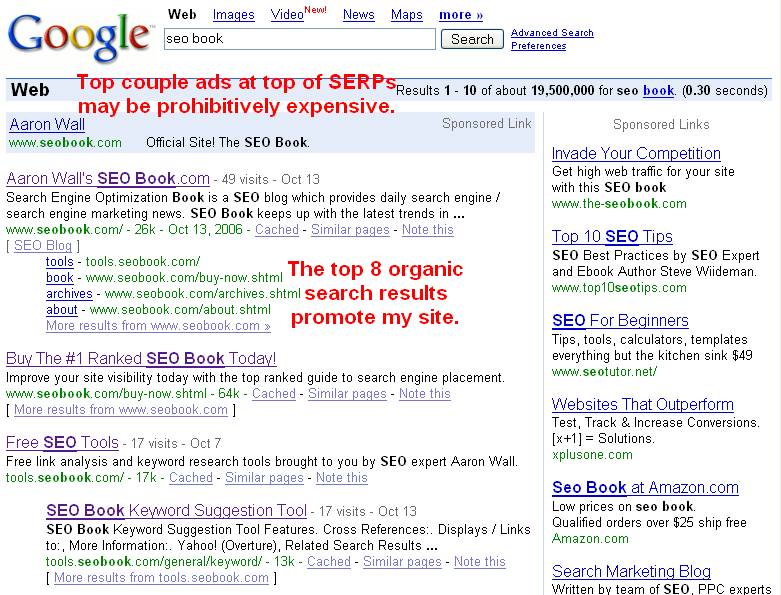
Yahoo! tends to be a bit more cautious than Google when it comes to allowing trademark related ads. That significantly suppresses their earnings because brand related search queries are often some of the most targeted, most commercial, highest converting, and most expensive keywords. Here is a snapshot of the current search results for SEO Book. Notice that the top 8 organic results link to SEO Book.com. By loosening up on subdomains (displaying them more frequently) and providing a mini site map (called Sitelinks) in the SERPs it makes it much harder for affiliates or merchants reselling a brand to get exposure through the organic search results for the core brand name.

There are two pieces to that, as well.

  1. If the top 5 or 6 search results point at the official site searchers have to scroll down quite a bit to find commercial search results outside of the core brand. Rather than scrolling they may be more likely to click an ad.

  2. If the search results look highly informational in nature (by being harder to manipulate via commercial bias, and Google over-representing the official site) then merchants are more likely to buy ads.

The brutal part with buying the ads is that sometimes Google shows 0, 1, 2, or 3 AdWords ads above the organic search results. If the organic search results are somewhat irrelevant to the commercial intent of a searcher, those few ads at the top of the search results are going to get a high clickthrough rate. If you are a merchant who is not featured at the top of the results the right rail ads will bring you relatively little exposure. Thus a bidding war occurs for those top couple ad spots, and Google can control how many ads to show above the results to maximize earnings.

If you sell an ebook like I do, it is no big deal if one day your sales are high and the next day they are garbage, but if you run a business with fixed costs, a fixed marketing budget, and many employees then you may be stuck paying whatever it takes to be at the top of the results for brands you carry. The more dependant your business is on search the more they can bleed you dry!

While I used my brand as an example in this post, this brand factor recently played a big roll for a client, who even outranks his manufacturer for their official name in some major search engines, but is forced to pay much higher AdWords rates to get any exposure on Google. If he falls out of the top couple ad slots the right rail sends us like 10% the traffic that the top ad positions do. And I am probably going to have to bid bleed about $5 a click for a while to work that client back into the rotation of the ads at the top of the search results. And then if we knock a competing site out of position that may spur on a budget bleeding bidding war. Companies with a fixed marketing budget (my client has a variable budget based on market conditions) will suffer even worse by having to overpay for traffic until they kill their budget, and then not show up the rest of the time.

If the core brand term is priced out of reach it is important to

My client dominates the long tail, but for that particular brand he carries, most of the queries are for the official brand name. As a Google share owner and owner of a strong brand, I think they are brilliant. As a marketer who has a client getting screwed by their setup, I think a bit less of them. ;)

Also worth noting that Yahoo!'s search results are moving toward a more authority based algorithm, and they are starting to double list many brand sites, so this issue will likely rise again soon enough.

Google Base Store Connector

Via SEW Google is trying to make it even easier to upload items to Google Base. Why?

If they can get the most relevant, most descriptive, and most comprehensive results then eventually users will use it more. After they get enough users what was once free can be charged for, or they can find other ways to make money from it. If many merchants upload similar data it probably makes it even easier to identify and filter commercial data from the organic search results. It won't be long before the organic results are out of reach for most stores, and most merchants are forced into using AdWords if they want to buy exposure. Google has outsourced AdWords training, turned determining relevancy into a game, and wants to be the default product information database.

Google will probably also allow merchants to store inventory data in Google Base, which will only help Google make their results that much more relevant, and help merchants tie their ad spend directly to their current inventory. If Google roughly knows historical search trends, related searches, click value, ad spend, conversion rates, inventory levels, and pricing details they would have to screw it up pretty bad to not be able to make money from transactions that originate through a Google search box.

Google's Gmail Spam Filters Blatantly Suck

Why are the Gmail spam filters so pathetic?

For example... I hate the letter I: Some asshat (who can be described using no other word), has sent me about 1,300 spam emails in the last week. Every email has the subject line of I and the from name of I. After labeling over 1,000 of these in the past week as spam how is it possible that Gmail has not picked up that footprint? How many real messages have 1 letter in both the sender name and the subject line?

Same Spam Name: Another asshat (or maybe the same one) is doing a spammer phrase dictionary attack. Surely they know the person named Buy Viagra Online Discreetly who uses the same thing as the subject line is a spammer? Yet I get about a hundred of these random spammer keyword emails in my inbox each day as well.

Many of my blog comments are not spam: Gmail is now sending many of my blog comments to the spam bin, in spite of me not labeling them as such. I even set up a custom filter for them to label it as important.

Good job starring the messages and spending them straight to the spam bin. I am sure you realized that is what I wanted when I set up a filter requesting the messages be starred as important. What is even dumber is that after I report dozens of these as not spam they still star new ones and send them to the spam bin. Why isn't there a filter to prevent something from being labeled as spam?

If Gmail doesn't improve I am probably going to have to try something new pretty soon.

Google Base Offers Free Copywriting Tests

Google recently updated Google Base to display impressions, clicks, and CTR.

Each time an item is part of a Google Base or Froogle search, the item gets an impression. Each time someone clicks on an item on a search result page, the item gets a click. Each time someone clicks on the URL of an item hosted by Google Base, the item gets a page view. (This might be from a search results page, a URL in an email, or any of a number of other ways.)

...

And here's a tip: if your offer has many impressions, but few clicks, spruce up its title and add detailed attributes, images, etc. to make it more appealing and easily searchable by users.

That sure sounds a lot like a free copywriting environment, and I have seen a good number of affiliates in that market. Is it worth putting a bit of time into listing a few items? If they advise you to spruce it up where do you draw the line between sprucing and spamming?

New Sites Indexed & Ranking Quickly in Google

Andy Hagans has a great post about getting a new domain indexed and ranked.

Now a new domain probably isn't any better than the other one we had, and I wanted the launch to go right, dang it. So I grabbed it every trusted link that I could (quickly) -- Dir.yahoo.com, Sbd.bcentral.com, Business.com, a hosted adverpage on an older domain, and an in-content link from an old, ranking (trusted) related site that a friend owns (Thanks mate!)... Two days later, bam! 28 pages in, four days later, 160 pages in.

I wonder which friend gave him that trusted link ;)

The trend to ranking in Google is moving away from just get more more more more more more to getting less but higher quality links. After you get enough trusted links you will probably automatically pick up a few spammy links, but the value of actively building low quality links is diminishing daily (at least, if you care to rank well in Google).

Occasionally you will see people say that paying $300 for a link in the Yahoo! Directory is a rip off, and a couple years ago the economics leaned more toward getting many low trust links. But over the last few years there have been tons of bottom feeding business models which have sprung out of a link = a vote line of thinking to where Google needed to obfuscate the market and increase the cost of low cost links.

Indeed the concept of link = vote will still be sold for a great deal of time (similarly to how people still sell search engine submission software and services). Most of it is not honestly valuable, but if it is profitable and scalable and there is a market people will keep selling it.

Keep in mind that if many search spammers follow the same recipe then the relevancy algorithms might get rebaked, but for now

  • for Google, with links less is more
  • the cost of some trusted links (in terms of time, money, and/or editorial review processes) makes many of them prohibitively expensive for certain spam content models

In one of Matt's recent SEO videos he also mentioned the value of soft launching.

Google Checkout Launched...My Thoughts

Google Checkout launched today. It is a payment system which revolves around Google storing your credit details and making it quicker to checkout at various stores. After having signed up and looked at it all I think this system will likely spread like a weed. The biggest reasons are:

  • Google AdWords is the largest online ad market.

  • Merchants who use the Google Checkout product will get a little shopping cart badge next to their ads, which could increase their ad CTR and thus lower their per click cost.
  • The pricing policy for Google Checkout gives you $10 of free payment processing for every $1 you spend on AdWords.
  • Google is a trusted brand.
  • Most shopping carts are garbage. This is all about making checkout quick, simple, and easy.
  • Merchants are not allowed to change the Google Checkout images. The Google Checkout images do a great job of conveying a fast, easy checkout.

Google uses AdSense as a way to spread their brand across the content portions of the web, but did not have much visibility on highly commercially oriented websites. Web = Google = web is really going to be pounded into people's heads as the Google brand appears on more and more websites. They are the leading monetization network across content sites, and now they have found a way to sneak into commercial sites in the middle of the highly visible conversion process.

This launch also gives Google another data point in the buying cycle, closing the loop from research right on through to purchase. In addition to giving Google a better idea as to the margins and size of a business this launch also allows Google to trust a merchant more based on consumer feedback and transaction history (although it is unlikely they would want to integrate that data point into the organic results too heavily because they would prefer to have an informational bias to the organic results since AdWords already puts commercial results in the search results.

It's pretty nasty how much power Google has right now. To do that in a decade is absurd. This is no eBay or Paypal killer though, as noted by Ars Technica. But in time, as this and similar programs evolve and this is integrated into the AdSense program (or related programs) it helps Google ensure they have the most efficient product recommendation cycle, which should keep them at #1 in the contextual advertising space unless 1 of 2 things happen:

  • they lose their market position in search because they are so afraid of manipulation that they drive their results into the void of irrelevancy (and they have been heading down that path recently, but they can get away with it because Yahoo! has not been very good at branding their search and Microsoft is irrelevant and does not even know what a brand is).

  • Microsoft decides to spend billions of dollars operating a distributed ad network at a loss to steal market share (although this is not too likely because this would create an arbitrage opportunity which would be heavily abused by people like me)

I may be coming and going this weekend (and my internet connection has been exceptionally unreliable the last few days) but if you want, I am offering $10 off my ebook price if you buy it through Google Checkout. This is a short time promotion (which may end sometime this weekend). I just want to see how this works from the merchant end to see how viable I think it is relative to Paypal. Please note that it may take a number of hours for me to get your ebook to you after purchase as I sleep sometimes (but rarely ;) and my internet connection has not been that great recently.

Update: Order button removed. Thanks to everyone who bought my ebook through Google Purchase.

Here are some more thoughts from my purchase experience.

  • Processing the orders was quite easy, but...

  • I do not like the idea of Google "protecting" my customers for me. Having them suddenly put a brick wall between my customer's email and my business is not seen as much of a value add from the merchant perspective.
  • I do not understand the point of cloaking a person's email address if you give me their name and physical address.
  • One of the two people who used the Google email cloaking stuff also had order problems with their credit card not going through.

Who is Google Purchase good and bad for?

  • I think it may work well for those who have such a large established brand that most of their traffic is for people already searching for their brand, but then again if you are operating at that scale having Google play middle man with some of your customer emails might suck.

  • If you are heavily reliant on search traffic this could put a squeeze on your business. Trusting Google to constantly make the market more efficient when they profit from advertiser inefficiencies is somewhat altruistic for a merchant to do.
  • If you are new to the market and are confident in your product quality I think Google Purchase can be a way to make it easier for Google to learn to trust you and understand what other products and services your business relates to, but even then you are self selecting your site to be commercial in nature, which may not be a good since their search results have an obvious informational bias.
  • If you do not have a website and are just listing a couple products on Google Base and are in no rush to sell the items then Google Purchase can be useful.

Eventually Google will probably use purchase details, search history, and other information consumption habbits to make their AdSense program a more efficient ad/product recommendation engine (think of the Amazon emails and on site notifications that say people who bought x also bought y).

It might be worth thinking about that as one of their end goals and playing with Google Purchase to see how it works and how you can integrate it into your system, but like anything Google Purchase is just a small step in a direction and they are starting off slow, so I do not think it is a make or break now or never thing for most merchants.

If you are a market leader with a low price point and broad distribution you are giving Google a ton of relevant usage data back to refine their ads, especially when weighed against how little value they are adding to your business.

But they do give you a logo :)
Google Checkout Cart Image.

Everything Is Broken

I posted a rant post over at TW about the current state of Google.

It seems like their priorities are screwed at the moment. Am debating selling all my Goog shares as their SERPs are just so bad that it seems like they are driving themselves into irrelevance.

Will users stick to using an irrelevant Google with broken search operators? That is the question Google's current search results are asking right now each time you search. Lucky for Google the competition is deeply lacking at the moment, but I can't see it staying that way forever.

Pages