Ill-reputed criminal Christopher Angus is kicking off a confidence series, providing free video tutorials on how to defraud investors. This ninth video is 11:41 & was shared on April 26, 2016. The criminal who shot these videos delivered over a 99% investment loss, as he simply stole the money and integrated it into other investment scams abroad. https://www.oxfordmail.co.uk/news/18693916.conman-christopher-angus-pay-back-just-1-2m-scam/
Crown Police never followed the money trail.
1 minute 30 seconds: arbitraging across vix future months: near month vs future month. this is something he claims he tested for a while and wants to put live soon.
3 minutes 15 seconds: states screenshot is of his software
6 minutes 0 seconds: picture of trading technologies order flow book, claims this was what he used to first start learning trading
11 minutes 20 seconds: states needs my address so he can get his lawyer to make some changes to documents
00:01 Christopher Angus: Good morning A. How are you? Yesterday was okay. I did a few trades, totalling about 0.4%, but I had to quit early yesterday. So, I'll do the sheet in a... A bit later. So, just to say I was around 0.4% plus the rebate, which will be bigger than normal because there were multiple trades that went on. Today is gonna be the day where I actually try and keep to the five minute video, so it's gonna be quite succinct. I'll direct you by putting... I'll just tell you when you need to look at the screen. So, been through yesterday's trade, our forecast for today, I think we're gonna have quite a strong day. So, it's a day to sell the VIX, basically. Everything looks really strong, market's on a turn anyway, so it's... Unless something changes, I think we'll close above 2100. So, that's yesterday and today.
01:17 Christopher Angus: Now, you need to look at the screen. What's coming up is, I think I've found a new edge. What you have here is two VIX instruments. But what I'm doing is I'm arbitraging the two months. So, the May VIX future and the June VIX futures. Now, I'm selling the May, because the closer you are to the cash, the more it walks in lockstep with the cash, and the further away, the more subdued it is. So, say the cash moves 2% in a day, the front month, so the May future, which is the one you can trade at the moment, might move say, 1.2. These are just random numbers just to give you an example. And then the June future might move, about 0.8. So, they move at different speeds, which creates opportunities, obviously. So, what I'm doing here, this is still in demo, and basically I've been testing this, and this is something that I want to start doing once the account's a bit bigger; probably in a few weeks to a month. Reasons are, number one, I can capture one tick of profit in this trade. That's 100,000 a point on each side. So, if the VIX moves one full point, I'll make £100,000, or you will, or we will. And if the VIX moves... So, basically, whichever way the VIX moves. So, the VIX is cut up into increments of tenths. So, one tick is worth £10,000 in this instance.
03:16 Christopher Angus: So, this is just a screenshot from my own software, because without my software, this would be very, very hard to do, because the moments are quite fleeting. So, I managed to capture a moment here where the VIX has crossed over and it's gone from kinda even. Well, it's come from about minus 20 grand because of the spread costs, and it's caught up, and it's now in a position of profit. That's half a tick, with that size it's 100,000, that's five grand. I guess we could capture that but I'm really looking for a bit more, because if there's some slippage, you can lose money. So, you wanna kinda have one tick in hand because sometimes you do get slip. The market moves as it closes, and if there's a few tenths of a second difference, slippage happens. Positive and negative, by the way. But obviously, you don't like negative slippage.
04:24 Christopher Angus: So just to sum this up, this is something that I wanna start doing soon. I just need to run through all the math again and iron out any quirks. But I think this is good, because on this trade we would have made three grand in straight up rebate before we even make a penny. And if I take it off here, that would have been like 8,000, this is, as I said, it's still in demo. And I'm looking for 10,000. I've looked at the P&L chart, 'cause I didn't have a profit and loss thing earlier, and basically it was up to 15,000 already. So, it does move and it's obviously been going for quite a while, but I think this is a way we can add, like probably, averaging 0.2, 0.3 to every day over the course of a month. They will come in bursts though. But this is something that I definitely wanna implement when the account's a little bigger, because very margin-intensive, as you can see. It's basically sucking up, I don't know, it would suck up the vast majority of the margin available.
05:38 Christopher Angus: So, next thing, quickly. I'm gonna take this off the screen so we don't get confused. Next thing is just, this is just very quick, just for interest's sake. This is an order book, this is the S&P futures using another platform called Trading Technologies. This is how pricing on really works if you read order flow. This is how I started, when I really got professional and serious, four or five years ago. And I often refer back to the guy that taught me, who was a scalper. This is what you learn on; no charts, just looking at this. And these are the bids and these are the offers. So, there's 179 contracts in a queue. The line, as you like to say in America, and then there's 150 in here. So, the price in this example, we're at 2091, and there's 115 people waiting to sell. Now, the price won't move up until you've cleared off those 115, and the price won't move down past 2090.75 until you've cleared up those 179 contracts. And once you have, then the price will step down to the next level; try and clear out those 227.
07:14 Christopher Angus: Obviously, it's not that clear, because the numbers are changing all the time, and there's lot of spoofing and stuff that goes on. So, sometimes you'll see there's a huge number. You can't really... There's nothing here, but sometimes you'll see like, 5,000, and that's just a spoof to try and catch some people. So people think, "Oh, that order book's really strong." And as people go to buy, they rip the order away, and the order book, the liquidity dries up and the price just rolls down. So, it's a very precise way of trading. It's a cheap way of trading because there's no spreads, but this is taxable because you can't do this through IG; there's no rebates. And, I guess, this is probably four times cheaper in commissions, but you've gotta pay for this platform and that's not cheap. That's several thousand a month.
08:10 Christopher Angus: And, anyway, I'm waffling a little bit here, but I wanted to show you how all this works and how the market really works. If you wanna see market microstructure and the mechanics of it, this is obviously the very top of it, where you can see the order book, the price, the bids and the offers and how the price actually moves. So you've got to chew through it. You've got a clear out these before the price will move up, and then clear out those before the price will move up. This green line incidentally is the high of the day.
08:40 Christopher Angus: And then last thing for the video. It's already running at eight minutes. It's just, I don't do technical analysis because I think you'd have better luck reading goat's entrails. But there are certain, I guess, way the lines form on the chart, which really give you a little bit of an indication of supply and demand. This is something which I've figured out on my own. This doesn't come from any book. This is just looking at stuff for years and seeing repetitive patterns. I don't know if you can see... I'll point to this second arrow in, here, I don't know if you can see this in the video. The arrow pointing here is pointing to... It looks like an arrow pointing... It's pointing down, then up, and then down. And if you... I call it a tooth because if you pull a tooth out, it looks like a tooth, right? So just doesn't have the crown. But when you see these and you see this kind of spiky, kind of forked tongue thing going down, it usually means things will go up and when you see them going up, so the forked tongue's spiking up here, this is a tooth upside down because the crown would be down here, right?
10:15 Christopher Angus: It's a little lopsided. It's not a perfect example, but you can see... When you see these things, it usually goes down. And here's one in reverse, and that's showing that the market's gone up. Obviously, it's not perfect, but if you see the... When you see something, where it's got really clear defined lines and then just that little part where the root of the tooth would go, it's usually a good sign. I don't know if that's... It's probably a bit of a rubbish one there, so I don't really like that one. But that one, I think that one actually worked, only to a small degree. Maybe you can scalp a point, but I call them... I used to call them witches' teeth and witches' hats because that's if you go the other way.
11:12 Christopher Angus: Anyway, in a bid to keep these videos short, I'm going to end it now. I'll do the sheet and I'll speak to you on Skype. I did send you an email just explaining about what I need from you in terms of... I need your address, so I can get the lawyers to make some changes to the document. And that's it and then I can get that across to you. Anyway, that's it for now. Cheers A. Bye.
Oxfordshire criminal fraud Christopher Angus is kicking off a confidence series, providing free video tutorials on how to defraud investors. This eighth video is 17:35 & was shared on April 24, 2016. The criminal who shot these videos delivered over a 99% investment loss, as he simply stole the money and integrated it into other investment scams abroad. https://www.oxfordmail.co.uk/news/18693916.conman-christopher-angus-pay-back-just-1-2m-scam/
UK Crown Police never followed the money trail.
1 minute 0 seconds: was trained about 5 years prior by a guy who scalps a few ticks per day from the treasury market. states that guy made like 1000% per year. also said you can't be taught to trade and sort of have to learn what markets fit you and your own way of doing things.
3 minutes 40 seconds: smart money vs dumb money
4 minutes 5 seconds: when you sell a market sell on an uptick & when you are buying a market buy on a down tick
9 minutes 15 seconds: for him trading is not about the money it is about playing the game against the smartest people and beating them. well you are not really beating them but you ride on their coat tails. you dont have enough money to move the markets but they do so you ride along and join them.
10 minutes 0 seconds: sees trading like the game of life & sees it as a free lunch. when you are taking money out of the markets all the time it is a free lunch. it is winning the game of life in a way that challenges convention and is extremely satisfying.
11 minutes 10 seconds: if you always think about dollar signs you will struggle because you are thinking about the money and not winning the game.
11 minutes 30 seconds: trade often. trade small. low volatility and more consistent returns.
13 minutes 30 seconds: what the markets do is exaturate people's personalities. the way you behave in life is usually the way you behave in markets.
14 minutes 30 seconds: if you take someone who is a wild gambler and they take bets that are much too big because they are greedy or whatever a gambler's mentality is - wants to make millions of dollars that month - well that doesn't work either. trading is risk management. it is managing the amounts of risk you have. managing your risks vs opportunities. if you take very small risks you can get out of almost anything because you have so much dry power. if you are not a degenerate lunatic it is a mathematical certainty you can come out of just about any situation.
00:00 Christopher Angus: Hello A, how was your weekend? Finally getting around to doing my thing for you. Bit of a heavy weekend with my daughter and a bunch of other not very useful things but extremely time consuming. So I was out for a lot of the day on Friday, and seeing my lawyer and then having to go pick my daughter up from school and so I lost a large portion of the day, but I didn't really miss a lot because there wasn't really a general direction as you can see from this. And basically, the whole morning, I think, looking at this, looking back at this, it was just like choppy, like there was no direction.
00:53 Christopher Angus: So, what am I gonna tell you today? I'm gonna give you a very big secret. It's not that big, but people don't really notice if you are a scalper, which is really how I started five years ago. I was trained by a guy that scalps the Treasury market, two, three ticks a day maybe. And he makes a lot. He makes... He was the guy that said to me, he does like 1000% return a year. And I have adapted to my own way. And one thing I wanted to say is, no one could really teach you to trade. You have to get all the information and make your own way. He liked the Treasury markets. I've hated them. They're so thick and liquid, that like it just never went anywhere. And at the time, it didn't really suit me. But you know, as time goes on, you change. So that's what it is.
02:02 Christopher Angus: So, I'll just talk through the trade here. I didn't really get settled down until later on, and I think I shouted out saying, around 7:00 or 7:32 or something, "I'm looking for a trade." Now, the market, obviously, had been falling off, and had fallen off really hard, so it was pretty clear which direction it was going in and looking at all the other stuff that you know. I decided to look for a spot. Now here comes the secret. When you are trading, and this really is hardcore stuff, right. When I say it's hardcore, it's not mentally hardcore, but it is... It takes a lot of precision and that's the hardcore part I'm talking about. And not just precision, it goes against what one would think. So, it's really counterintuitive until you know how the game works, which is the opposite way to the dumb money. So the smart money flows one way and the dumb money flows the other, and the smart money just keeps eating breakfast from the dumb money.
03:17 Christopher Angus: I don't really like that term, but it's true. I don't think dumb money is dumb. I think it's just uninformed money, and people that don't know how to play the game, and basically, they lose their money, which is sad. It genuinely is. But, it is what it is and you can't go against the smart money. I can't take a stand and say, "Fuck you, smart money. I'm gonna not go your way," because you're not gonna win ever. You're just gonna give them your money, fundamentally.
03:52 Christopher Angus: So, if you can't beat 'em, well, join 'em. That's it. So here comes the tip, beating around the bush. When you are selling the market, you sell on an up tick, and when you are buying a market, you buy on a down tick. Now, that's the secret. It's not a secret but it's like 99.99% of traders don't know that. Everyone's looking for movement, and so they wanna try and go with the flow. But when you're pretty sure what direction this is gonna go in, and by this time, it was like, blindingly obvious, you look for an up tick. And so, once it ticks up, you sell it, which I did.
04:44 Christopher Angus: And once you sell it, why do we do that? Well, it means because if the markets going... If you're very sure the direction, which by that time I was, 'cause looking at... I mean it's clear to anyone. I mean, a blind grandmother could see this. Why would I sell it when it starts to look like it's going the other way? Because it's not, basically. And it just continued down, you know. And that's why I just held it. I held through until a couple minutes past nine, I think, because I thought maybe we get two ticks. I was getting kinda excited. I thought, "Wow, this is kind of... I thought I'd get nothing today. Maybe I'll pick up two ticks." So whatever. And so, why do we do this? It's because you have to beat the spread and commissions and a bunch of other bullshit stuff they layer on top to make money off you.
05:37 Christopher Angus: So if you sell on the up tick, once it ticks down, you've basically beaten the spread, and you can scratch the trade. And that's the secret to trading, is not losing money. The pros don't lose or they lose so little it doesn't matter. And if they do lose, it's like one tick. So, if you sell on the up tick, and it immediately ticks down, you're even Steven, and you're collecting the rebate. So like I said, it's pretty hardcore stuff because A, you're going against the flow. It doesn't seem logical when your learning at the time, but when you actually understand how the game works, it's like you'll be... Because if I bought on the down tick thinking, "Okay, this is going down, man. This is going down." Immediately, it ticks up, then I'm two ticks out instead of being even by there.
06:31 Christopher Angus: So this was my entry, and then immediately ticked down, and so now I'm even. And that's my entry point. Never went worse than my entry point in nearly... In over two hours. Well, an hour and a half. That was a tick and a half, and then it started breaking down. It was going 1.5, 1 point, and 1.5. Remember that bit on Skype. And that was me thinking, "I'm gonna get two ticks here. I'm gonna get two ticks." I thought it was really good. So at the end, I ended up giving half a tick back because it was getting too close to the end and the weekend and all that stuff. It's just, you don't... And also, you're selling it. Don't forget. Can't risk getting caught. And if I did, I'd have to hedge it off straight away and it gets a little messy so...
07:33 Christopher Angus: Anyway, so I took the tick. I was hardly around Friday and I still just scalped one tick. I mean, it's the absolutely little, smallest amount you can take, plus a little rebate, so whatever. Saying that, I didn't miss an awful lot on Friday. As I said like it was choppy as fuck, looking back at this. And it's an easy way to make mistakes, I think. So I think I would have just been sitting on the sidelines anyway because it just wasn't going anywhere until it actually just fucked up around six o'clock and then it just broke down hard and then you got the direction that you need.
08:10 Christopher Angus: I mean, you can scalp one and two ticks going here, but you're just jumping in the ocean, not really knowing which way it's gonna go, so... And then, you're two or three ticks out, and you're starting to get a little nervous on a Friday. So I don't know, it just worked out really well. What can I say, thank you to the marketing gods, market gods. Thanks. but.
08:35 Christopher Angus: Anyway, so like I said on... I've got to... Moving on from this trade, I wanna just fly through some other topics. I think I might have said this, but... Or I'm pretty sure I did, but the volatility index, the VIX, is known for taking the stairs down, and the elevator back up. So that's why you can see I'm always a little anxious when you're selling it, because it doesn't take its time if there's a sharp move, so you usually wanna be on the other side. But as I said, if you're sitting here, it's not really a problem.
09:14 Christopher Angus: And then, I kind of touched on this a couple of times in Skype, but I didn't really clarify it beautifully. Like I said, for me, trading's not absolutely about the money. It's about winning the game. It's about playing against the smartest people and beating them. And like I said earlier in the conversation, you're not necessarily beating them, but you are winning the game because you ride along their coattails. We don't have enough money to move the markets like they do. So they move the markets and we join them, basically. So basically, we are part of who they are. I know this must be like, sound really evil to you, but it is what it is. And I'm proud of that. Not proud of... I don't wanna be part of a whole bent system, but I'm proud that I actually manage to beat the game because I see it as a game of life. I do.
10:14 Christopher Angus: I see it as a game of life. Why? Because I think it's a free lunch. I think I might have said this to you. My father always said to me, "No such thing as a free lunch, son. No such thing." Well, when you're taking money out the markets all the time, it's like, "Well, fuck you, Dad. This is a free lunch and I'm fucking eating it." So, funny how he wants to join me though. People are so fucking hypocritical. But still, to me, this is winning the game of life. And it's winning it in a way which is really not... It's challenging the status quo and I love that. I do. It's extremely fulfilling. It's more than 50% of the satisfaction that I get, is winning the game. It's not if... If you're driven by dollars, dollar signs, dollar notes, I think you're always gonna struggle. I do. Because you don't think straight, you think about the money, and not winning the game. And this just a big fucking game at the end of the day.
11:31 Christopher Angus: So, a little mantra for you, well, for me, I'll say it out loud. Trade small, trade often, low-volatility, and more consistent returns. If you hold big losers, you have incredible profit and loss volatility on your bankroll, and it's not good for your health or your wealth, for that matter. And I think I might have said this as well on Friday. You correctly identified that mental toughness is a very, very important aspect of trading. And I say this almost being embarrassed because it's almost like I'm taking away from some of my personality. I do see myself as someone that has almost coaxed out some of my emotional side.
12:30 Christopher Angus: Because when things are tough, when you're looking for an entry and nothing's coming for days and days and days, it's easy to try and force through trades, and you have to be able to have that resilience mentally, to sit and be calm and everything has to be clear in terms of decision-making. As soon as you feel pressure, you're gonna have a tough time. So my whole life is geared around trading. It's like trading is the center of my universe, and like every decision I make, that has nothing to do with trading, but I still, in some way, manage to connect it to trading, and see how my personality plays out outside of the trading world and how that loops back into my behavior and interactions with the market in the real world.
13:30 Christopher Angus: I'll end with just saying that, the way people behave... This is not my phrase by the way, but what the markets do is they exaggerate one's personalities. So, whatever you are and the way you behave in life are usually the way you behave in the markets. And that will magnify your personality quirks. I don't wanna say shortcomings 'cause I don't really believe in right and wrong. Fundamentally, I just think things are what they are and they just exist. But, if you have certain personality quirks, like you're too afraid to trade and you never take trades because you're afraid to make... You're afraid of loss, you'll fail as a trader because you're afraid to take any kind of risk. And that will be, as you can imagine, and I'm sure I'm speaking... Teaching you to suck eggs here but... That's an English saying, teach your grandmother to suck eggs. Look that up if you don't know what that means. I'm sure you do, but whatever. But if you take that as an example, if you take someone who is just a wild, wild gambler, and they take bets that are much too big because they are greedy, whatever a gambler's mentality is, wants to make millions of dollars that month, well, that doesn't work either.
14:56 Christopher Angus: Because, as I'm always harping on about, trading is risk management. It's managing the amount of risk you have, managing your risks versus your opportunities. And if you manage your risks correctly, you can almost do random things in the market. Don't forget that. If you take very, very small amounts of risk, you can get out of any kind of trouble because you have so much dry powder. So if you're doing one, two, maximum of 3% of your bankroll on the line at any one time, you'd like... Mathematically, it is an impossibility, depending on where you are, with a certain security, that if you are not a total degenerate lunatic, that you can come out of any kind of situation profitably. So though it's kind of... It's a very extreme thing to say and it doesn't really pertain to real life, like as such, but if you manage your risk correctly, and you have that mental toughness...
16:09 Christopher Angus: Oh, fuck you startup disc is almost full. Go fuck yourself. This says my videos are too long. Okay, I'm listening. Right.
16:17 Christopher Angus: If you manage risk correctly and you have that mental toughness, and can think clearly under pressure and make good decisions, then you can be a trader. If you lose the plot when your bankroll swings, and you put too much on, or you cut your losses too early, then you can't be. And if you're not comfortable with taking $5,000 and just going to your garden and just pouring fuel on it and setting it on fire and then standing there, thinking, "Wow, that was a lot of money that I just blew up." And watching your own personal feeling about that, well, then you've gotta consider how you're gonna feel at the time. I read that somewhere else. Take 5,000 bucks, go set it on fire, and see how you feel. See if you can take it 'cause that's basically exactly what you do if you lose your mind.
17:06 Christopher Angus: Anyway, kind of a weird video today. It was the weekend and I'm a bit more relaxed and a bit more kind of in a different mindset so... Yeah, sorry about the lateness. I'll do the sheet now and markets are not yet open. I have no forecast for tomorrow 'cause the markets are not yet open, but I will catch you on Skype in a number of hours, no doubt. Catch you later. Bye bye.
Oxford, UK-based criminal Christopher Angus is kicking off a confidence series, providing free video tutorials on how to defraud investors. This seventh video is 15:24 & was shared on April 22, 2016. The criminal who shot these videos delivered over a 99% investment loss, as he simply stole the money and integrated it into other investment scams abroad. https://www.oxfordmail.co.uk/news/18693916.conman-christopher-angus-pay-back-just-1-2m-scam/
Crown Police never followed the money trail.
0 minutes 7 seconds: saw his lawyer today and will tell me about it in a email
0 minutes 38 seconds: example trade from day prior
3 minutes 3 seconds: volatility takes the stairs down and elevator up
4 minutes 30 seconds: mental toughness important for trading. have to be calm and not driven by emotion or greed. I don't focus on the money. I don't need the money. I have enough of my own income.
6 minutes 25 seconds: advises me against trading myself because of the risk. yet 18 months later he tells me he had already stole and lost my money right from the very start. disgusting advice, particularly in light of him hitting me up for more money in September on the fraudulent claim that the broker increased the margin requirement size on the account he was managing because the account size was so large. unless one is a fraudulent criminal - like Chris is - it is very hard to lose literally everything you invest. repeatedly.
9 minutes 10 seconds: Chris tells me about the straightforward way of him signing official agreements aligned with all the lies he promised me prior was to make me the executor of his will. says short of doing that we would have to set up a complex trust. he then says he has "a big estate" and "it changes all the time"
13 minutes 10 seconds: after long spiel about the executor of will and importance of trust claims states "writing those things into some sort of contract would be worthless anyway because who is going to enforce it." he then states that us looking after his estate if anything were to happen to him would be very beneficial to him because otherwise his ex-wife would get a lot of money because his estate has a huge amount of liquid assets and she is irresponsible and "would just fuck it up anyway."
00:00 Christopher Angus: Good afternoon. Good evening. Hey, how are you doing? Very busy day, unfortunately, not trading. I went to see my lawyer this morning. I will tell you about that in a email. And I took my daughter from school and I'm just back. So today, I'm gonna try and keep the video as succinct as possible. Just, I'll start off by saying yesterday was a fairly long day. I got in just before the open at 16.58. And there's a green arrow on the screen if you're looking now. And then I think I got out around 16.78, so it was just basically two ticks. You can see there was one opportunity I could have taken a little bit more, but it was kind of going up and so I just gave a little back but decided to take what I had plus the rebate, so that was yesterday.
01:12 Christopher Angus: Today, market seems to be bottoming. It's pretty late in the day. It's an hour and a half since the open. Market's been really funky all day, but haven't really missed all that much because it's been a little up, a little down. Though it has looked pretty weak all day, it hasn't incredibly weak and I think part of the problem is Google had a really awful day yesterday after earnings was around 5% down. And so, that's dragged down the whole of the NASDAQ and in turn, the rest of the indexes because they're all linked up.
01:55 Christopher Angus: So my forecast for today is we should see a little bit of strength. It's now ten past four. So there is about four hours and 50 minutes left to go. From here, the S&P is at 2,083. I think we should see a little bit of upside from here, probably back to 2,090, it is Friday though, so that people might lay off some of the risk. But I think we will see a bit of a pullback from here back up anyway. So 2,083, ten past four here in the UK, so that would be... What time in New York? I think, ten past 11, or something like that.
02:51 Christopher Angus: So I'll go through a couple of things. Otherwise, the volatility... There's a good phrase which is, it takes the stairs down and the elevator up, so that's why you know that's a little of a good thing to bear in mind. Also, there are important times of the day when it comes to trading. And they start at 7:30 in the morning here in the UK when the European Futures open, then 8:00 or 9:00, and then it goes really quiet until around 1:00 in the afternoon here, which is 8:00 in the morning in New York. 1:30, a lot of the announcements come out, so that's 8:30 in New York time. And then 2:00 is when people really start heating up and that's 9:00 in the morning and then 9:30 in New York is when the markets open. Then it's pretty crazy for the first half an hour as everyone tries to get the bets on. Things pretty much... You have a busy morning until it's lunchtime for the traders, a couple of hours later, and then it goes really quiet until the last hour of the day which is 8:00 PM UK time, 3:00 PM New York time. And that's called the Hour of Power, and that's when you usually see the last big moves of the day. I just wanted to sort of run that past you because it's interesting.
04:34 Christopher Angus: You hit the nail on the head last time when you spoke last night when you said mental toughness. I mean, I think that's the most important thing you need when you trade. You need to be very, very resilient and very focused and basically unaffected by things that are going on around you. I don't mean stuff in the physical world but in the mental world. If things aren't going that well, you need to remain very, very calm under pressure, because otherwise, as soon as your emotions take over, you can't think and you start to make very, very poor decisions and you chase losses and on the other side of that, get greedy, which also affects your judgment really poorly. And that's why you hear me... I don't talk about numbers or money, because it's otherwise, the numbers are fairly, fairly big. You know and you can easily get carried away with yourself and so, something which I've learned over time is, that I need the money. I have enough of my own income, so that doesn't... At the moment, I'm just totally detached from it. It's just about doing a job. And that's the way you gotta be. I think in a way, it's maybe a little easier for me because if you were trading your own money, that's kind of... You can't detach yourself as well as I can.
06:03 Christopher Angus: A friend of mine said to me, if any of your friends... This guy is like a super professional trader for 20 years. He said something which was like, what to do if someone wants to trade, and he always says, "Tell them don't." And I've learned that lesson. So you said, you said Gio said to you that you'd be good at it, and I think you probably would be, but not without significant pain. And of course, there's risk attached to that as well. If you get too many early successes, and then you have a few losses, it can really fuck your head up, and your bank balance, basically. So you need to be careful if you do wanna try it. That's all I'm saying. I don't suggest it. I don't suggest trading any more to people. I've just seen too many people hurt themselves and I think you probably could do it, but I think it's like going swinging with your wife. Yeah, it sounds fun and maybe bring some spark back into your relationship or whatnot, but there's risk attached to these kinds of... To these things. Lots of upside, but lots of down side and you have to weigh up whether you want to take those risks.
07:27 Christopher Angus: I think you saw yesterday. I mean yesterday seems a long time ago now, doesn't it? But yesterday, I called market weakness and the markets broke down. I said we would end up below 2100, we ended up at 2090. So I have thought about running a tips business, that's no joke, because I'm fairly good at calling direction, in a very, in the short term, in the ultra short-term, over hours. Longer term, you don't know. I think we discussed that last night. I can tell you where the S&P is gonna be in 10 minutes, can't tell you where it's gonna be in the year. No one knows. But from a statistical point of view, what's just happened in the very recent past is what's likely to follow in the very near future. That's something I have worked out for myself. Not that it's extremely obvious but whatever has just happened is likely... There's likely to be a continuation of that process and that's something too that I thought I'd run it past you and I don't know why I've just said that, but I've considered lots of things. One of them being a tip service. Anyway, when I'm selling my software 'cause it's pretty useful, and... Yeah, so I went to see the lawyer today, as I said. It's kind of... There's a straightforward way of doing it and a not straightforward way of doing it. I'll just give you a brief summary before the email.
09:10 Christopher Angus: The straightforward way of doing it is to make you the executor of my will, because that way, you can determine where the money goes. That's the money for my whole estates, which would be fine by me. If you're not in the UK, there's no tax issues around that. Also, debts always paid first, depending on how we structure it. But I think the simplest way is to make you executor of my will. And then you can be the one who will give yourself the money basically and that's the simplest way. Otherwise, you've gotta set up really complex trusts, which then protect the money from my estate. So, as I said, I'll follow this up. If you wanna go the simple route, I can change my will. I'll just speak to my probate lawyer, and so I have like a managed will service because I have quite a big estate, and it changes all the time. And basically, I can change my will within a few weeks, I guess.
10:41 Christopher Angus: And then, what I guess I'd like to do is, there's a few stipulations like, just about where my daughter lives basically, and the amount, and giving my... I'm giving her mother, my ex-wife, just an amount of money every month that would come from my own estate, obviously. That's already been provisioned in there, so it's got nothing to do with us. And then, anything that's left over is not spoken about. It's only given to my daughter on the provisor that she buys a house and other illiquid assets, like under no circumstances do I want her to get a large sum of money when she's young. Nor do I want her to be drip fed money, because it just removes any impetus ambition and motivation to do any sort of work, if someone's getting like four-five grand a month for the rest of their lives. I'd rather she got nothing, and that's the truth. I'd rather you just kept the money, because it just ruins people. I've seen it too many times.
12:00 Christopher Angus: So those are kind of my wishes. I mean, a lot of this is done on trust. Anyway, I'll be dead, so I won't care, but I trust you guys to do the right thing, to make the right judgement calls. And I'd rather you do it than some professional executing estates kind of service, because then, they just follow things to the T. If my daughter was being irresponsible, you're gotta cut her off, that kind of stuff. So I think, in a way, that me ensuring that if something happens to me in the next couple of years, that you're taken care of, you get your money back. But on the other side, I think a lot of the kind of nuance details are really down to a trust thing, because I'm not one that likes a lot of kind of "if this, that", like making really in-depth contracts. I trust you. I hope you trust me. And I don't really wanna... I know that you'll do the right thing because you know what I want. I have a document with what you want. And I think writing those things into some kind of contract would be, I guess, kind of worthless anyway, because who's gonna enforce it? It's just a matter of trust.
13:27 Christopher Angus: So, I feel very happy that you guys would look after that kind of thing for me, because otherwise, her mother would end up with a huge amount of money. My estate is worth a lot of money. I've got a few illiquid assets. And she's quite irresponsible. And she would just fuck it up anyway, and so therefore, punish my daughter. So, I'd rather just, if that's okay with you, I'll follow this up with a sort of more formal email. But I think, change my will, then you're protected. I wanna add some other documentation to that, then that's fine. Once you agree, then I talk to my probate lawyer. And they can sort the will out. And then, I guess you could see a copy of that. I don't know. We have to keep talking about this.
14:31 Christopher Angus: So... I have lots of things to say, but I'm actually gonna cut this video short because I've got to do the sheet and try and squeeze a few trades in and cook dinner. And it's not gonna be a big work day today. So, that's kind of the news. That was yesterday's trade. As I said, market was at what, 2083. I expect it to go up, so I might short the VIX if I see it moving a couple of ticks off and call it a day if I get two or three ticks in, 'cause I don't wanna be in my office all night when my daughter is just sitting, playing Minecraft, or something. I need to see her 'cause I only see her every other week. Anyway, that's just my own kind of neurosis talking there. But yeah. That's it for now. And I'll speak to you soon. Bye.
Convicted fraud and self-confessed criminal Christopher Angus is kicking off a confidence series, providing free video tutorials on how to defraud investors. This sixth video is 20:02 & was shared on April 21, 2016. The criminal who shot these videos delivered over a 99% investment loss, as he simply stole the money and integrated it into other investment scams abroad. https://www.oxfordmail.co.uk/news/18693916.conman-christopher-angus-pay-back-just-1-2m-scam/
Crown Police never followed the money trail.
Christopher Angus is associated with Stella Huh and Timothy Barton, who stand trial in the United States on November 2, 2026.
2 minutes 20 seconds: highlighted an example trade which was allegedly made on april 20th
2 minutes 45 seconds: mentions how his VIX trades have so much less risk than trading the S&P 500 directly
3 minutes 50 seconds: shows a chart to explain why he likes VIX so much
5 minutes 0 seconds: talks about hoping bankroll is higher by the time VIX spikes up at some point
6 minutes 0 seconds: mentions might have to trade more aggressively and scalp smaller gains in the face of tigher trading ranges
6 minutes 15 seconds: have to take a low risk low reward making tiny fractions of a percent per day playing small ball
8 minutes 0 seconds: got rid of his girlfriend so he could focus on trading full time
9 minutes 30 seconds: market has a rhythem and you have to focus. views self as strataverious which has to be in tune. needs calm and absense of stress or surprise to focus on market.
14 minutes 28 seconds: again says dislikes the term trading and it is risk management, risk management, risk management that he does. you could do an almost random strategy and still make money so long as it is tied to strong risk management.
19 minutes 20 seconds: does not like to set performance targets because if you set them then you start to take on unneeded risk to try to meet those targets
00:01 Christopher Angus: Good morning, good afternoon and good evening Aaron and Geo. How are we today? I'm doing well. It's pretty early in the morning, it's just before nine o'clock. I just wanna talk through what happened yesterday, what might happen today and some other little anecdotal stories, which may be fun. So yesterday was a bit of a boring day; low risk, low return. I've done some arrows. If you're not looking at the screen, you can just look at it now quickly. Basically, the arrows show where we got into a trade, I said, on Skype, "Okay, I'm taking a trade." And you said, "Nice." It was like 18.24, I think 6:24 PM, and I did this because I saw the dollar shooting up and also there was no risk really, because it had been bouncing along the bottom. Of course, there's actual risk but it's very, very, very small. A risk of a blow up is zero. The risk of substantial loss is zero. In terms of what's the worst that could have happened yesterday, I could have taken a one tick, two tick loss or held overnight.
01:20 Christopher Angus: So yesterday, I small balled it because the market had have been fucking around all day, as you'd seen, like a false start, false start, false start. So we took 0.3 points out of the VIX, although we didn't make that much because... I need to do numbers, but I did come in a lot smaller, maybe two-thirds of the size, something like that. So, you can see, we come in here. It ran against me two ticks, but I was pretty comfortable with that, because during the whole day it just wasn't going any lower. And this is yesterday the future rolled over, so this was gonna get a lot more stable. So we got in here; this chart looks extreme doesn't it? But there's only half a point between [chuckle] here and there; it's nothing. And then I said, "Are you there? Are you there? Are you there?" Somewhere around here. And then we just ran it right up to the close. I think, kind of there, whatever. And it was just like that, buy low, sell high.
02:38 Christopher Angus: I don't know why everyone doesn't do that. I once said that to another trader. "Well, hey man, why don't you buy the VIX?" And he's like, "Why?" I was like, "'Cause there's no risk." He's like, "Yeah, but, you know, just trade the S&P like I do." I was like, "Well, isn't there like lots of risks?" He's like, "Well, yeah, but just trade it." I was like, "What? Just trade something with no downside risk. All upside." He was like, "No. Why would you? Buy some penny stocks then." I'm like, "You know it doesn't work like that." People just don't like challenging the status quo. I think if you are... Went to college, and you did some finance degree and you decided to become some kind of bonds trader or something, not that a lot of traders go to college and do that shit, but usually people who are good traders don't go to college, I think, from what I've seen, they are street fighters. Not as in fight in the street, but their business acumen is learnt on the streets.
03:34 Christopher Angus: Anyway. I'm showing you this next chart here, if you're not looking, please look, as to why I like the VIX. I'm hating this chart, it's so long. Here you can see, the hard right edge here, that's where we are; very, very low volatility. But what follows low volatility is high volatility. As sure as night follows day, and day follows night, low volatility is met by high volatility and vice versa. Now, I actually saw this coming. This went up to like 60, I think, on the futures. And I was in it, thankfully, but I got out like mega early 'cause I didn't realize how sharp that move was gonna be, and at some point, we are going to be in another move like that, and I will be there. And this moved like 40 points in a day. Now, if we have 5% of the bankroll on because I see this coming or 10% of the bankroll, 10 times 40, that's kind of a lot, or even five times 40. It's gonna be a good day.
05:03 Christopher Angus: So hopefully we'll have built the bankroll up a bit more by the time that comes. And you can also, on the converse side, see why selling the VIX from a low level if you aren't here and to pay attention to what's going on is kind of dodgy, 'cause this could really fucking hurt you. So when you're selling, you're always very, very conservative, especially at a low level. Like once it got down here, you could've sold it and done extremely well. So there's gonna be some geopolitical event or some exogenous shock to some fucking economy and that will pick things up. I reckon I'm gonna have to change a trading strategy and just trade more aggressively and scalp 0.2, 0.3, 0.4 at the market for the next few months, every day. It's not really what I've been doing. I don't know if I've said this already, but if we keep waiting to make... Just wanting to make the nice big clean moves, I think we're not gonna make a lot. So I have to take a lower risk, lower reward approach. Not that there's a lot of risk in what I do anyway, but this is very low risk, very low reward and making like, 0.2, 0.3, 0.4 instead of making a 1% a day, you've gotta take into account maybe make like 1.5, 2% a week.
06:40 Christopher Angus: So a little bit of a change I decided to make last week, because the system was stalling, stalling, stalling, so we have to small ball it, unfortunately. I have to put on smaller bets, if you wanna put it that way, and yeah, just take little, small chunks out the market rather than looking for the big chunks. They come, and I'm here, but at the moment when there's extremely low volatility and there's no pick-up, we'll just make a little bit everyday, hopefully. You can see yesterday how hard I had to work to make that 0.3 on the thing, and because I small balled it, we didn't even make 0.3. As I said, I think maybe made like 0.2, plus the rebate. So something similar to the day before. I'll have to have a look in a bit.
07:49 Christopher Angus: So, some other things. I got rid of that new girlfriend of mine. I don't like people that drink a lot of alcohol; they piss me off. And also, I don't really have anything to give anyone at the moment. You can see how much time this takes out of my life and I really enjoy it, but I just don't have anything to give anyone else. So I don't wanna be a dickhead and take someone on or be with someone and then kind of ignore them because I'm working really hard. I don't even call it work. I'm doing my hobby really hard and I just don't have the time. Maybe in a couple of years, three years, when I'm... When we've got to where we wanna be, I'll have more time. But I don't really wanna be with anyone either. I just don't feel like I want the irritation to be honest. I have no patience. So I just maybe think I'm not that ready anyway, but you can see how intense this is.
09:03 Christopher Angus: And when I look back, with a lot more self-awareness, I sort of laugh to myself and I think, "No wonder my girlfriend left me." Because I think women need a lot more emotional interaction than men do. I'm generally speaking. And when I'm here and doing this, I'm not here. I'm doing this and this is where I'm living; like in my computer. It's like I become part of the market in a way. I get like... It's almost like the market has a rhythm and you have to really be there to get into the rhythm and that's why I get really irritable and funky, like people come visit me and the phone rings or something, because it breaks my rhythm. And I think I said in one of the videos, I'm like a Stradivarius, I play very nicely until something happens and then I'm a little off key, and it takes me a while to get back depending on the size of the shock.
10:07 Christopher Angus: And I'll tell you a little anecdote, because I'm reading this trading book and this guy was like a superstar trader for this firm. Made money every single day and didn't lose money for years. And then all of a sudden... He was trading stocks, right? All of a sudden, he lost money every day for two weeks. His boss came to him and said, "What the fuck's going on?" He's like, "I don't know. So, I can't make any money." And so he said to him, "What's going on in your life? Any weddings, funerals, birthdays?" He's like, "Oh, yeah, my daughter was born a couple of weeks ago." And that's pretty typical of traders. They really can't be disturbed mentally, not like mentally disturbed, but to have funky things going on in their life, especially me. I hate funky things. And I wear seven... Well, I've got seven shirts and they're all the same color, the same... The same four pairs of jeans, all the same color, same style. I hate change, and I just like things to be calm. I don't like any kind of stress in my life. And I think unexpected things cause stress.
11:22 Christopher Angus: So, I know I went off on a little bit of a tangent there. Oh yeah, I said I was... I feel the market. Sometimes... This is, I guess, when I know I can feel something coming, and it really it's like... It literally is a feeling. You're taking in a lot of data, and it is a gut feel. And what's a gut feel? It's all the things you know and you see to create a sort of decision or a feeling. And, I guess, have you ever seen one of those pictures that are made up of like millions of little other pictures? That's sometimes how I see trades developing, is like it's a picture. Imagine those tiny little pictures, kind of in a sci-fi way, coming together and there's so many different little parts to it, and then some of them are leaving, so until you can actually see the picture performing with these tiny little pieces are the picture starting to come together, at a rate that's faster than they are leaving, 'cause of course, certain signals are improving and certain ones are getting worse all the time and you have to know like, with Google's secret sauce, which one... How much weighting to put on things and the weightings change depending on what's going on.
12:55 Christopher Angus: It's very hard to articulate how decisions are made. It's not really that binary, because there's so many variables, and the decision points are constantly moving. But once they start to develop, they work. And I think talking to you has actually helped me realize that it's not that straightforward. And also, my buddies all losing money. They seem to be able to make the perfect decisions, just the opposite sides, so they should fade themselves, maybe.
13:38 Christopher Angus: Anyway, talking of Google, I once sat next to a business executive, ex-Googler, on the plane, and he started his own pay-per-click agency. He used to work for... Not Party... Poker Stars, and he was running their pay-per-click campaign as a consultant, and he said... The one thing I remember talking to him about was, "What does Google look for in running good accounts?" And he said, "Google care about three things. Click-through rate, click-through rate and click-through rate." And that brings me on, or links into, what I wanna say. I don't really like the word, trading, there's, lack of better descriptive, non-claim and sure ways of describing things, I think. So, I just have to call it trading. But in fact it's actually risk management. So my... It's risk management, risk management, risk management.
14:33 Christopher Angus: That's what you are. And if you actually take the time and study risk management, which I have done, you realize that you can do almost random things in the market and make money; that's a little secret there. And if you can find a good strategy, and actually know what you're doing, tie that up with strong risk management, and you're not a fucking lunatic, you can make money. Where most people go wrong is they go too big. And then the people are very highly geared and they lose their money. But if you have strong risk management, and you understand how the game works, I don't see how you can't make money, genuinely. And I say this to people, "You're not making money in the market, right? Why the fuck are you asking me anyway?" But let me ask you this question.
15:34 Christopher Angus: If I gave you $10,000, and your job was to lose that money because everytime you lost a dollar, I gave you a dollar. So that 10 grand's not yours, it's mine, but I want you to lose it. But everytime you lose it... For every dollar you lose, I will give you a dollar. Do you think you could lose money to make money? Does that make sense? So could you lose money as effectively as you do now? Or would you start to make money? People are like, "Oh, I don't think I could. I don't... I think yes. I definitely think I could lose it." I'm like, "Okay, go try it on a demo account somewhere." And it's the same. It's just a fucking mindset. It's just a mindset, and that's the secret. Buy low, sell high. Sell high, buy low. Don't go too big. You'll be good. You might not make a lot, but you're not gonna fucking lose your house. Anyway, I don't know anyone that's lost their house, but I'm sure people have.
16:56 Christopher Angus: So, I have some other things I wanted to say. So yesterday I said, I think, I could feel strength at the time and I like to use the word, feel, but today I see weakness. Yesterday it was at 2097, when I made the video it went to 2005 pretty like within two hours and then got kinda stuck around the 2100 area, which is normal, because um bit whole numbers there's a lot of buying and selling going on there. So it's very hard to break away from those areas.
17:49 Christopher Angus: So what do I see today? Based upon the little information I have, no Bloomberg to know if there's anything going on. Haven't looked at the earnings calendar. Haven't looked at the economic announcements calendar. Just pure price action and looking at the correlating instruments, I see a weak market. Treasury is actually down and the dollar basket is flat. But again, just the way things move, I will say that at some point we will be below 2100 today, and at the moment, we're at 2105, and I think we're gonna struggle today. Not us, but the market in general, is going to struggle today a little bit. Maybe some big buyer will come in which run it up again, but I think there's a lot of exhaustion from what I can see. Yesterday I was fucking exhausted and I'm sure the markets are exhausted, but not for the same reason. They just made such a tremendous move. Today might be good, might not be. As I said, we'll make a little, or make a lot. Worst case we'll make nothing. That's the way of the game.
19:22 Christopher Angus: I don't like to set myself targets because I think as soon as you set targets for yourself, you start to take on risks because you wanna meet those targets, so whatever comes comes. Whatever doesn't come, doesn't come. It's just the way it is. Over time, this makes money. So I am looking forward to today, as I do everyday, and I guess I need to do the sheet now and I'll catch you on Skype a bit later Mr A. See you later. Bye for now.
Convicted frauds and self-confessed criminal Christopher Angus is kicking off a confidence series, providing free video tutorials on how to defraud investors. This fifth video is 15:04 & was shared on April 20, 2016. The criminal who shot these videos delivered over a 99% investment loss, as he simply stole the money and integrated it into other investment scams abroad. https://www.oxfordmail.co.uk/news/18263036.christopher-angus-jailed-fraud-friend-philippines/
Crown Police never followed the money trail.
1 minute 20 seconds: talks about algorithm he wrote on the ninja trader platform. it went from close to zero to around a million in about 6 years.
3 minutes 30 seconds: talks about the VIX being around 13 being really low and how it most recently happened ahead of a crash & usually preceeded a crash like the crash of 2008.
7 minutes 15 seconds: starts sounding almost emotional when talking about how low VIX is on the back of poor earnings near record stock highs, sounds frustrated that share buybacks were driving the "hollow" stock market higher.
10 minutes 25 seconds: doesn't care if is right or wrong with preconceived outcomes. only goes with what he sees in the market & doesn't carry emotional baggage.
00:53 Christopher Angus: And listening to fucking... All that shit going on. At 9 o'clock, I just wanna get away. So I'd much prefer doing the reports the next day actually because I've got a fresh mind and I'm in a good mood. So I hope you'll be okay with that. I'm sure you will. Anyway, so I've gotta a couple of things I wanna show you today. And that is, one, just this is out of interest, this is an algorithm I wrote on a platform called NinjaTrader, which is a retail platform. It's, so to say, 50% for normal trading, 50% for algorithmic trading. Also, you can write plugins for it, you can buy plugins. It's a really versatile platform, very open platform. It's not open source, but it's an open platform, and there's like thousands of developers that write stuff for it and so on. All plugins.
01:43 Christopher Angus: Anyway, that's something I wrote several years ago. Several in England, by the way, means two, not seven or six. Just one of the English quirks. So I wrote this... And it says the sixth of the six, 2014. And back-tested it. Might be some curve footing going on here, but this went from zero to about a million in about six years, so not bad. Well, I guess that's like maybe 12% compounding a year. Not bad, especially when you say it's algorithmic. Not fucking amazing either, to be honest, but you don't have to touch this. This wasn't touched. And you can see, I mean, that went kinda well with hardly any crazy draw down periods. There's just a nice 45 degree angle, which is always what you wanna see when you're seeing profit and loss. If you see massive fucking swings up or down, you know you've got some major issues going on. If it went up to like 400k, and then... Even like even a swing up to 400k would have got... Is concerning. You don't wanna see big swings up or down. Anyway, that's from an angle point of view at least, that's a beautiful angle. It's all I wanna say.
03:05 Christopher Angus: Next on the matter is you asked me the other day about the VIX and will volatility pick up. The short answer is, I don't know, obviously, because I don't know anything about the future. But I can tell you that when volatility is very, very low, like it is now, it is fucking incredibly low, excuse my French there. But it's... Like, I had to go back through my records to actually see when the last time it was this low, and for the VIX futures to be around 13, this doesn't happen very often. I think the last time this happened was last year, just before the super crash in August, and then the time before that was just before the crash in 2008. So this is... It's not really a thesis, it's just the way it is. Basically, when the VIX futures go very low. So let's pretend that this was November last year. The VIX futures were around 15, 16, something like that, and it was just bouncing off the bottom and kind of doing that. But, end of the year, this concern for China picked up, etcetera and you saw this incredible crash in the markets where the S&P was 300 points further away than it is now, which is a bit nuts. The S&P is at 2100 at the moment and it got down to 1820. So that's what's 280 points.
04:55 Christopher Angus: So when the S&P is high... I mean, you know this, but when... The reason I'm telling you this is because when volatility is extremely low, which it is now, you usually... Well, you know that something is going to happen imminently. So you said, "Well, is it gonna be like this for like another year?" But categorically not. I think, at some point in the next couple of months, something's gonna really fucking kick off, and around... When did we... When did we start? Like February. Yeah. So we were making a lot of money just around here and all the way back down again, and it's only once volatility started bottoming again, that's when we started having a bit of a hard time, because once it gets down here, I'm disinclined to try and sell it, which obviously, we were up here.
05:54 Christopher Angus: However to sum this up, the point I'm trying to make is when volatility is very, very low that is the time to buy volatility, at least with a medium to long-term outlook. Of course, we're in and out the market the same day. Like I would never ever hold a sale position over night now. Never ever, ever, ever, ever, ever, ever, ever, ever. Because you don't know when that crash is coming, if I'm sitting here, you know, it's fine I'll take it off. But volatility... The point to sum this up for the fucking sixth time, there is an increase in volatility coming not because I know there is one, because I don't, but based on everything I know, every time volatility gets extremely low and like I can't emphasize how low this actually... How low volatility is. This is like happens like once every couple of years low, right? And you... And once that happens, everyone becomes complacent, everyone starts taking fucking tons of risk, all the stupid retail equity traders are back in and they're fucking buying the market, buying the market, buying the market.
07:02 Christopher Angus: They don't know they're climbing the wall of worry. I mean we're only 40 points off the record high on the S&P now, less than 400 points off the Dow high, intraday high, not even the closing high, intraday high. These are record fucking highs, on the back of poor earnings and a bunch of other bullshit that's going on. Like it's just like mind-bogglingly insane, where companies have been... Where the stock market has been after massive breakdown then a tear up of like 15%. The only reason the mark was supported is by share buy backs by the big equity companies, by the big companies, I mean. And everyone's like cheering, like this is the most hollow, fragile rally I think I've ever seen, since I've been watching the markets which is like over five years. It is like nuts. You have to be so fucking crazy to be long in the market now. Anyway, enough of the fucking little rants, I just had there, sorry about that.
08:03 Christopher Angus: So this will happen, and this won't happen... This will happen in the next few months. It's kind of picking up a little, actually. But you see I'm managing to make some money because it isn't just... It isn't just coming down, down, down, down, down. It's starting to pick... The volatility is picking up. So I reckon we are somewhere around here now. And over the next few months, volatility is gonna rise, and we're gonna have a good, good, good few months. And then once it starts topping again, like things will slow down because I'm not gonna want to sell it until I know that we're back on the down one, on the down trend again, in terms of volatility. So the S&P is doing the opposite. So at the moment the S&P is flying up. You just turn this thing on its head. And that's kind of it for the day.
09:09 Christopher Angus: Expectations for the day. I am a little unsure. Well, I'm pretty unsure. However, I would say that we're probably going to see an up day on the S&P. So that's my forecast. Yesterday, we saw a down day, so to speak, we closed lower than where we opened. And I said to you... I was pretty sure we would've seen a pull back from wherever we were in the video, which was over 2100 to below 2095, which we saw, we saw it go back to 2091. So that... So it was just a little slow. And today, we are at 2097 currently. I expect us to go over, I'm gonna write this down, 2100, and probably stay there once the market has settled down. I could be wrong, I could be right. I don't give a shit, I don't need to be wrong or right, I can make money either way. Also, I don't have any emotional attachment to being right, I don't need to prove anything. And that's the main thing. I don't need to prove anything to myself, I don't care if I'm wrong, I just go with what I see. But my general expectation today is that we will see the markets probably get over 2100 at some point. If it sticks, fine, if it doesn't, better for us, but that's kind of my feeling.
11:04 Christopher Angus: It's 11 o'clock in the morning, it's still very early, I've not even fired up Bloomberg. I've only just looked at the price action and what Treasuries and so on are doing. Treasuries are actually way up. But this is the thing... I'm gonna end off on this because yesterday's video was 40 minutes. I thought it felt like seven when it was like 40. Treasuries were way, way, way up this morning, and the market had come off a little, but it's not about, treasuries are up, what's the dollar do? Is the dollar down? That's definitely the sign, that's the way forward. That's definitely not the way forward. What you need to know is what's happening relative to the... To... Well what... Sorry, how the markets are behaving relative to each other at the time. Because if the markets are starting to move against each other, which they do obviously, they're inversely correlated. Then basically, even though Treasuries are up, you need to be aware that they're falling, and how they're falling relative to the S&P.
12:23 Christopher Angus: So I said I was gonna finish but I just wanna see whether I can... I'm just looking on the other screen here just to see whether I can show you what I mean. Bear with me.
[pause]
13:00 Christopher Angus: One more second please sir. Uno memento por favor.
13:15 Christopher Angus: What is that? It's our Treasuries. I'm just gonna see if I can lay this over. No, I can't. Fuck. Right. I'll have to show you another day. I don't want this video to go on too long.
13:36 Christopher Angus: But that's kind of my forecast for the day, that we'll see somewhat of an up day. Although, I have to say my level of confidence isn't particularly high. It's like the markets are just kind of moving around, Treasuries are up, now they're down... Coming off and market was up, and market was down, and then it's up. And you know, so, but my general feeling... If you had to say balance of probability, one being the markets are gonna crash and I know it, and 10 being markets are gonna rally hard. I'm probably at about a six where I just feel that we have some upward momentum. Again, just from what I see. I see the price action. I see the dollar coming off a little. I see the Treasuries coming off a little. And I look at what's going on with the other indexes. And with that limited amount of information, before I started looking at anything else this morning, my thoughts are that the market will probably make a small rally today and will, at some point, be higher than we were yesterday.
14:53 Christopher Angus: So that's it for today. I'll do the sheet just after the start of the upload of this video and catch you on Skype in a bit. Bye for now.
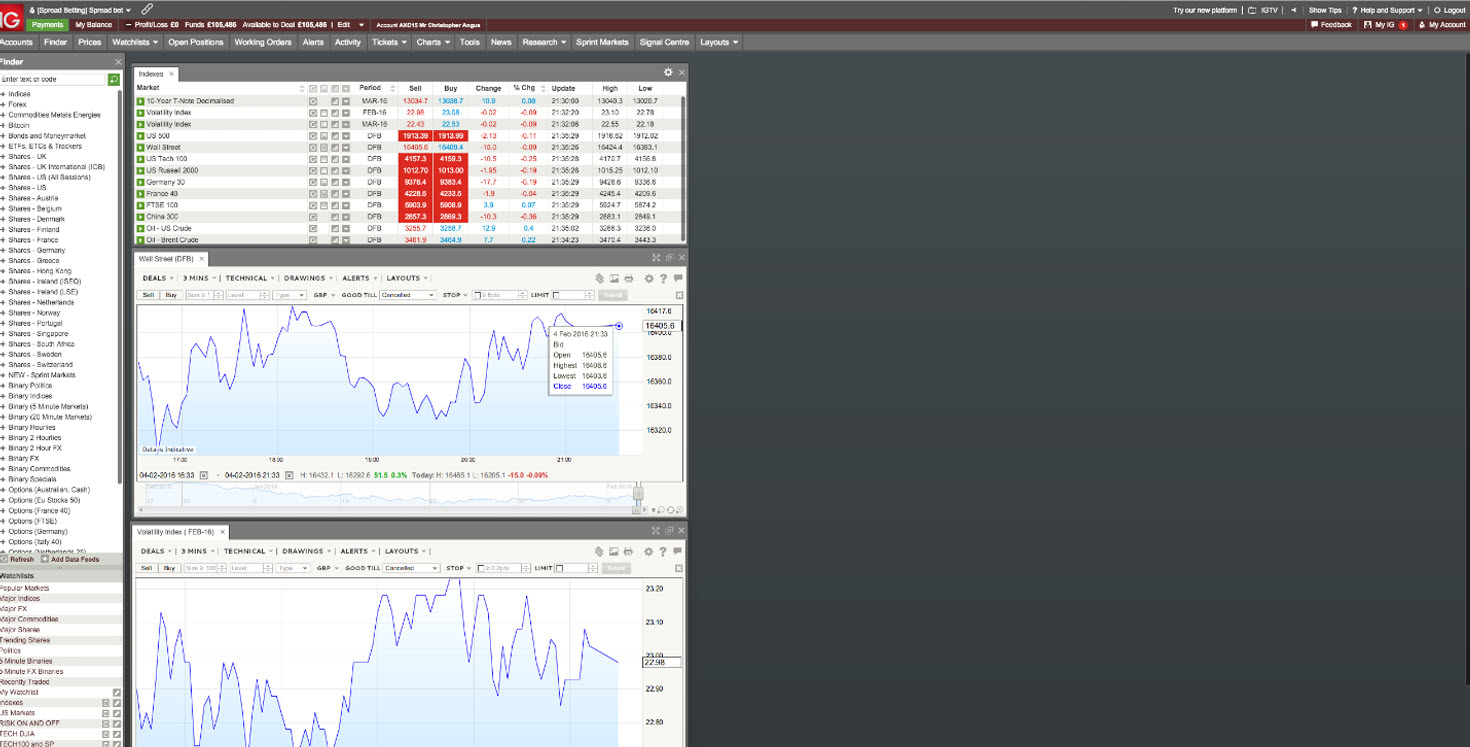
start: screenshot shows account balance of 1,105,907 GBP
1 minutes 15 seconds: uses his proprietary software rather than web interface
5 minutes 10 seconds: talks about not trading the near month expiring contract near date of contract roll
5 minutes 20 seconds: has had extensive training
5 minutes 40 seconds: decision tree on certainty with trades
7 minutes 30 seconds: talks about how volatile the oil market is and why it is not good to trade
18 minutes 15 seconds: mentions a bit on technical analysis
24 minutes 40 seconds: I don't really call trading trading because I am not really a trader. I am a risk manager. and that is it. trading is just risk management. so I put on a trade which I feel is an appropriate size. usually I start at 1% of the account.
26 minutes 10 seconds: studied 5 years knowing he wanted to be a professional trader and perhaps 10 overall. I probably have a brain of just like 1000 pages of knowledge. my communication skills are not that great so I do not really articulate what I know well.
27 minutes 20 seconds: mentions vix has fallen toward a bottom (if he lost the money early on in his trading history then why does this account still show the above mentioned balance?)
28 minutes 15 seconds: emphasizes he knows a lot about market microstructure, how the market plumbing works, how things move on a short term basis.
29 minutes 30 seconds: trading is 20% skill, 50% skill & 30% emotion. you need to have a lot of discipline.
30 minutes 10 seconds: "if you could rob a bank, you know, online, financial fraud, and you could get a million pounds and no one would find out, what would you do? would you steal it or not? and there is 0% chance of you getting caught. ... if they would say yes I would steal it then I say trading is not for them. ... if you are not honest with yourself and are not an honest person in general then you can't really trade. ... if you lie to yourself you don't have clarity in your trading and you don't have the discipline. ... if you don't have self honesty and have the ability to say I am going to cut a losing trade and take a loss you don't even have a chance." ... talks about how aspects of his life are a practice of his discipline.
32 minutes 30 seconds: talks about how people tell him he doesn't show any emotions and he says it is almost like he reprogrammed himself to not let his emotions rule him. he says you can't make emotional decisions and make good decisions in life & non-emotional decisions are much better in terms of making clear decisions with the best outcomes.
38 minutes 10 seconds: trades VIX "because somewhat of a riskless instrument if you know how to trade it"
00:00 Christopher Angus: Okay. So I just want to do a quick video explaining a little bit more about how I work. I don't know, you seem interested, so I'm gonna give it a bash for three minutes. Firstly, I just wanna explain how much money I make, and how I kind of determine that. And it is a little bit varied. For example, if we look at the volatility index here, you can see that it's 15.53 to 15.63, so that's a 0.1 spread, very tight. And I base my profit upon each point. So, yesterday was a classic example, and a very clean example. It usually doesn't work out this way, but say I take 1% of the account, so that would be 11,000, and then I bet 11,000 per point on the volatility index. I don't usually use this side of things. I use my own software because I've gotta manage more than one account, and it just is a little confusing. So, you can see that if I... It's not exactly the right amount for this, but if I bet this here, and press buy, for example, it would be a big fucking mistake today because the VIX is gonna roll over, so I won't. Should I? Shouldn't I? No. Fuck off. [chuckle] God, I'm mad.
01:49 Christopher Angus: Anyway. So, if I... If I did that, and the VIX moved one point, I would make £11,000. I wonder if I can blow this up so you can see it a bit better. Yeah, that works. So, if I did this, and the VIX moved exactly like what happened yesterday, I didn't sell the April because it's rolling over. I actually sold the May VIX. I don't usually use things on this side and get that up in a second. But let me just get that up now. Sorry. I keep saying that I don't usually use things in this side, I mean, I keep it open. Not this one... The smaller one because I need to sometimes reference whether the trades are going through properly, but I try not to trade from this because it gets fucking messy. And it just is not my system. And you know I don't like change. So... I've got seven black shirts, I wear the same fucking thing every day. Every good woman that I've dated has said, "You need to expand your wardrobe." I've got a big wardrobe. It's just I've got seven of the same shirts, seven of the same trousers, seven of the same everything.
03:08 Christopher Angus: I really hate change. Anyway, this is a better example. This is the May VIX here. Can't really go back enough. I wonder if it's gonna crash my browser. Fucking IG. This is why I don't use this bullshit, in this side, 'cause it makes my browser stall. Anyway, so let me just get something in perspective here. Let's just say... Where were we yesterday? Here, sold it somewhere here. 17 point... Actually, it was 17.28. So, it may be somewhere like... Somewhere around here. I don't know. Somewhere around here. Sold it somewhere around here, 17.28, and then we bought it back at 16.18, which was somewhere there. So, basically, I sold it because I saw that the oil short squeeze coming. I knew the correlation between oil and the S&P was going to drag the market up, thus crushing volatility yet again. But it was just so fucking obvious, and it just fell off a fucking cliff face.
04:48 Christopher Angus: Things have been exceptionally quiet. It hasn't been helped by the fact that April... April's rolling over tomorrow, this is the last day of trading today, and it's just... I can't trade April because if I get stuck in a trade, it'll absorb that loss on the roll over. So that's also been somewhat of the issue. Anyway, I don't know what's gonna happen today. And this is the way I was trained, I wanted to mention this, I have had actually extensive, very intensive training at various points, because I wanted to just learn as much as I could. So there's only three answers when you're trading. Yes, no, and I don't know. And I use the, "I don't know" a lot because unless I'm fucking sure or I'm the opposite of fucking sure, those are like trading areas. The "I don't know", if you imagine the yes is 10% on the left and, as you move right, the "I don't know" is a 80%, and then the no is the other 10%. So you have like this... This three part like decision tree for me.
06:00 Christopher Angus: And when it's "I don't know", you can't trade, so that's why I end up sitting out for such a long period of time. Also, volatility's been so fucking low and moving just so grindy, in one direction, you need moves to be able to do stuff because if it's kinda doing this, you get trapped a lot and you end up scratching trades or, worst case, take one off for like a tenth of a tick loss, and it just like... This is the way you just... Death by a million cuts. This kind of... This kind of action here, where there isn't really a clear direction. And the direction really is determined by the S&P, of course. So this is an instrument that I end up watching an awful lot. So you can see the S&P is flying up today, but the VIX is not responding.
06:54 Christopher Angus: Now, as I said yesterday, on the mail, on the text, on the Skype thing, the S&P... Sorry, the VIX has been broken in terms of the correlation between the S&P somewhat, because there's a lot of people who are along with VIX and are absolutely being crushed because they're like long-term players, big hedge funds, institutions, that kind of stuff, and they're being absolutely smashed. So what you saw yesterday was a double-whammy, so the oil short's being crushed because the oil fell of 7%, everyone started selling oil. I thought, yeah, you fucking guys are gonna get smashed up because when there's a sharp move down, there's a sharp move up. And it was such a sharp move down, there was tremendous pressure going down, but then everyone, all the big players came in and they started buying oil, 7% off this guaranteed 2%, 3%, 4%. Actually, it made a full recovery, and then a little more, so it went down 7% and up 8%.
07:52 Christopher Angus: Think about how fucking insane that is, a 15% range in one day. It is fucking lunacy. Anyway, you wanna lose all your money, you go trade crude oil. That's the fastest way to go broke. Anyway, so I saw that happening, because the correlation's virtually one to one at the moment. And this does change, by the way, correlation between crude oil and the S&P does change, so you have to be very aware of the correlation, because once crude oil goes back to 50, 60, or even 45, and everyone eases off, the correlation might be like zero. And it's just like they start acting independently of each other, but I know when crude oil gets crushed, the correlation is like one to one. I know that because I used to trade futures a little, and I traded crude oil. So I'm pretty switched on when it comes to trading crude oil.
08:46 Christopher Angus: I made a little money, actually, but it's a really, really hard game. So that's how I saw what was happening yesterday. Now, I wanted to just go through some of the things I look at. Part of this is I'm not gonna be able to explain, not 'cause I don't want to, it's because I can't. There's so much stuff that I take in, like I've got Bloomberg going, I've got Twitter, I've got the Associated Press, so I'm very aware of what's going on in the world all the time because I think that gives me a little edge. I'm also looking at the Euro... It's the wrong one. Told you I don't use this fucking thing. Euro, USD... And then the Euro. Oh, sorry, the dollar basket. So dollar basket is obviously a basket of US dollars or the US dollar crosses, the FX crosses. So the dollar basket goes down, the Euro goes down... Let me get rid of this fucking thing, because it's gonna confuse us. So the dollar goes down... Oh, I just got out of the wrong fucking thing. Jesus Christ.
10:25 Christopher Angus: So the dollar gets weaker, which is... In this case, it is. You can see that the Euro's 0.1 up, but the dollar basket's down. This correlation is fairly weak. But I do... I guess if I wanna explain it properly, or at least in a way that you may have a chance of understanding, the dollar correlation is fairly weak. And so I have like a group of signals, maybe like 15, 20 signals in my... That come at me, and I put a weighting on each of those signals. This is just like fucking SEO, by the way.
11:01 Christopher Angus: So I put a weighting on each of the signals. Now the dollar... The dollar signals are weak to me. They're strong, but they're not the strongest, should I say. So, on a scale of one to 10, maybe they're like a six. The strongest signal's, obviously... The... What's happening on the VIX itself. Because you can't argue with what's actually going on. The second strongest signal's, obviously, the S&P. Because the way... I'm sure you know the way the VIX works, it's determined by how many put options are being bought. It's a lot more complicated than that, but, in the most succinct way, that's basically how the VIX is calculated.
11:51 Christopher Angus: So more fear, more put options being bought, the higher the VIX. So the reason it started getting crushed yesterday is because everyone was along the VIX, and then everyone started covering their positions, and basically started selling the VIX to cover, and it just started crushing it. So, you know, all that selling pressure hitting at the same time, just crushed the VIX and they made a disconnect between the two of them. So, you also saw me talk about flashy blue and red things. No, these are the flashy blue and red things. This is something [chuckle] I probably... I couldn't explain on Skype. But you can see how they're just ticking along, blue, red, blue, red. Once these start having some kind of consistency, and they start hitting, you'll see they go a little more solid blue, a little more solid red.
12:56 Christopher Angus: Okay. So, look, that's going red now, right? So, we'll see the S&P come off, and you can see it's just come on. I mean, it just changes, like, by a tick, and I can show you. Right... So, let me see if I can do a live demo here. This is really on a really micro basis, but I look at this to see where the starter moves are coming. So, there isn't a move coming now, but I may be able to show you how I'd look at this. So... Okay, so it's looking a little like there's a little bit of a pressure building. Now, the S&P is up, and I don't know what's gonna happen, but I expect a small pullback before the open, and then it'll probably reverse. But it looks like it's gonna come off a little bit here. And you can... Well, what I'm looking for are basically big splots of color. So it looks like it's gonna come off a few ticks, maybe a few points now. So we can watch this here. It's 6.75, alright. And I think we'll probably see half a point to a point come off, just by looking at the pressures building. You can see the reds that... Building.
14:25 Christopher Angus: So, again, this is one of my signals that I look at. See the reds just flash up. I mean, you've gotta be able to tell the difference of the intensity between the blues and the reds. It takes a lot of practice but, you know, that's kind of the way it works. That's, again, one of the signals, and that's something I use to get into positions and get out of positions. And this is why when you imagine staring at this for... For 10, 12 hours, that I start to get a headache, because you start... All I'm doing is staring at this, especially yesterday, when you're trying to take your profit, you know, I was fucking fried. I went to bed straightaway.
15:18 Christopher Angus: I think maybe I had something small to eat and I just went straight to bed. So, yeah, I was asleep by 10:00 PM. Let me check my Fitbit. I had the... Great sleep. I was fucking screwed though.
[pause]
15:54 Christopher Angus: So, yeah, 10:00 PM right through to like 7:00 AM, I was fucking screwed. Anyway... So, remember we started at 6.75. I'm going to stop looking at this, but at... I think that we're gonna come off about a half a point, maybe, to a point. So we wanna see 5.75, not really trying hard... Hang on. Excuse me, I just had to cough there. So I'll just move on, but, as you can see, the... I call them the flashy blue and red things, they are signals that I use to get in. Then I also look at... This is in hours. The MSCI are these indexes in the other world, so everything but the US, basically. And, wow, this thing's on a fucking tear. Jesus Christ. And then you can sometimes see, if you're looking at this, when it goes a half tick, so instead of going seven, it went 6.87, that's usually a little sign of weakness there.
17:13 Christopher Angus: So I'm still gonna stick to my side, you know. I wouldn't be surprised if we see eight because the trajectory is just up, but I just wanted to give you a little demo. I'm gonna stick to my side, saying, I think we're gonna come off. Oh, maybe we're not. Right. So, here we can see... Look at that, the VIX is still crashing. So the VIX is pointing down, that means the market's wanting to rally. So... Wow, look at that. Seven. Wow, I have to take on or I have to take my thing off. I'm a little bit cautious about this area here, because... Not... Not for this video. I'm just telling you, as an example, because we're at 2100 now, the whole numbers, so that the 100s serve as a lot of resistance. I don't do a lot of technical analysis, but I'm aware of the levels. So 2100 is a very, very strong level which... But there's an extra spread on here as well. So the... The futures would be just a little bit lower. But once the futures... I wonder what the futures are at. Once the futures get to... So the futures are five points off. Once the futures get to 2100, they're probably gonna bounce off.
18:49 Christopher Angus: Jesus, look at that, fucking thing is ripping like a motherfucker. Wow. So this is a kind of a dangerous area to trade because if you sell the VIX, look, the VIX doesn't have that far to go. I mean, it's maybe got two points, yeah, we can make some money, but like just at this area here, it's... It's very, very dangerous because if this thing bounces, the VIX is gonna reverse straightaway. So, I'm very much in the area of... I'm very cautious today of what's gonna happen. If this gets above like 2105, and holds there, so like 2107, 2108 and holds, this, actually, it has some ability to stick, then we'll start shorting the VIX again. I think also what I wanted to say was like we've had a couple of... We haven't had like a very good run because volatility has been so low.
19:47 Christopher Angus: I mean, I'm a very cautious trader anyway, but what I wanted to do was, I'm gonna just try and step up the aggression maybe like 20%, especially at the moment, because it's fairly easy to trade, it's not like a lot of sideways action. So I'm probably gonna wait till closer to the open to see this, because right now, I'm not doing shit. So, moving on, some of the other signals I trade are... This is the 30 year, so that's called the ultra bond. Usually, on the futures, this is in fractions, but they have decimalized this for some reason, probably because English people don't understand fractions. So this would move in increments of 32, so fractions, one over 32. And they've just converted that. I don't look at the 10-year that much or the two-year that much because they don't move as much, they don't give me like a really strong correlated signal.
20:54 Christopher Angus: Of course, I also look at Brent Crude, as you saw yesterday. I look at what's going on on the Footsie, but the Footsie's comprised of a lot of mining constituents, so you see oil go nuts, you see the Footsie rise, but it does seem to do its own thing. That's why I got the basket of other... Of other stock exchanges here, sort of like the dollar basket, of course, this is somewhat off, it only works in hours. Gold is very poorly correlated. I mean, the correlation is actually zero, so it can be up, it can be down. But, at the moment, with the safe havens... So the safe havens are the dollar, the yen, and gold, and treasuries, of course. The correlation is usually quite good. However, as you can see today, the market's going up, and gold is going up, but, normally, on a day-to-day basis, they work somewhat in opposites. However, what never fails is the treasuries. Treasuries are down, markets are up. VIX is down, markets are up.
22:13 Christopher Angus: As I said, the dollar's a little more iffy, but you can see the dollar's down today, markets are up. I guess those are kind of the main things that are coming at me. Then depending on... This is nothing compared to in hours. When these things really start going, it becomes a lot more obvious as to what's happening, and you can start seeing the blue and the red flashes, and they start hitting. Once they start hitting consistently, you can sort of start to read what's going on. Of course, I showed you the other... My put-call ratio thing, although this is like about... What? How many hours before the open? Four and a half hours for the open, so nothing's really going on. And I guess, in a nutshell, that's kind of the main stuff I tend to look at. Of course, I'm looking at the news and Bloomberg and Twitter, not just Associated Press. I follow a bunch of professional traders as well. And so there's... I don't know. I probably explained seven or eight there, but there's probably a bunch of others that I'm not even thinking about at the moment, just small things that I'm listening to across the day. For example here, the Tech 100, that's the NASDAQ, and, usually, I have the Russell on here as well. So, usually, I put the Russell on as well. As I said, I don't use this account. This is a... I just have it open from time to time to make sure the trades are going through correctly. So that's one, two, three, four, five, six, seven, eight, nine, 10, 11.
24:03 Christopher Angus: Yeah. So, as I said, 15, 20 things that I look at, and that kind of comprises the information that I'm constantly absorbing at a very, very, very fast rate. In the back of my mind as well, I have the global events that are going on. I try not to think too much, too much in advance. Like, yes, we're all expecting a market crash and... But I know my crystal ball is fucked. I can't determine the future, I can only go on what I see. So that's the trick to trading. I mean, I don't really call what I do trading trading because I think I'm not really a trader, I'm a risk manager, and that's it. Trading is risk management. So I put on a trade which I feel is an appropriate size. Usually, I start around 1% of the account and then I move up from there, and sometimes I come in and out. So yesterday was a very nice example of how you make 1%. It was like 1.1%. Basically, the VIX moved one point, and that's the way I do it. It just is an easy way. Now, everyday is really not that clean because I may come in and out of a couple of little trades. If a trade is going against me two ticks but I can see the market's moving up, I may add a little more, but I kinda know, from a VIX perspective, how much I'm making. Usually, I have to wait till afterwards and just do the numbers and see how much I made then. But I hope that gives you a little more insight into how I work.
26:06 Christopher Angus: I think... I don't know, I guess I'll sum up by saying this: There's so much stuff coming at me, and I've studied this for so long, like four or five years very intensively, probably 10 in total, but five knowing that I wanted to be a professional money manager, trader, whatever you wanna call it. That I probably have a brain of a thousand pages of just knowledge. My communication skills are not good, so I don't really articulate what I know that well. And also, I don't wanna give the impression that I'm, I guess, interested in too many other things, because of course I am, but I'm very, very focused on what I do. I keep thinking to myself, I need to open up the strategies a little, but then, I think to myself, we could do some spreading like I showed you on the pictures and stuff. I know I can do that. I can trade that, but it just makes it a lot more variable, and... I don't know. This works, and it's just a quiet period. It'll get better because now we're doing the roll over and the volatility will pick up in the back month, and we'll have some space to play. Right now, we've got no space. And that's the thing.
27:21 Christopher Angus: The bottom of the VIX... The VIX is the lowest it's ever been. It's like 11 something, 12. So, you can see there's no downside left. And this is rolling over today, but here we've got a little more space to play. So, it'll pick up a little bit after tomorrow... Well, today, really... Especially once it rolls tomorrow. Fucking hell, this thing is gonna fucking tear. Jesus. This is interesting, actually. You can see... I don't know if you can see this, but the US 500, that's the S&P 500, is up 0.37. Wall Street's up 0.34. And the Tech 100, that's the NASDAQ Composite, is up 0.38. When you see... This is, again, one of the things that I know. I know a lot about a lot. But... I know a lot about a little, which is about trading and market micro structure, really, if I have to sum it up. That's really where I know a lot, is market micro structure. So, how the plumbing of the markets work. And how things move on a short-term basis. When it comes to the bigger picture, I know fucking nothing. But you can see here, like these are all very, very, very, very, very close together. Even then, the Russell's up 0.45. So, these are all within basically a 10th of a percent.
28:51 Christopher Angus: And when you see the market walking in lockstep like this, you know that this is professional money moving the market now. And this is a very strong move to the upside for the moment. This may change on the open, but, for the moment, the market is walking in lockstep, and so all the indexes are moving together. And that's just like... It's like double confirmation that the market is actually moving in a certain direction. So, as I said, sounds really wanky. But if I say, "This is the way I trade, and these are the things I look at," there's a lot that I can't really explain. It's just about... And I always say... So people say, "How do you do it?" I say, "Trading is like a lot about experience. It's like 20% skill, 50% experience, and 30% emotion."
29:50 Christopher Angus: And you have to have a lot of discipline to do what you do, and to do what you say you're gonna do." And usually when people say they wanna be a trader, well, I show them... What are... Normally, I ask them a question is if you... Fuck, this is a long one, I'm gonna need to cut this off. But if you... If we... If you could rob a bank online, financial fraud, and you could get a million pounds, and no one would find out, no one in the world, zero, okay, what would you do? Would you steal it or not? And there's zero chance of you getting caught. Now, I hate the banks as much as anyone. And then I ask them that question. And if they say yes, they would steal it, then I usually say trading is not for them, because if you're not honest with yourself and an honest person in general, then you can't really trade because you end... Dishonest people lie to themselves a lot, and if you're lying to yourself all the time, you don't have clarity in terms of trading and you don't have the discipline, like you say, "Okay, I'm in a losing position. I'm gonna get out." Or if you don't have a lot of self-honesty, if I put it that way.
31:11 Christopher Angus: 'Cause a lot of people are honest people, they're just not honest with themselves, but if you don't have self-honesty and the ability to say, "I'm gonna cut a losing trade and take a loss." Or, "I'm gonna get into position for this reason and that reason. It's not an emotional thing." And then you have a chance. But like my mate who just seems to keep... He's just like a money leak. He's just like a money murderer, basically. He's a smart guy, probably smarter than I am, but you have to have a certain mindset. And, again, this is something that I've learned over five years, and it's something that I practice every single day. If I wake up, I look at my phone and it's 7:24, I say, "Okay, I'm gonna lie in bed until 7:30." I get out of bed at 7:30. I don't go, "Okay, just another five minutes." I make sure whenever I make myself a promise, I keep that promise, because it's a practice of my discipline every single day. Everything I do is a practice of my discipline, because it's taken years to... And my ex-girlfriend said this to me. She said... Three people have said this to me since I broke up with my ex-girlfriend.
32:21 Christopher Angus: My ex-girlfriend, her parents, and someone else said this to me. They said... I think it was another girl, actually, said, "You don't show any emotion." And I think part of that is I've almost re-programmed myself to live... To not let my emotions rule me at all because I think you can't make emotional decisions in trading, especially, but in life, and make sure that they're good decisions. Non-emotional decisions are much better in terms of actually making clear decisions which has the best outcome. It makes life a little dull. And I think also part of who I am is I'm a Stradivarius, so like a musical instrument that plays very well when he's in tune, but he goes out of tune, he doesn't play very well, and he goes out of tune pretty easily. And that's why I don't like disruption in my life. I don't like noise. I don't like people coming to my house, I wear the same fucking shit every day. I get nervous and weirded out really fucking easy. Like go to the same shop, same hairdresser, same fucking everything. I don't like my friends coming here. I think that happened the other day, actually, like this guy, my friend, turned up. He didn't phone me before, and he just turned up while I was watching the market, and I had to say, "You can't come in." That kind of disrupts my kind of mental place for maybe 30 minutes, even just someone coming to the door.
33:55 Christopher Angus: So a part of this is my focus and my programming of myself to have this, because like this is something which I've said, we wanna do for a finite amount of time right. So we wanna maybe build this up say 50 million, 100 million, whatever it might be. My personal goal is to have 50 million, so I mean what does that leave you like a 100 million, something like that. So we get it to 150, and then I wanna stop because I think this... I'm here every single day and I do love it so it's not hard work but I wanna experience other things in life as well. I wanna have the freedoms. Not that I think that's gonna make me happy, like you said, but I wanna be... Have the ability not to ever think about money ever again. That's my goal, to never, ever, ever, ever to think about money. You have money in your bank. You never have to think about. You're gonna buy and never have to look in your bank. Of course, it's not all gonna be in my bank, it's gonna be in some kind of investment thing, but this is my life at the moment.
34:57 Christopher Angus: In the morning, I wake up... Jesus, this is going on. This is the last thing I'm gonna say. In the morning, I wake up, I check the markets, then I'll kind of watch the markets loosely up until like maybe 12:00. If there's something going on, I'll be straight at my computer from 8:00, and I'll sit here until 9, 10 o'clock, so that's 14 hours straight at the computer, and I do love it. Right. The market's coming off here. So here we go. Here's a VIX spike up, market's coming down, and what's the treasuries doing. Oh, here they are. I don't know. It's the treasuries, open the treasuries. Like I said, this isn't the side that I use. I use the other account, because that's kind of set up a lot more nicely, the little one, just for history. So here's the treasuries coming up. I'm just trying to get this set up nicely.
35:55 Christopher Angus: Right. So treasuries are spiking, VIX is spiking, market's coming off. So let's see. Now we see... We want to see some red splodgy things. Oh, fucking treasuries are coming off again, motherfucker. I'm gonna... We're still gonna stick to my side that I want to see a pullback. I reckon, before the open, we'll see a pullback probably to at least 2096. I'll watch that. I'll let you know once you've watched this video. Another little signal, before I forget, is I look at the highs and the lows. That's like really important as well.
36:40 Christopher Angus: So when things are very close to the high, like S&P here is at 2101.9. That's bullshit. Anyway, this is just because it's a synthetic market. Things don't move in fractions of a tick. A tick is 0.25, but you can see the high is 2103, and this is 2102, for all intents and purposes. This is very close to the highest, and when things are very close to high, they tend to keep magnetizing the high. And if something's pulled back, if things made a new high, pull back two points, usually want to buy it. In this case, I wouldn't be buying this with the VIX pointing up and treasuries pulling up like that. See that. But that... If you're a directional trader, I could probably... I can make money trading this, and this would be a position, not right now, but something where I'd be feeling like I've got the mindset, okay, we're two points off the high, let's pull back. It's grinding up.
37:41 Christopher Angus: This is a buying spot. This is a... This is like a micro buy, the dip. Again, market microstructure, but like not with treasuries facing up, and the VIX facing up, no fucking way, Jose. Anyway, so that's that. Hope that gives a little more insight. As I said, there's so much I can't articulate. There's so much about feel, about speed of the markets, about... It's too much. I can't really explain it. And that's also why I trade the VIX, because it's somewhat of a risk-less instrument if you know how to trade it. S&P, it's got so much upside, so much downside, you get it wrong, you can really fuck up. But, on the VIX, there's somewhat of a floor, and you can keep buying it, if needs be. And, again, that's... When it comes to daily profits, you may come in and out of several trades, wasn't as clean as yesterday's, one big trade, but, usually, you make more than one trade or re-buying, it gets less clear, but it gives a little bit of understanding. The VIX goes up from 16 to 17. If I get onto a trade at 16 and it goes to 17 and I don't come out, that's 1%. And that's the way I work it. Of course, as I said, it's not that clear because, often, I'll be in and out a couple of times if I... If I want to just grab a little profit, so on. But yesterday was one big trade. And I'm just gonna take a screenshot of this while I'm in here, so I can do the numbers. Okay, Mr A, I will catch you on Skype later. Bye.
It really is like Google is no longer a search engine, and more like a Yahoo! directory.— SEA☂☂LE SEO (@searchsleuth998) March 31, 2016
Maybe the doommasters who called SEO dead for over a decade were finally proved right about SEO?
SEO was only ever a bug. And web users mostly didn't notice when the search results turned into nothing but ads.
Everything is going full circle. Ad heavy is bad to nothing but ads.
Webmasters are focusing so heavily on mobile-first that they are making their desktop sites unusable...
Some websites have become so mobile-first that they’re basically unreadable on a big desktop monitor.— Matthew Yglesias (@mattyglesias) April 1, 2016
...at the same time usability experts are now recommending making things harder to save humanity.
Change creates opportunity. New changes, new channels, new options, new models, new methods.
I have decided to take a break from SEO and am transitioning to paid search, since clearly that is the future of all search marketing.
I've closed our membership site down to new paid member accounts & canceled all active paid subscriptions.
Perhaps it might be time for me to dust of PPCblog and shift most of my blogging to over there.
That is, if blogging still matters!
Maybe I’m super slow, but it sure seems Google has worked hard to destroy blogging as indexable content.— SEA☂☂LE SEO (@searchsleuth998) April 1, 2016
Going out on a positive note, the great team at Bing recently shared a promotional code with me to offer new advertisers a free $100 ad credit. Bing Ads clicks are a great value when compared against Google AdWords. You can access this coupon today via the following link:
Convicted fraudster and self-confessed criminal Christopher Angus is kicking off an educational video series on boosting investor confidence so you may steal from them. He is providing over a dozen detailed free video tutorials on how to defraud investors. This third video is 22:38 & was shared on March 18, 2016. The criminal who shot these videos delivered over a 99% investment loss, as he simply stole the money and integrated it into other investment scams abroad. https://www.oxfordmail.co.uk/news/18155553.oxford-fraudster-christopher-angus-defrauded-friend-2m/
Crown Police never followed the money trail.
0 minutes 40 seconds: did not do any trades because risk in market was too high, sat on hands
3 minutes 30 seconds: talks about how 5 point range in S&P 500 is absurdly tight & how normal range is 17 to 20 points
5 minutes 20 seconds: gambling is not what we do
6 minutes 20 seconds: difference between high volatility & low volatility markets in terms of margin of safety in entry and exits
12 minutes 5 seconds: does not believe in crystal ball & only trades reactively to good trade set ups
15 minutes 10 seconds: again talks about hedging any positions
16 minutes 20 seconds: vix at 20 is often a decent entry point to start buying
19 minutes 20 seconds: (over next 1 minute & 10 seconds) explains how low volatility makes entries harder & states he thinks options get too complicated. mentions most the smart people in options make money selling premium, which is writing options betting volatility will fall. then states he can't deviate from what he does which works even in bad markets we still make money.
20 minutes 30 seconds: states importance of discipline & states people who lose it and start fooling around are basically gambling
00:00 Christopher Angus: Okay, so, just a quick recap. I didn't do any trades today, reason being is nothing happened. Looking back at the opportunity, there was possibly one move that may have worked, but it was such a tiny move that the risk far outweighed the reward. I'll get to that just in a second. Let's go here. And this is the move that I'm talking about. You probably can't see these numbers 'cause on the video, it always comes out with slight low quality, but that's starting at about 13.82. The futures again operate at a slightly different number, but... And they move a little less than this. So, even if we're just trading the VIX here, we would have really struggled to do anything and actually come out with a profit and not get trapped in a trade over the weekend, which is something which should always be avoided 'cause you don't know what's gonna happen.
01:13 Christopher Angus: So, as you can see, this is the open and we... Because it's... We're in such a low, low, low place, we are only buying. So, as it came down, this is the only time we could have bought it. Bear in mind, when you take into account the spread, this move is about 0.4, and the spread is 0.1. So that leaves you with 0.3 points to play with. Again, you're not gonna nail it on the bottom, maybe you'll get a 0.1 off the bottom and 0.1 off the top because you gonna let it roll on you as it starts going over and then you're gonna say, "Okay, you know, it's... The markets turn, I'm gonna take my profit here." So, take into account that's 0.4. You can take off 0.1 straight away for the commission. Yes, we get a tiny bit of that back, but it's not much on one's tiny trade. So then we've got 0.3 left and we're gonna give away 0.1 to stock, and we know it's actually turning, and we're gonna give away 0.1 when we think it's rolling over. So, from 0.4, we're left with 0.1 profit, which is one tick, 10 ticks to a point on the VIX, which is the very smallest increment you can make. Bear in mind, I like to make one point a day, not 0.1 points a day. Its just the risk doesn't justify the reward.
02:48 S1: And if I just go back to the S&P here, you can see the S&P opened, what's that, 2045, went up to 2050, went back down to where it opened, and then went back up to where it closed. So the whole day, this was in a like five-point range, which is insane. That's just algos fighting each other, basically, with no big market participation. Volumes are very, very low at the moment, for some reason. Normally, there's around 200,000 shares traded on the DOW. At the moment, there's 200 million shares traded with all the DOW constituents, there's 30 companies within the DOW. It's 200 million shares, and that's kind of the average. At the moment, I'm about 90 million, so we're really down on volume. So, we need some news. So to have a market that's stuck in a five-point range... The average daily movement on the S&P normally, like just in a normal day, the normal range is like 17 to 20 points. It was 17 a while ago, but when the volatility really picked up in the last three months, went to about 20. So, even stuff which is historical that... The movement on the S&P will be about 17 points; today, it's five.
04:25 Christopher Angus: Really an impossible trading environment at the moment. Now, the market really just couldn't break out, it didn't break down, either, but it seems to be running out of steam. So we're positioned in a very good position, again, we've had a shitty week. I'm sorry, I do apologize, but there's literally nothing I can do. There's one move today and it just does... It didn't make any sense to even bother trading that and getting stuck over the weekend. You know, I would have been reporting 0.1% at best. You can see it's just what the market's doing, and even if you're trying to trade another market like the S&P, it would be a very similar story. What's the alternative? Go pick some small stocks and gamble. It's not really what we do.
05:25 Christopher Angus: So, I wanted to just take some time as well just to explain how things work in low-volatility environments and how things work in high-volatility environments and where the risks are. I don't know how... Oops. I don't know how high I can actually get this. That's a bit better, and then... That's kind of better. So, the brown tree or the green tree here... This is high volatility. See if I can do some writing here.
[pause]
06:31 Christopher Angus: And then the brown tree here is low. Low volatility. And what this... Imagine it was raining and you had to go stand under a tree, and both of us had to get under a tree. The brown one's only gonna take one person because it's narrow, so, that's you. And it's raining, here's me. I'm getting rained on. But we could both easily fit under... Stupid analogy, maybe, but we could both easily fit under with some other friends under the green tree, which is high volatility. Which means as the market moves, there's more time to take an entry, and there's more profit to be made. You don't have to get your entries as correct. You can come in anywhere and make a lot more profit, and you can exit earlier and still make profit. Now with the brown tree, you've gotta really nail it in the right place. And imagine this was one move, you'd have to get in here, and then you'd have to get out here to make the smallest amount of profit. So it's high risk for low reward, which is not a good trading theory.
08:28 Christopher Angus: And this is exactly the brown tree. It's, you've gotta nail that baby on the nose because if you screw up, you're basically underwater straight away and there's no recovery. And again, I hope that makes a bit more sense. That's a low-volatility environment which we seem to be in, which we'll be in this week. High volatility, when you have tremendous moves... I'm just gonna put this on a little bit longer. It's not been great the last couple of weeks, but here's a high... That's a three-point move, nearly, so, we could've... Today, we had a total range and one possible move of 0.4 on that... This example here that I showed you, that was basically within one day. I kinda ran over two days, but just for this example, there's a three-point move.
09:44 Christopher Angus: So you can see the difference in volatility at the moment is enormous, and the risk of getting stuck underwater is high. So, in a way, it takes a lot of discipline not to feel pressured and say, "I'm gonna do something because I feel like I need to do something, 'cause we haven't had a really good week." But I'd rather do nothing than have to report that we're stuck underwater in some horrendous trade over the weekend, 'cause it's gonna be stressful, and it opens on Sunday, I'm not gonna have a good weekend. I actually have some kind of coldly-flu thing coming on, so I'm not feeling too good anyway, so I'm pleased. But what I'm trying to say is... I'm not trying to toot my own horn, but I did the right thing today in not doing anything. Because there was one move, and it was such a small move that I could've made almost no money but could've been stuck much more easily than I could've made money.
10:46 Christopher Angus: So, as you can see, this is the longer-term thing from beginning of March 'til today, and the moves have been much more dramatic. It's just these last few couple of days... Well, this week, because it's been a downhill train and as you know, we can't sell volatility here because we're heading to the bottom. And there's basically... We could've grabbed a point, yeah, but the risk, again, risk-to-reward ratio is... It's pretty close to the bottom so there's not a lot of downside to capture, but there's a ton of upside to capture. If I roll this back a little longer, 28 days, there's volatility of 29. So, as you can appreciate, there's 15, 16 points on the upside, but like one on the downside. So that's why we can only buy when it gets down to these levels, and when it's there, I'm waiting for about a bottom, basically. Like I said, I trade reactively, not proactively. I don't know the future. My crystal ball's fucked. It's never worked. And I think anyone who tries to think that they have a crystal ball that is efficient and works properly, we usually end up losing money.
12:18 S1: So I can only trade reactively, so I wait for an event to happen. Unfortunately, the S&P's stuck in a five-point range, it's just unbelievable to have a tight range like that all day. Some of the spikes of two minutes might have been a little higher, but fundamentally, it would've spiked up. That's just market manipulation at a micro-level market microstructure. So there's nothing to do. It does become infuriating and creates sort of unreasonable doubt, and it is unreasonable because I know over time, this will come right. I was hoping the end of the week was gonna turn. You said a couple more days, I think that's Monday. And you seem to have a better hand on the markets than I do, to be honest, so, I'm just trying to run this out.
13:21 Christopher Angus: I don't know what I've done to my thing now. Okay. So as you can see, volatility does come back. It's just a matter of time. And... I'm gonna just put this into a more reasonable timeframe. It's pretty cool when it's at the bottom, because you can grab full points over and over and over, and literally it does become a bit of a printing press, as I've said a number of times. We're yet to see the printing press. At the moment, the fucking machine is on some kind of go slow, but it'll speed up, I promise. Like here, you can see, there are times when it is quiet, but it always comes back. And I could run this back years, and it's been the same. So, this is back to '91, 1991, when I was 11 years old. You can see, there are down times, of course, but it always comes back. The spike here is the great recession of 2008, 2009, when the VIX went to 80. Now this has smoothed out a lot of... This has smoothed out all the intra-day stuff and all the daily stuff so that this probably went a little higher last year, 24th of August, Black Monday, which was actually the day that my girlfriend left me, so I'll never fucking forget that day, when the S&P lost like 200 points in one day and the VIX also went to like 60 or 80.
15:08 S1: Now if you've loaded up, and you're short, that could really fucking damage your account; it really could. That's why, when you're on the short side, you have to run a hedge, so it catches you by a point, you run it up to 60, you start taking the leg, you start lifting the legs, and it starts to come down, and then you've had a really good day. And if it goes to 65 or goes to 63, you put the... You put what the hedge will be on anyway, because it goes on automatically, but it'll pick up the hedge. And yes, you do slide backwards a little, but it doesn't stay here. So the day that the VIX rockets up here, even if we're in a hedge, we'll be opening bottles of champagne, because it'll be awesome. Anyway. I diverge.
15:58 Christopher Angus: So, things are cool. It could be cooler if we actually had a decent week, but I'm sorry, I just couldn't do anything. This week's been shitty. It's been on a... Like you can... And I'll change this here. It's been on a downward slide all dog goddamn week over there, and I just... Once it gets below this 20 point, 20 is like my cut-off, I don't sell anymore, because I wanna start buying it, and so now I'm waiting. And yes, it was a little better 'cause I could scalp like a quarter point and half point. Not even that much, but a couple of small trades like third of a point, third of a point kind of thing. Something like that, plus the rebate.
16:42 Christopher Angus: But today, there was fuck-all. There was nothing to have. But you can see, this is going back to 2010, 2010, just short of beginning of 2010. So, it won't be like this forever; things go up and down. It's just that we're in a down phase and it's loading up before it goes back up again, so there isn't anything to worry about and I'm gonna trade much more aggressively next week 'cause we're at a really good level. But I just... I have to be reactive and not proactive, and I have to see the market turning, because like I showed you the thing the other day, we're waiting for the fed. I was deliberately holding off until something happened. If I'd been in a trade, the VIX dropped a full point straight away, we would have been underwater, and we'd still be underwater if I had actually taken a trade. And that's experience talking. My experience, I know when it's good to go and when it's not good to go. And again, today, if I'd taken a trade, the probability that I'd have either maybe just scratched the trade, which would have been like barely okay, or we would have been stuck. There would've been over 50% probability.
18:00 Christopher Angus: And again, it comes down to experience. I have to be reactive, I have to see the market turn before I go. And it's the whole... I'm looking at not just volatility turning; I'm looking at what the S&P is doing, what the DOW is doing, what t-notes are doing. You can see in my screenshots the flight to quality. Sometimes I leave that watchlist up if don't close it. And I don't see anything. I see the markets locked up, and just this really backward and back and forth fighting all the time over like two points each way. Two points up, two points down, two points up, two points down. And it's not... If you are trying to trade the S&P as like a regular trader who, there was unlimited upside and basically unlimited downside, you would have been chopped to pieces. You would've just given away loss after loss after loss because you had got in a trade, seen it go up a point, said, "Okay, it's gonna break out now." It would have turned on you and then would have come down a point, gone down another point, then you would have scrapped... Taken off for one point loser and you would have been chopped up.
19:13 Christopher Angus: These very, very low-volatility environments are no good for anyone. The only thing I could probably do is I could take a straddle with some options, betting that the markets aren't gonna move. I don't know, fuck options. I like options, they do interest me, but they're so complicated, and that's not what I do. I only like them 'cause I'm interested in them. But we're... If you're in these low-volatility environments, you're selling premium, because you're betting that the markets are not gonna move, not buying, not buying puts and calls, you'll be selling them.
19:47 Christopher Angus: And that's how all the big-option guys make money, really, is they sell premium. And all the smart ones don't sell naked calls and naked puts because you make 15% a month until one month, you lose everything. So, I've heard many, many horrible stories like that. And options have always really scared me, because of it, so I've never... And they're not a big thing in the UK, anyway, to be honest. So I've never really got into them. And at times, I really wanted to, but I can't deviate from what I do; what I do really works. You can see this. Even in a shitty week we don't lose money. We still make money, we just make a little less. And I never wanna deviate. Even once I've made my 50 mil, and you've probably made 100 mil, I don't wanna ever go and start fooling around because I think it's this...
20:41 Christopher Angus: Once you start fooling around, you've lost your discipline and that's that, and then you're basically just gambling. And it's just, even if you feel like you have a strategy, it's not the disciplined, well-honed, bona fide, well-optimized strategy. It's just like fucking screwing around and... I don't know, it's just it's always seemed kind of like really sloppy to me.
21:04 Christopher Angus: So, that's today. When I don't make money, I make videos to explain. So if you see a video, you know it's not been great. But like I said, just hang in there. And I'm sorry that as you've started sending some big money, things have like ground to a fucking halt. It's not good. You're gonna wait at least a couple of weeks before you send any more money. I'm not in any rush, especially not at the moment; everything is quiet anyway. So, we'll make money every week. We will. Even if there's... We have another week, like next week, you know, maybe we'll make 2%, 3%, hopefully. It's not the end of the world; it could be better. I like to do the 1% a day that's like my goal. Of course, February, was fucking wild, so, we had a really good February. Unfortunately, I wasn't with the big money.
22:00 Christopher Angus: Anyway, I don't wanna make excuses, it is what it is, I can't do anything. But thanks for your patience, thanks for the trust in me, thanks for everything. Thanks for remaining happy and calm. I need it, especially at times like this, 'cause I don't wanna feel pressure to perform because there's nothing I can do and then I don't wanna start doing crazy things 'cause I think I need to like put some trades on. Because I just... I won't do it, but I don't wanna ever feel the pressure that I have to anyway. Anyway, bit of a monologue, thanks again, and I'll catch you over the weekend or Monday at the latest. Bye for now.
Convicted fraud and self-confessed criminal Christopher Angus is kicking off a confidence series, providing free video tutorials on how to defraud investors. This third video is 22:36 & was shared on March 18, 2016. The criminal who shared these videos delivered over a 99% investment loss, as he simply stole the money and integrated it into other investment scams abroad. https://www.oxfordmail.co.uk/news/18263036.christopher-angus-jailed-fraud-friend-philippines/
Crown Police never followed the money trail.
0 minutes 40 seconds: did not do any trades because risk in market was too high, sat on hands
3 minutes 30 seconds: talks about how 5 point range in S&P 500 is absurdly tight & how normal range is 17 to 20 points
5 minutes 20 seconds: gambling is not what we do
6 minutes 20 seconds: difference between high volatility & low volatility markets in terms of margin of safety in entry and exits
12 minutes 5 seconds: does not believe in crystal ball & only trades reactively to good trade set ups
15 minutes 10 seconds: again talks about hedging any positions
16 minutes 20 seconds: vix at 20 is often a decent entry point to start buying
19 minutes 20 seconds: (over next 1 minute & 10 seconds) explains how low volatility makes entries harder & states he thinks options get too complicated. mentions most the smart people in options make money selling premium, which is writing options betting volatility will fall. then states he can't deviate from what he does, which works even in bad markets we still make money.
20 minutes 30 seconds: states importance of discipline & states people who lose it and start fooling around are basically gambling
00:00 Christopher Angus: Okay, so just a quick recap. We didn't place any trades today as I suspected. I thought today was gonna be another horrendous day, and it was. This is just... Let me just go back a little here, what time is it? Let's see if I can...
[pause]
00:35 Christopher Angus: Sorry I'm just... It's not good.
[pause]
00:50 Christopher Angus: Let me do it like this. So yesterday we closed at down here. And once the cash opened, it basically would've just gapped up. That's not really a trade there. You would've just found the cash there, and then had to decide are we gonna buy it here, 'cause you ain't selling it there, that's for sure. And if you had decided to buy it, which of course I didn't 'cause I just... Instinctively, I knew it was gonna happen. I just watched it and it just fell off again and turned around and came back up. As you can see, it's so volatile just on the open from 9:30 US time to 10:00 that you always have these really big moves. These moves aren't really big enough to make decent kind of money. This one here is like around half a point, which would've actually been able to make money, but we weren't really in that frame of mind where we're trying to take half a point because you're not gonna get half a point. You're not gonna get it right on the bottom; you're gonna get it here, like at 17.2. And then as it comes up, you're not gonna get it at 16.2; you're gonna sell it something down there at like 17.4.
02:20 Christopher Angus: Plus, you have to take 0.1 into consideration, so 17.2 to 17.4's 0.2. And then there's 0.1 in commission that you're paying back. Of course we get some of that back, but in a sense we would've made 0.1. We would've made one tick on that. That's not really a trade. And this, of course, is not a trade at all. There's there's nothing in that like. You're not gonna nail this at 7.04, so 17.1, 17.30. They would've had to have complete precision to make 0.1 after you've paid your commission. And that's not a trade, that you would've not even broken even. So there's just been no opportunities. But like I said, we wanted to see the VIX drop-off. Thankfully, at the end of the day, it sort of dropped again.
03:15 Christopher Angus: Again, the contracts rolling over, the March contract is expiring. Which means that we can now get on and trade tomorrow because we may have been able to make a little money today if I'd really worked like a son-of-a-bitch. Wouldn't have been easy and I wouldn't have made a lot but, with the Fed stuff coming up, that's all Bloomberg's talking about, getting us ready for a June rate increase. No, a cut, sorry about that. Basically, no one's ready trading. Or people are trading, but they're just gently buying it. And you'll see some interesting stuff. If I look at the S&P, so S&P had a big gap down on the open opposite to the volatility, as you could see. And you could see everyone selling into the open here and then covering their positions at the close of the day. These people got short and I guess probably hoping for a breakdown or something. That didn't happen, so everyone just settled at the end of the day.
04:27 Christopher Angus: It would've been obviously virtually an equal number of buyers that wanted to fill this gap. So whenever there's a big gap, the algos are always gonna wanna fill the gap. It's a standard play, so the algos start buying it here hoping they'll get back here. And it didn't even do that. It was so lackluster it was unbelievable. If we look what happened on the open, we opened... Where's the open? Around 17.11, and we traded between 17.11 to 17.05. We closed at 17.15. It's a very, very tight range. No break out, just stuck. And this is really indicative of some really big upcoming news and... Oh, bollocks. If we look at the news that's coming up tomorrow, this the Forex Factory. It's like a Forex thing, but I use it because it lists all the upcoming events. Very, very important because that's when you get a lot of the volatility. And you can see, this is from like this an hour after the open tomorrow 'cause we're an hour ahead on Daylight Saving. That'll be evened up at the end of the week 'cause for some reason, the US changes an hour early compared to Europe, which is pretty cool for me. I wish it was always like this 'cause it lets me finish an hour earlier.
05:55 Christopher Angus: But over here, we can see there's all this, there's crude oil, there's all this FOMC, which is the Fed stuff. And it's gonna be a really kind of crazy day. And even now before the open here, we can see there's building permits which is really indicative of what the economy's doing. Not really, 'cause it's all bullshit anyway. They bend the numbers. But it does cause volatility in the market and the CPI. Tomorrow's a huge news day. Massive. Let's have a look at the end of the week. Unemployment tomorrow as well, and then the Philly Fed Manufacturing Index. Again, this is a lot of the industrial stuff and it gives an indication which way the economy is going or the industrial side because if people are not spending money on industrial goods, like investing in machinery and stuff, it's seen as usually quite a negative signal for the economy.
07:03 Christopher Angus: There's gonna be some massive volatility tomorrow and on Thursday, yay. Finally. 'Cause the last two days, I can't even remember shitty days like this. So, no trades at all. Didn't even bother. I was hardly interested 'cause I knew this is just a way to get caught under water as you try and buy this and then be unhappy. I know it. What did I wanna show you here? Let's have a look.
07:38 Christopher Angus: So I wanted to show you a time where we would hedge... Now we only would really hedge when we are selling volatility, when we buying volatility, there's not really a need to hedge because if it does run through your order and you to go under water you know it's gonna come back, especially if you buy it well. And the time when we would hedge is when we got it wrong on the sell. So let me just see if I can zoom in a little bit here give you a little example this is obviously not going to be... This is just a made up thing 'cause I haven't had to hedge but... So a hedge we would want to... We would think that the market was... This is well out.
08:31 Christopher Angus: Hedge would be once we'd be thinking that the market was going down, but actually what it did was it just turned around and went back up again. So over here last... No, give you a more recent example, yeah. So... See if I can make that a bit better. Okay, so here... It was at February, yep, alright. So we we we... Systems nearly fully automated now anyway. The hard thing is just trying to tell the system where the ranges are because we don't just buy at 14 or 15 and 16 and sell it 25. It depends on where the ranges are being established over a short amount of time. So this would be a really nice range to trade because like one point one point one point one point like it's very obvious, we wouldn't have been selling it here. We would have just bought it wait it bought it wait it... And so on.
09:49 Christopher Angus: Until it got to about here and then we would have sold it because that there becomes quite a clear place, but I want to show you a place where we would have had to hit. So what we do is when we buy volatility, we just buy it. We place it depending on where it is in relation to the bottom and this is very, very close to the bottom but depends on the size of our trade. So its a money management thing. Now, when we sell volatility, we have to have a hedge in place because volatility has unlimited upside. So say we wants to sell volatility here and have a hedge, wait what number is that... 19, have a hedge on 21. So we sell volatility and it doesn't, it goes against us and it hits our hedge, now our positions is Delta neutral. So we've locked in a loss, say we're like two grand down. Now we're gonna remain two grand down as it comes up here. Now, one position is going to be four grand up, for example, and the other is gonna be six grand down. Once it gets here, we'll start to break the hedge and take... Lift one of the legs and we would then lift some of the leg so that the... That the buy side of things has been... Is lighter than the sell side. So we now are going to start pocketing some of the profit.
11:31 Christopher Angus: This isn't a profit gain, by the way. Let's start pocketing some of that profit and start to remove it bit by bit by bit. So now, by the time it gets back here, we probably only have one side of the leg back on. In effect we'd would still be two grand down but our balance would be four grand higher. But we would still be running a negative position and then we would of just let it go through. That's a really over simplified version of how hedging works. It's never... It doesn't really play out that... As simply as straightforward as that because, as I said, there is a cost attached. There's higher transactional fees. When you lift legs, often you lift a leg... Say we started lifting a leg early, we might have to put the leg back on.
12:18 Christopher Angus: It gets, as I said really, really complicated and its something which we try hard not to do because what happens is you don't lose money but you end up focusing a lot on trying to unwind hedges and you have to unwind them very, very slowly because as soon as you take off big pieces in one go, you inevitably will have to be putting them back on because you don't want it to continue out. So that's fundamentally how we handle trades that don't work this... You would have seen the market turning. Okay, maybe it's turning... This is around the level which its turned. No it didn't, caught in a hedge, picked up a hedge here, lift the leg over simplified and then let it run down and if it had turned here we would have had to put it back on again.
13:12 Christopher Angus: Often make money from hedging just because you're picking it up, it's running back down, and you'd taking some money, then you take that money you take it out then you reduce your risk on the other side. So say we'd made four grand there but was six grand down, we could basically take... Make that position a lot smaller and then we would still be two grand down but our actual risk could be much smaller because the contract numbers would be much lower, if that makes sense. The position would be much, much, much smaller. So if there is a big rip, it's not going to be hurtful. There's many ways of doing it, that's kind of my way of doing it. Anyway, like I said, we fully automated the problem teaching the computer or the algorithm and trying to train it is to train it where the ranges are. And as I said, this is obvious as a human being because you buying selling wait, buy sell wait, buy sell wait. This is also a range which we were trading, was it we were trading for you here? I don't think so. But this is a range which we were trading.
14:17 Christopher Angus: This is arranged we... I think, we traded a little bit, but you don't make as much money. This is where you make lots of money. I think I said yesterday, these big one-way moves down or up. And this is not even a range. This is just like this needs some Viagra or something because it's like nothing's happening. Anyway, this one's a little easier because we kinda knew it was at the bottom anyway because of where it had been and what the broader markets were doing. Over here, you can see I'm a little bit more cautious because I know that it's highly likely to come down a little bit further. Because that's kind of [chuckle] what it does. And I wanna get a good position. Over here, we would have handled that in a different way and been a lot smaller. But I'm looking to really try and capitalize on this and do well for us here.
15:25 Christopher Angus: So, we'll have to see. As I said, tomorrow, it's very likely that we'll start trading again, pretty much regardless of what this does. I'm not gonna be waiting around too much longer because just after the stuff in the morning... Where are we? US time. It's evening for you. But just after the stuff at 12:30 UK time, that's at 8:30. That will cause some volatility. And almost certain you'll be wanting to trade there. If unlisted, it's just flat again. But this is gonna cause some incredible volatility. And I'm gonna eat that all up. Yummy.
16:12 Christopher Angus: And then again on Thursday, I've got some unemployment stuff. Yep. Thursday I've got unemployment in the US and that is wild. So yeah. Monday and Tuesday, zero. But I'm pretty sure at end of the week we'll be where we need to be. We're at 5% at least. At least. So that's the video. Not even that interesting I'm afraid because there's so little that's happened all day. It's just been a bit of just a zero day. Nothing. Nothing's gone on. But thanks for your patience. It will come good. And it's the right thing to do. I can't just start forcing on trades because I'm getting impatient or I feel under pressure, I don't. This is what we have to do. We've just got to wait, be patient, and on average, we'll make good money. Thanks a lot. Speak to you tomorrow.
A few weeks back Google introduced literallyorganic-free search results on mobile devices in the travel vertical. Google is now deepening that organic-free offering, announcing their new mobile travel guides would launch in 201 cities.
If you live outside of the United States it can be hard to appreciate just how ad heavy some of Google's search results have become in key ad categories.
Plenty of Room in Hotel California
When Google rolled out the 4 AdWords ads above the organic results layout they mentioned it would mostly appear on highly commercial search terms like New York Hotels. Hotels are one of the most profitable keyword themes, because:
the searches tend to be fairly late funnel
the transactions are for hundreds of dollars
OTAs and other intermediaries often get somewhere between 10% to 30% of the transaction
Google search results for hotels not only contain 4 AdWords ads, but they also have price ads on the "organic" local listings. That gives Google a second bite at the apple on monetizing the user.
Click on any of those prices and you get sent to a beautiful(ly ugly) ad heavy click circus page like the following.
today we will begin phasing out the following Digital Magazines: Yahoo Food, Yahoo Health, Yahoo Parenting, Yahoo Makers, Yahoo Travel, Yahoo Autos and Yahoo Real Estate.
Direct Marketing Budgets vs Brand Ad Budgets
Google recently had another vertical search program which paralleled their hotel offering which focused on finance. It allowed users to compare things like credit cards, home loans, auto insurance policies, and other financial offers. They acquired BeatThatQuote, hard coded aggressive placements for themselves near the top of the search results, increased the size of these custom ad units - and then killed them off.
Why would Google invest hundreds of millions of Dollars in vertical search only to kill the offering?
It turns out the offering was too efficient from an advertiser perspective, so it didn't drive enough yield for Google.
If it is a lead-based product the ad rates are set by rational lead values. There is no brand manager insisting on paying $120 a click because "we HAVE TO be #1 in Google for auto insurance."
If Google does lead generation and sells the lead off exclusively they get paid precisely once for the consumer. Whereas if Google scrubs many aggregators from the market & allows searchers to click on one brand at a time they get to monetize the user many times over and take advantage of any irrational bidders in the ecosystem.
As long as Google is monetizing brand advertising budgets they can insert many layers of fat into the ad stack.
Google's vertical ad offerings may come and go, the biases behind the relevancy algorithms may shift, and the ecosystem constantly has some number false positives. As search engines test out various features & shift their editorial policies some companies get disrupted and are forced to change their business models, while other companies get disrupted and outright disappear.
Google's move into auto insurance might have been part of the reason Bankrate decided to exit the business. But Google exiting the Google Compare business and adding a 4th text AdWords ad slot above the organic search results a few days before Bankrate reported results caused BankRate's stock to slide by as much as 47%.
Brand Building to Lower Risk
Part of the SEO value of building a brand is the strength of the brand awareness helps you rank better across whatever portion of the search ecosystem Google has not yet eaten, while lowering your risk of becoming a false positive statistic. Branded-related searches should (in theory) also provide some baseline level of demand which insulates against ranking shifts on other keywords. And having a brand name rather than a generic business name allows one to go from one market to the next.
Just be Apple...
Computers.com won't magically morph into MP3player.com then CellPhone.com then Tablet.com then Watch.com, but Apple was able to move from one market to the next with ease due to consumer familiarity and loyalty toward their brand.
Investing in building brand awareness is often quite expensive & typically requires many years of losses to eventually see positive returns. Trends come and go, and with them so do associated brands.
Heavily invest in the wrong trend & die.
Wait too long to invest in an important trend & die.
Few companies are able to succeed in field after field after field.
For every Apple-like example, there are dozens of losers. Look at how many computer companies shifted to an emphasis on higher margin laptops, then sold off their laptop divisions for almost nothing and chased cell phones for growth. While they outsourced everything and relied on a faux open source software provider they guaranteed their own death. Look at how some of the mobile companies are valued at almost nothing, or those that have been bought & gutted like Motorola or Nokia. There are only 3 somewhat strong mobile manufacturers:
Apple - the source of the original iPhone which Google worked so hard to copy
When the financial crisis happened about 8 years ago Google saw both their revenue growth rate and their stock price crash. Direct marketers receded with the consumer, but many pre-approved brand ad campaigns continued to run. Google's preferred custom shifted away from direct marketers toward large global brands.
Since dumping that profitable as hell company on the public they've only had to invest in removing about 2.4 million articles from eHow.
The site is still torched by the Panda algorithm.
And they are still losing money. ;)
Companies like Mahalo which chased eHow also washed up on the rocks. They've since pivoted to YouTube, to mobile apps, to email & perhaps should re-brand to Pivot, Inc.
If you shop at big box stores in the United States you may have no awareness of the following product.
Look a bit closer at that image & you'll see it wasn't LEGO, but rather LEBQ.
Sales for Le Bao Quan are not sales for the core LEGO brand, the consumer gets acclimated to an artificially low price point, and imagine what sort of a traumatic impact it might have for a child if their first LEGO-like toy looks like a pig fresh from the butcher's shop.
The key difference between that sort of stuff and gray areas monetized by the big online platforms is you may have to go to third world to find the sketchy physical products in the real world; whereas the big online platforms all have some number of sketchy globally accessible offers at any point in time. Here are just a few examples:
At the core, all these platform plays are both brands unto themselves & places where third party brands get monetized.
The start up costs to have leverage to work with brands in an official partnership can be quite significant. Just look at how much Jet.com has raised and how much hustle they've used to get in the game, even with their massive burn rate.
Part of why Apple has such strong margins is their brand is so strong they can dictate terms and control the supply chain. Others are willing to give them the majority of the profits because carrying them completes the catalog and helps the retailers sell other, weaker goods where the retailers have higher profit margins.
Luckily when fake products use spammy titles on Amazon the reviewers will quickly highlight if they are of inferior quality. But if they look authentic & work, it can be hard for the brands to know unless they proactively track everything. And as that demand gets filled, if there is a negative experience it may lead to customer complaints about the brand, whereas if there are no complaints & the product works it still leaves less money for the brand which is being arbitraged.
"The Internet doesn't change everything. It doesn't change supply and demand." - Andy Grove
Some companies die slowly, as accountants drive strategy & they outsource their key points of differentiation and become unremarkable. When Yahoo! turned their verticals into thin "me too" outsourced plays they made it easy for Google to offer something of a similar quality, which in turn left the Yahoo! vertical properties without much distribution.
As Yahoo! struggles, some investors want to buy the core Yahoo! business so Yahoo! can exit the web business while being a holding company for Alibaba and Yahoo! Japan stock.
Some retailers have symbiotic relations with brands they sell, while other platforms may compete more aggressively with those whose products they sell. The same is true with affiliates. Affiliates can genuinely add value & drive new distribution for brands, or they can engage in lower value arbitrage, where they push the brand to pay for what was already owned by it through shady techniques like cookie stuffing.
One of the most one-sided and biased hate-filled perspectives I've ever seen about affiliates is Lori Weiman's guest columns at Search Engine Land.
Just the same, some merchants treat affiliates honestly and fairly, while other merchants have a pattern of scamming their affiliates through lead shaving, adjusting revenue share without telling the affiliates, and a host of other sketchy behaviors.
Monetizing Brand (Search Engine)
Search engines allow competitors or resellers to bid on branded keywords, which creates an auction bidding environment for many branded terms. Typically Google offers the official site / brand clicks at a significant discount for these terms in order to encourage them to compete in the ad marketplace & to help shift some of the organic click mix over to paid clicks.
Google has also tried a number of other initiatives to boost their monetization of branded keywords. A partial list of such efforts includes:
a test of banner ads from brands which were merged with organic listings (though this effort was quickly dumped due to lack of driving revenues as it didn't allow for auction dynamics to drive prices upward - similar to the reason Google Advisor was shut down)
adding other distracting eye candy to mobile results including the knowledge graph and "also searched for" links pointing at competing businesses
allowing syndicated search partners to use harder to notice ad labeling
allowing syndicated search partners to use more ads above their organic search results
Sophisticated vs Unsophisticated SEM
Many poorly managed AdWords accounts managed by large ad agency ultimately end up far more damaging to brands than the efforts from "shady" affiliates. The set up (which is far more common than most would care to believe) revolves around the ad agency arbitraging the client's existing brand, falsely claiming the revenue generated by that spend to be completely incremental & then get a percent of spend management fee on that spend. The phantom profits which are generated from those efforts are further applied to bidding irrationally high on other terms, to once again pick up more percent of spend management fees.
Both eBay and Google have done studies on the incrementality of paid search clicks.
eBay being a large brand found they didn't see much incrementality [PDF]. Search Google for eBay and they won't run AdWords ads. eBay still participates in product listing ads / shopping search for other products they carry.
Google (of course) found much more incrementality with paid search ads. While they conducted their internal study and suggested it would be too hard or expensive for most advertisers to conduct such a study, they also failed to mention that the reason it would be expensive for an advertiser to perform such a test is because Google intentionally & explicitly decided against offering those features inside the AdWords platform. It is the same reason Google shut down Google Advisor / Google Compare - offering it doesn't provide Google a guaranteed positive yield when compared against not offering it.
One thing Google did note about seeing higher rates of incremental clicks in their study was when there was increased space between the listings there tended to be a higher rate of incremental ad clicks. This is part of why we see AdWords ads getting larger with more extensions & there being so many features in mobile which push the organic results below the fold.
The same Lori Weiman who hates affiliates is currently running (literally) an 8-part series on why you should bid on your brand keywords.
If anyone other than a search engine monetizes brand that might be bad, but if the search engines do it then going along with the game is always the right call.
Owning the Supply Chain
"The true victory (the true 'negation of the negation') occurs when the enemy talks your language." - Slavoj Zizek
The opposite is also true. If you are a brand who is being dictionary attacked by an ad network, the brand quickly shifts from an asset to a liability.
"The only thing that I'd rather own than Windows is English, because then I could charge you two hundred and forty-nine dollars for the right to speak it." - Scott McNealy
Google owns English and Spanish and German and ...
Is your control over the supply chain strong enough that you can afford to be below the fold for your own brand?
While you think about that, other pieces of the supply chain are merging in key verticals to better combat the strength of search ad networks.
Expedia, Travelocity & Orbitz
Zillow & Trulia
Staples, OfficeMax & OfficeDepot
How much are you willing to pay Google for each click for a brand you already own?
When does that stop being worth it?
During the next recession many advertisers will find out.
Added: Within days of writing the above post Google was once again found running ads promoting phishing campaigns, even though the ads arbitrage Google's branded keyword terms.