If People Hate Your Writing Google Hates Your Website

I recently got asked to review a couple articles to see which one was better for Google. But the problem was that it was obvious that the writer did not know much about the subject they were writing about, based their content around a keyword list, and was not structuring the content for Google.

Gathering Background Information:

You can learn enough about a topic to sound intelligent about it if you just research the topic for about 10 minutes. Go to the associated Wikipedia page, search Del.icio.us for your topic, and find a few other articles that are research oriented (like the history of, industry background from trade organizations, trends, what people are blogging about in that topic, etc etc etc).

Automated Content:

If you are just trying to build traffic to get ad clicks until a site gets burned you may as well use automated content generation tools. Markov chains / RSS / Wikipedia / etc etc etc provide a large pool of easily recyclable information. Automated content generation is getting more sophisticated to where there is little purpose in manually writing an article unless you are creating something to be read by people.

The Trend Toward Real Content Becoming More Profitable:

If search engines get more aggressive at using user feedback as a quality signal the profitability of poorly formatted content will be drastically reduced. If people do not read your content then they aren't going to link at it either. Content without links only works if you operate in an undiscovered or uncompetitive niche - which eventually will get competitive when others find it.

More and more people are reading and writing online. As the amount of content increases the value of strong filters goes up. Thus if you have content that you can pitch to them it will spread virally. I recently created one good article for a client, pitched it to 3 websites, and it got well over 100 organic citations in the first week.

Writing for People:

Those same sources that make it easy to create automated garbage also make it easier to create real content. After you have strong baseline knowledge of the topic, general writing principals, and know how to package information then the packaging is the only difference between profitable and and unprofitable content.

General Information Packaging Tips:

If you are taking the effort to manually create content:

  • Write it for people

  • Using small chunks
  • That are easy to digest
  • Don't write a paragraph that is 400 words long
  • Format your content
  • Use headers and subheadings, as well as pictures, lists, and quotes to break up your content
  • Sound authoritative
  • Write with style and bias

ROI Matters:

If you are doing something as a hobby, then people should matter far more than search engines. In that case ROI and search engines shouldn't be much of a factor.

If you are doing something as a business, then either automate your content generation or write for people. The ROI of original hand crafted content that targets search spiders over people is not going to be something that promotes a long-term growing business.

Sure you can look at your traffic logs and use keyword lists to tweak the copy of important pages to include a few more modifiers and pick up more traffic, but don't do it so much that the page looks like it was only created for search engines.

If your content is focused on conversion and converts well then you can afford to buy advertising and acquire affiliates. And if you point a few more quality links at a real content page it will rank far better and be far more profitable than a hand crafted page that was created exclusively for bots.

Marketing Science

Without marketing great ideas go nowhere. Google's Larry Page recently stated:

"Virtually all economic growth (in the world) was due to technological progress. I think as a society we're not really paying attention to that," Page said. "Science has a real marketing problem. If all the growth in world is due to science and technology and no one pays attention to you, then you have a serious marketing problem."

Tim Berners-Lee, who created the WWW, wrote this in Weaving the Web:

People have sometimes asked me whether I am upset that I have not made a lot of money from the Web. In fact, I made some quite conscious decisions about which way to take my life. These I would not change - though I am making no comment on what I might do in the future. What does distress me, though, is how important a question it seems to be to some. This happens mostly in America, not Europe. What is maddening is the terrible notion that a person’s value depends on how important and financially successful they are, and that that is measured in terms of money. That suggests disrespect for the researchers across the globe developing ideas for the next leaps in science and technology. Core in my upbringing was a value system that put monetary gain well in its place, behind things like doing what I really want to do. To use net worth as a criterion by which to judge people is to set our children’s’ sights on cash rather than on things that will actually make them happy.

I have always been fascinated at the idea of bridging science with marketing because (from limited conversations I have had with various scientists) it seems that most scientists are nearly purely academic, or are populists who know little about their topic. It seems like there is not enough time for someone to do marketing and cutting edge research, or is there? And if/when you start marketing aggressively does it undermine the credibility of the scientific research?

Don't Write Nameless

I recently wanted to quote another writer who posted to a community site outside of my normal realm. On their profile page it had their nickname and their AdSense ID number, but no name. If it is hard to quote you then fewer people will quote you. Having a nickname for a brand is a good idea for some, but if you are a freelance writer or service seller it is a good idea to build an identity that is easy to attach to a real name. In an anonymous world people trust and gravitate toward things that seem human and real. If someone has to be a search guru or a person willing to sound like an idiot to quote you then less people are going to quote you. If nobody is quoting you then there is little point to being a writer.

Using a name (real or fake) is a way to gain easy credibility points amongst those who do not know you or your industry.

Alexa Data Gets More Granular

Alexa updated and now shows link data, top websites by language or geographic market, as well as your top geographic markets. They also provide a site report service where they crawl your site for broken links.

RC Jordan on Search

Graywolf recently interviewed RC Jordan about SEO. Great interview of one of the true industry pioneers.

I worry less about the threat of mobile than I do about "specialty browsers" or "surfing channels" being built into the X-box, Wii, and other gaming and home entertainment servers. John Q. Public will accept channeled/gated browsing and, worse, full-blown Push technology because he's lazy. Searching is work and, to make it worse, he isn't very good at it.

But is it SPAM?

Many marketers promote a naive worldview where things are black and white, but few profitable marketing methods are ever clearly black and white. The largest areas of profit are usually somewhere in the gray. You take the brand of something really white and good and you use that to gain enough leverage to monetize it using shadier or more aggressive margin rich ideas.

Using AIDS to Market Your Products:

Want an example? Werty was recently pissed off about product Red being a scam. Charge twice as much for a product and share HALF of the PROFITS with AIDS related causes.

While still on the topic of AIDS, did you know that last year Bristol-Myers Squibb got a bunch of media coverage for a site called Light to Unite, where they donate $1 to the National AIDS Fund each time someone lights a candle with the click of a mouse*. There have been nearly 1.8 million candles lit, but Bristol-Myers Squibb used the asterisks and small print to cap the payout at $100,000.

You take a corporate agenda, give a few crumbs to a non-profit, and have them market your story for you. Is that spam? Is that legitimate marketing? Not sure.

Is it biased ans self-serving? Absolutely, but then all marketing is.

Ads as Content:

I told my girlfriend that Obama will accidentally be called Osama because it was too easy to make that accident. Turns out it has already been happening for years.

Language is intentionally used and misused in specific frames, formats, and various levels of preciseness or vagueness to push the agenda of the author or originator of the story. Public relations is still going strong today.

Why do the media keep running stories saying suits are back? Because PR firms tell them to. One of the most surprising things I discovered during my brief business career was the existence of the PR industry, lurking like a huge, quiet submarine beneath the news. Of the stories you read in traditional media that aren't about politics, crimes, or disasters, more than half probably come from PR firms.

Brand Duplication:

In most fields, most profitable businesses are arbitrage plays.

Why does InterActive Corp need Expedia, Hotels.com, TripAdvisor, Hotwire.com, and then even niche brands like ClassicVacations.com all in the travel vertical? What is the significant value add and mark of differentiation between each of those brands?

Yahoo! has search results, paid ads, local listings, their directory, Yahoo! Shopping, Yahoo! Answers, and Yahoo! News. Those cover virtually every vertical, but then they have content in other large verticals like auto, sports, tech and travel. Some of these leverage content from one another. They extend that content further with spam aggregator ideas like Yahoo! Brand Universe, plus they own automated content networks and niche brands like Del.icio.us, Flickr, and MyBlogLog. Do they really need that many brands competing with each other? They are already the most popular site on the web and they STILL are avid link buyers. If they already have that much traffic do they still need to buy links? And why are they selling these links on their homepage?

$200K loan for only $667/mo
$40K loan for only $287/mo. Fixed for life of the loan. Bad Credit OK. Pay off debt, remodel your home.
--------------------------------------------------------------------------------
Can’t afford to quit your job? - Earn your AS, BS, or MS degree online in 1 year - Start now.
--------------------------------------------------------------------------------
Attractive card for ugly credit - Our MasterCard is the 1st step to build or re-build credit.
--------------------------------------------------------------------------------
The average U.S. credit score: 675. The cost to see yours: $0 by Experian.

So that is mortgage / credit, education, credit cards, and credit reports. In SEO those are generally considered spammy fields. Why? Because they are high profit / high margin fields where there are a ton of duplicate brands which do not add much value to the web.

Google is no better than any of the other companies. How much web spam is paid for by AdSense? Why does Google recommend publishers blend the ads with the content (unless they are selling links, in which case it is a sin of some sort)? Why does Google sell ads for software they recommend avoiding in their webmaster guidelines? Why do they syndicate ads on Warez websites? Why do they recommend bidding on keywords like bootleg movie download?

Having an automated ad network that pushes just about anything does not make it any more humane. It just increases the margins, so Google can push it further. But blindly profit seeking algorithms cause people to push the envelope to stay competitive. Is it any surprise that the UK is enacting laws to make fake reviews illegal?

If Google is so worried about noise that they have to quality price many ads off the page to keep it clean, why are the Google Checkout buttons so graphically large and aggressive on a virtually all text search result page? Does Google really need to push their checkout product this hard?
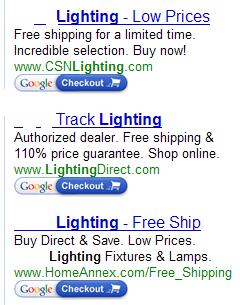
Doesn't that look a bit spammy, or tacky at the least?

What is Relevancy?

In The Search Engines Are Killing SEO Mark Simon predicts that in an attempt to have relevant results that search engine optimization will be rendered largely useless by improving technology:

Searchers want relevant results. They’ll reward or punish engines according to the relevance they provide. Advertisers, meanwhile, go where the searchers are. And so in order to keep the advertisers, who make the engines money, the engines need to make sure their search results are as relevant as possible.

I would argue that branding and marketing have more to do with search market share than relevancy. Google destroys the competition in marketing savvy.

In most highly profitable commercial markets there is not much difference between one company and the next. What can a bank offer but money? And if they operate on smaller margins they have less they can spend on marketing, and they lose market share.

Look how hard Google is fighting to try to marginalize Paypal, to collect marketing data and make their market knowledge more complete. Google is making their own SERPs look spammy to try to win another market, and failing hard. With Checkout, Google is telling a story nobody cares about.

Google Ranks Garbage:

What does Google consider as an authoritative quality website? Why are sites like Yahoo! Shopping, Bizrate, Nextag, MSN Shopping, Dealtime, Pricegrabber, and Shopping.com all ranked in Google as being more valuable than most smaller retail sites? Because they have some editorial guidelines and they spend a ton on marketing. But they all offer similar content, with little differentiation between them, and no value add from one to the next. If Google is so good at determining relevancy why are they ranking so many sites with similar content and similar user experience?

If Google dislikes double dipping on AdWords ads then why do they have so many similar low value sites ranking at the top of the search results for so many search queries?

Google Has to Trust Something:

Maybe search will close some of the easy loopholes, but the search engines have to trust something to create relevancy. Whatever they trust people will manipulate. So search engines will start trusting end users and popular opinion more. So SEO will be more holistic, focusing on users more than engines, but it won't go away. There are too many high margin markets with little brand differentiation, and that means that those who can differentiate or get people to talk about them will win marketshare.

It doesn't matter if you were early to a market and your market growth was slow and organic, or if you are new to the market and are better at marketing. Google has to rank something, and staying stale isn't how they are going to have the best relevancy. People expect to find the results that people are talking about. If your brand is well known Google will rank it highly. They have to in order to be relevant.

Every Market is Gamed:

You can differentiate by showing your message over and over again in hopes that someone cares (like Google Checkout), you can partner up with PR firms and non profits (like Gap and Bristol-Myers Squibb), or you can try to connect with people by sharing information about your topic or creating some other type of real value.

Anyone who thinks the search results will stop being manipulated is a person who fails to see how much the mainstream media is gamed everyday. And so is Digg. And so are most blogs. All authority systems are gamed by marketing.

People tell themselves certain lies to make the world make sense. Microsoft is bad. Apple is good. etc etc etc

The web is more targeted, more viral, and more reactive to marketing messages than other channels. Search will get gamed faster and harder as search commoditizes many thin arbitrage plays, the system teaches people to mesh ads and content, and the easy search algorithmic holes are closed.

SEO will never die. It will just continue to evolve with the market. Some self promotional gurus will associate SEO with dying low value spam, but as long as search companies are hiring SEOs I don't think we have much reason to worry about the future of SEO.

The John T Reed School of Hate Marketing

When I reviewed one of John T Reed's books I stated that his view of SEO was a bit simplistic. He believed that you would just rank for anything you wrote about, but the reason why he ranked for everything under the sun is that he published many scam and scammers review articles.

Making it Easy to Love a Hated Topic:

If your website is in a sketchy field, one of the easiest ways to gain authority is to knock down things that are far sketchier than your own business model. If you review things that are easy to hate which rip off a lot of people it is easy for people to link at that. Then that authority and link equity spreads around your site to your other pages.

The core of your site should be based on servicing your customers as best you can, but if you need a bit of a bump in terms of link equity and you are in a sketchy field you might be able to get those links by reviewing things that people are generally biased against.

How far Should I Push it?

The thing you have to be careful with is to not be too hypocritical when you do those reviews, or else a large part of the market might not take to it too well.

If what you are doing costs you significant credibility and support from within your community you are not going to rank well if the algorithms become more community oriented, plus when people search for you they won't find others saying nice things about you, which makes it hard to charge a premium for your products and services.

Emotions = Links:

People link because of emotions. If you can tap curiosity, laughter, happiness, hate, or rage you can get more link equity than you know what to do with.

View All Your Google Supplemental Index Results

[Update: use this supplemental ratio calculator. Google is selfish and greedy with their data, and broke ALL of the below listed methods because they wanted to make it hard for you to figur out what pages of your site they don't care for. ]

A person by the nickname DigitalAngle left the following tip in a recent comment

If you want to view ONLY your supplemental results you can use this command site:www.yoursite.com *** -sljktf

Why Are Supplemental Results Important?

Pages that are in the supplemental index are placed there because they are trusted less. Since they are crawled less frequently and have less resources diverted toward them, it makes sense that Google does not typically rank these pages as high as pages in the regular search index.

Just how cache date can be used to view the relative health of a page or site, the percent of the site stuck in supplemental results and the types of pages stuck in supplemental results can tell you a lot about information architecture related issues and link equity related issues.

Calculate Your Supplemental Index Ratio:

To get your percentage of supplemental results you would divide your number of supplemental results by your total results count

site:www.yoursite.com *** -sljktf
site:www.yoursite.com

What Does My Supplemental Ratio Mean?

The size of the supplemental index and the pages included in it change as the web grows and Google changes their crawling priorities. It is a moving target, but one that still gives you a clue to the current relative health of your site.

If none of your pages are supplemental then likely you have good information architecture, and can put up many more profitable pages for your given link equity. If some of your pages are supplemental that might be fine as long as those are pages that duplicate other content and/or are generally of lower importance. If many of your key pages are supplemental you may need to look at improving your internal site architecture and/or marketing your site to improve your link equity.

Comparing the size of your site and your supplemental ratio to similar sites in your industry may give you a good grasp on the upside potential of fixing common information architecture related issues on your site, what sites are wasting significant potential, and how much more competitive your marketplace may get if competitors fix their sites.

50% Off ReviewMe Coupon Code

Through the end of this month ReviewMe is offering advertisers 50% off. For advertisers to use the 50% off coupon they simply have to enter: trial into the coupon code at checkout.

Get Your Blog Out of Google's Supplemental Result Hell

Blog Indexing Question: My ranking for my core keyword went up, but most of my site was recently put in Google's Supplemental Index, and I saw my income and traffic drop sharply. I have not built any links recently or made any changes to my site. How can I fix this and get my site top rankings again?

Answer: Google has been tightening down on their duplicate content filters. They have also been using PageRank scores to determine whether to index a page, if they should stick it in their supplemental results, and perhaps how strongly they should apply various filters (such as duplicate content filters).

Between slightly lower internal PageRank scores (minor issue) and increasingly aggressive duplicate content filters (major issue) and significant duplication from page to page on your site (major issue) much of your site is in Google's supplemental index.

Get Real Links:

Google's Matt Cutts stated:

In general, the best way I know of to move sites from more supplemental to normal is to get high-quality links (don’t bother to get low-quality links just for links’ sake).

Since you said you have not built links in a great deal of time and few people are talking about your site in the active parts of the web the key is to write more about things that people are talking about or would comment on. Great content helps build links. You have to keep blogging if you want to keep your mindshare up.

Others pointing more link equity at your site from external sources should help improve your PageRank scores. PageRank is a large part of what is used to determine if a page is of high enough quality to stay indexed (or put in the supplemental index), and how aggressively duplicate content filters (and other filters) should be applied against it.

If you get strong editorial deep links from other bloggers that should also help search engines crawl that portion of your site better to make up for any information architecture related issues that may be causing certain portions of your blog to be inadequately crawled.

Make Longer Posts:

Since your posts tend to only be a sentence or two long, most of the pages are rather similar to each other. You may want to post more text in each post, and turn comments on to have more unique text on each page.

Reduce Sitewide Repetitive Features:

You need to make your page titles and meta descriptions unique on each page.

You may also want to resort your code order to put unique content higher in the page content and have duplicated and sitewide template related issues occur later on.

Don't Link at Garbage:

Since your site has a rather low PageRank you may want to only list your blogroll on your home page instead of every page of your blog. Take out other parts of your site that heavily duplicate each other from page to page. Also consider removing your sitewide links to some of the unimportant pages on your site to flow more of your link equity throughout your site.

I would also recommend removing the tagging pages on your site as your site is already navigable via your categories, and the tags create low value noise pages that reduce your link equity distributed on the quality pages. I also think it is foolish to link at all those auto-generated Technorati pages...that wastes a lot of your link authority. I would also recommend not linking to some of the pages you don't want Google to index, such as those printer friendly pages. You may also want to block those printer friendly URLs using the Robots.txt protocol.

You have canonical URL issues which can be fixed. If www.mysite.com and mysite.com are showing different PageRank scores 301 redirect the less popular version of your URL to the more popular version.

You also have a few broken links on your site that could be fixed.

All these changes should facilitate better indexing of your blog posts.

Issues for Commercial Sites:

Many commercial sites (especially thin product database sites) also fall into the Google Supplemental index. The above examples all apply to those types of sites, but in addition you could consider the following

  • add an editorial element to your site to improve your sitewide authority score

  • enable customer feedback and reviews to get more unique content on your pages

Keep in mind that if you do not do any offline marketing or much marketing outside of search, your site is more prone to large swings from search related fluctuations than some other sites which have more brand equity and/or do other forms of marketing.

Pages