Weekend Reading

Here are some interesting articles I recently came across.

  • Tapping into unconventional link attributes - tips to evaluate the value of a link, including the fresh boost and the actual lasting value of the link.
  • Beet.tv NYT report - Google traffic to NYT has doubled since unlocking their archives
  • Microsoft Tracking Search and Browsing Behavior to Find Authoritative Pages - even without PageRank you can easily discover authoritative pages largely through tracking usage data.
  • Yahoo! Buzz - a proof of concept of the Microsoft research...they look at search queries, emails, and votes to find what is really popular.
  • Portfolio.com interview of Michael Arrington - rather in depth interview explaining how Mike got into TechCrunch and how it took off to become a high paying full time job. With blogs being such an important part of the current structure of the web, reading the strategy of the leading technology blogger is a no brainer good idea.
  • 19.20.21. - project to research how population growth and urban living may alter the world and our ecological footprint.

The Future of Business Process Outsourcing

The Disadvantages of Low End Outsourcing

My History of Outsourcing

Last year I lost thousands of dollars multiple times outsourcing projects to people who could "do them no problem" until time for showing the results came in, and that capital was simply wasted. At the lower end, where people will take your money and do nothing for you or offer services not worth paying for, there will always be a market where people are glad to take your money.

That piece of the market creates a market for lemons effect, be it SEO, web design, programming, eBay listings, whatever.

The Cost Advantage of Outsourcing is Quickly Eroding

Not only is there a market for lemons effect, but the cost savings advantage is quickly eroding:

The reality is that wages are rising in India. The cost advantage for offshoring to India used to be at least 1:6. Today, it is at best 1:3. Attrition is scary.

Jobs that are low value-added and easily automatable should and will disappear over the next decade.

That means that if you provide a high value service, there is a greater presumed risk to hiring you, unless you have great brand strength and/or enjoy valuable personal recommendations. Worse yet, if the job is easy to automate eventually a computer will do it.

The Problem With Most Outsourcing Projects

Many people who look to outsource have a marginal business model and are outsourcing rather than improving their business model, in a last ditch attempt to try to keep it surviving after the business model is already in decay, without changing their business model to fit the current marketplace.

High End Business Process Outsourcing

You Can't Outsource Loyalty

At the other end of the market, some of the most talented people are also so ambitious that loyalty or output is limited. When I decided to change the SEO Book business model about 6 months ago I started working with one of the best programmers I have ever met. He did great work and started off faster than lightning, but he wanted to grow his revenues so fast and was so overwhelmed with work that he had a hard time making time for my project. In spite of me sometimes paying him 250% of his original rate, he and I both decided that it would be best if I finished the project with someone else. So then I ended up spending thousands more to have some re-learn some of the stuff he did, and then create custom coding to

  • verify the affiliate program would work and give the proper affiliate credit while changing the tracking method
  • cross reference account status and permissions across 3 databases
  • integrate it all with Paypal subscription data

There are still a couple things with the site that I really need to improve (Drupal FlashVideo conversion and some stuff with the Autoresponder module), and that does not even include additional features I want to add. The second programmer is helping with some of it, I am doing some of it, and a third programmer is helping with some of it.

Freelancing to Pro: Training Your Workforce for Better Jobs

I outsourced the writing of one of my sites to a person who was passionate about the field. I let them be associated with the brand and put their name on it so they would be more passionate about building it up.

I have marketed the site quite aggressively and gave them my ideas for how to create featured content and what topics to write about. That has lead to them getting so much exposure that other people are offering them higher paying jobs.

There is an aspect of outsourcing where if you teach them enough and give them enough exposure they end up being worth more than you can pay them unless you already have a market leading channel.

When Outsourcing Works Great

Pre-made & Self Serve Software Packages & Services

All the above models work so well because they

  • allow a single piece of work to be sold many times
  • use the feedback of many customers to improve the product

Word of Mouth Recommendations

  • All my hosting providers that I recommend were recommended to me by other online friends.
  • I have a guy who makes banners for me who is fast and does great work. He was recommended by a fellow SEO.
  • My designer for this site and other sites came as a recommendation from other friends.
  • Most of my other custom service providers are people who read this site, learned to trust me, and built a relationship from there.

My wife and I have only bought outsourced services via word of mouth recommendation that I ended up regretting on 2 occasions. In both cases, the person giving the word of mouth marketing was recommending themselves. Other than that, I have rarely had a bad experience with word of mouth marketing. And I think this is true for two reasons

  • you first learn to trust the source, and they earn that trust over months and years
  • then you trust what they recommend

Spreading that risk out over stages lowers the chances of making a bad choice.

How to Continue to Profit as an Outsourced Service Provider

Seth mentioned this Gavin Potter quote a couple days ago

The 20th century was about sorting out supply, the 21st is going to be about sorting out demand.

As the cost advantage of outsourcing disappears, the web gets polluted with scams, the web gets saturated with competitors, and more offline conversations influence online transactions, it seems the best ways to make money outsourcing are:

  • work to build some of your own projects so you are not reliant on clients
  • specialize on a niche and own the idea
  • build a brand that demands market leading rates
  • give away a lot of value free to do your marketing for you and qualify your prospects
  • inspire customers and ensure you offer a remarkable valuable service worthy of word of mouth marketing
  • turn your service into a product that is sold as a service, and include customer interaction touch-points where it makes sense to add value

Why Does Yahoo! Search Lag Google & Microsoft in Ranking Newer Websites?

Yahoo! has guys like Jeremy Zawodny marketing their fresh new search platform, and yet they remain behind the competition. Microsoft jumped into the search field way later than Yahoo! did, so why is it that Microsoft rankings for well promoted sites often roughly track Google rankings, while Yahoo! still has yet to give many of these sites an opportunity to rank?

Here are some examples of what I am talking about (with URLs expunged to protect the guilty)...

A couple year old site that was lingering about with a few inbound links and was promoted last November. Notice how quickly both Google and Microsoft took to the marketing, whereas Yahoo is still nowhere to be found

Here is a site that was promoted from brand new. Notice how Google and Microsoft are trending toward trusting it more and more, while Yahoo! Search occasionally picks it up and then spits it back out again

Here is yet another newish site that Microsoft loves and Google is starting to like more and more. Yahoo! is still nowhere to be found

If you had to pick the 1,000 most competitive keywords on the web I think all 3 of the above would fall in that group. I could list numerous other example sites as well. All the above sites have been in the Yahoo! Directory for at least 4 months. Even with new sites and a moderate amount of targeted promotion it is not that hard to work your way up into Google and Microsoft's rankings, but Yahoo usually ignores it.

I have highlighted that Yahoo! Search has their domain authority score overemphasized in their relevancy algorithms, which causes a lot of parasitic SEO to dominate their search results, but do they even care?

Can you rank a new site in Yahoo! for terms like insurance without getting it nuked in Google? What makes Yahoo! so much slower at ranking new sites than the other major search engines?

Starting From Scratch in a Fair Market vs Building an Honest Sustainable Competitive Advantage

Naive Excitement

When you are new to the field of SEO there is a certain excitement in starting a site from scratch and growing it out into a flourishing enterprise. You ask someone to link to you and when they do you get excited. When you get cited without asking for it you get excited. And when the rankings start to show up you get excited. At some point you may even develop an irrational emotional attachment to some of your websites. I know I have.

Fair is Fair

Search engines teach you that there are equitable rules to follow. The rules keep shifting in accordance with the search engine's business models, but somehow they are always fair. You see other people doing things that are "spammy," but refuse to. When you submit your site to 100 directories, donate money for links, attend every conference that will link at you, or when you syndicate your content to dozens of websites it is not spam. Your content is quality, you follow the rules, and one day you will be rewarded for it. One day...

Who Starts From Scratch?

But do you have to start from scratch to be doing SEO?

In Cosmos Carl Sagan said that "to make an apple pie from scratch, you must first create the universe." I tend to think the same way about SEO.

  • Some people who jumped on the web and were immediately successful started when the marketplace was much less competitive.
  • Some companies like Amazon.com lost millions or billions of dollars building their brands.
  • Others carried offline success and relationships online.
  • Some people have jobs or schools that offer them the opportunity to publish content on a trusted domain.
  • Some companies can do whatever they want because they have a big brand and/or a large ad budget.
  • Some people who are better salesmen than you may borrow your ideas, re-package them, and then talk trash about how ignorant you are.
  • And yet another group of people have a large following because they are highly biased and/or lie (ie: Fox News).

What is Fair?

Are any of the above categories unfair? Or is the concept of fair nothing more than bogus self-posturing by profit hungry corporations? Many companies who helped fund the large networks (affiliates, for example) later saw their sites classified as spam or priced out of the same markets they built by quality scores which said their sites are no good as the network got more competitive. Mind you many of these changes were not algorithm related, but were driven by direct human intervention.

The rules keep driving value (and profit) to the networks. They appear fair so long as your interests are aligned with those of the network. But behind the public rules, they fund theft of copyright work hoping it leads to the original publisher giving in and partnering with them to wrap their ads around the content. In other cases, if you get too successful human intervention within the network votes against you while leaving your competition unscathed. Why did Text Link Ads get penalized while Text Link Brokers still ranks?

Leverage Your Assets

Not every strategy works for every person, but if you are starting from scratch thinking that you are following the rules, you are missing out on some fundamental truths of the marketplace. If you are not leveraging and building upon your knowledge, passions, curiosity, and social relationships every day you are losing money (likely to an inferior and/or less honest competitor).

Take the Red Pill

Some of the most effective SEOs buy and sell links, buy and sell websites, buy and sell companies, rent personalities to promote their sites, openly engage is link schemes, use successful positions to promote other similar positions, expand out to other high profit market positions, and do whatever they see fit to profit. It is not our job to create the algorithms, we just satisfy the criteria to rank.

Take the Blue Pill

Others start every project from scratch, hoping that one day the market will be fair and shine a light on them. One day...

Yahoo! Open Search

One of the biggest things holding back Yahoo! Search is their preference for Yahoo! content. As a shift in strategy, Yahoo! announced they are opening up their search results to third party data integration. Instead of a typical search result, some of the results with third party data may look like this

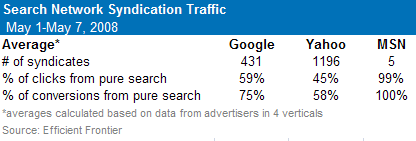
Google has largely been pulling in third party data and doing their best to keep that traffic on the Google network. To appreciate how aggressive this has been, you only need to look at the increased size of Google local listings or the sharp decline in stock prices of traditional Yellow Pages companies, as highlighted in this WSJ article.

A couple questions that remain are how interactive will the paid inclusion results get, and will the paid search ads get more interactive as well?

Google has a similar program to what Yahoo! offers, with a couple major differences

  • Yahoo! will turn on third party data for some leading sites by default
  • Google requires you to learn their proprietary confusing language AND promote Google, Google Search, Google Subscribed Links, AND get your users to subscribe for you to get any additional exposure (and yet they wonder why it hasn't taken off yet)

Through different strategies both of the top 2 engines are turning their search results into destinations. Worth watching as it progresses. More information available at Search Engine Land.

Is Your Content Solving Symptoms or Fixing Problems?

A normal business practice is to treat symptoms as problems and come up with a wide array of bogus solutions, but content that asks why actually solves problems and creates real value.

Once you look at content creation from that perspective, there are a lot of great content ideas that you will not find on many competing sites simply due to limitations tied to their business interests, or their lack of interest in providing real value to the market.

Microsoft Announces Engagement Mapping Ad Technology

AdWords has become a black box beyond the means of many small advertisers. To help some advertisers automate their accounts tools like free conversion tracking and CPA based bidding have came about. But all the tools that help enhance the perceived value of search ads and the value of conversions does nothing for brand ads or the other ads people see before searching and buying.

Content ads, which were relatively expensive when AdSense first came out, have seen their price drop over the years as

  • advertisers adjusted content bids downward
  • smart pricing reduces prices (again, again, and again)
  • quality scores that drives out arbitrage ads
  • the clickable region has got smaller

The value of many publishing based business models has aggressively eroded as

  • publishing markets get saturated
  • AdSense has replaced direct ad sales for many sites
  • Google keeps discounting the price (and perceived value) of non-search ads
  • Google's search based ads get conversion credit for demand created by other ads

Google claims their success is just because they are simply better than the competition and they have been doing search longer (that second claim is untrue - Yahoo! owns Inktomi and AltaVista, which have both been doing search longer than Google). The truth is they have a huge advantage in network effects, have advertising believe that their inventory is worth more than it is, and that other online ads are worth less than they are. It is going to be hard to create a viable competitor unless the metrics for measuring value are changed.

Microsoft's answer to this is called Engagement Mapping, yet another black box, but one that aims to share part of the ad credit with display ads (clicked or not) instead of tying most of the ad value to the search based conversion. Publishers would clearly benefit from this, but if it is hard to get advertisers to buy AdSense ads on Google (where Google essentially giving away the ads) how hard will it be to get advertisers to buy in on this? Perhaps big brands will use it, but smaller companies will not be interested.

If Microsoft does not own a big piece of the search market, another big hurdle is how will they advertisers trust this model without giving Microsoft their analytics data?

How might this pricing model change online publishing (for better or worse)?

Inclusionary Statements - Are You Willing to be One of the Best?

One of the things that a lot of thought leaders do is inspire people. It is easy to believe when they give you something to believe in.

I recently stumbled across this page. Although it is just text, to me it seems just as powerful as listening to Barack Obama speak. It is not even the words that matter...it is the underlying tone and enthusiasm.

Sometimes I am a bit too cynical for my own good. Far too often I place principal ahead of growth strategies. But most of that stuff does not matter. The future of sustainable marketing practices is more about creating inspiring stories than about knowing more or blending ads in content better. Which, I suppose, is a good reason to go to the gym every day. The better you maintain yourself the easier it is to be inspiring. Now that's a holistic marketing strategy. :)

Free Stuff

Chris Anderson, author of The Long Tail, announced his next book Free, in a featured Wired article.

Speaking of free stuff, Patrick Altoft created a free Wordpress plugin to track which pages on your blog get crawled most frequently. Joost De Valk has a free newsletter dedicated to Wordpress plugins.

Interview of Nicholas Carr on The Big Switch, Blogging, & the Internet

I recently finished reading Nicholas Carr's The Big Switch, and as a longtime fan of his Rough Type blog asked if he would be up for doing an interview. He said sure, and here is the interview.

What is The Big Switch about?

It's about the interplay between technology and economics and how it influences the way people live and work. I look at how the electric grid transformed industry and society a hundred years ago, which is a cool story in itself, and then I use that story as a way to explain the similar shift that's going on today with computing, as software applications and data storage shift onto the Internet's computing grid. I argue that the rise of "cloud computing," as it's called, will also have far-reaching social, cultural, and business effects - some good, some bad.

What inspired you to write The Big Switch?

It's been clear to me for a number of years that the Internet was going to transform computing - to turn it into a kind of centrally supplied utility. I guess I just wanted to put that shift into a broader context for readers, a historical and economic context as well as a technological context.

The web empowers many individuals. Yet in spite of all this innovation, the middle class in the United States is hollowing out. Why is that? As individuals how can we protect ourselves from that trend?

People with computers and Internet connections have enormous new opportunities to express themselves, and a smaller set of people have also gained new economic opportunities thanks to the Net. But I don't see any sign that the economic opportunities are being widely spread, as they were with industrialization in the last century. I think what we're seeing, in fact, is that software can take the place of labor on a broad scale without creating large new pools of attractive jobs. That's one of the main reasons the middle class has been stagnant in recent years and the divide between the very rich and everyone else has been growing ever wider. As the cost of computing continues to fall, software-based automation will only expand and accelerate. There will still be lots of good opportunities for individuals - the ranks of the rich are bigger than ever - but for the middle class in general things will likely get tougher.

With the publishing economy becoming more attention based, will most writing come in chunks so small and so fast that they lack context and the bigger picture? If so, how could this trend be reversed?

I think it's quite clear that the Internet is training our minds to take in information in quick bursts and that in turn we're slowly losing our ability to maintain the concentration and patience necessary to read extended pieces of writing. This is a phenomenon that many people who use the web a lot have noticed. I think we're probably at the start of a major shift in cognition, and I doubt it's reversible.

Sometimes I read TechMeme and 100 claimed thought leaders are all agreeing on the same thing. Then the next day (or sometimes two days later) you write about how all of them are wrong, and then 2/3 of them agree with you. What makes your contrarian blogging so captivating and buzz-worthy?

The wisdom of crowds is, I think, greatly overrated. Crowds are usually full of crap. So if you see a blog mob happily racing off in one direction, you can be pretty sure that if you go the opposite way you'll find something interesting.

TechMeme, by the way, is a great site to visit if you want to get a quick read on what's going on at the moment in the Internet end of the technology world. But it's a very dangerous site to spend a lot of time on if you're a tech blogger. It narrows your view and promotes rapid-fire me-too-ism. It's better to try to seek out interesting new sources of information, to give yourself some space to think rather than just reacting.

Some bloggers have called you cynical, but many of them fail to see connections that you easily make. What makes it so easy for you to identify relationships that others miss?

I don't really know. Being open to a broad set of influences is important, I think. To me, what's fun about writing - and about thinking, for that matter - is making unexpected connections. When most people write, they get very earnest. They approach writing as if it were work. It's better to be playful, to let your mind and your sentences take chances.

Is user generated content an answer to anything, or does it only accelerate the diminishing content quality problem?

People write blogs and upload photos and videos and tag content because they enjoy it. It gives them satisfaction. There's absolutely nothing wrong with that. But user-generated content does not exist in a vacuum. It competes with other content, and because it's cheap to produce and usually given away free it has a big market advantage. You have to ask yourself what's going to be crowded out of the market - what good stuff are we going to lose. A lot of people seem to think that new digital media represents a break from mainstream mass media. I don't see it that way. I think new media represents a continuation of mass media and a further amplification of some of mass media's worst qualities.

You mentioned studies about political blogs in The Big Switch. From those studies, it seems links, attention, and readership seemed confined and self-reinforcing in some ways. How may search engines (and other gate-keepers) promote the creation of balanced content when people typically vote for content that is aligned with their biases and identities?

That's a good question, but I don't have a good answer. I think what we're going to see is greater personalization in search and other filtering and navigation tools, and in time that will tend to further reinforce biases and push people to have less sympathy for views that are different from their own. I think media personalization is good for search engines and advertisers. I don't think it's a great thing for society.

Some publishing companies already use profit potential to guide what types of content they create and what topics they cover. Could this create a thinning out in many important fields where the economic viability of the publishing in the field is limited?

In the long run, all for-profit publishers are influenced by profit potential. How could they not be? That's not meant as any kind of criticism of journalistic ethics. It's just a simple observation that production shapes itself to the market. So, looking again at the longer term, you can expect that the combination of unbundled content and precisely targeted advertising will mean that some types of content, including some times of very serious, very worthy content, will fall by the wayside or be shunted to a small elite. We may come to look back fondly on the days of bundled content and lots of cross-subsidies.

How far will the shift to publishing profitable topics go. Might we see a weekly (or daily) NYT story on Viagra?

I think it will be more subtle than that, at least for the top papers. What we'll see is a slow but meaningful change in what's published and how it's published as publications adapt to the new modes of information consumption among readers and the new expectations of advertisers.

I just added a subscription based service to access parts of my website. Do you see publishing shifting to charging less for content (using content for marketing) and charging more for interaction? In what areas may selling content without interaction be a viable business model 20 years from now?

I think there will always be niche markets where specialized content carries a high value, and printed books and magazines will probably continue to sell well for a good long time. But for most online publishing, including interactive publishing, a subscription fee is an awfully hard sell.

Increasingly we let machines make decisions for us, which on the surface simplifies things. But what are the hidden costs?

When you let machines take over parts of your thinking, you start to think like a machine. This is the greatest danger posed by the Net. Computers get a little smarter, we get a little dumber, and eventually we meet somewhere in the middle.

Do you feel you have a health records problem, or was Google's recent move into the space guided by profit potential? At some point will people refuse to use the data hoarding ad networks?

There's a huge health records problem - a fatal problem for some unfortunate folks. I think Google sees this as a problem to solve, a problem well suited to its own expertise. I applaud them for their ambition. But I think that using health records as a platform for advertising is dangerous and unethical, and so while I don't doubt Google's good intentions I am very suspicious of how its program will actually play out.

If I was new to the web and wanted to write for a living, where would you suggest I start? What was key to helping you becoming a great writer?

First of all, thank you for the compliment. I think the best way to learn to write well is to read a lot, particularly when you're young and impressionable. If you want to write for a living on the web, your best bet is to find a niche market that's attractive to advertisers, start a blog, and then work like hell. You'll still probably fail, but you never know.

-------

Thanks Nick. If you would like to read more from Nick please check out his Rough Type blog. Go buy The Big Switch today as well, I promise you will like it.

Pages