Guide To Local Search SEO

Local search, meaning geographically defined searching, provides a wealth of cheap and effective marketing opportunities. Not only is it possible to segment audiences by location, the SEO competition in geographically constrained areas is lower than in generic searches. If you have a service or product with a strong local component, then adopting a local SEO strategy can pay off handsomely.

Whilst local search has been slow to catch on, things are changing quickly, especially with the advent of "location aware" devices, such as iPhones, and the new marketing opportunities they present.

In this document, we'll take a look at local SEO, and provide you with specific, geographic strategies to help enhance your visibility on a local level.

The Growing Importance Of Maps

In 2005, Google introduced a free local mapping service called "Google Maps". Yahoo also has a map product, as does MSN. Whilst there are numerous map providers, these online services took mapping one step further by integrating data in order to make maps more useful. No longer was a map a static page, it was now a personal, interactive navigation tool that can plot how you get from place to place, show you where the local restaurants are, tell what people thought of them, and more.

These interactive maps provide valuable opportunities for online marketing in the local space.

Firstly, these maps services provide businesses with the opportunity to claim a space on a map, and it is free to do so.

Secondly, Google is starting to integrate maps into the search result listings. It is now possible to be featured at the top of Google without even having a site. You simply have to list with the mapping services, and chances are you'll be featured in local search result listings.

For example, let's take a look for "hairdressers near Beverly Hills, CA"

The first two results are local directory pages. The third is a Google Map. The sites listed alongside the eye-catching map occupy lucrative screen real estate, and all they did to get there was claim their place.

In order to claim your place on a map, follow these steps:

Google Maps

1.Go to the Google Local Business Center and sign up
2. Fill out the forms
3. Validate your listing by phone, SMS, or mail.

Yahoo Local

1. Go to the Yahoo Local sign-in page.
2. Fill out the form.
3. Wait :)

These services also allow reviews, so ask your friends and colleges to write a review on you.

You can also use Getlisted.org to check your local visibility. This service will tell you if you're listed in various local search services, and prompt you to register for those services in which your site doesn't currently appear.

Local Strategies

Local SEO strategies are much the same as general SEO strategies, the obvious difference being the local component. You still need to cover the bases - produce on-topic content, be crawlable and well linked. Simply add some local flavor, and you will show up in local searches, too.

Local Business Listings, Hub, Chamber of Commerce

Make a list of all relevant local business hubs, chambers of commerce, and other organizations. The U.S. Chamber of Commerce is a business federation representing millions of businesses, both large and small, and you can find your local branch by searching this site.

Look for members directories. For example, the Seattle Chamber of Commerce has a directory located here. Often, you only need be a signed-up member in order to qualify for a listing.

Yellow Page, CitySearch, SuperPages & Local Directories

Get listings in local business directories.

These types of sites usually have sufficient levels of authority to rank new pages quickly, meaning any listing you have on such a site will get you near-instant visibility in the search results. Some of these sites will will also pass link juice to your site. Ensure you submit in the local-specific categories, as opposed to the general categories.

A word of warning: unless you have sufficient link authority, the directory pages might outrank your own site, so if outranking your directory entries is a priority for you, it is a good idea to build up your own link authority first.

Local Identifiers

Include local identification data on your site, such as local phone numbers, addresses, and zip codes. Use standard nomenclature.

If possible, try to include this information in the footer of every page of your site. This will ensure each page you create has at least some local keywords, which will help catch local searches.

Ask Customers, Suppliers & Partners For Links

Customers, suppliers and partners can be a great source of links. It's even better if they have a local presence.

Appear In Local Media

Do you have a story with a local angle? Small, regional papers and websites are often short of local material, so will jump at stories handed to them on a plate. Make sure you ask for a link.

Also issue locally focused press releases using services, such as PRWeb. Use local keywords in your press release title, and spread liberally through your copy. Link back to your site.

Adwords For Local Searches Are Cheap

Google Adwords and other PPC services allow local targeting i.e. the ads only appear if the searcher is in the local region.

Google allows you to target by:

  • Any zip code, metropolitan area, state, or country
  • A radius near your business
  • A radius near a point on a Google Map
  • The defined coordinates of any polygon you enter
  • Any combination of the above

Google also offers a Local Ad Preview tool to show what ads will appear on search results in different areas.

You can also use it to get an idea of the size of your local market. Run a test campaign for a week or so and determine the number of local searches against a range of keyword terms. This information can flow through into your SEO campaign when you choose which keyword terms to focus on.

Google also offers the AdWords Local Plus Box. The Local PlusBox is a feature that displays more geographical information for a local business ad that appears in the top position above Google search results. When users see the Local PlusBox and click on it, the ad expands to include a map, address, driving instructions, and phone number, in addition to the location name that appears beneath the last line of ad.

By running both SEO and PPC campaigns side by side, you occupy more screen real estate, and have a higher likelihood of receiving a click.

Mix Keyword Text With Location Information

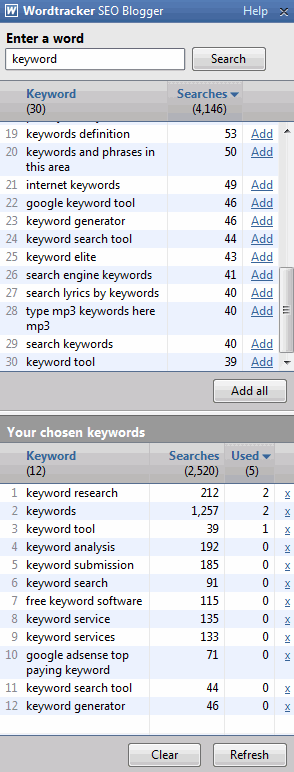
Include local keywords in your body copy, headings and title tags. Use the Google keyword tool to give you ideas as to what keywords Google associates with certain regions.

For example, if I type in Wisconsin into the Google Keyword Research Tool , and scroll down to "Additional keywords to consider", I get a list of related keyword terms sorted by relevance. Incorporate as many of these associated keywords as applicable. Google is likely to associate these terms with each other, so the more of these terms and variations that appear on your page, the more relevant you're likely to become in the eyes of Google.

Google Coupons

Google coupon feeds enable businesses to provide coupon listings that will be included in Google search results. You can create a Google coupon feed here.

These coupons will show alongside Google Map listings, and they are free. At the time of writing, the take-up of Google Coupons is quite low, possibly because it isn't well known yet, so grab this opportunity while it lasts.

Syndicate Your Content

Are there any local blogs or sites that may host your articles? Offer to make guest postings. Search Google for your chosen local keyword terms and see what sites come up. If you can get your content on to any of the top sites, you will get both the traffic and a highly desirable link.

In return, the well ranked site gets free, unique content. Win-win.

Linked In & Social Media

Get listed with LinkedIn and other business contacts services. It is free, and LinkedIn pages often rank well in the results listings. Leverage your contacts, engage with people, and ask them for links. Personal networking is a much more affective way to get links than anonymous approaches via email.

Also get a profile in FaceBook and any other social media site where your customers might hang out.

Wikipedia

Wikipedia is an online encyclopedia that anyone can edit. Wikipedia use a no-follow tag, so is unlikely to pass link juice, however Wikipedia pages do rank highly, which provides an easy opportunity to get seen.

Navigate to local pages and, if appropriate, add your link. You can even add body text if your business or service is relevant to the topic of the page.

A word of warning: Wikipedia users can be hostile to marketing and advertising. Given that anyone can change the content of Wikipedia, blatant marketing pitches won't last very long. Try a factual, informational angle instead. For example, write an article on local history or points of interest.

Email Signatures

Ensure your email signature and forum tag lines contain local address and contact data. Sometimes forum and blog posts will pass link juice, and that link will appear alongside local keywords.

Sponsor Local Events And Sites

Are there local events you could sponsor? How about local school sports teams or clubs? Often, small local events don't cost a lot to support, and the link value alone could be considerable.

Try To Include Specifics In Your Business Name

If you haven't decided on a business name, try and include a service description in the name itself. For example, a photography business called Elite could name themselves "Elite Wedding Photography" for the purposes of directory listings. If you can get the keyword in the link text, you increase your chances of ranking for that term.

Also, small businesses often don't have the brand recognition, so explicitly describing what you do can make your offering clearer to potential customers.

Optimizing for Multiple Locations

If you cover a number of regions, it can be a good idea to dedicate a section to each region, rather than trying to cover a multitude of regions on one page. Each page should be optimized for one, specific local query.

What are your most important referrals? Perhaps people who search on your local town end up becoming customers, where those who search on a state do not.

Try to figure out which group of searches result in the most business. Assign a value to the traffic, either by monitoring conversion rates, or counting the volume. Then focus your site on those visitors.

If you site was going broad - say, targeting a big region like California - you might want to hone in on your town instead, especially town search traffic turns out to be the most valuable. For example, a real estate agent who lives and works in San Clemente is probably better off focusing on keywords relating to San Clemente, as opposed to the whole of California, which she can't possibly service. It's also a lot easier to do in terms of SEO. A few links, some on-topic copy and a Google Map entry might be all that's required in order to get rankings and drive traffic.

Your home page is usually the most likely to rank, so ensure the title, content and tags target the specific local traffic that gives you the most bang for your buck. Move your most valuable content, in terms of visitor value, as close to the home page as possible - one click away, if possible.

If you target multiple areas, you could create a series of subdomains i.e by State, and each subdomain only contains information pertaining to that state.

Resources & Further Reading

Links & Relationships vs the 'Social' Media Monster

John Andrews highlighted how the narcissistic "social" media platforms are in many ways replacing links

The players producing platforms are manipulating the currency that they see those platforms aggregate — which is mostly links. As you type type type your content into Twitter or Wordpress.com or Wikipedia you are fueling the coffers of an elite group of benefactors, and if they continue to manipulate the open web, we lose the “free” benefits of our world wide web. They used to encourage you to sign onto their systems, but now they need you. We’re not linking because our tools don’t make it easy enough to express our linking selves. Those who make the flexible tools today do so for personal gains, not the betterment of the web, and so they manage the linking. Greed is the new black.

If enough such platforms keep growing then Google will have to evolve their algorithms to look beyond links, placing significant weight on other factors and/or some nofollowed links.

A while ago I mentioned how Twitter was pulling blog links away from bloggers (lowering the ROI of blogging from super explosive to only explosive). This trend is not only spoke about in the SEO industry, but is starting to receive coverage in broader channels. Brian Solis recently mentioned this trend, noting that many of the top blogs are seeing lower link counts in Technorati. People would rather write about their status than spend the effort needed to digest and compile something deeper.

Since more links are occurring on networks like Twitter that will lead to a rise of tools like BackTweets. Until the search relevancy algorithms evolve more, we need to look for ways to encourage as much conversation as possible to happen on independent websites. How do we do that? I have a few ideas, but would love to read some of yours first. :)

Hyperlinks Subvert Hierarchy

One of the first books I read about the web which really helped me understand the culture of the web and the concept of the web as a social network was the Cluetrain Manifesto. In it, David Weinberger stated "hyperlinks subvert hierarchies," a concept that helps explain a lot of the chaos in the current world.

The staggering rate of change and seeing cracks in imperfect structures makes us more likely to question authority. Fear slows down economic activity but it also creates the conditions to help speed up change through creative destruction, as insolvent structures crumble and are replaced by thousands and millions of online experiments ran in parallel due to forced entrepreneurship. As Clay Shriky puts it:

That is what real revolutions are like. The old stuff gets broken faster than the new stuff is put in its place.

Each link creates a new opportunity, which in turn creates new opportunities, giving our social nervous system many senses. And the web is just getting started. Watch this Tim Berners-Lee video and try to predict the future of the web. You can't do it.

As the web grows (and grows smarter) two of the biggest risks are machines learning too much about us (through spying on our browsing habits) and proprietary databases that lock away pieces of our culture while surfacing other favorable pieces (the divisions could be nationalistic, idealistic, or commercially driven - like "brands" that we are apparently "hard wired" to). For both of those reasons, Google's market dominance scares me.

On the above video by Tim Berners-Lee, Ralph Tegtmeier wrote the following

As long as we don't seriously do something about protecting people from the very abuse of their personal data (more often than not linked without their express acquiescence), we're merrily lighting the fuse to a humungous collective powder keg. (And it's really not helpful at all shrugging such concerns off with pejorative epitheta such as "tin foil hat", "conspiracy theories" etc. as is so common across the board.

Let's never forget that all the major atrocities committed in "civilized" countries ever since the 19th century, ranging from genocide to mass destruction, ethnic cleansings, wars, the holocaust etc. were only as scalable as they eventually proved to be because of just that: "linked data" ruthlessly leveraged and deployed by those who could get their hands on it.

Think about how distributed (and targeted) ad based business models work in a republic / quasi-democracy. Buy ads that change the opinion of couple percent of people and you change the course of a country, and perhaps the course of civilization. Think about how well Google intends to know your flaws, and sell them off to the highest bidder in any medium they can:

users that spend a long time bartering instead of stealing in a game may suggests that they are interested in the best deals rather than the flashiest items so the system may show ads reflecting value. As another example, users that spend a lot of time exploring suggest that they maybe interested in vacations, so the system may show ads for vacations. As another example, users that spend a lot of time chatting instead of fighting or performing other activities in online games suggest that they like to chat, so the system may show ads for cell phones, ads for long distance plans, chat messengers, etc.
...
The dialogue could indicate that the player is aggressive, profane, polite, literate, illiterate, influenced by current culture or subculture, etc. Also decisions made by the players may provide more information such as whether the player is a risk taker, risk averse, aggressive, passive, intelligent, follower, leader, etc. This information may be used and analyzed in order to help select and deliver more relevant ads to users.

And while we are being profiled, pieces of our culture are being locked up via anti-competitive agreements. Richard Sarnoff, the chairman of the Association of American Publishers, noted how they were hoodwinked in a deal with the devil:

Sarnoff also speculated that … [l]egal hurdles may make it infeasible for any other firms to build a search engine comparable to Google Book Search.

Many power structures that are being killed off by the web are the walking wounded, making deals that are rational only when paired against death. And we are stuck living with the consequences of those decisions.

With Google being so profit driven they are leaving room for a pure search play, if only someone that got branding, marketing, and the web would step up. I hope Rich Skrenta (or anyone) provides real competition to Google soon, before spying is seen as respectable and too much of our culture gets locked up in exclusive deals.

SEO For Affiliates

http://www.ariozick.com/how-google-wants-to-destroy-small-business-online/
http://www.youtube.com/watch?v=9Xui5gzV0To
http://www.seobook.com/corporate-seo-services

link profile seen as a whole
http://www.bing.com/community/blogs/webmaster/archive/2009/06/19/links-t...
http://googlewebmastercentral.blogspot.com/2009/10/dealing-with-low-qual...

Affiliate marketing is a business model whereby the marketer is paid a commission based on the products or services they help to sell.

Typically, a merchant provides the billing, the stock, the handling, and the customer service function, whereas the affiliate finds the buyers, and directs them to the merchant's site.

This business model is a natural fit for search marketers. The search marketer need only get the traffic by way of search rankings or PPC, and the profits come flooding in.

That's the theory, anyway.

The reality is that most affiliate marketers aren't making much, if anything. You'll find thousands of e-books promising instant riches by way of affiliate marketing, however the people making the money tend to be the people selling the books!

In this guide, we'll show you how affiliate marketing really works. We'll look at the nature of the game, the obstacles, and the SEO techniques and strategies you can use to create profitable and defensible revenue streams.

History Of Affiliate Marketing

Commission selling and revenue sharing is nothing new. It pre-dates the internet. However, unlike off-line equivalents, the internet version requires little active selling effort on the part of the affiliate, other than placing internet-based advertising. Needless to say, affiliate marketing on the internet took off quickly.

According to Wikipedia,

"The consensus of marketers and adult industry insiders is that Cybererotica was either the first or among the early innovators in affiliate marketing with a cost per click program.[2] During November 1994, CDNOW launched its BuyWeb program. With this program CDNOW was the first non-adult website to introduce the concept of an affiliate or associate program with its idea of click-through purchasing. CDNOW had the idea that music-oriented websites could review or list albums on their pages that their visitors may be interested in purchasing. These websites could also offer a link that would take the visitor directly to CDNOW to purchase the albums."

How Affiliate Programs Work

Most affiliate programs work like this:

  • A visitor arrives at a site run by an affiliate
  • visitor clicks on a link that leads to the merchants site
  • the lead is identified as belonging to the affiliate by way of a tracking code, a cookie, or URL referral
  • if the visitor then buys a product or service, the affiliate receives a commission

Another common model involves capturing sales leads, and then selling them on to a merchant i.e. mortgage applications.

The benefit to the merchant is a low-risk sales channel. The merchant only has to pay the affiliate if a visitor buys something, or qualifies as a genuine lead.

Therefore, most of the risk in affiliate marketing lies with the affiliate. The affiliate must buy or earn the traffic, but will only make any money if the traffic actually converts into a buyer or a lead.

How To Become An Affiliate

Becoming an affiliate is, in most cases, easy. You fill out a form and you're good to go.

Incidentally, we have one of our own :)

The hard part is getting high quality visitor traffic. A lot of people are fighting for that same traffic, which means it is going to require time, effort and cost to acquire. In order to make a successful business out of being an affiliate, you need to get traffic at a lower cost than you can "sell" it.

Let's take a look at a PPC approach to illustrate the affiliate business model:

  • You sign up for an affiliate program
  • You choose a product to market
  • You place PPC ads on Google Adwords for $.50 cents per click
  • These PPC ads lead to your landing page
  • The landing page contains your affiliate link, leading to the merchant site
  • If the visitor buys, you make a commission of $100.00

If you bought one hundred clicks at .50 cents, your cost of advertising was $50. Your affiliate payment is $100. Therefore, your profit is $50. If you can repeat this automated feat a few hundred times per day, you'll soon be driving that new Ferrari.

The problem is, of course, that many other affiliates, and the merchants themselves, are doing likewise. This drives up the cost of the clicks and reduces the margin available to the affiliate. Typically, affiliates have little or no control over the margins they can attach to the products or services of the merchant.

The PPC marketers tend to work on slim margins and high volumes. Those who can do high volumes tend to have more leverage with their merchants in terms of margin. Another barrier for the new entrant is that PPC accounts, like Adwords, build up a credibility history, which can give high volume players lower prices.

SEO Tactics And Techniques

Unlike PPC, SEO doesn't involve a cost per click charge. Therefore, if an SEO can rank pages, s/he stands to make significant margins. The SEO still has competition from other SEOs chasing the same rankings, but it is harder for new entrants to unseat the SEOs positions, as often happens in PPC.

There are a number of different ways to approach SEO affiliate marketing, from building a site consisting of a merchants product inventory, to building a comparison shopping site, a review site, or simply creating a collection of on-topic landing pages.

In choosing your approach, it pays to keep one thing in mind:

Google doesn't like you

Google's Quality Rater Guidelines

A few years ago, search engines weren't very good at spotting duplicate pages.

If you performed a search in any of the competitive P.P.C areas - in affiliate marketing, PPC also means "Pills, Porn & Casinos" - you'd likely see thousands of near identical sites. The search results "street" was chock full of pimps, and the law was pretty much powerless to stop them. Take out a few pimps, and there would be tens of thousands stepping up to take their place.

These days, Google does a better job of weeding out duplicate content, and what it deems "low value" pages. This has led to significant changes in the way affiliates approach affiliate marketing.

To understand the approach you'll need to take, let's firstly look at how Google classifies affiliate sites.

The Google Quality Rater Guidelines, a document which is reportedly a training course for Google's army of human spam police, was leaked to the internet in 2007.

This document provides valuable insights into how Google classifies spam. Anyone interested in SEO will find this document essential reading, but it is of particular interest to affiliates. The document singles out affiliates for special mention on a number of occasions. Those mentions are usually followed closely by the word "spam"

State your reason for assigning “Spam”, “Maybe Spam”, and “Malicious” flags. For example, Sneaky redirect to eBay....Amazon thin affiliate

Major cosmopolitan cities are preferred targets for spammers, especially hotel affiliates. Such results should be labeled as Spam, even if they have relevance to the query

Thin Affiliates: Spammers make money when a transaction is made after the user has clicked through to the merchant’s site

Types Of Spam - A thin affiliate is a page that exists to deliver a visitor to a page on another domain with a different owner.
Keywords deliver visitors to the affiliate page, and links on the affiliate page deliver visitors to the second page,
which is owned by a real merchant.

Not great news for the budding SEO affiliate.

However, Google does make a distinction:

  • Thin affiliates are bad
  • Other types of affiliates are not

What is a Thin Affiliate?

Google defines a thin affiliate as:

...a page that exists to deliver a visitor to a page on another domain with a different owner. The thin affiliate site contains text and perhaps images copied from the merchant site. It offers no (or very little) value-added service while earning its commission"

An example of a thin site which Google provides to it's quality raters: http://findmeatune.com/artist-Pink

What Is A "Fat" Affiliate?

Google also states the types of affiliate pages it deems to be acceptable.

"If a page offers some value in addition to its links to the merchant, then it is not a thin affiliate. For example, if the affiliate offers price comparison functionality, or displays product reviews, recipes, lyrics, etc., it is not a thin affiliate, and, therefore, not Spam"

Google gives examples such as www.shopping.com, www.pricegrabber.com, and Kelkoo.co.uk. These sites are deemed acceptable because they provide extra value.

So, if you want to fly under Google's spam radar, you should aim to become a "fat" affiliate*. In order to do this, you should look to add value of an informational nature.

*Note: you can still be a thin affiliate and make money. There are plenty of these sites in the index. However, they are engaged in an arms race with Google, and it is a race that Google will likely win. Most of the hardcore thin affiliates effort goes into staying one step of Google, which can be a lot more work than simply building more valuable content.

Create Valuable Content

The Search Quality document also tells us what type of content Google finds valuable.

Google have a content rating scale which consists of five grades: Vital, Useful, Relevant, Not Relevant, or Off-Topic. In order to escape Google's spam filters and hand edits, you must fit into the first three grades.

The Search Quality document goes into great detail in terms of defining these grades, but the most important point to remember is that a page is rated based on the match to the *concept* of the query, not the presence or absence of the query term on the page. What this means is that it isn't good enough for a page simply to mention a keyword term, a page must "answer" the visitors query. This blows away a lot of conventional theory on SEO - relevance isn't just about adding keywords.

Google doesn't treat all search queries the same. Google separates queries out into three categories: navigational, informational, or transactional.

A navigational query is a query intended to locate a specific web page. For example, "yahoo mail". The searcher clearly wants to find the Yahoo Mail service, not information about Yahoo Mail, or where to buy mail services.

An informational query seeks information on a topic. For example, "tsunami". A Wikipedia article providing information about a tsunami would be a relevant result.

A transactional query seeks to complete a transaction on the Web – for money or free – of a product or service. For example, "Beatles poster". A relevant result would be a page on which to purchase poster.

Affiliates often focus on transactional queries. These queries indicate a person is some way along the sales funnel as is ready to buy, which suits the affiliate just fine.

However, the danger is that if you focus solely on transaction queries, you may well be labeled a thin affiliate, especially if your next step is to link to a merchant's site. Google will look to differentiate the affiliate sites from the merchant site, leave the merchant site in the results, and flush the thin affiliates. After all, the thin affiliates are adding no value to the transactional sales process.

Create Added Value

A good approach, and one used by many super affiliates, is to create hybrid sites.

A hybrid site covers both informational and transactional queries. There are a number of reasons why doing this is a good idea.

Firstly, Google is more likely to identify your pages as "useful" if you add value to the sales process. For example, rather than just having a transactional landing page that repeats the same offer the merchant is making, you might create a page that compares the relative merits of various products.

Secondly, Google's algorithms are constantly changing in favor of high quality, authoritative content. Not only does the content need to be authoritative, but it needs to appear on an authoritative domain in order to rank well. In order to be perceived as a quality domain, you'll need high quality linkage data. Consider how difficult these links are going to be to obtain for a purely commercial site, let alone a purely commercial affiliate site.

If you provide genuinely useful information, you'll achieve three things. One, it will be easier to get links. Two, you will build some brand equity that can be used for other purposes if the merchant doesn't work out i.e. Adsense. Lastly, it will be less likely you'll be taken out by Google. Google wants genuinely useful information it their index.

The downside is that useful information can take a long time to build. The alternative, however, is engaging in an arms race of cat and mouse with Google, which can also be time consuming.

Check out this useful tool from Microsoft AdCenter Labs: http://adlab.microsoft.com/Online-Commercial-Intention/Default.aspx
Even a shopping oriented site, such as shopping.com, is predicted to have visitor traffic intent that is 23% transactional, and 77% informational. If this fat affiliate site didn't provide a high level of information, it would miss out on a lot of traffic.

Tips & Tricks

Disguise Your Shopping Cart

One spam flag is a transaction occurring on a different site i.e. the merchants site

Look for affiliate programs that will let you host the shopping cart on your own site. You can pass the information to the merchant at the very last stage of the transaction, thus hiding it from all but the most determined quality rater.

Also keep in mind Google's guidelines for recognizing true merchants:

  • A “view your shopping cart” link that stays on the same site and updates when you add items to it
  • A return policy with a physical address
  • A shipping charge calculator
  • A “wish list” link, or a link to postpone purchase of an item until later
  • A way to track FedEx orders
  • A user forum,the ability to register or login, a gift registry
  • An invitation to become an affiliate of that site

If you're handling transactional queries, the more of these signals you can include, the more likely you are to stay beneath Google's radar.

Redirects

If you do redirect to a merchant, try to cloak your redirects in scripts. It is less likely Google will follow these links to the merchant site. It also helps protect you from unscrupulous operators who may steal affiliate referrals.

This is by no means full-proof, however, and unlikely to pass human review.

Here are a few URL cloaking techniques to try:

Provide A Genuinely Useful Service

Not sure what "useful" means?

Here is Google's definition:

When you feel unsure if a page is spam, ask yourself the following question: If I remove the copied content,
scraped news feeds, fake forums and blogs, thin affiliate links, parked/expired domain links, and all that is left
are PPC ads and sponsored links, the page is probably spam

Think reviews, comparisons, context, sales questions and answers, buying advice, trends, statistics, social elements, discussion, competitions, awards, etc.

Target The Regions

The algorithms used on some regional variations of Google can be more forgiving of thin affiliate sites than Google.com. This is because the depth of content in the regions can be shallow, so in order to show enough results, Google often lets past content they wouldn't in deeper markets, like .com.

If you're having trouble competing in the US space, try out some regional affiliate programs. Not only is the algorithm more forgiving, but the competition is decreased. The downside is the lower traffic numbers overall.

Coupons

Offering coupons can be a great strategy, as it helps differentiate your offering from other affiliates, and everyone loves a bargain.

Here's an example Aaron is using to promote AdCenter.

Load Up On Relevant Keywords

Look at how many keywords are integrated into this page.

Keywords include:

  • 2008
  • pubcon
  • webmasterworld
  • webmaster world
  • coupon
  • coupons
  • code
  • discount
  • promo
  • promotional
  • las vegas
  • november
  • conference
  • brett tabke

That page contains low volume, but high value keywords, including coupon keywords. Yet, the page doesn't look spammy.

  • 2008 pubcon discount code
  • Pubcon coupons
  • Webmaster world conference discount

Aaron explains his approach to integrating affiliate programs here.

Different Engines

The demographics of MSN and Yahoo are different to Google.

It is fair to characterize most MSN users as less technically savvy than users of the other two engines. There is also anecdotal evidence to suggest they are more interested in shopping than in research. Yahoo lies somewhere between the two points. The users of these engines may not care so much about advertising, so don't overlook these valuable channels.

They also don't appear to be as good as Google at filtering out thin affiliates.

Brand Terms

If you can, try and target brand related terms.

Brand terms tend to be transactional, especially if you directly target such terms. For example, "discounts on Toshiba televisions".

It can be difficult for PPC marketers to bid on brand terms because of legal issues, but not for SEOs. The main obstacle you'll come across is Google's new brand-oriented search algorithm.

Down Market

The current economic crisis might be good news for affiliates. People with less disposable income tend to be more interested in value. Consumers have an ingrained perception that the best prices can be found online.

So, in your copy, emphasize convenience, savings and communicate the value proposition. Price comparison affiliate approaches should do well in the current market.

Program Selection

While outside the scope of this document, here are a few tips on how to select a merchant.

Avoid saturated affiliate areas

If you can, by-pass affiliate programs altogether and approach merchants directly. This can be more work, but it can pay off handsomely if you have the niche largely to yourself.

Don't pay any attention to anyone waving around an oversized check as proof of their earnings

What they're not telling you is how much they spent. If their check is for $1M and they spent $2M, all they are saying is "I lost $1M dollars and - hey - you can too!"

Don't listen to anyone who tells you what specific area to get into, either in a free forum or for $97

Why would any affiliate give away a treasure map? The answer is they don't. You'll usually see this type of information long after a niche has become heavily saturated. Most affiliates work a niche, then move on once the area becomes too well known to others.

Do research niches

Approach affiliate marketing like you would any other business, and ask the same questions. Is this niche crowded? How will I differentiate my offering? What can I do that my competitors don't do? Is there a market for this product or service?

A major key to success in affiliate marketing is niche selection, so study up on this area. You'll be head and shoulders above the rest :)

Check out:

Keyword Research For Niche Terms
SEOBook Competitive Research Tool

Bigger, Louder, & More Obnoxious Ad Units

Some larger online publishers are facing declining display ads with a bold strategy: bigger, louder, and more obnoxious ad units. AdWeek reports:

  • The fixed panel, a 336-by-860-pixel banner that is wider than the standard skyscraper and follows users as they scroll down the page.
  • The XXL box, a 468-by-648-pixel unit that can expand with video.
  • The pushdown, a 970-by-418-pixel placement that takes up over half of the page before rolling up.

We recently added a slideup and a popup to the site here, but you should be able to click them once and not see them again (at least until you clear cookies), and at least they are marketing our own site.

But the idea of making larger and more obnoxious ad units some sort of standard for cross-selling seems to be against what is working. Most of Google's ad revenues come from tiny text ads that are relevant to user demand. One of the best ways to have relevant ads is to create what users want and sell it. If they are going to spend that many pixels on the ads, rather than making bigger ad units the publishers should use the content area to sell and add premium services to their sites and start selling content.

Phorm/Google Behavioral Ad Targeting - Based on Your Browsing Data

Phorm, a UK company that partnered with BT to run secret trials to target ads based on usage data, was roasted by the media with article titles like Phorm’s All-Seeing Parasite Cookie.

Google, which has long stayed away from behavioral targeting due to privacy (and negative publicity) concerns, announced they are jumping into the behavioral ad targeting market:

Google will use data it collects about what Web sites users visit and what it knows about the content of those sites to sort its massive audience of users into groups such as hockey fans or travel enthusiasts. The data won't be drawn from users' search queries, but from text files known as cookies that Google installs on the Web browsers of users who visit pages where it serves ads.

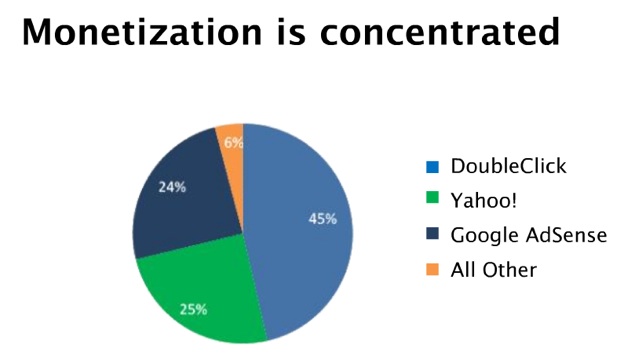
DoubleClick, AdSense, Google Toolbar, Gmail, Youtube, Blogger, Google Groups, Google Checkout, Google Chrome, Google Analytics...there are lots of ways to track you, even if you do not want to be tracked. Google will allow users to opt out of such targeting, with yet another cookie, but if you clear cookies then you are back in the matrix again.

And while Google claims they are not using search queries in their current behavioral targing, Danny Sullivan wrote:

Google confirmed in a session I moderated at the Omniture Summit last month that they have tested behaviorial targeted ads using past search history data. Again, that doesn’t seem to be part of this release, but it could come in the future.

As discovered during early Google research titled The Anatomy of a Large-Scale Hypertextual Web Search Engine:

we expect that advertising funded search engines will be inherently biased towards the advertisers and away from the needs of the consumers.

Indeed. Tim Berners-Lee, creator of the world wide web, spoke out against behavioral targeting:

"People use the web in a crisis, when wondering whether they have a sexually transmitted disease, or cancer, when wondering if they are homosexual and whether to talk about it … to discuss political views."
...
"The power of this information is so great that the commercial incentive for companies or individuals to misuse it will be huge," he said. "It is absolutely essential to have absolute clarity that it is illegal."

If Google continues down this path unquestioned, then in due time you may not be able to get health insurance because of a web page you viewed or a keyword you trusted Google enough to search for. Better luck next life!

Soft-Bundling: The Value of Perceived Authenticity & Transparency

Brian Clark notes the rise of the word authenticity in the field of marketing. Clay Shirky wrote that transparency is the new marketing. For individuals these are true, because if some people grow to like you some will grow to hate you, and it can wear you down to try to fight off a bad reputation in a sound byte culture. Just ask Jim Cramer about Bear Stearns

But for larger companies perceived transparency & authenticity is far more important than actual having either.

Google's Free Ride

Because Google provides a valuable service for free and is easy for end users to like they can get away with a lot of stuff that a company like Microsoft could never do.

Paid Posts

Google's search engineers have waged a war on paid blog posts. Google Japan knew they were operating outside of the guidelines when they were buying links in blogs. Google attempted to sweep the story under the rug until after they knew it was going to get enough exposure that they couldn't effectively do it, and then it became a case study for their anti-spam team, when they applied a fake penalty against their site.

Click Fraud

One of my AdWords content campaigns had an image ad unit that was pulling a 2% clickthrough rate and getting over 600 clicks a day, for a cost near $100 a day. I have already blocked a lot of the nasty no-value exclusion categories but I spent the last couple days blocking some more, and the above $100 a day spend was reduced to $5.42 once the fraud and skimming was removed.

I know Google says they offer some refunds for fraudulent clicks, but some of the stuff in their networks is so fraudulent that the only way to police it is to remove it completely. Over the past year some of these fraudulent sites have got hundreds and thousands of dollars from me for setting up nothing more than a thinly veiled click fraud botnet - feels more like Yahoo! than Google when I looked at the traffic, but at least I was able to filter it out after they stole some of my money.

Such fraud damages the entire ad ecosystem - advertisers have their budgets depleted due to click fraud, legitimate publishers are paid less because content is viewed to have less value when so much of the advertiser ad budgets are blown on click fraud, and web users see lower quality ads because some of the best ads had their budgets blown on click fraud.

Support Piracy

BearShare is an official Google search partner. At one point years ago I saw ads for a company supporting illegal downloads of their very own copyright work. Now Google has moved on toward promoting keywords with Torrent in them on brand searches.

If the domain name has leech, domain, or torrent in it then you know most advertisers do not want to subsidize it. Google needs to make a category for downloads and warez sites. The only reason they have not is because doing so would make people realize how bad some of the content network is.

Reverse Billing Fraud

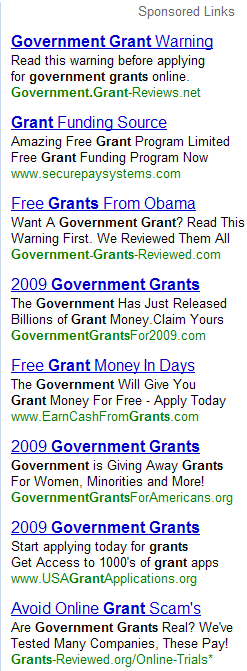
Many services are marketed as being free or complimentary or just pay shipping, and then in 6 point text in the footer there is a disclaimer about how your credit card will be charged $20 3 times a month until you notice it. These typically promote broad market fads & services like acai berry diets, ringtones, credit checks, and free government grants. A group of con men / scam artists jump from one opportunity to the next to scam consumers using the Google ad network.

The government grants scam made enough of a footprint that the FTC is getting involved. Google claims that they are sorting out the issue:

"Our AdWords Content Policy does not permit ads for sites that make false claims, and we investigate and remove any ads that violate our policies," said Google in a statement e-mailed to ClickZ News. "We have discussed these issues with the Federal Trade Commission and reaffirmed our commitment to protecting users from scam ads."

but a Google search for government grants shows the ads still are running.

Microsoft Gets the Shaft

The Opera CEO believes that Microsoft giving users the option to turn IE 8 off is not enough, and the EU is trying to rip Microsoft apart day by day. Even if Microsoft is able to buy Yahoo! Search it will not be enough to compete. Why? Even when you use Microsoft's products they recommend Google's stuff over their own.

Google's Momentum

While Microsoft is busy fighting off competitors in many markets, Google keeps gaining market-share and market leverage in new verticals through soft-bundling.

One of my clients that did not use Google Checkout simply had to stop advertising on AdWords until Checkout was enabled, because without it the usually slim profit margins on AdWords turned negative. It turns out that pricing ads based on "quality" with a discount for a higher clickthrough rates allows the highest quality advertiser to rank #1, so long as they are using Google Checkout to give Google more market data and another chance at monetization. ;)

The Google Chrome browser is recommended on Youtube, advertised all over the AdSense network, and pushed via bundling partnerships with the likes of the Real player and Divx. Its release forced Microsoft to make some of their security products free, and will keep costing both companies money, with the hope that it costs Microsoft more than it costs Google.

Google is still crying to the EU that Microsoft's business behaviors are uncompetitive. Once you get branded it is hard to get un-branded. In spite of the recent slowdown in search volume Google still has a lot of market momentum behind them. You will know Google is in trouble when the market stops giving them leeway and treats them more like Microsoft.

How You Can Apply This to Your Business Today

1.) Always push to own a market default position and once you achieve that position keep investing in maintaining it, while reminding the market that your growth was organic due to your superior quality.

2.) Even if the business model is not there you can always create one/bolt one on if you get enough exposure. In the age of soft bundling it is no accident that we offer some of the best free distributed SEO tools like the SEO Toolbar and SEO 4 Firefox, with intent of helping push this site into a default market status.

3.) What sorts of distributed marketing can your site benefit from?

  • real time data
  • unique data interfaces
  • widgets
  • tools
  • open source software
  • mashups
  • etc.

Each day more options will reveal themselves.

The Point of Increasing Returns

when I got on the web one of the first mistakes I made was trying to go after the cheap traffic on the second and third tier networks. I arbitraged one of them and was pulling a 300% ROI selling them back their own traffic - but the wankers never paid me a cent.

It can be appealing to think of how to do things cheaper...and sure in the short term it might make sense to do something half-way to get it up and going and then to keep making incremental improvements. But people like Philip M. Parker have created automated technologies to write books. Cheaper is a hard way to compete in the content business.

If you are just fishing for nickels and do not intend to take the market head on then any of the following can take you out:

  • algorithm updates
  • remote quality rater or spam report
  • self-sabotage through doing something a little too clever
  • more established niche competitors accidentally or intentionally copying you
  • large general competitors accidentally or intentionally copying you

With search many early successes will be longtail keywords, but eventually you want to go after the biggest and best that you can achieve. Why? Once you have status you enjoy cumulative advantage in everything else you do. Things that are somewhat remarkable become quite remarkable just because who is doing them.

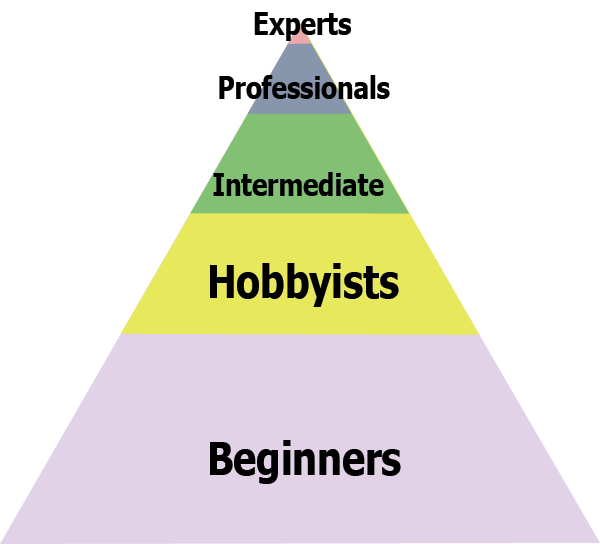
It can take a long time to work yourself to the top of a hierarchy. Most people who succeed ignore the hierarchy and look for a way to dominate a related niche

Ideally, a new player wants to come in with a fresh approach that doesn’t necessarily threaten the existing hierarchy. This allows you to develop an audience by sharing with existing players, not necessarily competing with them.

What you’re looking to do is intensify the niche by doing something more, or differently (or maybe even better) than the existing players. You do this by first evaluating and understanding where the niche is currently, and position your content in a way that pushes the envelope.

Unless you are really well established there is a lot of uncertainty in what you do online. Each additional investment can seem like you are getting closer to the point of diminishing returns, wasting your time. But then surprisingly one day things go way better than expected, and things are received much better than expected. You get a dopamine rush and the sun shines a bit brighter. Network effects kick in and you have reached the point of increasing returns - where each $ invested returns 10s or 100s of dollars back. I think Seth refers to this concept as The Dip - its what separates market winners from people who wasted their time.

But you usually have to lose $50,000 to $100,000 in sweat equity to get to that point, at least on your first successful project. The good news is that once you have already done that work nobody (except for you) can really take it away from you. Even if Google or some other market maker does not like you then you still have other social leverage and exposure which can be used to help generate revenue, launch new websites and projects, or (God forbid) get a real job.

I posted the cartoon version of this post about a month ago.

Review of Amazon Kindle 2

My wife recently bought me a Kindle 2. Here are some of the things I loved about it

  • easy to change font size
  • easy to read - Jakob Nielson said it is roughly the same speed as reading a regular book
  • lightweight - 10.2 ounces
  • easy to travel with
  • solves my buying too many books and bookshelves problem
  • you can store notes in it (everything is backed up on Amazon's servers)
  • You can search against all your books and notes in it (which really turns it into a powerful reference library...makes me want to buy about 3 or 4 of them to store different topics in) . This should be VERY powerful for looking well researched and finding money quotes. Steven Johnson (one of my favorite authors) uses Devonthink when he writes a book.
  • it has an audio/reader version baked in
  • it has an Oxford dictionary baked in
  • new books are typically only $9.99 and take less than a minute to download
  • it starts off where you last read

While it has many shades of gray, it lacks color and does not have a touch screen interface. It is a nice device and will make moving far easier than it would have been if I kept buying so many physical books.

If books get more interactive with more permiable barriers when they are digitized then they may play a much bigger role in the web graph. Google's copyright settlement with authors and publishers may make Google more likely to promote books:

“When someone goes to Google, they've got a question in mind and an answer they need,” Jennie Johnson, a Google spokesper son told DMNews. “We don't really care where [on the Web] that answer comes from. If it comes from a book, great; if it comes from a Web page, fine.”

One of the things I regret over the past couple years is that I let my reading slide. If early usage is any indication of future usage then hopefully the Kindle will help me get into reading more often.

Interview of Jonathan Mendez

I have been a follower of Jonathan Mendez's Optimize and Prophesize for a while, and recently interviewed him.

At SES in New York you are speaking on a panel titled "search becomes the display OS" - what does that mean, why is this shift happening?

The shift is part of the Darwinian evolution of the web. Many people have mistakenly viewed search as a channel when in reality it is a behavior. It is the way people use the web. This is clear as YouTube is now the #2 search engine, Facebook, eBay & Craigslist are in the top 10 search engines and Twitter is trying to position itself as a real-time search. Search is integral to the web experience.

From the display standpoint we need to keep in mind that this medium does not need ads to support it nor are ads part of the experience. Display advertising was built as a parallel platform - not weaved into the web like search but placed on top of it. Display has always had its own ecosystem of real estate, content and serving that is separate from the public web.

What we’ve witnessed with display’s lackluster performance and the inevitable crash of CPM rates is the idea of it being a stand-alone platform was wrong. Display needs to be an application that is integrated with web platform and the way people use the web. It should be based on user controls and rules based delivery of content. To truly be relevant and useful for people, publishers and advertisers, it must become a web service like search.

Search is currently at the center of the web. Do you foresee any technologies or services that might shift its position?

On the contrary I think it will become more entrenched and important since everyday millions of new pieces of content data keep getting added to the web and older content gets digitized. As I mentioned search is basic human behavior. We all go online with a goal in mind to either recover information and content or discover information and content. Those behaviors are primal. No technology or services will shift them.

How do you place value on a search impression?

The value is based on what you do with the information. Impressions are the ultimate arbiter of interest and demand. Of course if you go to Google trends often you will become somewhat worried about the collective psyche of this country. In all seriousness however, this is business intelligence. Quick story about impressions - a few years ago I was working with a big client and they were launching a new product. We had purchased the category kw for this product over a year and it hardly had any impressions. We strongly advised them against spending two million dollars to launch this product because there was no demand for it. They didn’t listen to the “search” guys. Within a year the CMO was fired because the product flopped. So in that instance I would say those couple hundred impressions were worth two million dollars.

One of the most powerful pieces of search is that the ad unit looks just like the content. What can publishers do to maximize ad integration without risking their perceived credibility?

In my experience you add credibility as a publisher if you provide helpful, useful and interesting content. There’s no reason that can’t be an ad. Most everyone I know has clicked on a Google ad. Sometimes it is preferable. This creates value to Google as a publisher. Ads that are helpful and interesting will add value to other publishers in the same manner because they are helping their visitors. People rarely forget who helped them in a useful way whether it be a website or “in real life.” In fact there is a large intangible value that is not even being captured when this happens. I think some people even refer to it as branding.

What can publishers and vendors learn from the dominance of search when thinking about how to build and brand their websites? What are some easy ways to make our user experiences more relevant?

Give people control over the delivery of content. The most successful online segmentation strategy is when a person tells you what they want -- self-segmentation. That is the beauty of search. The keyword is the ultimate expression of people’s goals. No website or advertiser knows more about what I want than I do! It explains why the best and most successful experiences on the web (Google, eBay, Craigslist, Yelp) have query fields and lots of text links and it is something I always keep in mind in doing page design. As far as branding I think that goes back to what we were just talking about, the site experience. Great experiences build brands and that is the same online as well as off. Keep in mind all of this should be tested and optimized. It is no accident that Google is the #1 brand in the world without spending a penny on advertising. From day one no one has tested online experience more than Google.

Many people have been promoting Twitter as a Google-killer in real-time search. Why are they wrong?

You mean besides the fact that Google made $21B in ad revenue last year has $8B in cash, owns half a million servers and Twitter search has probably 10 employees and no revenue?

There are some major problems with RTS. First let’s start with the way people search. This has been studied and very clearly defined over the years by brilliant people like Andrei Broder, Daniel Rose and others. I recently took the query classifications they defined and applied it to RTS (http://www.optimizeandprophesize.com/jonathan_mendezs_blog/2009/02/misguided-notions-a-study-of-the-value-creation-in-realtime-search.html). I came to the conclusion that with optimal RTS - which is a huge challenge as I’ll get to - that less than 20% of all queries would benefit in anyway from RTS.

As far as the technical challenges spamming would be very hard to filter in real-time. Also authority as we know from PageRank is a fundamental driver of relevance. How do you define authority in real time? If you do not rank results than is it just a noisy stream? I’ve come to the conclusion that if it RTS becomes anything useful it will be a search vertical, like travel. Helpful for certain things but nowhere near a primary search tool. It is still a great addition to the web but not something Google needs to be concerned with. In fact I think Google is in the position to provide RTS for the entire web which is much more useful than RTS for a single app.

How slow and painful will the transition of ad dollars from offline to online be? What will be the catalyst that allows ad agencies to push search and online aggressively?

Very slow, but this shouldn’t be painful. We know the attention is online so dollars will continue to increase but I think a $25 billion dollar online industry is pretty good right now. It’s grown much faster the past few years than even the most bullish forecasts from five years ago. The catalyst will be innovation and the businesses themselves that must demand performance. Bill Gross the inventor of PPC said it best, “the true value of the Internet is in its accountability…performance guarantees have to be the model for paying for media.” As soon as we embrace performance for all advertising, even so called brand advertising, we will prove our value and grow our industry. Google stands as proof of concept for this. But the battle over performance will be long and bloody. In just the past couple of weeks we’ve had groups like the IAB and the AAAA speaking out against performance and metrics. This type of rhetoric and their fear of accountability are actually helping to slow down the transition.

How many newspaper companies do you see lasting through this economic downturn?

Not too many. Besides the fact that their authority over the past years has waned with bloggers and false reporting the real problem is that newspapers are not an efficient means of information compared to everything else we have today. What percentage of the paper is relevant or interesting to you? 5%? 15%? Yet you are paying for the entire paper when you buy it. Doesn’t make sense. We used to have town criers too, but then newspapers came along. I don’t think most people will miss them. Times have changed. Maybe we’ve just come full circle – people getting their news from other people they trust is the best way to disseminate information. Who trusts the papers?

What will the online vs offline divide look like in 2 years? 5 years? 10 years?

I’m not so sure we’ll have a divide in 5 or 10 years. The kids graduating high school this year were 8 years old when Google was started. I see kids 4 and 5 years old naturally manipulating iPhones. Many of us have persistent web connection and we like it - we feel uncomfortable without it! Of course it’s nice to get off the grid sometimes but what is happening with digital technology is the great story of our age. Everything is becoming digital, addressable and connected via the web. All of us lucky enough to be working here will reap the rewards of that in the coming years because the growth of digital will far outpace the amount of talent in the workforce. We should have bigger paychecks in 5 years!

Many people focus on one particular segment of the market, whereas you seem to have a well-rounded knowledge of SEO, PPC, user experience, and conversion strategies. How did you find the time to tie all these different disciplines together?

Well, I’ve been at it 11 years so that accounts for the time. It is corny but I love the web and I am passionate about trying to make it more relevant to everything we do. Looking back my career path from Site>Email>SEO>UX>SEM>LPO>Display, it seems like a very natural progression to me. Basically, with one stop for UX I have just been a marketer trying to stay ahead of the advances in marketing technology. Also, I love learning how people use the web and all the disciplines I have worked in are fundamentally rooted in the same thing -- understanding people’s goals and optimizing the delivery and presentation of information to meet those goals. As an industry we tend to divide the web into vectors but we often lose sight that the web experience for people is linear. The more holistic understanding we have generally the better our results.

_____________________ Thanks Jonathan! To read more of his thoughts check out Optimize and Prophesize.

Pages