Your work is marvelous...

according to the world's most benevolant comment spammer, hoping to use spam to fight world hunger :)

If People Respect You They Will Pay You for Your Time

Every day I still get lots of emails and phone calls asking me to answer SEO questions and how to build their businesses for free. I get far more email than I could possibly answer, but much of it is from people who place a $0 value on my time - which does not scale as a 1 person business, especially after the failure of communism.

There are a couple great things about running a paid members only forum in a marketplace dominated by the cheaper faster free mindset

  • When people pay they value and appreciate what they pay for and are more likely to act upon it. The act of paying for information increases its utility and value.
  • Lots of people dig up scoops and have a wide array of experience that make the forums far more valuable than they could ever be with just the experience of one person or a small group.
  • The pricepoint filters out people who do not value my time or their own time. This has multiple benefits, a couple of which are listed below.
    • Rather than being chuck full of the self promotional hype, affiliate offers, and misinformation that dominate most public forums our private forums have a much higher signal to noise ratio.
    • Rather than rushing through hundreds of emails just to finish them, I can take time and do the best job I can answering the questions of the people who actually value my advice.

There is no such thing as pricing pressure. You just need to focus on the people who care about what you have to offer, and ignore the 99% of the market that does not.

Google AdPlanner Media Buy Planning Tool

Google announced AdPlanner, a tool to help ad agencies find where desired demographic audiences are active online. The WSJ highlighted how the new Google tool can help make the ad marketplace more efficient:

The Web-audience data could be combined with the ad-serving system, so that advertisers would be able to find out whether they would reach the right audience before they committed to placing an ad.

In addition to AdPlanner, Google will launch another tool that compares consumer response to ads against a control group of users who did not see the ad:

Separately, Google this week is expected to roll out a new tool aimed at showing how Web surfers respond to online ads. It will compare groups of people who are exposed to an ad with others who haven't seen it, taking into account such factors as search activity and site visitation.

Update: Search Engine Land Reviewed AdPlanner.

Google Website Trends & The Death of Privacy

Google launched a new version of Google Trends which includes website traffic estimates, and highlights....

  • visitor locations
  • top keywords
  • related sites

You need to be logged into a Google account to get a numerical scale on the traffic graph, but you can still get the general trend graphs and other data without logging in. Google also allows you to compare up to 5 sites at any given time
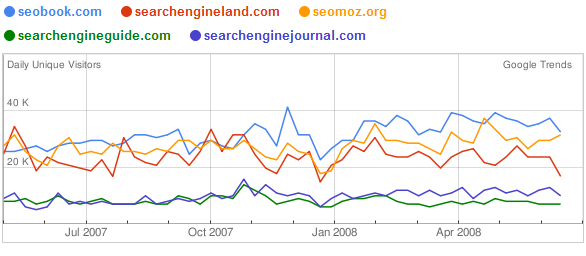
Search Engine Land reported that Google Trends...

This tool bases its data off Google search data, aggregated opt-in anonymous Google Analytics data, opt-in consumer panel data, and other third-party market research.

Those who wondered why using Google Analytics is a bad idea just got a taste of why it is a bad idea! Sure the data is only aggregated anonymously, but with Google owning 70% of the search market and having access to your analytics data you never know how deep they could decide to go through the data for competitive purposes. Is your site a keyword source for AdWords? How much of your data will appear on Google Trends?

You can't export the data yet and it only shows data for high traffic sites, but it is a great free tool for marketers.

  • If sites do not show any data then they are probably either low traffic sites or penalized.
  • The related sites feature lets you know how related your audience is to other sites, which is useful for determining how familiar their audience is or if you are reaching a new audience when buying ads.
  • The top keywords shows you what competing sites are getting traffic from, and if those terms tend to be more brand oriented or more generic in nature...which is useful when thinking about the stability of a website you may want to purchase.

Fred Wilson did a review of Google Trends, comparing Google Analytics to Compete.com and comScore across 3 high traffic websites.

Since we are investors in these three companies and know what their internal numbers are saying, I can safely say that ComScore and Compete are lower but directionally correct. Google is like Alexa in that they don't report absolute numbers but even if they did, they are not directionally correct on this particular set of companies.

The fact that Google is even compared to the analytics firms with years of experience and algorithmic tuning shows how easily they could take a leading position in this market if they wanted it. Google will improve their accuracy, and at any point in time they could chose to expand the top 10 keywords to the top 100 or top 1,000.

The AP threatened to sue a blogger for quoting small passages, and at the same time the mainstream media is trying to redefine copyright for their own benefit. Eventually much of the mainstream media will start looking like eHow and Mahalo. Your content compiled and slightly rewritten by a third party. Your keyword list is their money list. Thousands of people are competing against you while you read this sentence. As your data leaks it is going to be tough to stay competitive unless you are often the topic of conversation. Public Relations is the only PR that matters.

I am probably a bit less pessimistic than Michael is at the moment, but firms are using G.P.S. data to create "reality mining" for offline analytics, predicting everything from traffic patterns, where to buy an ad, and where to place another store. A recent NYT article highlighted some such services:

Tony Jebara, also 34, the chief scientist and another co-founder of Sense, said, “We can predict tourism, we can tell you how confident consumers are, we can tell retailers about, say, their competitors, who’s coming in from particular neighborhoods.”

The idea of staying competitive through obscurity is obsolete. So you may as well be a loud mouth, encourage users to be loud mouths, and build a big brand that helps protect your plot from competitive market forces.

Niche SEO Advice

As a field get saturated one of the easiest ways to stand out is to take generalized tips from one field and apply them to another niche. Recently Rebecca mentioned this Recruitment SEO guide, and a friend of mine named Dave spotted this real estate marketing guide.

Some resources are niche specific while others are applicable to many industries. Ping Pong Pie (nice domain name) compiled a list of top social networking sites by category. The Zip Code Guy blog offers a 27 MB database of US cities, counties, and states which works great for local keyword generation for AdWords when used in combination with tools like Speed PPC.

Defending Your Brand From Shadow Brands & Email Spam

If you build a clean trusted brand many people will emulate your brand and leech off it. Everything from wrapping spam in the Google brand right on through to registering a domain name that sounds just like your name and doing mass email spam with it. You can't stop all of it (or even most of it) but you can defend yourself from a lot of it by:

  1. Registering a couple of the more common alternative domain extensions (like .net and .org). This also has the benefit of locking out some competition if you own a keyword domain.
  2. Adding the word the to your domain name and buying it
  3. Adding an s to your names and buying the .com versions (the person who bought seobooks.com wanted $25,000 for it...I should have spent $8 instead)
  4. If you own a 2 or 3 word domain name consider buying the version with a hyphen between the words
  5. If you have an affiliate program you either need to actively monitor the search results or prevent affiliates from registering your brand in the URLs
  6. If your brand domain is not generically descriptive then buy not only your brand name, but also buy the name with your brand name + your field of trade in it. Just recently one well known SEO firm was the victim of brand dilution due to someone registering theirnameseo.com and doing a massive email spamming campaign.
  7. Given that the April 2007 version of Google's remote quality rater guidelines defined social sites as vital results if they rank then it is best to register your brands on the major social sites before others do. (Someone else is already seobook on twitter and I don't think it would be cheap or easy for me to change that at this point.)
  8. For each major product launch or linkbait launch you may also try to get at least the matching .com name (advice I wish I would have gave myself in the past).

Some companies may also go so far as to check for other domain names containing their keywords, monitor recently registered names containing their trademarks, or pay a third party to do so. You probably do not need to go that far in most cases, but if you are going to put a lot of time and effort into building a brand then carrying an extra couple hundred dollars a year in registration costs is a negligible fee to help protect your offering from brand dilution from unsavory market competition.

Peter Norvig - Google Does Not Directly Use Search Usage Data in Relevancy Algorithms

Anand Rajaraman recently spoke with Peter Norvig, who revealed that:

  • their best machine learning algorithms is already as good as, and sometimes better than their current hand roled relevancy algorithms
  • but they still prefer to use their hand roled algorithms because of hubris, and they feel that machine learning algorithms may be more inclined to have catastrophic errors on searches that do not look much like those in the training set

I think a third piece (that you will never hear Google employees admit to) is that as the web's structure changes Google feels they have use FUD to police the web and help ensure Google has revenue entry points into important markets. In their 2007 Google search quality rater guidelines they used a typical Commission Junction link as an example of a sneaky redirect. It is doubtful that Google would ever do that with AdSense code or a Performics link (since they own those).

In the follow up post about his chat with Peter Norvig, Anand highlighted how Google measures relevancy. In the post he stated why Google prefers internal review data relative to using direct usage data:

Peter confirmed that Google does collect such [usage] data, and has scads of it stashed away on their clusters. However -- and here's the shocker -- these metrics are not very sensitive to new ranking models! When Google tries new ranking models, these metrics sometimes move, sometimes not, and never by much. In fact Google does not use such real usage data to tune their search ranking algorithm.

Exposure from top rankings already creates a self-reinforcing effect because of the power of defaults. Further tying in search usage data directly into relevancy might not add much benefit to searchers, especially as more people click on the first search result. Anand further explained why direct usage data is not used to refine Google's relevancy algorithms:

The first is that we have all been trained to trust Google and click on the first result no matter what. So ranking models that make slight changes in ranking may not produce significant swings in the measured usage data. The second, more interesting, factor is that users don't know what they're missing.

By 2009 Will PPC = AdWords? As Keywords & Industries Evolve...

I created a new training module talking about how language in new industries changes over time, how you can track change, and how you can take advantage of structural changes. I made the first 1/3 of it freely available, but the action items are for subscribers only.

I am still trying to figure out how to balance creating premium members only content and publish many posts to the blog. Which of the following ideas do you like best?

  • make one out of every few freely available forever
  • make a portion freely available forever
  • make new content freely available in its entirety and then make it exclusive after a week or some other period of time

Create more value than you capture

Tim O'Reilly thinks the web is much bigger than search, and actually likes the Yahoo! deal. I think it is easy to overlook how Google is quietly winning marketshare in many non-search markets - and how they can easily build such positions using their brand recognition & distributed ad system. A throw away quote from Tim's post is the title of this post:

At O'Reilly, we always say "Create more value than you capture." All successful companies do this. Once they start capturing more value than they create, their market position erodes, and someone displaces them. It may take a while but it happens eventually.

Two of the easiest ways to ensure short term growth are to

  1. undermonetize to ensure you have a better user experience worth talking about
  • create some content that is easy to monetize aggressively, and leave most content clean and pure while only monetizing the most profitable content
  • use ad units that do not look or feel like ads, and/or ads that add value to the experience
  • reinvest profits into building content & social relationships that get network effects on your site
    • feature your best content so it is easy to find
    • interact in the community
    • ensure your domain name and design add credibility to your content
    • create interactive or viral components that raise brand awareness even if they do not create direct revenue streams

    Google AdWords Price Fixing

    In Google's commentary about their ad deal with Yahoo! they wrote:

    This does not let Google raise prices for advertisers. Google does not set the prices manually for ads; rather, advertisers themselves determine prices through an ongoing competitive auction. We have found over years of research that an auction is by far the most efficient way to price search advertising and have no intention of changing that.

    Aspects of that statement are categorically untrue, perhaps even lies. In many competitive markets with lots of participants the ad market may set ad price minimums, but Google...

    1. publicly talks about how they tweak the number of ads they display to maximize revenues
    2. uses quality scores that allow them to give friendly businesses discounts
    3. Google not only favors its own ads, but also creates custom ad units that only it can buy

    Abitrary Pricing Floors

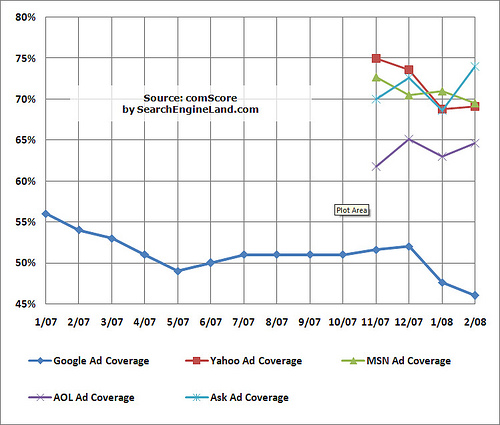
    Google has articles in the media talking about how they tweak dials to optimize revenues. While many competitors have increased the number of ads they show, Google has been showing ads across a smaller portion of their search queries, as shown via this comScore data.

    If you do not pay Google enough they simply will not show your ads, even if there are no competitors. I have ads where I am the only bidder and I get a 17% clickthrough rate - and yet there is a 17 cent price on those clicks, rather than a true market floor. Bid too low and your ads simply do not show up - even if you are bidding against nobody.

    Preferential Pricing

    Getting your account Google slapped is a well known phrase amongst many affiliate marketers. One day your ads are going great, and then the next day every keyword has a minimum bid of $5 or $10 per click.

    On the flip side of that, many click arbitrage based business models are only profitable *because* a publisher gained access to a high authority trusted Google partner which allowed cheaper ad prices for the same keywords & ad units.

    Google has went as far as publishing information about the types of business models that they do not like. Unlike acceptable business models like reverse billing fraud and infidelity, selling ebooks on sites with ads might merit a low landing page quality score.

    Google Only Ad Units

    Google products are advertised aggressively across Google's content network. Given that internal Google product benefit from brand awareness, bidding with funny money, and cheaper ad prices (since they don't have to give Google a cut) others with similar business models can not compete.

    When Google recently entered the mortgage lead market they gave themselves an ad title of 49 characters, and a dropdown that is not available to other advertisers.

    Pages