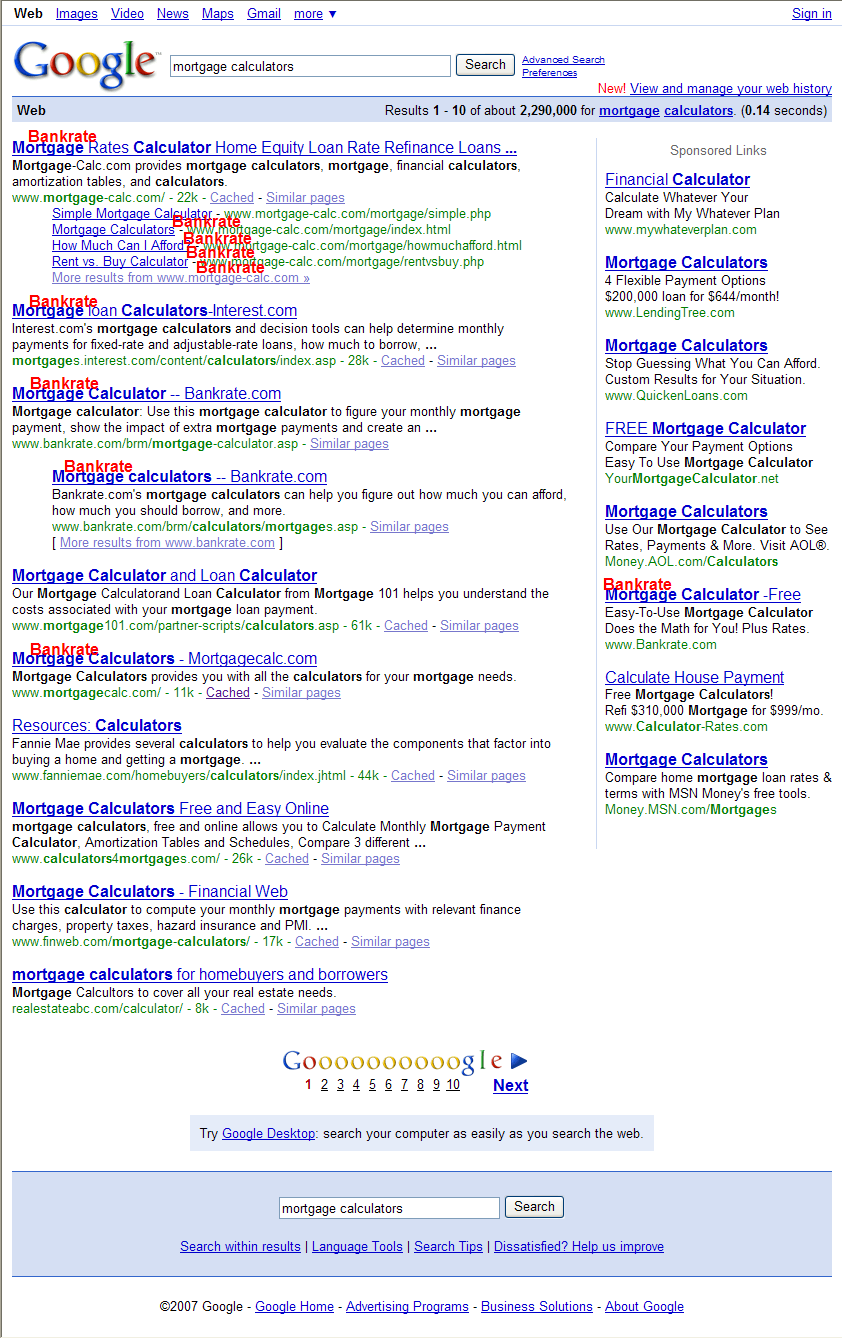
Link Quality: Perception is Reality

A friend of mine recently submitted a sleazy site to a number of human edited directories and was surprised at how many accepted it...almost all of them.

A bigger surprise though was who rejected it. Yahoo took the $300 and accepted the submission. A directory that has been highlighted as a spot that sells links to anyone who has $10 and a URL rejected it.

Perception of quality and brand awareness (as signals for trust) often trump true quality, usefulness, and how strongly a link source discriminates.

How Interactive Media is Changing Marketing

Language has historically been butchered by politicians pushing their own agenda, but as networks get better at spreading information quickly, we are immersed in more information than we know what to do with, and more people are voting for ideas / spreading messages without even thinking through what they are voting for. I can't count how many times I have felt duped by supporting things that I later found out to be pure crap.
In a blog post Google tells us why they are buying DoubleClick:

In short, Google’s acquisition of DoubleClick will benefit all parties in the online advertising business, including advertisers, publishers, agencies and, most importantly, consumers.

Wow! The world is going to be better for EVERYONE!!! Gee those guys really are out to make the world a better place.

Corporate drivel has been around far longer than I have, but the fundamental changes that are occurring right now are due to people voting for causes without even thinking what their votes mean. Of course that has always happened, but now we have quick direct measurable feedback of how people reacted, searchable databases of past successful marketing campaigns, and a network quickly willing to go wherever potential revenue exists.

Networks are trying to capture and spread passion in ways that have never been possible before. Consider Google Earth Outreach, which allows non-profits to spread their messages on Google Earth. Every non-profit using this builds the Google brand, which helps Google make more money selling ads for Ponzi schemes, among other things.

Was that unfair? Perhaps, but the point is that even if we are a good judge of character it is hard to understand the full affect of our actions on a network so complex. Worse yet, marketers realize that people vote for many ideas without even thinking them through or reading them. Good headline...wow. So then people package information to cater to the hollow voting systems.

Marketers (like me) are creating more and more elegantly wrapped and packaged informational research studies that starts with the end goal, and collects whatever facts are necessary to justify them. Consider The Progressive Majority: Why a Conservative America Is a Myth, a study which came up with results like Nearly 58 percent said government should be doing more, not less. What should the government be doing more of? What question did they ask to get that result? Worse yet, even by calling that study crap (and linking to it) I just voted for it and gave it further credibility.

The endless drive toward efficiency by ad networks is hollowing out the viability of profitable content creation, while increasing the profit margins for those spreading remarkably biased misinformation.

It really doesn't matter what compartment we put ourselves in. Someone is willing to act as a leader, tell us what we want to hear, and display targeted ads. Should information agents look beyond popularity when considering the value of information? Will the web end up further fracturing society by making it too easy to find like-minded people who have little care for truth?

Do Article Submissions Work for SEO?

Michael Gray recently asked what people thought of using article syndication as an SEO technique. While it may have some upside if the articles get picked up and syndicated outside the article databases, the article databases themselves carry little weight. Patrick Altoft noted that after tracking the results for about 500 clients he discontinued his automated submission service because he thought it didn't offer any value anymore.

A better way to syndicate content to sites outside article databases is typically to create something they would want to link at, or to start building social relationships. As Jeremy Luebke posted in Graywolf's comments, those links work. Google is getting better at determing what parts of the web are active and worth trusting.

Was MySpace an Overnight Success?

Brad Greenspan, the CEO of eUniverse, posted about the history of his company leading up to MySpace. His company survived the dot com meltdown (while profiting the whole time). By the time they created MySpace in 2003 they had a top 20 (US web traffic) network of community driven sites. When they launched MySpace they were able to leverage their other content sites and traffic streams to help MySpace spread quickly. MySpace may have appeared as an overnight success, but it didn't hurt that eUniverse had years of experience launching numerous high growth community sites.

Almost all high growth web businesses start out with an idea that works but a model that does not, but that is why the evolve, and why experience is worth so much. Paul Kedrosky recently shared this Niklas Zennstrom video:

Search, Advertising, Gatekeepers, & The Pending Online Security Wars

As email filtering gets better many of the true scammers of the web are shifting to distributing adware on websites. As terrorism is used to help politicians push their agendas, fear marketing and the concept of security are only going to grow in importance online as well.

Google vs Microsoft

Google already highlights some websites that might distribute malware in their search results and promoted research showing that Microsoft computers were twice as likely as Apache servers to distribute malware. In addition Google bought GreenBorder, perhaps to help them make an anti-virus / anti-spyware software program.

GreenBorder's Ulfar Erlingsson moved over to Microsoft Research. Microsoft is also pushing a suite of integrated anti-virus and anti-spyware service.

All Search Engines Link to Scammers

In May McAfee did a study on the safety of search results, noting that the paid search ads are far more likely to scam consumers than the organic listings by over a 2 to 1 ratio:

The improvement in search engine safety is primarily due to safer sponsored results. The percentage of risky sites dropped from 8.5% in May 2006 to 6.9% in May 2007. However, sponsored results still contain 2.4 times as many risky sites as organic results.

What is spam? What is a scam? Whoever is the trusted source for those limits gets to shift markets overnight. Google shows warnings near organic results leading to bad sites, but you never see that warning on an ad. The fact that the ads are over twice as likely to lead you to a scam as the regular search results shows the value of being trusted as the security police.

What People Forget About Efficient Ad Networks

Up to some point efficiency comes easy, but after you get to a certain point increased efficiency comes in the form of hidden risks, hidden costs, and outright fraud. It is a reflection of the nature of capitalism. Many of the tools that aim to protect you are hypocritical beyond belief. For example, SpamArrest, an email spam protection service, ironically spammed people via email.

How Valuable is Security?

As data collection gets more aggressive, and ad networks sell ads to scammers, being the company that is trusted for security is a big deal from a financial standpoint. Calling something unsafe gives ad networks another chance to monetize the user experience.

  • In the past Microsoft incorrectly labeled one of my sites as a phishing site.

  • My girlfriend just got a new laptop, and at the top of her IE browser was a huge Norton banner stating fraud monitoring is on.
  • Verizon recently launched a service that redirects typos so they can cash in, just like VeriSign tried to do.

How to Protect Yourself From the Security Wars

  • Use a short memorable domain name on a common TLD, so few capture typo traffic intended for your site

  • use home grown software if possible
  • keep your software updated
  • place community and interactive parts of your site on isolated domains or subdomains if they are known to get cracked (like PHPBB)
  • only link to trustworthy sites (if you have a community section keep it clean as well)
  • build signs of trust (links, subscribers, usage data)
  • minimize the amount of cursing done on your site or it might get flagged as being pornography, like mine recently did...as noted by an SEO Book reader who sent me this image from the Kansas City airport

Leveraging Your Search Knowledge to Market to Different Communities

The type of person who reads this blog and other blogs about search marketing knows far more than the average webmaster (or web user) about search. You can use that knowledge as a marketing advantage over the competition, by doing things like creating a custom topical search engine, or write about harnassing the power of Google to _____. Search is a big power on the web, and it relates to everyone publishing a site. Leverage Google's brand to push your own. If you story spreads great, if not then you site is at least a bit thicker and harder for people to compete with.

In almost every field you can make your content seem more linkable and more remarkable by talking about it as though it is a search play rather than a pure content website. Look how much press Mahalo got compared to the quality of the site and the quality of the concept.

Why an RSS Subscriber is Worth 1,000 Links

The type of people who subscribe to sites are also the type of people who write about that topic. If you have built up trust and a following your ideas spread faster than the competition. It builds on itself to the point where you can sell out in 8 minutes or 2 minutes. Selling out gives the perception of scarcity and creates more demand. Viral free marketing creating more free marketing...that is as good as it gets.

In many cases the quality of the idea does not matter as much as who said it. If a no name person launched Truemors would it have become popular enough to where I would have just linked to it as an example? If a no name site with no following, little traction, and no marketing budget does something great how will it spread?

The Evolution of a Profitable Site

The following is the three step process that I view as the best path for creating sustainable sites that are valuable, successful, and profitable.

Launching a New Website

When starting a new site a webmaster should be willing to do just about anything to build link equity, brand exposure, and an audience. This includes:

  • not monetizing too heavily off the start

  • buying a good domain name and site design (or as best you can afford)
  • paying attention to the marketplace
  • stroking the ego of important players in the market (via things like award programs, interviews, mentions, etc etc etc)
  • having a unique value proposition and something you stand for
  • create real value
  • buying a few key trusted links

This phase should include trying many different things...even if 90% of your ideas go nowhere you still do good if just a few of them spread. Test and learn, test and learn, etc etc etc. It is ok if some of your ideas in this stage are flat out bad...it shows that you are learning and it will make others more comfortable feeling they can also learn with you. People don't like to read someone who thinks they are perfect, especially if they are new to a market.

In this phase I usually do not care too much about monetization other than coming up with ideas that I know I can bolt on, unless the site is so niche that it is already immediately focused on the commercial aspect.

If you bought an old trusted site you can skip step 1 and head to step 2.

Monetize Your Site

As the site gets traction, the site can be back-filled with related higher profit content ideas. Don't place ads on your subscription channel in a distracting way. Instead, add other content sections to the site that are of high profit potential. Make a channel / feed of related deals, or create a static content portion of the site with related commercial offers. After you created enough content you can also repackage portions of it in an information product or sell a premium subscription service.

The site's internal link structure should also place more weight on the important high profit pages. As the site ages and gains high authority trusted links, the site's inbound link profile can back-fill that with obtaining some average to lower quality links with the desired anchor text for the most profitable sections of the site.

Here you can also look to launch (or at least think of) ideas that make you the authority on the profitable section of your site. What can you do in that niche to make people view you as the expert? Why would they cite you instead of competitors?

Solidify

If your site makes more than your living costs, but you feel is on shaky ground, it is time to reinvest earnings to create a real brand. If you don't have a great design and great domain name make sure to buy them. Make the site so strong that the competition can't clone you and has no choice but to buy you out. Create thick content that builds your brand even if it does not feel like it will be highly profitable in the short term. After you have enough easy to monetize content keep increasing the quality of your content and create something people would want to subscribe to and share with their friends.

As you keep building your brand and link equity you can also look to increase your income by doing any of the following

  • selling consulting or information products

  • adding parallel profitable content sections monetized via ads
  • going deeper with the commercial sections on your site (by adding more content in that section)
  • if you have enough distribution and market leverage, consider creating a marketplace or leverage your brand asset to move your site up the value chain

Website Sustainability: What Percent of Your Traffic Comes From Search Engines?

As an SEO one of our primary goals is to get more search traffic for targeted search terms. Search traffic is typically far more valuable than other traffic sources because it is so targeted. But non-search traffic is perhaps the single most reliable sign of quality. As Google controls a larger portion of the overall traffic flow across the web, they risk creating self fulfilling prophecies where low quality sites continue to rank only because they already rank.

If you were Google, and discovered that 98% of a site's traffic comes from Google.com might you want to give that site a bit less exposure? I would. Maybe those algorithms do not exist now, but eventually they could.

If you have a site that earns far beyond your living costs, and it is almost entirely reliant on search for income, then one of the best moves you can make for the sustainability of that site is to lower the percentage of traffic that comes from search by creating other traffic sources. The other traffic sources may not be as profitable on a CPM basis, but as you diversify you lower your risks. It doesn't matter how the algorithms shift if your site is strong in every signal of trust they could possibly measure.

Tracking the Growth of Competing Sites

Question: How do I track the progress of competing sites over time? How do I know what keywords my competitors are ranking for, and which ones they are improving on?

Answer: There are a way variety of means to track competing sites.

Online Ranking Checkers

Online tools such as Digital Point's keyword ranking tool, the ShoeMoney SERP tool, the our rank checker, or the new tool at ZoomRank show where keywords rank. The Digital Point tool also shows you where a keyword ranks over time, but the problems are who wants to check a lot of these keywords one at a time, and where do you get the opening list of keywords?

Competitive Research Tools

There are numerous organic search competitive research tools on the market. SpyFu is a paid tool which offers limited free data, and SEODigger and URLTrends are free tools which shows you keywords that a site ranks for. AdGooroo also takes a look at similar data, with more focus on paid search. If you can afford to spend $10,000+ you may also want to consider trying HitWise.

Keyword Research Tools

After the competitive keyword research tools you may also want to look at the keyword tools promoted by the search engines (Google, Yahoo, MSN) and companies like Wordtracker and Keyword Discovery. The Google Traffic Estimator will tell you what terms Google thinks are most valuable, and you can also check keywords in bulk and track them over time by buying software like Agent Web Ranking.

Don't forget to also consider macroeconomic factors and seasonal traffic trends.

Look at the Competitor's Website

Looking for a few more keywords that the competitor may have found but the market missed? Beyond those competitive research tools the easiest spots to look for keywords on competing sites are

  • the internal navigation of competing sites (especially look for pages that are bizarrely over-represented in their navigation)

  • a competitor's homepage page title and headings (you can see the page titles with Xenu and the last two data points with OptiSpider)
  • abnormal patterns in their inbound anchor text (use a tool like Backlink Analyzer)
  • if they participate in AdSense and allow site targeting, buy AdSense ads targeting their site to dig into their traffic stats

Look at Their Reach

As far as general traffic trends for a site go, Compete.com, Quantcast, and Alexa all give snapshots of site traffic trends. That data tends to be rough though...especially for small sites. The two big ways to track site growth from a market penatration and search representation standpoint are to look for changes in the rate of citation by using the following data points and tools

and look for the rate of the growth of the site's content, reach, and trust using the following metrics

  • number of RSS subscribers (use Bloglines subscribers as a sample estimate if they don't have any other numbers public) and/or number of comments on blog posts for sites with feeds

  • how often you see well read channels mentioning the competitor
  • how often you see (search, contextual, or affiliate) ads for the competitor
  • number of pages on the site indexed in Google
  • the ratio of the pages that are in the regular index vs Google's supplemental index (having most of your pages in the primary index is a good thing)

Pages