Disappearing Clicks

When Compete.com launched with credits-based pricing well over a decade ago I felt like a kid in a candy store using their competitive research tool. Recently Compete.com announced they were shutting down, but many of the link analysis & competitive research tools which leverage scraping have also started licensing clickstream data from sources like Clickstre.am & JumpShot.

These sorts of features add a lot of value to traditional keyword tools, as they can highlight the CTR on ads vs organic results & show if people click on anything after they search for a particular term.

When I read Ahref's recent blog post about integrating clickstream data I got that same kid in a candy store feeling I got when I first used Compete. Some highlights...

  • their keyword database contains over 3 billion keywords
  • they offer localized search volumes
  • searches with clicks vs searches without clicks
  • clicks per search
  • repeat searches metric
  • organic vs ad clicks

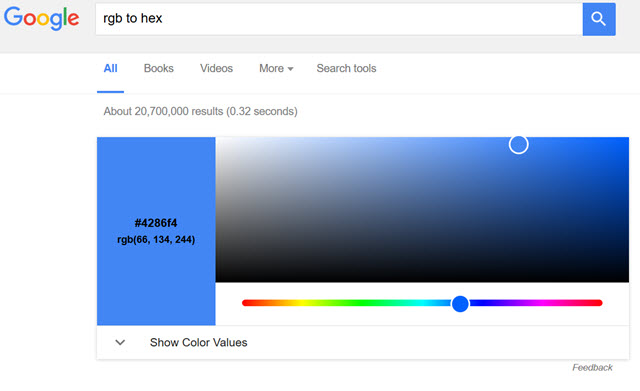
As an example of how the searches with clicks feature is helpful, consider Google's recently announced RGB conversion feature

In that image you can see how the feature displaces the result set.

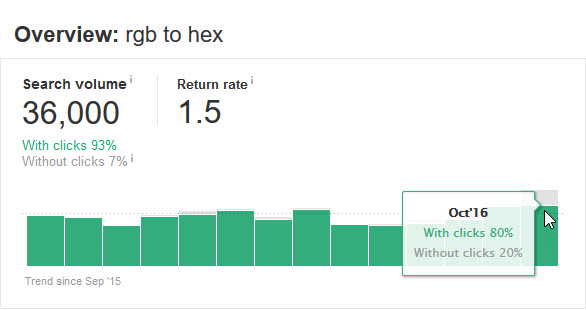
What's cool about the Ahrefs feature is you can also see what sort of impact that feature has on click volumes.

After 1 month, 20% of the searches for [RGB to HEX] no longer had any clicks to an external website.

On the second month it looks like the "no click" rate was closer to 7%, so perhaps some of the initial additional search volume was driven by people searching for the related keywords after blogs covered the new feature.

But the nice thing about the feature is you can see how the click rate changes over time as the feature evolves.

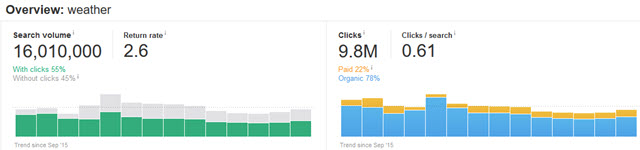
In some areas like weather Google ends up dominating most the user behavior with their in-SERP feature.

About half of all weather keyword searches do not click on any listings. And then of those which do click, about 20% of people click on an ad.

That means the potential organic click volume for that keyword is only about 40% of the initial search volume estimates.

Search results keep getting more interactive features & some of them appear to be click black holes. Literally...

Here is a new item comparison feature table.

As more of the value chain appears in the search results, more of the value chain which formerly appeared on websites disappears. This is true from a wide range of aspects including ad sales, content hosting, ad blocking & brand value.

General Ad Sales

No click into the publisher's site means no ad revenue for the publisher. Voice search will only accelerate the declines seen from mobile, which shifted user attention away from large screens with many listings to smaller screens with fewer listings & a far higher ad ratio in the search results.

Facebook Instant Articles & Google AMP

Google has already pushed hard to make hotel searches a pay-to-play vertical & yet some publishers are adopting AMP formatting in that vertical. Google is also forcing AMP down publisher's throats in other verticals like recipes.

If central ad networks host your content then they get better user data for your content than you do as a publisher.

User Tracking, in Aggregate

Increased user tracking depresses premium ad sales & moves value from niche players to broad networks "Whether it’s a third party like Facebook or Google tracking across the web or an ISP leveraging its distribution arm, this is outside of consumer expectations. Importantly to the digital media industry, it also devalues the context and relationship of consumer trust which drives the businesses of premium publishers."

Ad Blocking

Some large sites like Google or Facebook either pay ad blockers or technically work around them within their apps. By funding ad blockers exempting the search result page from having their ads blocked, Google is ultimately defunding competing ad networks.

Brand Value

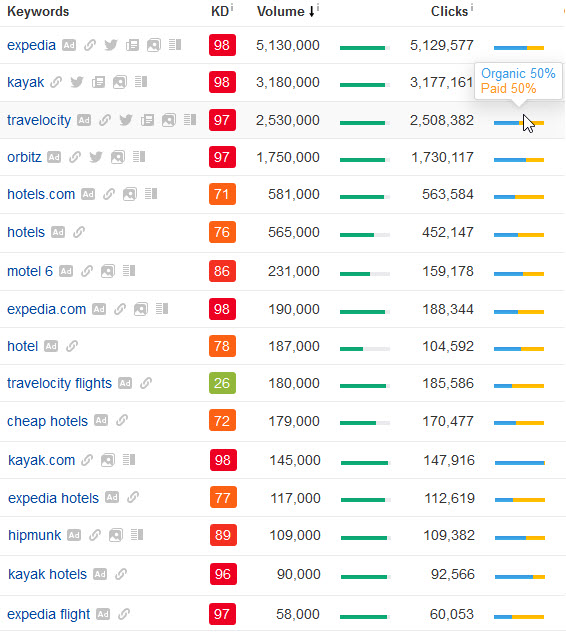
As search results get noisier & more ad heavy, Google is trying to coerce brands into re-buying their pre-existing brand equity. These efforts are effective, as on some branded & navigational searches over half the click volume goes to the ads. Here are a few examples from Ahrefs. The orange bar shows what percent of the SERP clicks are on ads.

And the above doesn't even account for...

  • Google Maps being an ad-heavy search engine.
  • the Google Trips app which prevent searches from happening on Google.
  • The mid-tail of travel search on mobile where Google does away with the concept of organic search results.
  • Direct booking features complementing traditional AdWords ads & hotel price ads.
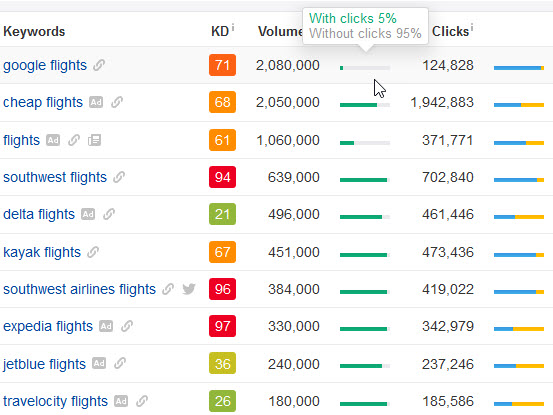
  • Google buying ITA Software to dominate flight search. Notice the most popular term is Google's branded term & for the generic term [flights] 72% of people don't click on any external site while 37% of the remaining 28% of searches click on an AdWords ad.

    And almost everyone else in that industry is stuck licensing flight data from Google, as they own ITA Software.

So Google is eating the generic terms, the brand terms, and the search query pool more broadly.

There's a reason Google's online travel business is over twice the size of anyone else & has their biggest advertisers seeking more sustainable & more legitimate alternatives.

The biggest travel players are accustomed to Google’s moves and trying their best to adjust and work around them. Missing from this story is the fact that Google’s latest moves are making it nearly impossible for all but the smallest number of consumer travel startups to succeed. — Dennis Schaal

And some of the aggressive stuff carries over into other lines of business outside of travel. Google is also testing large image extensions on AdWords ads on cell phones that don't leave room for even a second AdWords listing on the screen. When one invests in brand they have to start thinking about how much they are willing to pay Google as an ongoing tithing for their success. Look at the following ads where a competitor bidding on a competing brand drives the brand owner's official site below the fold.

Google is willing to make their results worse (to the point they would consider something that looked like their search result page as an ad-heavy doorway redirect page of spam if hosted by anyone other than themselves) in order to monetize navigational searches.

What's more, you can't just opt out & ignore. When brands make agreements to not cross-bid Google has the FTC sue them.

On some high end fashion brands Google lists shopping ads which lead to third party sellers who sell used goods. Quite often counterfeits will also be in the mix. When the counterfeits are destroyed in the first wash, it is the brand owner who was took to the cleaners.

But there's a solution to that... they can pay Google ever-increasing protection.

Criminal Christopher Angus Fakes IG Data

Watch on YouTube

Video Background

Investment guru, psychopath, and criminal fraud Christopher Angus is kicking off a confidence series, providing free video tutorials on how to defraud investors. This nineteenth video is 8:46 & was shared on November 21, 2016. The criminal who shot these videos delivered over a 99% investment loss, as he simply stole the money and integrated it into other investment scams abroad.
https://www.oxfordmail.co.uk/news/18693916.conman-christopher-angus-pay-back-just-1-2m-scam/
The UK Crown Police never followed the money trail.

Christopher Angus is associated with Stella Huh and Timothy Barton, who stand trial in the United States on November 2, 2026.
http://www.seobook.com/stella-huh/criminal-case-docket-sheet%204-22-2026-(22-cr-00352).pdf

Video Highlights

  • chart date shows November 21 of 2016 near bottom.
  • the same date appears at the top right of the browser and the words "Christopher Angus iMac"
  • the deal.ig.com/platform/index.html URL contains the variable ?201611161220 which I believe means it was 12:20 on November 16 of 2016
  • the alleged account shows balance of 4,487,582 GBP (either this account was real at the time or he doctored not just the static images he sent me but also videos - yet another indication of intent to defraud)
  • it also shows S&P 500 at 2187 to 2188. on that date the s&p 500 traded specifically in that range. finance.yahoo.com/quote/%5EGSPC/history?period1=1479456000&period2=1479801600&interval=1d&filter=history&frequency=1d low: 2,186.43 & high: 2,198.70
  • the November 21, 2016 date is also shown via the interactive chart scroll over at 1 minute and 5 seconds
  • this video was created LONG AFTER Chris took all the deposits from me, indicating all the IG stuff he ever showed me was absolute constructed fraud from the onset and Chris did indeed do what he "joked" about on Skype - he had converted my investment to Bitcoin and then laundered it through Stella Huh across to the Wall Cos controlled by Timothy Barton.

A version of this video is available for download at
https://www.dropbox.com/s/trxqkc39j76iy9d/algovid2.mp4?dl=0

Video Transcript

00:00 Christopher Angus: Hello, Mr. A, just a very quick video, just to follow up on the one from Friday, if you took the time to watch that. If not, well, maybe you won't watch this one either, but let's have a go anyway. So I wanted to show you what it actually looks like instead of just like looking at some numbers flashing up and down, but on a chart. And you'll see why you need to actually look at the order book to see when the market turns. But anyway, let me just change this to a candlestick chart, because you can't really see it with the line, that's if you look at charts, which when I was trained, I was trained not to look at charts, because they can be very misleading. But let me just zoom out a bit here and just show you what it looks like.

00:58 Christopher Angus: If you remember on Friday, the volume came down, the market came down, paused, went down a couple of more ticks, and then it sprung back up. And that's exactly what I'm going to show you here. So this is a classic example of a pullback move. Now, you can see there's actually been quite a few. If I was making one tick, I could have done it there, there, there. But let's just look at the most extreme example, which is here. So remember the padding. As the market starts to come down, you'll see there's a huge spike in volume. And this is generally selling volume. So you'll see a big, big spike in volume, or you'll see a building amounts of volume, and that will be when the market can't break through the next level. It can't actually break down, and you'll see a big surge of selling.

01:55 Christopher Angus: And then what will happen is... I'll just get off there... The market will then pause, which is exactly... Look, it's come down two ticks. This looks like exactly what happened on Friday, but this is today. It comes down, flutters around, and then starts to go back up. And then the opposite is true in reverse. You can see what happened here about like a quarter passed. There was a huge volume of buying, I mean, it's not a huge, because it has moved like two points, but it looks like a big move. So the market's moved up a couple of points. And then the market stalled, it stalled in about... That's a one... Basically one or two tick range. And then it started to come off again. And that's how it looks. Let me just see if I can find one more example in hours from last week. So Friday... God, I hate these charts so much. Alright, this is the open, just ignore that, because it's always really, really noisy.

03:21 Christopher Angus: But this one would have worked here. You can see there's has just been a sell-off. Big spike down, hovers around, and then it comes back up one tick. It's not the greatest example, but that would have worked. And then if we go out to the next one here, because the volume has to really be two or three times higher than the kind of the average volume. So you're looking for really big bursts of volume. Also, the market has to have a direction. So if it's going sideways and then you have a burst of volume, you can't touch it. If it's moving down and there's a burst of volume, then you can touch it. If it's moving up, and there's a burst of volume, then you can touch it. And also you need to see a falling... An amount of falling volume, so you see a big spike volume, and then you see falling volumes.

04:13 Christopher Angus: So, it goes high and then it goes low, and if the market is stalled there for about 30 seconds, then you can usually take the trade. So this first one here, you couldn't, because you need to see a falling volume. So this one here would be the first time we could have taken it. So here we are. So the market's been moving down, sharp move down, two-volume, high spikes. Can't make a lower low. Okay, can't break down to the next level. Falling volume... Trade here, wait... That would have even a long trade there, but... What's that, about 5, 10 minutes. But you see, it just doesn't break lower. Occasionally you do get stopped out, but if you get stopped out for two or three ticks maybe, and you're doing 7, 8, 9, 10 of these a day, it's fine. Mine is through commissions.

05:04 Christopher Angus: I worked out that I'd probably make... If you make, say, a 1000 pounds in gross profit, you probably would have made 2000 pounds throughout the course of the day. Because capital losses and then your commissions, but that's just roughly half. But you know, that doesn't matter. High-frequency trading guys lose 50, 47% of the time, so that's another example. And you can see another one here. Okay, there's another high burst of volume that's around two times that the number average of the last... It's a really... This that stands out tremendously. And then there's falling volume. So then you can see the next buy, there's a lower volume and a pause. And then you would have sold it, you would have sold it there and then picked up once it hit there. And the goal is... Really is to automate that and then stream it across all the different markets, like you can see here.

06:13 Christopher Angus: The S&P, Wall Street is the Dow. The tick 100 is the Nasdaq. Probably won't work on the Russell, but it will work on the Dax. Probably won't work that well on Forex, but there's lots and lots of markets here. The treasury markets, which are really, really liquid and have the same kind of behavior. And the goal is to really get 10 or 20 different instruments running at the same time. Run to buy and sell like 100, 200, 330 lots at a time, depending on the market and pick up three or 4000 to trade. Multiply that out by, let's call it five trades a day, that's 15 grand, then multiply that out again by 10 different instruments, that's like a 150,000, that's like the top line, but that's what I was saying. And... Like really consistent churn of 20 files a day. This is really what I'm excited about, and what I'm working towards.

07:16 Christopher Angus: But I wanted to follow up the video on Friday, with what I said or showed you with the numbers and stuff because it's very really hard to see if you don't sit there. And you're going to look at it for five years and you can't read the order volume properly... That's what I sort of trying to point it out, but I wanted to kind of show you in reality what... People puking out looks like. The parading, the reversal, and it's pretty straightforward. Now, one thing I'll finish off with is, remember I said that I think you need the order book. And that is if the order book... The candle chart doesn't really show you what's on the order book, it only shows you what's happened.

08:05 Christopher Angus: So if you see the order books, like really, really thin on your side, so say you're trying to buy it, but you see it's like really, really thin, the candle chart would still show you the same thing, but it doesn't show you that the order book's really weak. So if you don't have the order book, you'll come in and buy this, and then just watch the thing collapse away from you, and then you'll be... And then you'll be stopped out. And without actually seeing what's going on in the order book, it's very, very hard to tell what's going on and whether the move is a really a safe move to make. And that's it, for now. So, hope you enjoy the video, and I'll catch you later. Bye for now.

Conman Christopher Angus Touts New Trading Algorithms

Watch on YouTube

Video Background

Christopher Angus used funds stollen from Giovanna Villanueva and Aaron Wall to help fund the Wall companies associated with Timothy Barton, using Stella Huh to move the money across.

Since the Timothy Barton case is only a few months away, we thought it made sense to do a throwback confidence series, sharing the voice and dissemblings of the criminal who started it all.

These are Christopher's free confidence videos he used to defraud investors. This eighteenth video is 5:19 & was shared on November 18, 2016. The criminal who shot these videos delivered over a 99% investment loss, as he simply stole the money and integrated it into other investment scams abroad.
https://www.oxfordmail.co.uk/news/18693916.conman-christopher-angus-pay-back-just-1-2m-scam/
The UK's Crown Police never followed the money trail.

Christopher Angus is associated with Stella Huh and Timothy Barton, who stand trial in the United States on November 2, 2026.
http://www.seobook.com/stella-huh/criminal-case-docket-sheet%204-22-2026-(22-cr-00352).pdf

Video Highlights

  • X trade professional platform, he says gaining access to it allegedly requires having a broker account.
  • interesting bit: shows mechanics of a trade, mentions wanting to be a billionaire so bad in a song at the end of the video.

A version of this video is available for download at
https://www.dropbox.com/s/ug0y0z7ao3tn8uu/orderbookalgo.mp4?dl=0

Video Transcript

00:00 Christopher Angus: Okay so a very quick video about five minutes in total, I just wanna show you kind of what I am working on at the moment. Just a pure interest. Remember what I said about padding, so you watch where there is a lot of volume that comes through if that volume doesn't break a certain level, then you know that someone is absorbing those orders. So if the market's going down and you're selling and there is a lot of selling going on but it is not breaking a level, you know that it is called an iceberg order. So someone is just sitting there taking the orders, taking the orders, taking the orders, taking orders, and they are gonna run it back up a little, maybe like one point, a few ticks whatever. And that's really riding the wave of the big money. You're gonna see that now. Now, the platform I'm showing you is called Xtrade, it's a professional platform. I have it for the data feed, I got a pad for each month via a broker, so to get that I actually have to have a broker account, which obviously I have a futures broker account, I got a few of them, costs quite a bit about 1200 a month, but it's totally necessary for everything I do.

01:09 Christopher Angus: So I'm gonna trade one lot, nothing I don't have much money at the broker, I don't trade with a broker like this at the moment because I'm doing something else very soon, maybe I'll think about moving across or moving some across or making a new fund, or I do not know but we'll have to see what happens. But I just wanna show you the algorithm in a kind of points and click style so you can see what I do and see why this is very, very interesting, for me and for you. So I am gonna start the video and you'll see something. So just before I start, you'll see what I saw here was there was a lot of selling going on it and it sort of come down a little and it had come down a little and then it had bounced about one tick and then I saw some more selling. You can see that 91. So what I'm looking for is more selling that's not really going any lower. And then I wanna see some buying and you'll see that come through now, so I'll start the video.

02:23 Christopher Angus: Also the speed of the tape here makes a difference. So the tape's, not really going anywhere at the moment, but you'll see, it will start moving in a second. So I've seen that, I haven't placed an order and I can see the markets, can see that's 61. Now, that really caught my eye. It's nine, that's a 2179 and a quarter. And I see that, doesn't break so I decide I'm gonna put one lot on, I put the lot on here, so got one order in, I'm 65 of 90 in the queue and boom I am taken. Okay, so now I am in the market, I am one contract long. Each tick is worth $12.50, four ticks make a point, it's $50 a point on the S&P minis. So I'm now in the market, I have two orders waiting, one to stop if it rips back down one point then I'm gonna be taken out and I'm gonna lose a point or if it goes back up, I've got a limit order waiting here. I'm number 143 in the queue of 184. So what I'm looking for here is I'm looking for pressure building on each side, so I want the bids to start increasing and I want the offers to start decreasing, I wanna see some trading on the offer here. So that's gonna push the price up then the offers are gonna be taken out.

03:48 Christopher Angus: Okay so now so you'll see that someone is cleared off a big price. You'll see... You see that 80 there boom. Okay, so now... Now we've got some buying action that's going up and you can see it's rather blue as opposed to red as when I bought into weakness. You've gotta sell into strength and buy into weakness. And now my order is 101 now, it was 115 a second ago, now I'm break even I'm back to where I bought and it's just ticking around here. Okay so now it's actually sitting on the offer so technically I am $12.50 up I just have to see that order disappear now, that's my order to sell, so I bought and that's my order to sell. 54 in the queue of 110. And you can see there is a bit of pressure building up here 'cause that's 54. Now, there's more people joining the offer to try and push the price back down or they may be just joining the offer to then lift. Okay, boom so there I was taken out and that's it, that's the whole trade beginning to end, around two minutes. Like I said, a little bit... Need a bit more optimizing 'til we're done but this is the future, this is the future for sure. I wanna be a billionaire, so freaking bad and I won't quit my day job. Thanks for all. Bye bye.

Google & Facebook Squeezing Out Partners

Sections

Just Make Great Content...

Remember the whole shtick about good, legitimate, high-quality content being created for readers without concern for search engines - even as though search engines do not exist?

Whatever happened to that?

We quickly shifted from the above "ideology" to this:

The red triangle/exclamation point icon was arrived at after the Chrome team commissioned research around the world to figure out which symbols alarmed users the most.

Search Engine Engineering Fear

Google is explicitly spreading the message that they are doing testing on how to create maximum fear to try to manipulate & coerce the ecosystem to suit their needs & wants.

At the same time, the Google AMP project is being used as the foundation of effective phishing campaigns.

Scare users off of using HTTP sites AND host phishing campaigns.

Killer job Google.

Someone deserves a raise & some stock options. Unfortunately that person is in the PR team, not the product team.

Ignore The Eye Candy, It's Poisoned

I'd like to tell you that I was preparing the launch of https://amp.secured.mobile.seobook.com but awareness of past ecosystem shifts makes me unwilling to make that move.

I see it as arbitrary hoop jumping not worth the pain.

If you are an undifferentiated publisher without much in the way of original thought, then jumping through the hoops make sense. But if you deeply care about a topic and put a lot of effort into knowing it well, there's no reason to do the arbitrary hoop jumping.

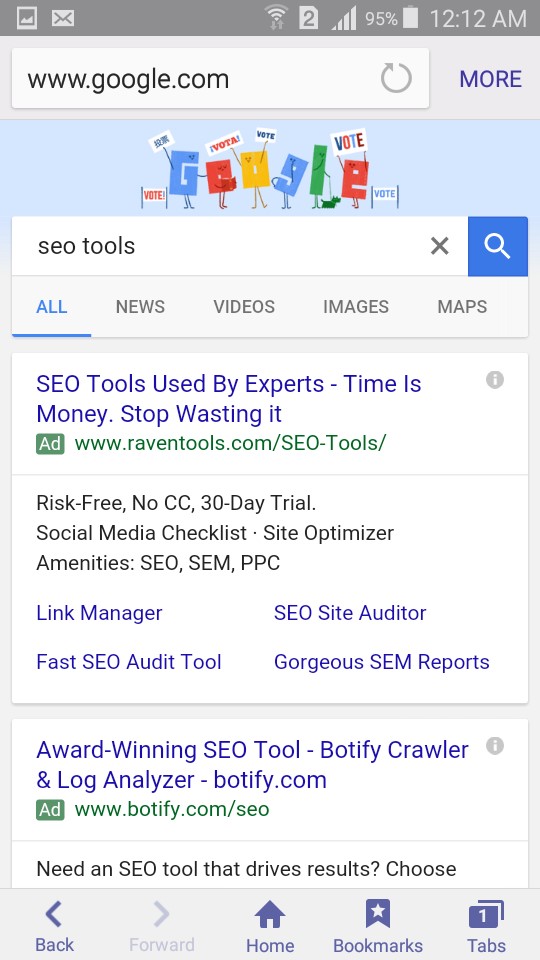
Remember how mobilegeddon was going to be the biggest thing ever? Well I never updated our site layout here & we still outrank a company which raised & spent 10s of millions of dollars for core industry terms like [seo tools].

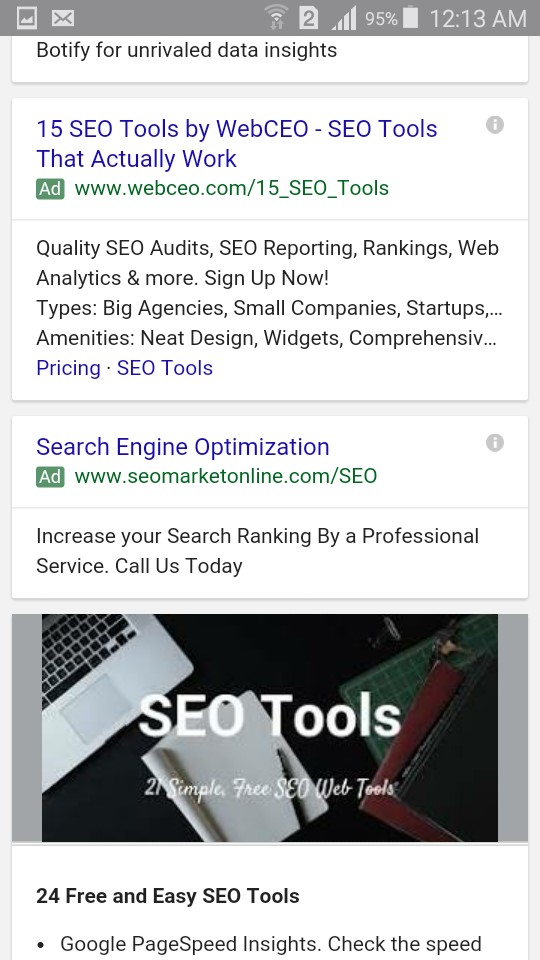
Though it is also worth noting that after factoring in increased ad load with small screen sizes & the scrape graph featured answer stuff, a #1 ranking no longer gets it done, as we are well below the fold on mobile.
   

Below the Fold = Out of Mind

In the above example I am not complaining about ranking #5 and wishing I ranked #2, but rather stating that ranking #1 organically has little to no actual value when it is a couple screens down the page.

Google indicated their interstitial penalty might apply to pop ups that appear on scroll, yet Google welcomes itself to installing a toxic enhanced version of the Diggbar at the top of AMP pages, which persistently eats 15% of the screen & can't be dismissed. An attempt to dismiss the bar leads the person back to Google to click on another listing other than your site.

As bad as I may have made mobile search results appear earlier, I was perhaps being a little too kind. Google doesn't even have mass adoption of AMP yet & they already have 4 AdWords ads in their mobile search results AND when you scroll down the page they are testing an ugly "back to top" button which outright blocks a user's view of the organic search results.

What happens when Google suggests what people should read next as an overlay on your content & sells that as an ad unit where if you're lucky you get a tiny taste of the revenues?

Is it worth doing anything that makes your desktop website worse in an attempt to try to rank a little higher on mobile devices?

Given the small screen size of phones & the heavy ad load, the answer is no.

I realize that optimizing a site design for mobile or desktop is not mutually exclusive. But it is an issue we will revisit later on in this post.

Coercion Which Failed

Many people new to SEO likely don't remember the importance of using Google Checkout integration to lower AdWords ad pricing.

You either supported Google Checkout & got about a 10% CTR lift (& thus 10% reduction in click cost) or you failed to adopt it and got priced out of the market on the margin difference.

And if you chose to adopt it, the bad news was you were then spending yet again to undo it when the service was no longer worth running for Google.

How about when Google first started hyping HTTPS & publishers using AdSense saw their ad revenue crash because the ads were no longer anywhere near as relevant.

Oops.

Not like Google cared much, as it is their goal to shift as much of the ad spend as they can onto Google.com & YouTube.

Google is now testing product ads on YouTube.

It is not an accident that Google funds an ad blocker which allows ads to stream through on Google.com while leaving ads blocked across the rest of the web.

Android Pay might be worth integrating. But then it also might go away.

It could be like Google's authorship. Hugely important & yet utterly trivial.
Faces help people trust the content.
Then they are distracting visual clutter that need expunged.
Then they once again re-appear but ONLY on the Google Home Service ad units.
They were once again good for users!!!

Neat how that works.

Embrace, Extend, Extinguish

Or it could be like Google Reader. A free service which defunded all competing products & then was shut down because it didn't have a legitimate business model due to it being built explicitly to prevent competition. With the death of Google reader many blogs also slid into irrelevancy.

Their FeedBurner acquisition was icing on the cake.

Techdirt is known for generally being pro-Google & they recently summed up FeedBurner nicely:

Thanks, Google, For Fucking Over A Bunch Of Media Websites - Mike Masnick

Ultimately Google is a horrible business partner.

And they are an even worse one if there is no formal contract.

Dumb Pipes, Dumb Partnerships

They tried their best to force broadband providers to be dumb pipes. At the same time they promoted regulation which will prevent broadband providers from tracking their own users the way that Google does, all the while broadening out Google's privacy policy to allow personally identifiable web tracking across their network. Once Google knew they would retain an indefinite tracking advantage over broadband providers they were free to rescind their (heavily marketed) free tier of Google Fiber & they halted the Google Fiber build out.

When Google routinely acts so anti-competitive & abusive it is no surprise that some of the "standards" they propose go nowhere.

You can only get screwed so many times before you adopt a spirit of ambivalence to the avarice.

Google is the type of "partner" that conducts security opposition research on their leading distribution partner, while conveniently ignoring nearly a billion OTHER Android phones with existing security issues that Google can't be bothered with patching.

Deliberately screwing direct business partners is far worse than coding algorithms which belligerently penalize some competing services all the while ignoring that the payday loan shop funded by Google leverages doorway pages.

"User" Friendly

BackChannel recently published an article foaming at the mouth promoting the excitement of Google's AI:

This 2016-to-2017 Transition is going to move us from systems that are explicitly taught to ones that implicitly learn." ... the engineers might make up a rule to test against—for instance, that “usual” might mean a place within a 10-minute drive that you visited three times in the last six months. “It almost doesn’t matter what it is — just make up some rule,” says Huffman. “The machine learning starts after that.

The part of the article I found most interesting was the following bit:

After three years, Google had a sufficient supply of phonemes that it could begin doing things like voice dictation. So it discontinued the [phone information] service.

Google launches "free" services with an ulterior data motive & then when it suits their needs, they'll shut it off and leave users in the cold.

As Google keeps advancing their AI, what do you think happens to your AMP content they are hosting? How much do they squeeze down on your payout percentage on those pages? How long until the AI is used to recap / rewrite content? What ad revenue do you get when Google offers voice answers pulled from your content but sends you no visitor?

The Numbers Can't Work

A recent Wall Street Journal article highlighting the fast ad revenue growth at Google & Facebook also mentioned how the broader online advertising ecosystem was doing:

Facebook and Google together garnered 68% of spending on U.S. online advertising in the second quarter—accounting for all the growth, Mr. Wieser said. When excluding those two companies, revenue generated by other players in the U.S. digital ad market shrank 5%

The issue is NOT that online advertising has stalled, but rather that Google & Facebook have choked off their partners from tasting any of the revenue growth. This problem will only get worse as mobile grows to a larger share of total online advertising:

By 2018, nearly three-quarters of Google’s net ad revenues worldwide will come from mobile internet ad placements. - eMarketer

Media companies keep trusting these platforms with greater influence over their business & these platforms keep screwing those same businesses repeatedly.

You pay to get likes, but that is no longer enough as edgerank declines. Thanks for adopting Instant Articles, but users would rather see live videos & read posts from their friends. You are welcome to pay once again to advertise to the following you already built. The bigger your audience, the more we will charge you! Oh, and your direct competitors can use people liking your business as an ad targeting group.

Worse yet, Facebook & Google are even partnering on core Internet infrastructure.

Any hope of AMP turning the corner on the revenue front is a "no go":

“We want to drive the ecosystem forward, but obviously these things don’t happen overnight,” Mr. Gingras said. “The objective of AMP is to have it drive more revenue for publishers than non-AMP pages. We’re not there yet”.

Publishers who are critical of AMP were reluctant to speak publicly about their frustrations, or to remove their AMP content. One executive said he would not comment on the record for fear that Google might “turn some knob that hurts the company.”

Look at that.

Leadership through fear once again.

At least they are consistent.

As more publishers adopt AMP, each publisher in the program will get a smaller share of the overall pie.

Just look at Google's quarterly results for their current partners. They keep showing Google growing their ad clicks at 20% to 40% while partners oscillate between -15% and +5% quarter after quarter, year after year.
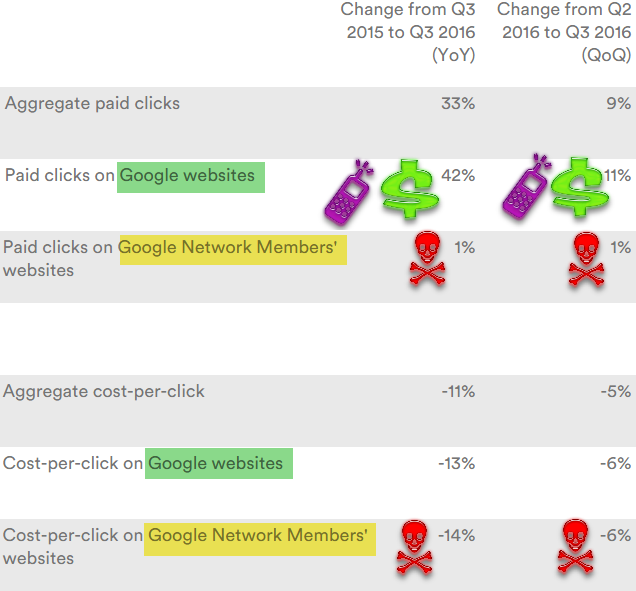
In the past quarter Google grew their ad clicks 42% YoY by pushing a bunch of YouTube auto play video ads, faster search growth in third world markets with cheaper ad prices, driving a bunch of lower quality mobile search ad clicks (with 3 then 4 ads on mobile) & increasing the percent of ad clicks on "own brand" terms (while sending the FTC after anyone who agrees to not cross bid on competitor's brands).

The lower quality video ads & mobile ads in turn drove their average CPC on their sites down 13% YoY.

The partner network is relatively squeezed out on mobile, which makes it shocking to see the partner CPC off more than core Google, with a 14% YoY decline.

What ends up happening is eventually the media outlets get sufficiently defunded to where they are sold for a song to a tech company or an executive at a tech company. Alibaba buying SCMP is akin to Jeff Bezos buying The Washington Post.

The Wall Street Journal recently laid off reporters. The New York Times announced they were cutting back local cultural & crime coverage.

If news organizations of that caliber can't get the numbers to work then the system has failed.

The Guardian is literally incinerating over 5 million pounds per month. ABC is staging fake crime scenes (that's one way to get an exclusive).

The Tribune Company, already through bankruptcy & perhaps the dumbest of the lot, plans to publish thousands of AI assisted auto-play videos in their articles every day. That will guarantee their user experience on their owned & operated sites is worse than just about anywhere else their content gets distributed to, which in turn means they are not only competing against themselves but they are making their own site absolutely redundant & a chore to use.

That the Denver Guardian (an utterly fake paper running fearmongering false stories) goes viral is just icing on the cake.

many Facebook users wish to connect with people and things that confirm their pre-existing opinions, whether or not they are true. ... Giving people what they want to see will always draw more attention than making them work for it, in rather the same way that making up news is cheaper and more profitable than actually reporting the truth. - Ben Thompson

These tech companies are literally reshaping society & are sucking the life out of the economy, destroying adjacent markets & bulldozing regulatory concerns, all while offloading costs onto everyone else around them.

The crumbling of the American dream is a purple problem, obscured by solely red or solely blue lenses. Its economic and cultural roots are entangled, a mixture of government, private sector, community and personal failings. But the deepest root is our radically shriveled sense of “we.” ... Until we treat the millions of kids across America as our own kids, we will pay a major economic price, and talk of the American dream will increasingly seem cynical historical fiction.

And the solution to killing the middle class, is, of course, to kill the middle class:

An FTC report recommended suing Google for their anti-competitive practices, but no suit was brought. The US Copyright Office Register was relieved of her job after she went against Google's views on set top boxes. Years ago many people saw where this was headed:

"This is a major affront to copyright," said songwriter and music publisher Dean Kay. "Google seems to be taking over the world - and politics ... Their major position is to allow themselves to use copyright material without remuneration. If the Copyright Office head is towing the Google line, creators are going to get hurt."
...
Singer Don Henley said Pallante's ouster was "an enormous blow" to artists. "She was a champion of copyright and stood up for the creative community, which is one of the things that got her fired," he said. ... [Pallante's replacement] Hayden "has a long track record of being an activist librarian who is anti-copyright and a librarian who worked at places funded by Google."

And in spite of the growing importance of tech media coverage of the industry is a trainwreck:

This is what it’s like to be a technology reporter in 2016. Freebies are everywhere, but real access is scant. Powerful companies like Facebook and Google are major distributors of journalistic work, meaning newsrooms increasingly rely on tech giants to reach readers, a relationship that’s awkward at best and potentially disastrous at worst.

Being a conduit breeds exclusives. Challenging the grand narrative gets one blackballed.

Mobile Search Index

Google announced they are releasing a mobile first search index:

Although our search index will continue to be a single index of websites and apps, our algorithms will eventually primarily use the mobile version of a site’s content to rank pages from that site, to understand structured data, and to show snippets from those pages in our results. Of course, while our index will be built from mobile documents, we're going to continue to build a great search experience for all users, whether they come from mobile or desktop devices.

There are some forms of content that simply don't work well on a 350 pixel wide screen, unless they use a pinch to zoom format. But using that format is seen as not being mobile friendly.

Imagine you have an auto part database which lists alternate part numbers, price, stock status, nearest store with part in stock, time to delivery, etc. ... it is exceptionally hard to get that information to look good on a mobile device. And good luck if you want to add sorting features on such a table.

The theory that using the desktop version of a page to rank mobile results is flawed because users might find something which is only available on the desktop version of a site is a valid point. BUT, at the same time, a publisher may need to simplify the mobile site & hide data to improve usability on small screens & then only allow certain data to become visible through user interactions. Not showing those automotive part databases to desktop users would ultimately make desktop search results worse for users by leaving huge gaps in the search results. And a search engine choosing to not index the desktop version of a site because there is a mobile version is equally short sighted. Desktop users would no longer be able to find & compare information from those automotive parts databases.

Once again money drives search "relevancy" signals.

Since Google will soon make 3/4 of their ad revenues on mobile that should be the primary view of the web for everyone else & alternate versions of sites which are not mobile friendly should be disappeared from the search index if a crappier lite mobile-friendly version of the page is available.

Amazon converts well on mobile in part because people already trust Amazon & already have an account registered with them. Most other merchants won't be able to convert at anywhere near as well of a rate on mobile as they do on desktop, so if you have to choose between having a mobile friendly version that leaves differentiated aspects hidden or a destkop friendly version that is differentiated & establishes a relationship with the consumer, the deeper & more engaging desktop version is the way to go.

The heavy ad load on mobile search results only further combine with the low conversion rates on mobile to make building a relationship on desktop that much more important.

Even TripAdvisor is struggling to monetize mobile traffic, monetizing it at only about 30% to 33% the rate they monetize desktop & tablet traffic. Google already owns most the profits from that market.

Webmasters are better off NOT going mobile friendly than going mobile friendly in a way that compromises the ability of their desktop site.

I am not the only one suggesting an over-simplified mobile design that carries over to a desktop site is a losing proposition. Consider Nielsen Norman Group's take:

in the current world of responsive design, we’ve seen a trend towards insufficient information density and simplifying sites so that they work well on small screens but suboptimally on big screens.

Tracking Users

Publishers are getting squeezed to subsidize the primary web ad networks. But the narrative is that as cross-device tracking improves some of those benefits will eventually spill back out into the partner network.

I am rather skeptical of that theory.

Facebook already makes 84% of their ad revenue from mobile devices where they have great user data.

They are paying to bring new types of content onto their platform, but they are only just now beginning to get around to test pricing their Audience Network traffic based on quality.

Priorities are based on business goals and objectives.

Both Google & Facebook paid fines & faced public backlash for how they track users. Those tracking programs were considered high priority.

When these ad networks are strong & growing quickly they may be able to take a stand, but when growth slows the stock prices crumble, data security becomes less important during downsizing when morale is shattered & talent flees. Further, creating alternative revenue streams becomes vital "to save the company" even if it means selling user data to dangerous dictators.

The other big risk of such tracking is how data can be used by other parties.

Spooks preferred to use the Google cookie to spy on users. And now Google allows personally identifiable web tracking.

Data is being used in all sorts of crazy ways the central ad networks are utterly unaware of. These crazy policies are not limited to other countries. Buying dog food with your credit card can lead to pet licensing fees. Even cheerful "wellness" programs may come with surprises.

Want to see what the future looks like?

For starters...

About 2 months ago I saw a Facebook post done on behalf of a friend of mine. Gofundme was the plea. Her insurance wouldn’t cover her treatment for a recurring breast cancer and doctors wouldn’t start the treatment unless the full payment was secured in a advance. Really? Really. She was gainfully employed, had a full time, well paying job. But guess what? It wasn’t enough although hundreds of people donated.

This last week she died. She was 38 years old. She died not getting access to a treatment that may or may not have saved her life. She died having to hustle folks for funds to just have a chance to get access to another treatment option and she died while worrying about being financially ruined by her illness. Just horrid.

Is this the society we want? People forced to beg friends on gofundme for help so they can get access to medical treatment? Is this the society we are? Is this truly the best we can do?

Click here to read more.