My buddy Patrick Münzinger just informed me that SearchGuild went offline - forever. SearchGuild is the forum that (along with NFFC, a few other mentors, and a few lucky breaks) took me from near bankruptcy to knowing enough about this market to be exceptionally profitable and be able to help many other people do well.
While many other forums were polluted with useless noise, syndicated spin and half truths from search engineers, self promotion (submit your site to MY directory AND buy MY services), bogus ethics claims (what is a white hat anyway?), and tactical misinformation ... SearchGuild was the one that taught me to test stuff and to gain enough confidence in myself to make my opinions matter and make my decisions profitable. Guys like Chris Ridings and Lots0 may have seemed cranky, but they were blunt and honest. They helped people just because they liked helping. The web could use more of that.
But when SearchGuild was profitable the profits were donated to charity, and even though the site's popularity has been maintained, ad revenues dropped, and so that great service no longer exists as a hobby in spite of the great value it offered. In the last 5 years my 2 favorite sites about search were Threadwatch and SearchGuild, and now they are both dead because they had bad business models. This is yet another sign to me that you really have to charge what you are worth if you create value for others, or eventually it dries up. Thanks for the 5 great years SearchGuild.
In the past many Google penalties were blatantly obvious. You either got traffic or you did not. But as time has passed penalties are getting blurrier, meaning your site can be penalized and still get traffic from Google. Some traffic reductions are due to competitive market forces, some are due to algorithm changes, some are due to automated filters, and some are due to penalties. If you are new to the market (and in some cases, even if you are experienced) it is hard to know which problems, if any, are holding back your ranking potential.
A friend just told me about how his Google traffic went way up after he spoke with a Google engineer, but he didn't want to talk about it publicly. I wonder how many other people are just like him, but don't speak about it or don't know they are penalized? And then I think back to the ban of the official AdSense blog, Brian Clark's PageRank hit, and Sugar Rae's ranking woes, and have come to the conclusion that spam fighting has become more of a shoot first and ask questions later game. They do not make a lot of mistakes, but when your site is just a number, it hurts pretty bad.
From a marketer perspective this shoot first shift is an important one which requires a few things of online publishers hoping to keep their businesses profitable:
Track your traffic using analytics tools, such that you know if/when something goes wrong, can prove it with hard stats, and can research it more specifically.
Publish at least 2 or 3 sites in different markets to give yourself additional data points on whether the issue is site specific or not.
Use public relations and viral link marketing where you once used link buys. If you are still renting links try to make them covert, and offset them with many natural links.
If possible package your offering as a service, so that you can justify charging recurring, and/or create an affiliate program. These make your income less reliant on search engines.
If nobody cares that the site is missing there is no harm nor foul. Build up enough social significance that you can cause enough noise if/when something goes wrong such that Google gets enough blowback to fix the issue quickly.
If you have not yet heard of Drupal, it is the open source CMS that powers this site (and many sites far more robust and popular than this one). I think I am pretty good at predicting web trends, and 2 or 3 years from now Drupal will be about as popular and well known as Wordpress and Wikipedia are today.
Drupal is more powerful than what the average blogger needs to run their site, but it has so many features and options that it can allow you to bolt many things onto your blog that you would not be able to do very easily with something like Wordpress or MovableType.
People who are well established can trade on reputation and attract strong enough clients to not need to perform tests to learn the algorithms intimately well.
Recently another well known marketer put out a video saying domain names were irrelevant to SEO. Then they got feedback from viewers who said they thought that statement was wrong. And then their reply sent to thousands of members on their list included
It's true that your domain name has no REAL effect on your SERPS.
That answer is intuitive, but it is also incorrect. The only way one would claim that as fact is if one has not done any testing recently.
It is one thing to be wrong, but it is another thing to be wrong, be called out on it, and stand by your incorrect claim. People are spending good money to read incorrect and/or outdated information. Unfortunate really, but if you are already doing well you don't need to track and test every little thing to keep doing well. Very few gurus openly sharing information have thin affiliate and newly launched test sites that back up their claims. But it is getting harder to succeed with thin affiliate sites as Google becomes creative director of content development.
Share REALLY Good Tips & Die
Most established people are too lazy or too busy to do in depth testing. And if they are doing it, they probably do not want to share it publicly. Share a hole and watch it get plugged. After a search engineer reads your blog and destroys one of your sites you mentioned, it makes it much harder to want to reveal tips and algorithmic holes with hard evidence behind them. Show your proof and watch Google burn it to the ground. Even if you know what you are doing you can't overcome a hand edit unless it was unjust AND they care enough about your site to let it rank again. You were right, but only until you opened your big mouth. :)
Much of the game of relevancy is a mind control exercise. The conversation revolves around debates including "should be" or "in an ideal world" rather than "how it is".
The Endless Sea of Tests & Noise
People newer to the field have less to risk by being aggressive, place a lower value on their time, are generally more excited about the pursuit, are more willing to try things that established people may not, and are more willing to share their results. But many of them have limited exposure, limited confidence, and/or are drowned out by an endless sea of incorrect information. With so many people saturating the SEO market it is getting harder to be the person first with the scoop. Today blogs are a lot like forums were a few years back. There is no way you could ever get any work done if you subscribed to all the SEO blogs, so it is impossible to read all the information.
Marketing, Marketing, Marketing
If you create a public facing SEO brand, so much of your time goes into brand management and marketing that it is hard to have time to launch many new sites unless you have scaled out a staff. If you have scaled out a staff, you must keep more of your secrets to yourself, because getting a site burned or losing a competitive advantage not only hurts you, but also hurts everyone who works for you. This really hit home after Google killed a site that I had a team working on.
I Was Just Looking At Your Site!
Some of the people who introduced themselves on SEO Book recently mentioned that they were in fields or owned sites that directly competed with some of my sites. If I share all my best ideas with them for free on the blog and they share almost none of their best ideas with me that gets a bit hard to compete with them on my secondary sites, especially if I am competing with them and search engineers decide to pillage my sites. ;)
More Work for Less $ = Bad Trend
The market is getting more competitive. So longer hours are required to achieve similar profits from thin sites. People who see and feel this trend are not only working extra to make up for it, but are also working extra to establish a firmer foothold for the future. 1 hour of work today may be more effective than 2 hours of work next year, or 3 hours of work the following year. But after you get that network effect behind a site the ball is rolling down hill. Gravity is on your side.
SEO as a Subset of Marketing
As it gets harder to fake it people make more legitimate sites offering more value. But as their sites become more embedded in the web doing SEO tests related to links become less and less relevant because it is harder to isolate variables. Dominating the search results becomes a game dominated by the people who are the best at spreading ideas. And so with each passing day SEO for most webmasters is more of a subset of marketing than an independent discipline.
Wikipedia ranks #1 in Google for SEO, public relations, and marketing. What would it take to displace Wikipedia from a #1 ranking if you were in a field that bloggers, designers, and web developers generally had a distaste for, hated, or misunderstood?
If only Google, Wikipedia, and a couple other sites outranked you for SEO, what would you do to push past them? Could anything short of an act of God or a hand edit move you past them?
In my last post about how contextual advertising targets the weak and poor, I promoted the idea of niche publishers shifting to sell niche products and services directly as a better means of monetization. Dan Rootasked why many of the leading news sites are dropping their pay walls. The answer is that future relevancy is driven by the point to economy, and news is a commodity.
The business models for news companies rely upon regional based monopolies that are quickly eroding.
Domain names and community activity largely supplement or replace the need for much of the generalist news or syndication based business model. I used to live in State College and talked to the guy who owned StateCollege.com. The local paper was doing worse and worse every year, and with a small aggressive staff, better technology, more interactive ads, and a great domain name beat them.
And the news that is worth money spreads fast OUTSIDE OF the pay wall. Does WSJ want the pageviews for breaking a news story, or do they want to see the TechCrunch post about the WSJ story get those pageviews?
As the web grows users are getting better at tuning out obvious ads. So ads will get more insidious, and more and more businesses will be built off a missing features and shadow brand built on the back of the goodwill from sharing and open source.
One guy got angry at me claiming that I was providing conflicting information, because he read the blogger's guide to seo and saw that I recommended using Wordpress but also recommended avoiding using Wordpress.com. I am not the one who created that shadow brand, but I do realize that is has the potential to be enormously profitable.
Pligg, an open source software program similar to Digg, recently went up for sale but did not sell. Now Pligg is has some plug ins available from the official Pligg pro store. One of them is a list of known spamming domains.
As an advertiser and a publisher I have ad CTR data spanning hundreds of millions of impressions and about a million ad clicks across a wide array of verticals. One of my early opinions on contextual ads and search ads was that people are far more likely to click ads if they are desperate, stupid, or ignorant. While I was flamed for my opinion, this opinion has only been confirmed from talking to friends who have much more data than I do, and Dave Morgan from AOL also confirmed it.
Based on what I've seen qualitatively, my hypothesis would be that heavy ad clickers are:
More representative of lower income households than the average user.
Less educated than the average user (or from less-educated environments in the case of minors).
More likely to live outside of the major metro regions.
More likely to be using [social networks] to meet new people than the average user (who is more likely to be using SNSs to maintain connections).
The problem with catering to the lowest common denominator is that the people who are clicking the ads
have less of an ability to buy premium products
are less likely to do follow on marketing for you to promote your products to other
are a small minority of your visitors
are driven away from your site when they click
each day many ignorant users learn more about the web and click less ads
the new users coming on the web replacing those who are learning about it are even poorer and less socially connected than those already on the network
In the next couple years there is going to be a major shift in online ad based business models where many publishers push themselves up the value chain. The trend for profitable publishing, is going to include the following aspects
fewer ads
ads with more information
ads that look more like information
ads tighter integrated into the content
having a semi-porous brand which allows your free content to do your marketing for your paid content
in many case selling ads that include personal endorsement, and ads for white label products or house products (often via subscription)
As more premium publishers shift from ad based models to selling white labeled and house products it is going to get harder to buy ads affordably on the clean parts of the web. And the trend has already started. If you look at some of the most popular investment sites you will see that many of them provide free offers for products that lead you into buying a subscription service.
If you are going to monetize your site from a small minority of your visitors it makes sense to build relationships with them and charge recurring if you can. If your only monetize 5% of your audience would rather have $50 a month from them or 50 cents?
Google opts to not show AdWords ads above the search results unless they deem them exceptionally relevant to the query, with the ads proving that relevancy with a high CTR. With Google's other verticals, they have a database of options which is
much shallower
spammier
less efficient
with fewer signs of relevancy and trust
Markets start out ugly then you try to make them more efficient as they develop. Google tries to make some of the verticals become relevant by pricing them at free and forcing exposure upon them, front and center at the top of the search results - hoping competitive market forces and market feedback will drive the new verticals toward relevancy, and a market leading position they can charge for. You rarely see Google charge for basic level usage of something if they are the #2 or #3 player in the market. First they want to buy the market leading position by giving it away, then start charging for it.
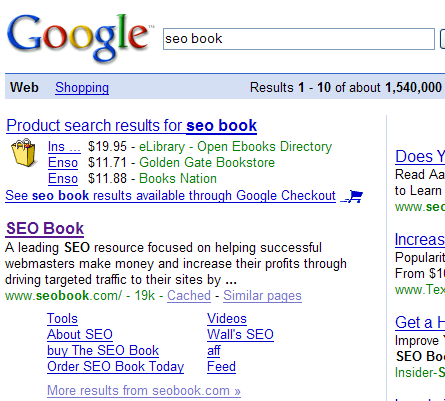
In some cases they are willing to hold these new verticals to a much lower standard than their paid ads in an attempt to win marketshare. Google tracks CTR on Google accounts and knows most of the people searching for SEO Book click on SeoBook.com, but they still show their product search ads for that query:
While some marketers paying Google for traffic can not pay enough to keep their ads live, here Google is giving away traffic. As a marketer I see this more as an opportunity than a reason to pout. How hard is it to get inside these other verticals? Probably a lot easier than you think, and many people who are just entering the PPC game will be too lazy to enter the other markets until they are proven. When you see Google rolling out other projects know the early bird gets the worm.
With about 4,000 members signed up so far I figured it would be good to have an SEO Book introductions thread. Please use this thread to introduce yourself, and give feedback on how we can make this site better for you.