Will SEO Be Dead Within The Next Two Years?

Another question we received recently was:

"SEO as we know it will be dead within the next 2 years – true or false? With the wealth of info at their fingertips combined with localized, customized search to name but a few Google will no longer need to do what it does now to determine rankings?"

I'd say "false".

People have been predicting the death of SEO since, well, the beginning of SEO. Here's a debate from 2004, and another from 2006. These arguments probably started around 1995.

So long as search engines display a list of sites, for which payment is not required, SEO will exist.

How SEO is done will change. It has always changed. In the bad old days, SEO was all about getting listed in the Yahoo Directory. If you didn't, you were pretty much invisible. There was a time that listing with Looksmart got you decent rankings in MSN. These days, few of those new to SEO have even heard of Looksmart.

Google will certainly adapt and change, and use a variety of metrics in order to determine relevance. SEOs will adapt and change, trying to work out what these metrics are.

Recently, Eric Schmidt made the following comment:

The internet is fast becoming a "cesspool" where false information thrives, Google CEO Eric Schmidt said yesterday. Speaking with an audience of magazine executives visiting the Google campus here as part of their annual industry conference, he said their brands were increasingly important signals that content can be trusted"

So, having a brand might be a signal of quality, which may, in turn, lead to a higher rank. Or perhaps Schmidt was just playing to the audience of newspaper owners. Difficult to tell ;)

Google collects a wealth of usage data from toolbars, analytics, and their ad systems, so it is conceivable they might fold these metrics into their ranking systems. Marissa Mayer recently suggested that SearchWiki data might be used ranking calculations.

Will the bar get raised? Will SEO become more difficult? Of course. But a raised bar works two ways. If you can reach it, there's a new barrier between you and those who follow you. That gives you some level of defensibility.

So how do you do SEO going forward?

I've written a lot about the importance of holistic strategy. Your aim should be to sell something to people - be it an opinion, a product, a service. All your endeavors should support this goal, and most of the time, that means doing the basics well - make your site crawlable, well linked, and solve a genuine problem for people. If your SEO efforts are not resulting in an improvement in the bottom line , then there is little point doing SEO.

Bob Massa put it well:

"I believe anyone can be successful at online marketing or even traffic generation and search engine placement specifically, if they just stop looking for ways to trick machines and instead look for ways to connect with humans".

What Aspect Of SEO Should You Be Spending Most Of Your Time On?

There are so many SEO tasks demanding your attention. How do you prioritize them?

Seems to be a common issue, as when we asked for questions a while back, we received this one:

"What aspect of SEO should you be spending most of your time on? Optimizing the title tag, getting links, creating quality content? "

So which area of SEO will give you the most bang for your buck? Link building? On-page? Social media? Ask ten different SEOs, and you'll likely get ten different answers.

Let's take a step back and start with strategy.

1. Define Your Goals

Without clear goals, it's difficult to know how to spend your time. Start by listing your goals.

Do you want to sell services or product? Do you want to increase traffic levels? Do you want to increase brand awareness? Knowing which SEO dial to twist depends very much on what goal you're trying to achieve.

Once you have your list, create a set of KPIs. KPI stands for Key Performance Indicator. KPIs will give you a set of metrics to help you decide if you're meeting, or missing, your goals.

Here are a few examples:

  • Rank top ten for keyword term x in Google
  • Increase traffic from search engines by *x* percent by *date*
  • Get 1,000 new sign ups from search visitors in March
  • Sell ten widgets per day to search visitors by next week

The most useful KPIs are specific. You either hit the target or you miss.

Your strategy will be defined by your goals. For example, if your goal is to sell ten widgets by next week using a new site, then your strategy might be to forget SEO for the meantime, and focus on PPC instead. If your goal is to get 1000 new subscribers by the end of the year, then you might spend a lot of time analyzing your demographic, determining where they hang out, and getting your name and content in front of them at every available opportunity. If your goal is to get #1 for term X, then you'll be focusing a lot on link building, using keyword term X in the link.

And so on. Your goals define your tactics.

Once you have a list of clear objectives, and a clear list of KPIs, the next step is to consider the age of your site.

2. What Type Of Site Do You Have?

New Site

One of the most important task for new sites is link building. The sites with the highest quality linkage tend to trump sites with lower quality linkage when it comes to rank.

Until you build links, then tweaking on-page aspects of SEO on a new site won't make a lot of difference in terms of rank. Get the basics right - keywords in the title tags, keyword focused content, strong internal linking, a shallow structure and good crawlability - but focus your efforts on attaining links. If that means establishing a large body of quality content first, then so be it. Others may choose to buy their way up the chain, or aggressively pursue social media opportunities.

Established Site

The opposite is true for an established site. Whilst links are always important, an established site can leverage on-page factors to a greater degree.

Once your site has built up sufficient link authority, then you may only need add a new page of content, and link it internally, in order to rank well. People running established sites may wish to focus more on producing quality, focused content, and let the linking look after itself.

3. The Five Most Important Areas Of SEO On Which To Spend Your Time

These are highly debatable, but here's my ranking:

1. Produce Remarkable, Attention Grabbing Content

Everything starts with remarkable content i.e. content worth remarking on and linking to. Do you have unique, timely content? Does you content solve a problem? Does you content provide a new insight? Does you content spark controversy? Does you content start - or contribute to - a conversation?

2. Crawlability

If your content can't be crawled, you won't rank. Ensure your site is easily accessible to both humans and search engine spiders.

3. Build Links

Google's algorithm is heavily weighted towards links. Beg, buy, or earn links, and rankings follow. Get your keywords into the link text. Building links also means building relationships with people. Spend a lot of time doing this, especially in the early stages.

4. Title Tag

It is debatable how much ranking value the title tag has, both it definitely has click-thru value. Your listing fights for attention with all the other links on page. What will make people click your link?
Learn the lessons of Adwords. Match your title tag to the keyword query. Solve a users problem. Arouse curiosity.

5. On-Page Content

Forget endless on-page tweaking. Largely a waste of time. Instead, keep a few keyword phrases in mind when writing. Use semantic variations of your terms in order to help catch long tail terms. Link your page to related pages, using keyword terms in the link.

Bonus: Watch Your Competition. Do What They Do

Download the toolbar. And keep a very close eye on your competition. Whatever they do, you need to do more of it :)

Summary

SEO used to be a technical exercise involving the isolation of specific factors that, when tweaked, lead to higher rank. It still is, to a certain extent, but much less so than it used to be. Therefore, there is little point looking at each factor in isolation.

SEO has become a lot more holistic and strategic, so by far the most important aspect is clearly outlining your goals, and defining a strategy to achieve those goals.

Good luck out there :)

Advanced SEO Toolbar Functions

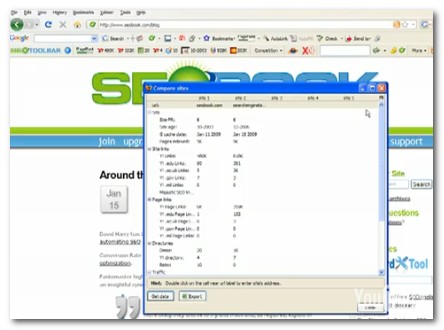
I thought it would be worth highlighting a few of the advanced features in the SEO Toolbar. Some of the highest value ideas do not consist of looking at one data point, or boiling things down to 1 arbitrary and meaningless number (like many "professional" SEO tools do), but consist of looking at many data points across multiple sites, and hunting for inconsistencies that help you build new profitable traffic streams. Along those lines, I thought I would run through a few ideas to get your juices flowing...there are dozens more like these :)

The advanced tips are here.

How Twitter Can be Corrosive to Online Marketing

In the past when you did something quite cool and attention-worthy people would reference it on their blogs. But now in the age of Twitter, many people mention your stuff on Twitter. This can be good if they have thousands of Twitter followers, but if most the people mentioning a topic are all in the same small tight knit space then you are only reaching a fraction of a fraction of the potential distribution you would have before the age of Twitter.

  • How many people read every Twitter update from the people they subscribe to? Very few. Since you are in a high volume aggregator the loyalty is nowhere near where it is with traditional blog subscribers.
  • Exciting news quickly falls into the archives due to the rapid nature and high volume of Tweets.
  • If you dominate a channel and keep reaching the same people over and over again that does help provide social proof of value, but after seeing the same message 5 or 10 times it becomes noise.

Worse yet, even though Twitter mentions are organic links and recommendations by highly trusted topical experts, those don't show up on the broader web graph since Google pressured Twitter into adopting nofollow EVERYWHERE, even for user profiles.

And unlike Delicious...

  • most people do not have automated mechanisms to dump their daily Tweets / Tweet links into their blog to provide trusted direct links
  • people rarely use Twitter as a bookmarking service, so it is rarely worth searching into yesterday's content. The Twitter content is very zen-like...here today, gone today.

Multiple people asked me to add their RSS feeds to the default set that in the SEO Toolbar that was soon to be downloaded by over 10,000 webmasters. And for wanting all that exposure (and future exposure) they didn't even post about it on their blog. They mentioned it on Twitter...where the same 3,000 people saw the message 20 times each. No value add whatsoever.

Out of over 21 pages of Tweets (300+ Tweets) mentioning "SEO Toolbar" in the last 3 days, Yahoo! is showing less than 10 inbound links to the SEO Toolbar page that came from sources other than direct friend requests, social news sites, or automated links brought on by that exposure. Twitter is pretty worthless as a link building strategy, even if you are giving away something that is both free and better than similar tools selling for hundreds of dollars.

Even if you have a strong launch and a product far superior to related products, the exposure you get may not matter if your coverage is stuck on Twitter. It is a connecting medium, but it doesn't make money:

Venture Beat says that Twitter made Dell a million dollars. That's nuts. Did the phone company make Dell a billion dollars? Just because people used the phone to order their Dell doesn't mean that the phone was a marketing medium. It was a connecting medium. Big difference.

Is Twitter a nice complimentary channel that can add exposure to your launch? Absolutely. But if the conversation does not leave Twitter.com then it has quite limited value in a search-driven Google-centric web. And that limited value is even less if you don't already have thousands of Twitter followers.

The "make money on Twitter" ebooks will be coming out soon, but other than the ebook authors, I doubt anyone will make much money from it (unless customer feedback helps them create new product lines).

Fresh Start For A New Year: Reduce Clutter

“Practice not-doing and everything will fall into place.” - Lao Tzu

Did you take a vacation?

If you took a break, I hope you had a good one! I've just returned from a relaxing holiday - it is summer where I am, the weather is great, and life is lazy and fine.

Holidays provide a great opportunity to reflect and take a new perspective, so one thing I tried to do was to step away from the internet. I didn't take a laptop with me on holiday. Needless to say, I really missed it. After all these years, I suspect I may as well be hard-wired into the interweb.

However, out there amongst the isolated dunes, I was reminded that....

Most Stuff Doesn't Matter

Most blog posts don't matter. Most news doesn't matter. Most Tweets don't matter. Social networks don't matter. These things can quickly become a meaningless distraction.

What's worse, is that we often miss the important things going on, because there is too much irrelevant clutter fighting for our attention. When I returned, there was so much stuff l hadn't read.

But was I any worse off?

Not really. I quickly came up to speed again by selecting a few important sources, and reading those.

It didn't take me long.

With this in mind, it was time to do some weeding and make a fresh start. My feed reader had become ridiculously cluttered.

Hard To See The Wood For The Trees

How many feeds to you subscribe to? Do you have a lot of unread items?

I certainly did.

Using my RSS reader had become a chore, mainly because I'd subscribed to so many feeds over the years that I was never, in reality, going to read. All those unread items were just made me feel guilty. I needed to reduce the clutter.

So I took a chainsaw to it.

I asked myself - what are the one or two sites in any given vertical that provide me with genuine value? Could I name them without looking at them?

It was actually surprising easy, especially given the rather useful historical usage data. Once I answered this question, I kept the truly useful feeds, and deleted everything else.

My feed collection now feels very Zen. No more news re-writers or trivia about who is doing what to whom. It's simple, elegant and best of all, a lot more useful than it was before.

What Is Your Desert Island List?

Your list will probably differ significantly from mine, but I thought I'd share a few sites, and try to see if there was any pattern to my choices.

One pattern was a fondness of good aggregation. By subscribing to one good aggregation site, I pretty much know what is going on in the generalist tech world, but without the need to subscribe to numerous individual blogs. One such site is Techmeme. Techmeme does a good job of harnessing the wisdom of crowds, by being selective about who is a member of that crowd.

The other thing I noticed was that I chose blogs with a distinctive personality behind them, coupled with an established reputation. For example, I read pretty much everything Danny Sullivan writes, because what he writes about is important.

Finally, there are the "official" blogs from the big companies in search - those blogs that form the horses mouth. Most of Google's blogs appear in this folder.

Do you notice any patterns to your RSS selections?

Getting Noticed In Crowded Markets

One problem with my approach is that it tends to be elitist. I'm concerned I'm going to miss upcoming writers who don't yet appear on the establishment radar.

Were you planning to start a blog this year? Have you done so, but are having problems getting noticed?

This article is a good reminder on the essential factors you need when you plan to enter a crowded market:

You can choose to sell to different people, such as small businesses; you can find new distribution channels; you can stratify the industry's price points by introducing a luxury class; or, you can redefine your selling proposition," he says, noting how Starbucks (SBUX) revolutionized the coffee shop by selling an experience rather than just a beverage.....However you choose to be different, you must be great at the basics and exceptional at your defining factor

That last part is killer. If I look at my RSS choices, they all have those defining features.

Recommended Search Reading

By no means conclusive, but I guess that's the point :)

Please share your killer sources with the SEOBook community in the comments.

  • Search Engine Land - Great editorial. Also features some of the top search writers as columnists and feature contributors
  • SEOBook - How could this not be on anyone's list! ;) Aaron writes some of the most useful SEO instruction in this vertical.
  • Google Blogoscoped - Keeping an eye on Google, so you don't have to!
  • Matt Cutts - Google's resident (Anti) Spam Engineer. Be sure to read between the lines.
  • Official Google Blog - All Google's announcements come through here.
  • Sphinn - One good way to spot new search writers, although it can tend towards industry navel gazing. Numerous gems, especially under the Greatest Hits section
  • SEO By The Sea - Bill digs out obscure search patent filings and analyzes them. Don't let the tight niche fool you - this site can provide valuable insights into the future direction of search.
  • Search Engine Journal - Always on top of all things search.
  • Top Rank Big List - When you've just gotta have it all! Top Rank Online Marketing Blog is also a great read.

Thanks for the Feedback & All You Need is Love

Early feedback on the SEO Toolbar has been quite positive.

You know people like a Firefox extension when an official Microsoft blog makes an entry promoting it!

Have a good weekend everyone!

Actually I just wanted an excuse to embed this Beattles video in a blog post :)

Time to Update the SEO Toolbar

Earlier today I called an older version of the SEO Toolbar that does not have the update option built in it. If you downloaded it earlier today, please download again from
http://tools.seobook.com/seo-toolbar/

The current version should be 1.0.1 (rather than 0.1). Sorry about the error on the updating part...but you won't have to download it again after this time...the update feature will work, and it is safe to just download it now as it will write over the earlier version of the extension.

The SEO Toolbar

What would happen if you smooshed together many of the best parts of Rank Checker, SEO for Firefox, the best keyword research tools across the web, a feed reader (pre-populated with many SEO feeds), a ton of competitive research tools, the ability to compare up to 5 competing sites against each other, easy data export, and boatloads of other features into 1 handy Firefox extension? Well, you would have the SEO Toolbar.

Around the Web in 20 Links

Loren Baker is holding a 3 day spring break SEO get together in Deerfield Beach, Florida. There are only 200 tickets cheaply priced at $500 each (especially when you consider that there will only be 200 people attending and you have people like Loren Baker, Chris Winfield, Todd Malicoat, Brent Csutoras, Rae Hoffman, and more speaking).

David Harry has been publishing brilliant content, including finding Yahoo!'s patent for automating SEO and a wonderful post on SEO higher learning.

Todd Malicoat highlights some great social media marketing tips.

Conversion Rate Experts shared some tips on why to get obsessed with conversion rate optimization.

Fantomaster highlights how behavioral metrics would create many surfbot nets, and offers an insightful cynical comment about the dangers of trusting data mining outfits:

Conclusion #1: The more they know about you as an individual, the more likely they will be to try and track and, as required, exploit or manipulate you - be it as a consumer, as a citizen i.e. a polity member, as a (perceived) health hazard, as a (perceived) sociopath, as a (perceived) security risk, etc. etc.

Conclusion #2: The better they are able to categorize you (aka slap some generalized "profile" of theirs onto you), the easier it will be for the process to become self-perpetuating and auto-referential: anything you may do or avoid doing (as tracked and monitored by them) will actually only reinforce their hold on you - both as an individual and as a member of whichever societal group or subgroup you may belong to.

SugarRae highlights how you can rank well quickly, without focusing on SEO.

Dazzlin Donna is offering a mini-stimulus jump start plan.

Andrew Goodman and Aaron Goldman highlighted some shortfalls behind bid management software - namely that some of the rules are too concrete, give credit to the wrong spots, and don't provide a huge competitive advantage since there are sooo many services and in house technologies being built that commoditize most of the offerings. Time naturally commoditizes most software, especially in saturated fields. Just look at how Google Analytics ate the analytics market.

Michael VanDeMar shares some tips on how to find images.

And if you are into economics it sure looks ugly. The market casino is rough, debt to GDP is huge (and like bank credit is STILL GROWING). The ending isn't going to be pretty. I am trying to ignore the market and spend more time and effort investing in myself, but the carnage keeps attracting attention! I have lost faith in the US government and US dollar, but ponder where to invest.

What else of interest have I recently missed?

Google: Closing the Loop on Content, Advertising, & Commerce

Every listing site or review site has to start off from scratch at some point. Over the past 3 or 4 years it has got much harder to rank thin affiliate database sites, and now that is only going to get harder, with Matt Cutts asking for spam reports on empty review sites.

Of course if Amazon.com or TripAdvisor or Craigslist open new sections they can probably get away with using duplicate or thin content based on the strength of their brands. Branded networks can always throw out a new related niche site and have it be seen as being above board:

The internet is fast becoming a "cesspool" where false information thrives, Google CEO Eric Schmidt said yesterday. "Brands are how you sort out the cesspool."

But new competitors are going to have a hard time building the budget and funding the brand exposure needed to rank because SEO is getting more complex, and if you don't have enough brand or enough AdWords spend you pretty-much are not going to get the exposure needed to get consumer reviews and rank organically, unless you license/steal/borrow/mix/re-mix content to build an opening "reviews" database. Some software tools, like Web Data Parser, make the process easier, but you still need to wrap everything in some time of value add (good design, mash ups, etc.). Or have great public relations. Or start your site off as an editorial only play, where you review what interests you, and then move the brand into the reviews space after you get some momentum and an organic traffic flow.

Matt Cutts explained how thin listing pages may be against their guidelines

Use robots.txt to prevent crawling of search results pages or other auto-generated pages that don’t add much value for users coming from search engines.
….
Don’t create multiple pages, subdomains, or domains with substantially duplicate content.
….
Avoid “doorway” pages created just for search engines, or other “cookie cutter” approaches…

and yet Google crawls form boxes to generate new URLs.

Search is growing more subjective, becoming more about competition and expanding the ad channel. Think like a black hat. You have to stay ahead of Google's internal products & services if you want to avoid the spam label.

The shopping search engines/price comparison sites spend enough on AdWords to be considered a value add user experience (they give AdWords a broad backfill baseline inventory which other merchants have to compete against), but if Google can evolve their Product Search into a revenue stream and encourage reviews then many shopping search engines will soon run out of steam.

A Microsoft engineer notes:

I believe that the locus of advertising will gradually shift towards the creation of valuable and compelling content. There is, however, a relative dearth of professionals or companies that can provide such content creation services. Perhaps advertising agencies might evolve in this direction, or perhaps this may an opportunity for forward-thinking individuals?

Eventually Google will need to become more of a content play if they want to keep growing revenues. This is why...

And if Google co-opts the media that makes it hard to give them serious negative press. Eric Schmidt thinks the press needs to be more tightly integrated into Google

I think the solution is tighter integration. In other words, we can do this without making an acquisition. The term I've been using is 'merge without merging.' The Web allows you to do that, where you can get the Web systems of both organizations fairly well integrated, and you don't have to do it on exclusive basis.

Google's growing depth gives it a huge network advantage. More advertisers = more relevant ads = higher monetization with better user experience & more user loyalty. Microsoft is trying to buy marketshare and will likely push search harder in Windows 7, but it might be too little too late.

Yahoo! screwed up their US advertiser terms of service AND gave up on their international contextual ad service, giving Google yet another competitive advantage.

After reading John Andrews write a great review of Affiliate Summit I got thinking about some of Google's potential moves...

  • give consumers discounts for reviewing merchants and products to quickly build up a leading reviews database
  • broaden the AdWords ad system to allow room for more CPA deals / lead gen inside the SERP
  • offer free hosting and CMS for Google AdWords customers (& track inventory)
  • offer credit cards, or perhaps their own “goog” currency system, pegged to a basket of currencies
  • start buying out leading players in large verticals (Expedia - $2.5B, Bankrate - $600M, Monster.com - $1.2B, and/or WebMD - $1.2B) to strengthen their network advantage

Pages