Ill-reputed high finance investment criminal Christopher Angus is kicking off a confidence series, providing free video tutorials on how to defraud investors. This thirteenth video is 13:53 & was shared on May 27, 2016. The criminal who shot these videos delivered over a 99% investment loss, as he simply stole the money and integrated it into other investment scams abroad. https://www.oxfordmail.co.uk/news/18693916.conman-christopher-angus-pay-back-just-1-2m-scam/
Crown Police never followed the money trail.
0 minutes 25 seconds: if volatility stays low might have to shift strategy to try to trade for scratch trades which monetize via rebate
1 minute 35 seconds: mentions plateuing of earnings & what he sees coming for next couple years. eventually the S&P & markets in general will break down & there will be 1 or 2 big pops in VIX.
2 minutes 25 seconds: will likely make a large amount of money in coming years across a few trades when market breaks. no liquidity problems now, but could perhaps could see lower yields when account hits around 20 million
3 minutes 40 seconds: has to be very certain a strategy will be safe before putting live because "there is so much money at play"
4 minutes 10 seconds: when a strategy works with backtesting without much change or curve fitting it is usually a very good sign
4 minutes 28 seconds: IG platform allegedly blocked API usage of test algorithm because new test algo made about 22,000 requests. suggests new algo when it goes live could make about 5,000 GBP in rebate per day using automated HFT algo.
6 minutes 45 seconds: will keep grinding away at VIX. over next 6 months there will be another new strategy added to the mix & another strategy over the subsequent 6 months
7 minutes 40 seconds: likes mean reverting trades & trades which can be hedged, likes trades where you can make large returns with low amounts of movement and low amounts of risk. likes to have a little and often approach. if it is little and often it is extremely low risk. you know, no home runs.
8 minutes 50 seconds: gives new HFT algo probability of going live over following 3 months like a 30% probability because wants to test extensively and make sure there is no problem with it
9 minutes 15 seconds: really thinks he can do 100 million over next 3 to 4 years
10 minutes 10 seconds: thinks returns are perhaps a bit below 1% a day
10 minutes 45 seconds: wants to keep diversifying so he can make the little from little and often even more little to further reduce risk
11 minutes 0 seconds: philosophy is PPC - protect precious capital & ARR - always reducing risk
11 minutes 20 seconds: if he had 10 strategies which worked like the VIX then rather than taking a 1% risk on a trade he'd take 1/10th of a percent risk on each trade
12 minutes 0 seconds: sees smooth progress up to 25 million point and has a bit of anxiety about how he will handle the plateauing when the account grows to that size. return rate likely to drop 1/10th of a percent every few million beyond that point
00:00 Christopher Angus: Hello Mr A. Excuse me. Just a quick video. Nothing really to see today so the screen's black. You can just listen. Obviously, I was waiting for Yellin to speak so we can get some action. I guess first thing I wanna say is, if the volatility remains very, very, very low like this, I'll have to change the strategy a little bit and basically trade for straight out rebate. Obviously, you won't make as much but you'll probably won't have many days where we don't make anything. It's not a strategy I do out of preference, but if there's no break and she doesn't want to raise, we'll get something today for sure. But if there's no... If the market just keeps grinding higher and higher, the VIX is gonna keep grinding lower, daily take's gonna be lower and I will have to take a much more aggressive strategy and basically go for one or two ticks per trade, but multiple trades, and basically earn through the rebate. There's a million ways to make a million dollars and this is just another way. But if she does raise, and she will raise soon, before September, well, hopefully it'll be June, and the VIX will pop and we'll make some money. That's that.
01:33 Christopher Angus: I just wanted discuss, obviously, the future as well with the plateauing of the earnings, and the next couple of years is the way I see them. Obviously, we're both expecting, at some point, a market breakdown of the S&P and the markets in general at some point, at least in some kind of small scale, even a pop of 20 points in the VIX would be incredible. So that's highly likely to happen. So, over the next couple of years I expect that we'll have one or two pops which will be great, whether they are 60 points or 20 points or 30 points, I don't know. And once they go up, we ride them down, it's always highly volatile so it's good both ways. So if I had to say in the next two years, we'll probably make probably a very, very large amount of money over just a few trades. Also, obviously, we don't have any liquidity problems at the moment and I only really foresee stuff happening once we kinda get to the 20 million, not, maybe not, maybe a little bit higher, but somewhere around that mark, the yields will fall incrementally.
02:57 Christopher Angus: So from, like say... Let's just call it simple. I know that you're not making this kind of money at the moment but, say we're doing 1% a day, at 20 million we might expect to make like 0.9 and at 25 0.8, at 30 0.7, and so on, until it gets quite low. At the same time though, I am working on other strategies all the time. I wanna diversify anyway to make money in other directions with other strategies, so there's more consistent money and it's not we're all relying on one horse. And I have many strategies that I've made, but I need to be very, very sure of it, because there's so much money at play, that it's gonna be reliant and consistent, and even if it doesn't make as much as the VIX, it runs on the side as well. So I'm working on something at the moment. Like I said, it's showing a tremendous amount of promise. And usually, when things work quite quickly and you don't have to tweak them and stuff, you don't have to do too many changes to the overall strategy to make it work over many time periods and when you back test it, you're not curve fitting, it just works. It's usually a really good sign.
04:22 Christopher Angus: So I'm running a high frequency strategy at the moment. Ran into some problems, on the demo obviously, with IG today actually, because we made like 22,000 requests and they blocked us, so that was pre-market. Obviously, it's when you try it out, because you can't be blocked during market hours because that's kind of a disaster 'cause it takes a little while for them to unlock you when you promise not to DDOS them again. So that's showing a lot of promise and that would make a very consistent amount of money, because I can forecast basically how many trades we'll do in a day. Obviously, it will go up and down, but on average, say we do 500 trades a day, I can then say, "Okay, we'll make like five grand a day just in rebate, very consistent money." And times that by 220, 250 days a year, 'cause it's totally automated, I guess that's, I don't know, 1.25 million off the top of my head. Something close to that. And that's just the straight up rebate.
05:34 Christopher Angus: So I guess if I have to sum this video up, it's obviously the VIX is good, we'll continue to grind away money, maybe a little inconsistently if the volatility remains low. If nothing happens today... Well, we'll make money today, that's for sure. But if she doesn't raise today, next week we'll... It's Memorial week as well, so it's going to be very quiet, but say, come Tuesday, if the VIX isn't coming back up, we'll have to go really to almost a rebate only strategy, just while we wait for the volatility to pick up. So we're looking for zero profit really, or one tick. And that works, you know, I've done it before. And it's a little easier, I guess, but it just doesn't pay that well. But, if we're making one or two ticks a day equivalent, why not? But I don't want to mix up what I'm doing trying to actually play for three or four or 10 ticks a day, when we don't need to. Just do rebate only, because it's a different animal entirely. So that's Tuesday's plan.
06:48 Christopher Angus: And again, to summarize, over the next couple of years, we'll have a few big days. We'll continue grinding the VIX. And over the next six months, I guess, we'll have at least one new strategy come to fruition. And then the six months after that, another strategy comes to fruition. It's very hard to predict how much they'll pay. But it's all gearing up for when we start plateauing at like around the 20 to 25 million mark, and the yields start to drop quite quickly. So I think it's gonna be a good run upto that point. And I have to really get on and keep working my strategies until then, because once it gets to 20 million, and... It's easy to make money with relatively lower amounts of money. It's much more difficult to make money when you have large amounts of money. So I have my... The characteristic trades I like. I like mean reversing trades. I like trades that you can hedge. I like trades where you can make large amounts of money, with small amounts of movement, with very low amounts of risk. Don't we all?
08:00 Christopher Angus: So, I think, as well, is I like to have the little and often approach, which leads you to the large amounts of money off the small amount of movement, because if it's little and often the risk is always extremely low; no home runs. And that's why we're trialling this HFT strategy. It's really not characteristically HFT that'll make 100,000 trades today. This is more like 1000, but I mean, you couldn't do it manually. It's just too much, 'cause you've got to manage them as well. So, it looks hopeful, but what's the probability of it coming to fruition, in the the next three months? I don't know, maybe like 30-40%, because at some point, we may discover some problem while we're testing it, and I guess that's the point in testing.
08:58 Christopher Angus: But really, to make a summary, or the summary, it's the VIX will continue to go. We'll have a few home runs, or at least one, I'm sure of it, and we will... I'll continue to find new strategies. So, to mitigate some of the plateau later on, like I said on Telegram last night, I really think that I can do 100 million in the next like three to four years. And I think I'd rather go for that kind of number.
09:28 Christopher Angus: And if you want to cash out at that point, no, because you don't see any point in having any more money 'cause there probably won't be, then, no harm done. And I wasn't misunderstanding you yesterday. I know you don't want to cash out now and you want to cash out some of your other stuff. But I was saying, of course, at that point in two or three years, when I'm saying "Okay, we've got to 50. I want to keep going." You might want to say well, "I'm kind of done or done to some degree." So, that's my plan for now. Everything seems to be working. It's just, I guess, going to my plan, it's a little slow because of volatility at the moment. But I think on average, if I average it out, probably is close to 1% a day, maybe a little bit lower, it's just when volatility is like this, it's horrible. But I think, once... After the first raise, the first announcement of the raise, you're gonna be banging out 1 and 2% every single day; every single day. And that'll make up for the slow days.
10:27 Christopher Angus: So that's my plan for the future, which isn't really that exciting. There's no grand things here. It's just more of the same and bigger amounts of money, with more trades, but still not changing the fundamental ethos of little and often. And that's really why I want to diversify because then I can make the little even more little and lower the risk even more. As I said to you before, my two philosophies are; PPC, protect precious capital, and always reducing risk; ARR. Those are the two philosophies I live by. So I'm always trying to make the trade smaller. Always thinking about stuff that I can do, because for example, if I had 10 strategies equivalent of the VIX, then instead of taking 1% risk on a trade, I'd take one 10th of a percent risk on each trade, which is obviously much better.
11:40 Christopher Angus: And so, that's what I'm striving for. And finding the new strategies is fun. It's frustrating and disappointing when they don't work, but I have a very high degree of confidence that we will get where we wanna go, and we'll achieve it in the kind of timeframes that we wanna achieve it. But of course I do have a small amount of anxiety when it comes to around to the $25 million point, the pound point. How are we going to mitigate the plateauing, and how severe is it gonna be? I think it's probably gonna be like 0.1% every few million; every two and a half to 5 million and the curve will flatten until it... It's never gonna go flat, but it may go down to, like say a quarter of a percent. And that last stretch might take a while. I think it'll probably be the slowest point.
12:42 Christopher Angus: But, if I have a bunch of other strategies grinding out 0.1% a day, and I have by that time four or five of them, plus maybe at the say 35 million point, pound point, I'm at likes 0.3, and I have three or four other things grinding out 0.1, we're not that far off where we are now. So, that's kind of the plan. It's not, as I said, it's not the blow your head off plan. It's just more bricks building the house. And as the one bricklayer gets tired, we hire new bricklayers to take his place.
13:26 Christopher Angus: So, I guess that's it. I'm gonna wait for the Yellin thing in about hour and a half or so. And I'll let you know how I get on just before the close. I've got Zara this weekend, so I won't be around much straight after the close. I'll just tell you how we did and call it a day. But that's it for now. Thanks A.
Convicted criminal Christopher Angus is charting a new course. Rather than a life based on international wire fraud, money laundering, embezzlement, theft by conversion, and other such racketeering related crimes he felt the world should see the other side of him.
He is kicking off a confidence series, providing free video tutorials on how to defraud investors. This twelfth video is 10:25 & was shared on May 26, 2016. The criminal who filmed these tutorial videos delivered over a 99% investment loss, as he simply stole the money and integrated it into other investment scams abroad. https://www.oxfordmail.co.uk/news/18693916.conman-christopher-angus-pay-back-just-1-2m-scam/
UK Crown Police never followed the money trail.
beginning: grainy image, but shows IG account balance of something like 2,374,902 GBP
4 minutes 0 seconds: claims a friend named Chris kept losing money buying the VIX and averaging lower as it dropped but the VIX never came back
4 minutes 30 seconds: claims that prior day was almost the first day he lost a tick (lost money on the day) but it didn't happen
6 minutes 30 seconds: testing high frequency algo strategy across hundreds of instruments & looking forward to putting it live, because it has a lot of rebate
8 minutes 0 seconds: spreadsheet will be updated to reflect new deposits
10 minutes 0 seconds: can't make money in such a tight market unless the S&P 500 finally breaks
00:00 Christopher Angus: Hello Mr. A, hello Miss Geo. Just a quick video with what's been going on. Anyway, I have new internet. I can do uploading of videos now. I'd say that I'm probably about 95% settled. There's just a few bits and pieces that I still need to do, usually the bits and pieces of admin that you really don't wanna fucking do, like moving your car insurance and other nonsense, but it must be done. Anyway, so I'm mentally really close to being 100% here, but trading wise, I'm fine. So money's in the account, and just a very quick note, an important one, this spreadsheet will differ today 'cause I don't wanna fuck around with the spreadsheet. I don't have any time. I wanna just get on with the trading perhaps, and it'll all be adjusted tomorrow. So the spreadsheet will actually reflect a lower sum, minus 300 grand. There's what you would expect to see because I have to change figures everywhere to make the percentages work and you'll please forgive me for not doing it today.
01:01 Christopher Angus: Tomorrow, it will all be back to where it should be. And not that it's wrong today, it's just for reflecting a high balance as per the deposit. Yesterday was very, very hard. The volatility is in the fucking toilet again. Thanks a lot, guys. I managed to scalp out one tick. It was the hardest fucking tick I've had to scalp for a long time, because I bought it somewhere around here, like 16.23, and then I sold it around 8:30-8:45 for 16.33. So bought at 23, sold it at 33, and it ran against me, or it was going zero, one tick, zero, one tick. Two ticks, zero, one tick. So, and looked like it was gonna break out and eventually I just took the one tick and said, "Fuck this. Maybe I'll get something closer with the close?" But alas, no more potatoes for me that day, or you, sorry. But I'm not complaining, you know I like to whinge. I enjoy my job. Saying that, my motivation when volatility is this slow is poor, and I must apologize for that, because basically, when it's like this, I don't want to be near my computer 'cause it pisses me off and I don't wanna do work.
02:32 Christopher Angus: Because you start seeing things that aren't really there, because the movements are so small, and when the S&P is in this lock grind up, it kind of... You expect it to break down at some point, but you don't know when. And so, small movements become really magnified to you. I hope this is making sense, I'm speaking to you like you're an idiot, but you're not. But if the S&P breaks down five points, when it's been grinding really hard and hardly breaking down any, looks massive. And then you expect the VIX to pop, and then it doesn't, and you wanna take a trade and it's not easy. And, as I said, my motivation, when it's like this is not high. It's higher to go to a bar or talk to some girls or play on my Xbox or something. But I'm just telling you. I don't know why, 'cause it makes me look like a fucking lazy bastard, but whatever. So I think I've went through, it's kinda easy to lose money, because the VIX, if the VIX when it's... When the S&P is grinding like this, the VIX is just stepping down, obviously with a negative correlation to the S&P.
04:00 Christopher Angus: And there's a chance that you take, you buy the VIX, which is a safe trade, but it actually steps down and never, ever comes back to where you bought it. I've seen that happen like, 100 times. That's why my friend Chris lost money, because he... I said, "Sell the VIX." He bought the VIX, and then he kept buying the VIX, trying to average out, but it just never ever came back. So wherever he bought, it never came back and then it dropped four points and he lost a lot of money. So, whatever. But it's not... It's like I think yesterday, could have been the first day that I actually said, "I'm sorry. I've lost a tick." I think I was pretty close at one point. I thought this might be the first day when I'm apologizing. Luckily it wasn't, but when it stays like this, you can really expect perhaps that I might lose one or two ticks.
04:54 Christopher Angus: I suppose it's to be expected at this stage because I've gone quite a long time. Saying that, I pick my moments carefully, so you can see my motivation's low and I'm not trading, because I don't really see many opportunities. But I'm not losing money either, so it's kind of six, one half a dozen of the other. If I was taking a lot more trades, I'd be losing money, but I might be making more. I don't know. I like what I'm doing. I don't wanna fuck around with it. I'm really protective about what I do. VIX hedges; not gonna work out. Basically historically, I look back how they were performing against each other. About six months ago they moved about four points away from each other, in like a freak, splitting of the futures, and that would have cost about £400,000, so across all the accounts. So that's really not possible. And because you tend to hold them for long periods, you would let them let run against you quite a lot, like one maybe a point, at worst.
05:58 Christopher Angus: But if you're really trapped in a position where your a point down, and you're like down £80,000, you're inclined to wanna hold it a little bit more because you're expecting them to come back and they didn't. They got to roll over and the one expired and you just took the loss, and then you were fucked. It's not even a strategy that I wanna consider at this stage because I've just moved and I've got enough to fucking think about. Saying that, I've got a new strategy that I'm working on. It's completely autonomous. It's scalping micro amounts of money, not on the VIX, on like hundreds of different instruments, that high frequency trading strategy. I don't know why I brought it up because it's still far from any kind of seriousness, but it's running on the demo and it looks pretty good, but I have to run that for about three months, so I'll let you know.
06:49 Christopher Angus: A good thing on that is the rebate is pretty fucking high and consistent, so that's, it's pretty amazing. But it only takes one trade to wreck a strategy, so you're always looking for it. And I was thinking I might do a trade walk-through with you, just show you how the system works. I'd have to break the API, so all of the accounts weren't talking to each other. And do it small trades, say half the size, maybe on your small account. And then, maybe not, 'cause I'd be forcing a trade, might lose money. No. Rubbish idea. Sorry about that. I'm full of fucking shit ideas today. I think I've back tracked on everything I've said nearly, and I come across as lazy, so thanks a lot for everything. [chuckle] Just to remind you the spreadsheet is going to look different today because you have had a deposit. The money's come through and I'm not tweaking the spreadsheet 'cause I basically have to edit it to make the percentages work and I'd rather just wait 'til tomorrow when the screenshot will reflect the amounts in the account and I'll make a note on the spreadsheet. It'll make sense. I know, you're a very smart guy. Thanks for everything once again and back to business as usual.
08:29 Christopher Angus: I shall do the spreadsheet now and I'm looking at the action today. And the way S&P is still grinding higher, I am somewhat, what's the word? Unconfident. That wasn't the word, but that's a word, that we will struggle today. And I may make nothing, I may make one or two ticks. We just have to see how it goes, but we need a break now. Because you can see, look at the fucking VIX. It's in... Just look at this bullshit, man. Can you see this? Fuck, I hope this thing is recording. How do I make this bigger? Come on bitch. Oh, fuck it. Can you see how tight this range is? It's so close to impossible to make money, it's not even funny, and it just looks to be getting worse. So we need... There will be a break because the S&P's rallied like 70 points in a couple of days, 60 points; which is a huge amount.
09:47 Christopher Angus: So at some point, someone's gonna wanna take some profit and then everyone's gonna join in and then the VIX will go up a point and then we'll make a fucking load of money, but until the fucking day comes, we're going to struggle. Matter of fact, we cannot make any decent money until the S&P breaks down. Zero. Not zero. You can see we're really fucking grinding here and today looks worse unless we get a break. In fact, I might just go fucking to the bar right now. God, I'm mad. Oh, time to end the video. Bye.
If you are new to SEO it is hard to appreciate how easy SEO was say 6 to 8 years ago.
Almost everything worked quickly, cheaply, and predictably.
Go back a few years earlier and you could rank a site without even looking at it. :D
Links, links, links.
Meritocracy to Something Different
Back then sharing SEO information acted like a meritocracy. If you had something fantastic to share & it worked great you were rewarded. Sure you gave away some of your competitive advantage by sharing it publicly, but you would get links and mentions and recommendations.
These days most of the best minds in SEO don't blog often. And some of the authors who frequently publish literally everywhere are a series of ghostwriters.
Further, most of the sharing has shifted to channels like Twitter, where the half-life of the share is maybe a couple hours.
Yet if you share something which causes search engineers to change their relevancy algorithms in response the half-life of that algorithm shift can last years or maybe even decades.
Investing Big
These days breaking in can be much harder. I see some sites with over 1,000 high quality links that are 3 or 4 months old which have clearly invested deep into 6 figures which appear to be getting about 80 organic search visitors a month.
From a short enough timeframe it appears nothing works, even if you are using a system which has worked, should work, and is currently working on other existing & trusted projects.
Time delays have an amazing impact on our perceptions and how our reward circuitry is wired.
Most the types of people who have the confidence and knowledge to invest deep into 6 figures on a brand new project aren't creating "how to" SEO information and giving it away free. Doing so would only harm their earnings and lower their competitive advantage.
Derivatives, Amplifications & Omissions
Most of the info created about SEO today is derivative (people who write about SEO but don't practice it) or people overstating the risks and claiming x and y and z don't work, can't work, and will never work.
And then from there you get the derivative amplifications of don't, can't, won't.
And then there are people who read and old blog post about how things were x years ago and write as though everything is still the same.
Measuring the Risks
If you are using lagging knowledge from derivative "experts" to drive strategy you are most likely going to lose money.
First, if you are investing in conventional wisdom then there is little competitive advantage to that investment.
Secondly, as techniques become more widespread and widely advocated Google is more likely to step in and punish those who use those strategies.
It is when the strategy is most widely used and seems safest that both the risk is at its peak while the rewards are de minimus.
With all the misinformation, how do you find out what works?
Testing
You can pay for good advice. But most people don't want to do that, they'd rather lose. ;)
The other option is to do your own testing. Then when you find out somewhere where conventional wisdom is wrong, invest aggressively.
"To invent you have to experiment, and if you know in advance that it’s going to work, it’s not an experiment. Most large organizations embrace the idea of invention, but are not willing to suffer the string of failed experiments necessary to get there. Outsized returns often come from betting against conventional wisdom, and conventional wisdom is usually right." - Jeff Bezos
That doesn't mean you should try to go against consensus view everywhere, but wherever you are investing the most it makes sense to invest in something that is either hard for others to do or something others wouldn't consider doing. That is how you stand out & differentiate.
But to do your own testing you need to have a number of sites. If you have one site that means everything to you and you get wildly experimental then the first time one of those tests goes astray you're hosed.
False Positives
And, even if you do nothing wrong, if you don't build up a stash of savings you can still get screwed by a false positive. Even having a connection in Google may not be enough to overcome a false positive.
Cutts said, “Oh yeah, I think you’re ensnared in this update. I see a couple weird things. But sit tight, and in a month or two we’ll re-index you and everything will be fine.” Then like an idiot, I made some changes but just waited and waited. I didn’t want to bother him because he’s kind of a famous person to me and I didn’t want to waste his time. At the time Google paid someone to answer his email. Crazy, right? He just got thousands and thousands of messages a day.
I kept waiting. For a year and a half, I waited. The revenues kept trickling down. It was this long terrible process, losing half overnight but then also roughly 3% a month for a year and a half after. It got to the point where we couldn’t pay our bills. That’s when I reached out again to Matt Cutts, “Things never got better.” He was like, “What, really? I’m sorry.” He looked into it and was like, “Oh yeah, it never reversed. It should have. You were accidentally put in the bad pile.”
“How did you go bankrupt?"
Two ways. Gradually, then suddenly.”
― Ernest Hemingway, The Sun Also Rises
True Positives
A lot of SEMrush charts look like the following
What happened there?
Well, obviously that site stopped ranking.
But why?
You can't be certain why without doing some investigation. And even then you can never be 100% certain, because you are dealing with a black box.
That said, there are constant shifts in the algorithms across regions and across time.
Paraphrasing quite a bit here, but in this video Search Quality Senior Strategist at Google Andrey Lipattsev suggested...
He also explained the hole Google has in their Arabic index, with spam being much more effective there due to there being little useful content to index and rank & Google modeling their ranking algorithms largely based on publishing strategies in the western world. Fixing many of these holes is also less of a priority because they view evolving with mobile friendly, AMP, etc. as being a higher priority. They algorithmically ignore many localized issues & try to clean up some aspects of that manually. But even whoever is winning by the spam stuff at the moment might not only lose due to an algorithm update or manual clean up, but once Google has something great to rank there it will eventually win, displacing some of the older spam on a near permanent basis. The new entrant raises the barrier to entry for the lower-quality stuff that was winning via sketchy means.
Over time the relevancy algorithms shift. As new ingredients get added to the algorithms & old ingredients get used in new ways it doesn't mean that a site which once ranked
deserved to rank
will keep on ranking
In fact, sites which don't get a constant stream of effort & investment are more likely to slide than have their rankings sustained.
The above SEMrush chart is for a site which uses the following as their header graphic
When there is literally no competition and the algorithms are weak, something like that can rank.
But if Google looks at how well people respond to what is in the result set, a site as ugly as that is going nowhere fast.
Further, a site like that would struggle to get any quality inbound links or shares.
If nobody reads it then nobody will share it.
The content on the page could be Pulitzer prize level writing and few would take it seriously.
With that design, death is certain in many markets.
Many Ways to Become Outmoded
The above ugly header design with no taste and a really dumb condescending image is one way to lose. But there are also many other ways.
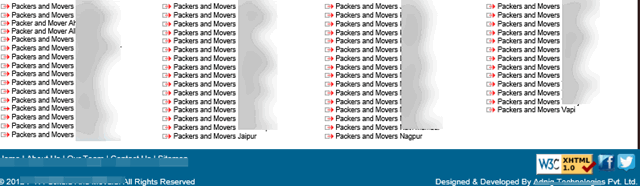
Excessive keyword repetition like the footer with the phrase repeated 100 times.
Excessive focus on monetization to where most visitors quickly bounce back to the search results to click on a different listing.
Ignoring the growing impact of mobile.
Blowing out the content footprint with pagination and tons of lower quality backfill content.
Stale content full of outdated information and broken links.
A lack of investment in new content creation AND promotion.
Aggressive link anchor text combined with low quality links.
Investing in Other Channels
The harder & more expensive Google makes it to enter the search channel the greater incentive there is to spend elsewhere.
Why is Facebook doing so well? In part because Google did the search equivalent to what Yahoo! did with their web portal. The rich diversity in the tail was sacrificed to send users down well worn paths. If Google doesn't want to rank smaller sites, their associated algorithmic biases mean Facebook and Amazon.com rank better, thus perhaps it makes more sense to play on those platforms & get Google traffic as a free throw-in.
Of course aggregate stats are useless and what really matters is what works for your business. Some may find Snapchat, Instagram, Pinterest or even long forgotten StumbleUpon as solid traffic drivers. Other sites might do well with an email newsletter and exposure on Twitter.
Each bit of exposure (anywhere) leads to further awareness. Which can in turn bleed into aggregate search performance.
People can't explicitly look for you in a differentiated way unless they are already aware you exist.
Some amount of remarketing can make sense because it helps elevate the perceived status of the site, so long as it is not overdone. However if you are selling a product the customer already bought or you are marketing to marketers there is a good chance such investments will be money wasted while you alienate pas
Years ago people complained about an SEO site being far too aggressive with ad retargeting. And while surfing today I saw that same site running retargeting ads to where you can't scroll down the page enough to have their ad disappear before seeing their ad once again.
If you don't have awareness in channels other than search it is easy to get hit by an algorithm update if you rank in competitive markets, particularly if you managed to do so via some means which is the equivalent of, erm, stuffing the ballot box.
And if you get hit and then immediately run off to do disavows and link removals, and then only market your business in ways that are passively driven & tied to SEO you'll likely stay penalized in a long, long time.
While waiting for an update, you may find you are Waiting for Godot.
Google Ventures Partner Blake Byers joined LendUp’s board of directors with his firm’s investment. The investor said he expects LendUp to make short-term lending reasonable and favorable for the “80 million people banks won’t give credit cards to,” and help reshape what had been “a pretty terrible industry.”
What sort of strategy is helping to drive that industry transformation?
How about doorway pages.
That in spite of last year Google going out of their way to say they were going to kill those sorts of strategies.
Google does not want to rank doorway pages in their search results. The purpose behind many of these doorway pages is to maximize their search footprint by creating pages both externally on the web or internally on their existing web site, with the goal of ranking multiple pages in the search results, all leading to the same destination.
These sorts of doorway pages are still live to this day.
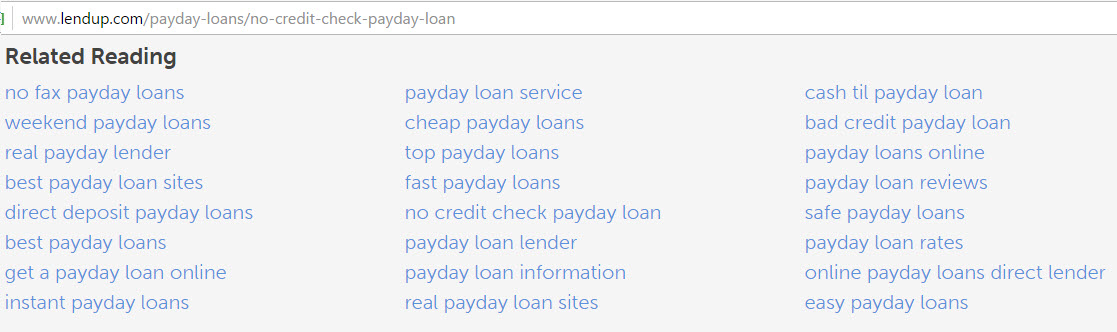
Simply look at the footer area of lendup.com/payday-loans
But the pages existing doesn't mean they rank.
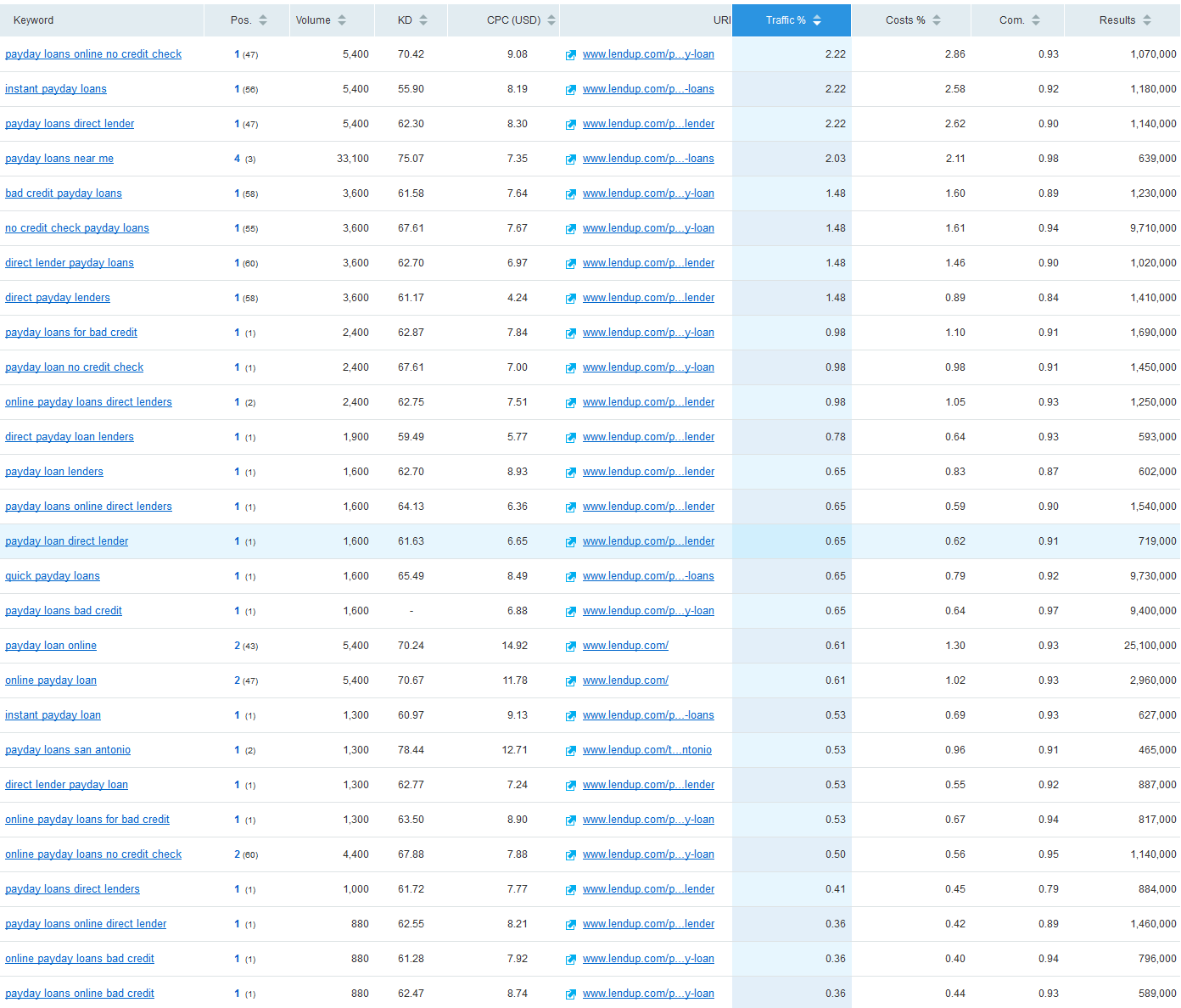
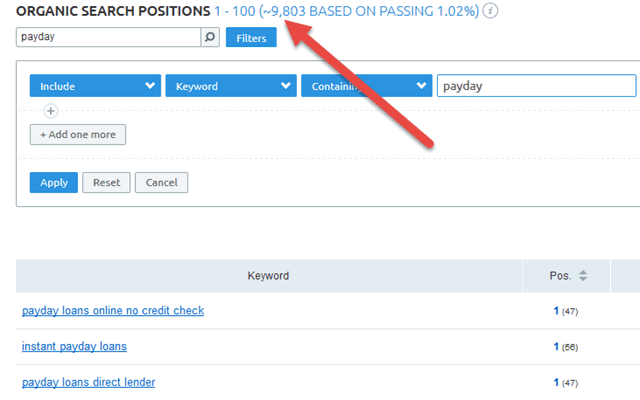
For that let's head over to SEMrush and search for LendUp.com
Today those sorts of stories are literally everywhere.
Tomorrow the story will be over.
And when it is.
Precisely zero journalists will have covered the above contrasting behaviors.
As they weren't in the press release.
Best yet, not only does Google maintain their investment in payday loans via LendUp, but there is also a bubble in the personal loans space, so Google will be able to show effectively the same ads for effectively the same service & by the time the P2P loan bubble pops some of the payday lenders will have followed LendUp's lead in re-branding their offers as being something else in name.
A user comment on Google's announcement blog post gets right to the point...
Are you disgusted by Google's backing of LendUp, which lends money at rates of ~ 395% for short periods of time? Check it out. GV (formerly known as Google Ventures) has an investment in LendUp. They currently hold that position.
Oh, the former CIO and VP of Engineering of Google is the CEO of Zest Finance and Zest Cash. Zest Cash lends at an APR of 390%.
Meanwhile, off to revolutionize the next industry by claiming everyone else is greedy and scummy and there is a wholesome way to do the same thing leveraging new technology, when in reality the primary difference between the business models is simply a thin veneer of tech utopian PR misinformation.
Don't expect to see a link to this blog post on TechCrunch.
There you'll read some hard-hitting cutting edge tech news like:
Banks are so greedy that LendUp can undercut them, help people avoid debt, and still make a profit on its payday loans and credit card.
#MomentOfZeroTruth #ZMOT
Update: Kudos to the Google Public Relations team, as it turns out the CFPB is clamping down on payday lenders, so all the positive PR Google got on this front was simply them front running a known regulatory issue in the near future & turning it into a public relations bonanza. Further, absolutely NOBODY (other than the above post) mentioned the doorway page issue, which remains in place to this day & is driving fantastic rankings for their LendUp investment.
Update 2:Record keeping requirements do not improve things if a company still intentionally violates the rules, knowing they will only have to pay a token slap on the wrist fine if and when they are finally caught. All it really does is drive the local businesses under.
The massive record-keeping and data requirements that Mr. Corday is foisting on the industry will have another effect: It will drive out the small, local players who have dominated the industry in favor of big firms and consolidators who can afford the regulatory overhead. It will also favor companies that can substitute big data for local knowledge like LendUp, the Google-backed venture that issued a statement Thursday applauding the CFPB rules. Google’s self-interest has become a recurrent theme in Obama policy making
Onine lending start-up LendUp, which has billed itself as a better and more affordable alternative to traditional payday lenders, will pay $6.3 million in refunds and penalties after regulators uncovered widespread rule-breaking at the company.
“LendUp lures consumers with false promises that repeat borrowing would allow them to ‘climb the LendUp Ladder’ and unlock lower interest rates. For tens of thousands of borrowers, the LendUp Ladder was a lie,” said CFPB Acting Director Dave Uejio. “Not only did LendUp structure its business around wholesale deception and keeping borrowers in cycles of debt, the company doubled down after getting caught the first time. We will not tolerate this illegal scheme or allow this company to continue preying on vulnerable consumers.”
Almost all the solutions to the problems faced by the mainstream media are incomplete and ultimately will fail.
That doesn't stop the market from selling magic push button solutions. The worse the fundamentals get, the more incentive (need) there is to sell the dream.
Video
Video will save us.
No it won't.
Video is expensive to do well and almost nobody at any sort of scale on YouTube has an enviable profit margin. Even the successful individuals who are held up as the examples of success are being squeezed out and Google is trying to push to make the site more like TV. As they get buy in from big players they'll further squeeze out the indy players - just like general web search.
And, once again, when everyone starts doing that it is no longer a competitive advantage.
There have also been cases where newspapers like The New York Times acquired About.com only to later sell it for a loss. And now even About.com is unbundling itself.
The more companies who do them & the more places they are seen, the lower the rates go, the less novel they will seem, and the greater the likelihood a high-spending advertiser decides to publish it on their own site & then drive the audience directly to their site.
When it is rare or unique it stands out and is special, justifying the extra incremental cost. But when it is a scaled process it is no longer unique enough to justify the vastly higher cost.
Further, as it gets more pervasive it will lead to questions of editorial integrity.
Get Into Affiliate Marketing
It won't scale across all the big publishers. It only works well at scale in select verticals and as more entities test it they'll fill up the search results and end up competing for a smaller slice of attention. Further, each new affiliate means every other affiliate's cookie lasts for a shorter duration.
It is unlikely news companies will be able to create commercially oriented review content at scale while having the depth of Wirecutter.
“We move as much product as a place 10 times bigger than us in terms of audience,” Lam said in an interview. “That’s because people trust us. We earn that trust by having such deeply-researched articles.”
Further, as it gets more pervasive it will lead to questions of editorial integrity.
Charging People to Comment
It won't work, as it undermines the social proof of value the site would otherwise have from having many comments on it.
He wondered how Google could become like a better version of the RIAA - not just a mediator of digital music licensing - but a marketplace for fair distribution of all forms of digitized content. I left that meeting with a sense that Larry was thinking far more deeply about the future than I was, and I was convinced he would play a large role in shaping it.
If we just give Google or Facebook greater control, they will save us.
Just look at Silicon Valley. They’ve done an extraordinary job, and their market cap is worth gazillions of dollars. Look at the creative industries — not just the music industry, but all of them. All of them have suffered.
Over time media sites are becoming more reliant on platforms for distribution, with visitors having fleeting interest: "bounce rates on media sites having gone from 20% of visitors in the early 2000s to well over 70% of visitors today."
Accelerated Mobile Pages and Instant Articles?
These are not solutions. They are only a further acceleration of the problem.
How will giving greater control to monopolies that are displacing you (while investing in AI) lead to a more sustainable future for copyright holders? If they host your content and you are no longer even a destination, what is your point of differentiation?
If someone else hosts your content & you are depended on them for distribution you are competing against yourself with an entity that can arbitrarily shift the terms on you whenever they feel like it.
“The cracks are beginning to show, the dependence on platforms has meant they are losing their core identity,” said Rafat Ali “If you are just a brand in the feed, as opposed to a brand that users come to, that will catch up to you sometime.”
Do you think you gain leverage over time as they become more dominant in your vertical? Not likely. Look at how Google's redesigned image search shunted traffic away from the photographers. Google's remote rater guidelines even mentioned giving lower ratings to images with watermaks on them. So if you protect your works you are punished & if you don't, good luck negotiating with a monopoly. You'll probably need the EU to see any remedy there.
As the platforms aim to expand into new verticals they create new opportunities, but those opportunities are temporal.
Whatever happened to Zynga?
Even Buzzfeed, the current example of success on Facebook, missed their revenue target badly, even as they become more dependent on the Facebook feed.
"One more implication of aggregation-based monopolies is that once competitors die the aggregators become monopsonies — i.e. the only buyer for modularized suppliers. And this, by extension, turns the virtuous cycle on its head: instead of more consumers leading to more suppliers, a dominant hold over suppliers means that consumers can never leave, rendering a superior user experience less important than a monopoly that looks an awful lot like the ones our antitrust laws were designed to eliminate." - Ben Thompson
Long after benefit stops passing to the creative person the platform still gets to re-use the work. The Supreme Court only recentlyrefused to hear the ebook scanning case & Google is already running stories about using romance novels to train their AI. How long until Google places their own AI driven news rewrites in front of users?
Who then will fund journalism?
Dumb it Down
Remember how Panda was going to fix crap content for the web? eHow has removed literally millions of articles from their site & still has not recovered in Google. Demand Media's bolt-on articles published on newspaper sites still rank great in Google, but that will at some point get saturated and stop being a growth opportunity, shifting from growth to zero sum to a negative sum market, particularly as Google keeps growing their knowledge scraper graph.
Yahoo’s journalists used to joke amongst themselves about the extensive variety of Kind bars provided, but now the snacks aren’t being replenished. Instead, employees frequently remind each other that there is little reason to bother creating quality work within Yahoo’s vast eco-system of middle-brow content. “You are competing against Kim Kardashian’s ass,” goes a common refrain.
...
Yahoo’s billion-person-a-month home page is run by an algorithm, with a spare editorial staff, that pulls in the best-performing content from across the site. Yahoo engineers generally believed that these big names should have been able to support themselves, garner their own large audiences, and shouldn’t have relied on placement on the home page to achieve large audiences. As a result, they were expected to sink or swim on their own.
...
“Yahoo is reverting to its natural form,” a former staffer told me, “a crap home page for the Midwest.”
That is why Yahoo! ultimately had to shut down almost all their verticals. They were optimized algorithmically for short term wins rather than building things with longterm resonance.
Death by bean counter.
The above also has an incredibly damaging knock on effect on society.
People miss the key news. "what articles got the most views, and thus "clicks." Put bluntly, it was never the articles on my catching Bernanke pulling system liquidity into the maw of the collapse in 2008, while he maintained to Congress he had done the opposite." - Karl Denninger
The other issue is PR is outright displacing journalism. As bad as that is at creating general disinformation, it gets worse when people presume diversity of coverage means a diversity of thought process, a diversity of work, and a diversity of sources. Even people inside the current presidential administration state how horrible this trend is on society:
“All these newspapers used to have foreign bureaus,” he said. “Now they don’t. They call us to explain to them what’s happening in Moscow and Cairo. Most of the outlets are reporting on world events from Washington. The average reporter we talk to is 27 years old, and their only reporting experience consists of being around political campaigns. That’s a sea change. They literally know nothing.” ... “We created an echo chamber,” he told the magazine. “They [the seemingly independent experts] were saying things that validated what we had given them to say.”
That is basically the government complaining to the press about it being "too easy" to manipulate the press.
When I worked curating Facebook Paper's tech section (remember that?) they told me to just rip off Techmeme https://t.co/LJ6O3coFMy— (@kifleswing) May 3, 2016
After doing a tour in Facebook’s news trenches, almost all of them came to believe that they were there not to work, but to serve as training modules for Facebook’s algorithm. ... A topic was often blacklisted if it didn’t have at least three traditional news sources covering it
As algorithms take over more aspects of our lives and eat more of the media ecosystem, the sources they feed upon will consistently lose quality until some sort of major reset happens.
The strategy to keep sacrificing the long term to hit the short term numbers can seem popular. And then, suddenly, death.
You can say the soul is gone
And the feeling is just not there
Not like it was so long ago.
- Neil Young, Stringman
If you have something unique and don't market it aggressively then nobody will know about it. And, in fact, in some businesses your paying customers may have no interest in sharing your content because they view it as one of their competitive advantages. This was one of the big reasons I ultimately had to shut down our membership site.
If you do market something well enough to create demand then some other free sites will make free derivatives, and it is hard to keep having new things to write worth paying for in many markets. Eventually you exhaust the market or get burned out or stop resonating with it. Even free websites have churn. Paid websites have to bring in new members to offset old members leaving.
In most markets worth being in there is going to be plenty of free sites in the vertical which dominate the broader conversation. Thus you likely need to publish a significant amount of information for free which leads into an eventual sale. But knowing where to put the free line & how to move it over time isn't easy. Over the past year or two I blogged far less than I should have if I was going to keep running our site as a paid membership site.
And the last big issue is that a paywall is basically counter to all the other sort of above business models the mainstream media is trying. You need deeper content, better content, content that is not off topic, etc. Many of the easy wins for ad funded media become easy losses for paid membership sites. And just like it is hard for newspapers to ween themselves off of print ad revenues, it can be hard to undo many of the quick win ad revenue boosters if one wants to change their business model drastically. Regaining you sou takes time, and often, death.
“It's only after we've lost everything that we're free to do anything.” ― Chuck Palahniuk, Fight Club
Conman Christopher Angus is kicking off a confidence series, providing free video tutorials on how to defraud investors. This eleventh video is 6:50 & was shared on May 3, 2016. The criminal who shot these videos delivered over a 99% investment loss, as he simply stole the money and integrated it into other investment scams abroad. https://www.oxfordmail.co.uk/news/18693916.conman-christopher-angus-pay-back-just-1-2m-scam/
UK's Crown Police never followed the money trail.
0 minutes 15 seconds: states made 3 profitable trades day prior. and shows times of some of them.
4 minutes 30 seconds: does not go into trades trying to take only 1 tick. usually wants to try to get 2 or 3 to have a margin of safety.
5 minutes 5 seconds: discusses another fairly passive trading strategy which might be able to make about 0.4% per day & allow a solid daily compounding. keeps testing lots of different strategies.
6 minutes 30 seconds: might want to change his personal goal to keep going until he makes at least 100 million
00:00 Christopher Angus: Good afternoon A. Just a very quick recording today because there seems to be a little bit more volatility. So I don't wanna waste too much time with my big monologue. So the plan for today is just really to tell you what happened yesterday, pretty straightforward, there's a lot more I could talk about, but no time.
00:22 Christopher Angus: So yesterday, in summary, three trades. I think I had called out early that I'm selling the VIX just as I was selling the first one and I'm just gonna talk you through each trade. If you look at your screen, the first one came in just before 12:30 and then I sold it just on the open; so that's one. I don't know if you can see on this video 'cause those will move with the cursor I think. Trade two came again very quickly afterwards, I think I called that one out to you as well on Skype, I'm not sure. And I held that for just under an hour. Again, I didn't nail quite the top and I didn't nail quite the bottom but you know that's kind of hard trade because I need to be somewhat sure of a direction. And trade three, I got kind of really excited and when I said, I think I remember typing, "Fuck me. I think there's another one here." I took that a little early actually and that one went against me by, I don't know, one or two ticks. And then I held that 'til 7:40 and I took that off way too early. As you can see, it really broke down. I was bitching about that on Skype as well, but roughly made 10 ticks yesterday so 1%. Again, I was selling it. So I do small ball it a bit. I cut just a little bit of the edges, which means that I don't use my full risk when I sell it because, if it does go against you badly, it's better to be a little smaller. And that was my day.
02:22 Christopher Angus: As for today, there seems to be, or there was some market weakness this morning, and you can see that reflected here. At eight o'clock, there was a spike up of nearly a full point on the VIX. I was a bit late getting that one actually, I sent you there. Just around eight o'clock, but by then I thought it was... I didn't know how much steam it had so I just sort of sat on my hands a little. So I missed that one, unfortunately. It seems to be coming off a little bit though, so things seem to be a little bit volatile again, not like February, when the market was moving up and down 100 points a day. But that was also exceptional times. I don't know if we'll see that again for a while, but this is perfect for us. It's not just the volatility. Before, I didn't make money for like nearly a whole week, one week, because I was being... I wanted to not scalp one and two ticks up because it isn't the most efficient way of trading. It's better if you can just get one big trade and that's how I was trading at the time.
03:37 Christopher Angus: But like poker, I guess, you have to adapt to your situation. So if you're playing a very tight player you can't, and you have a very tight knitty player, you can't be very loose. Or if you're playing a very loose player, you've got to tighten up a bit. And so, it was just, I think, a matter of over a couple of weeks just adjusting to the market conditions with the changing volatility. So from very, very high to dead, which was, I don't know if you remember, that was just insane. And now it's picking up a little and I feel very comfortable in this area when things are very, very quiet, it's very hard, as you know, to make anything. Some days it just doesn't move at all and I don't scalp one tick. I don't go into trades intentionally thinking I'm gonna scalp one tick because that is... It's so marginal. If it goes wrong, you're probably gonna be losing one tick. So, I go into trades thinking I might make two or three ticks at the least. Sometimes I make one, sometimes I scratch and I just get the rebate, so basically get zero, but I collect the rebate.
04:53 Christopher Angus: And then finally, I'm still working on my new VIX arbitrage thing. That's going very, very well, still. Tests are running very smoothly. Each time we trade we're gonna collect a few thousand in rebate, depending on how big we go, two or three thousand at least. So that's gonna be like 0.3 plus, plus profit of maybe half of one tick; so 1/20 of a point which will be about 5000. So I reckon each trade will be worth about 8,000 and probably take two days for those to work. So we're gonna be averaging 0.4 per day. I'm so looking forward to this. We're gonna be starting very, very soon, in a number of weeks, maybe a month at most. I just, obviously I'm not rushing into anything because we need to make sure that actually I know where the kinda dangers lie; and I do.
05:47 Christopher Angus: But I just keep testing and running through everything and practicing. So that's gonna be a big win for us. It's gonna create a very, very good, solid foundation, 'cause right now it's like, make money some days, don't make money some days. At the moment the volatility suits us. We're making money every day and I've become quite aggressive with my scalping, but still I miss some days. Last week I only traded three days. I sat here for five, or 4 1/2, but we only made money for three. This is gonna change the averages. It's gonna make a solid 0.3 baseline every day, and then we'll be running this on the side. So I think the... It's gonna creep up nicely. I think finally, I'll just change... I think I might change my personal goal. I think I'll stop when I get to a 100 mil now, not 50, but we'll see. And that's it. I'm gonna run. I gotta do the sheet now, and then, I gotta try and do some trading, amongst other things. So thanks for everything, take care and catch you later.